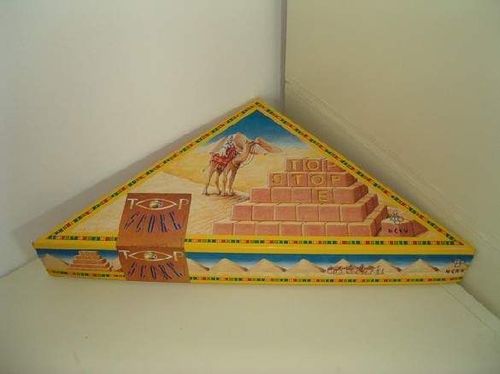
Topscore
Topscore Rulebook
Table of Contents
Table of Contents
The Game
Topscore can be played by 2, 3 or 4 players. In the game, players form ever longer words with the help of letter tiles. The player who in the end scores the most points is the winner.
A player always begins with a 3-letter word. Then he forms a word from the letters of the previous word plus one self-chosen letter from his letter holder. This is repeated until the word counts 7 letters. The player then chooses one letter from this longest word and places it on one of the seven small pyramid squares on the underside of the game board. The goal is that the player forms, in these small pyramid squares from left to right, as long a word as possible.
Example of words built in turn:
ROE OREN SNOER ROTSEN SENATOR
Components
- 1 game board
- 83 letter tiles
- 4 blank letter tiles
- 4 letter holders
- 1 score pad
- 1 bag with closing cord
- 1 hourglass
- 1 rules booklet
- 1 pen or pencil for each participant (not included)
Preparations
Place the game board in the middle of the table, so that each player has a playing field in front of them. Put all the letter tiles into the bag and shake it well.
Each player takes one tile from the bag. The player whose tile is closest to the letter A may begin. The tiles are then returned to the bag.
Each player takes a letter holder and, without looking, takes six tiles from the bag and places them on their letter holder. Each player also gets a score form on which they record their points.
The hourglass can be used to keep track of time. Each player has one minute to form a good word.
Playing the Game
The game is played clockwise. The first player must form a 3-letter word from their six tiles. They place this word in their own large pyramid on the game board, at the very top, reading from left to right, with one tile in each square.
If the player forms a good 3-letter word, they earn 5 points and record this on their score form (see "Using the Score Pad" below). If the player does not manage to form a word, their turn passes to the next player and they earn no points.
After the word has been formed, the player tops up their letter holder again to six letters.
The following players then take turns forming a 3-letter word, each on their own playing field.
When a player is on turn again, they may try, with the help of one of their six tiles, to extend the 3-letter word on their playing field into a 4-letter word. The letters may be placed in a different order. For a good 4-letter word the player earns 10 points. They note this on their score form and fill their letter holder up to six tiles again.
If the player does not form a 4-letter word, the next player may still try to do so with the help of one of their own tiles. If that player succeeds, they earn the corresponding points. With the remaining 5 tiles, the player may then, in the remaining playing time, extend their own word. In this way the players take turns forming 5-, 6- and 7-letter words.
After forming the 7-letter word, the player must choose one letter from it and place it on one of the 7 pyramid squares. A tile that has been placed may not be moved again.
The player then first tops up their letter holder to six letters, and then puts the remaining tiles of the 7-letter word from their playing field back into the bag. The game then passes to the next player for this round.
Each player must try to form, during the game, as long a word as possible in the pyramid squares.
Second round. When a player is on turn again, they start again with a 3-letter word, and the game proceeds as described above.
In total, the game has 7 rounds.
Scoring
Score in the Large Pyramid
For a word of 3 letters a player earns 5 points. For a word of 4 letters a player earns 10 points. For a word of 5 letters a player earns 15 points. For a word of 6 letters a player earns 20 points. For a word of 7 letters a player earns 25 points.
Pyramid Score
If a player has placed 7 tiles in their pyramid squares, they take the longest word that can be read from them. The word must read consecutively from left to right. The word must be at least three letters long; the more letters, the more points. Only one word may be chosen. The player earns 25 points per letter.
Example: in the pyramid squares, the letters lie consecutively as follows:
A L E K W A L
The player gives as their longest word KWAL, and earns 100 points for it.
Score in the Pyramid Squares
For a word of 3 letters a player earns 75 points. For a word of 4 letters a player earns 100 points. For a word of 5 letters a player earns 125 points. For a word of 6 letters a player earns 150 points. For a word of 7 letters a player earns 175 points.
Bonus
The player who is the first to place 7 letters on their pyramid squares receives a bonus of 100 points. The next player receives 75 points, and the third player earns 25 bonus points.
End of the Game
When a player has placed the 7 letters on their pyramid squares and has chosen their longest word, the game is over for that player. The remaining players continue to play the game.
If only one player remains, that player gets one more turn, in which they have the opportunity to fill their pyramid squares.
If not all 7 pyramid squares have been filled, the player may not choose a longest word and does not earn the corresponding score.
The player with the highest total score has won the game.
Some Important Instructions
1. The Blank Tile
The game contains 4 blank tiles, which may be used for any letter. A player who places a blank tile must state which letter it is meant to represent. As long as the tile is on the game board, it may not change letter.
During their turn, a player may exchange a blank tile on their own playing field, or on the playing field of another player, for the correct letter. The same blank tile must, however, be put back into play immediately, but it may then represent a different letter.
Blank tiles may never be used when forming a word in the pyramid squares on the game board.
2. The Turn
A player may use their turn to exchange one or more of their tiles. The player then puts their tiles back into the bag, and draws tiles from the bag until they again have six tiles. Their turn is then over, and they may not place any letters on the playing field.
When a player is on turn, they may change the word they placed in their previous turn. They may then swap one of the placed letters for a letter from their letter holder, and combine them into another word. The exchanged letter goes into the bag, and the player may draw a new letter.
For example, the word RIJN already placed can be changed into NOR or RIJK. The player earns no points for this, and their turn is over.
A player may only take action when they are on turn. Their turn is over when:
- they have placed their word and topped up their tiles;
- their time is up, or they have indicated that they cannot form a word;
- they have exchanged letters;
- they have changed their previous word.
3. Placing Words
A word that has been placed may not be changed during the same turn.
The 3-letter word must always be placed in the player's own pyramid.
For 4-, 5-, 6- and 7-letter words, a player may place a word on the playing field of an opponent, if it is a direct predecessor of their own. It is a matter of tactics whether or not to place a word on another player's playing field. The player does not receive the corresponding points for it, but does help their predecessor further along towards a 7-letter word.
If a player completes a 7-letter word on their predecessor's playing field, that predecessor may nevertheless place one of the letters in their pyramid squares as soon as it is their turn.
4. End of the 7th Round
When a player is ready, the 7 letters remain in the pyramid squares. The remaining letters go back into the bag.
Using the Score Pad
Each player takes their own score form from the pad and fills in their name. During the game, they record their own score on it. The points earned are always added to the score previously recorded.
The extra points earned for a good word in the small pyramid squares (25 points per letter) must be entered behind "PYRAMIDE". If the player has a bonus (100, 75 or 25 points), this must be recorded behind "BONUS".
When all points have been added together, the total may be written behind "TOTAAL".
Game Variants
- The game can be shortened by agreeing to move 2 letters at a time from a formed 7-letter word to the pyramid squares. The game then consists of only four rounds. A maximum of four 7-letter words then need to be formed. From the fourth word, a last, seventh letter must then be chosen.
- It can also be agreed to play with only 5- or 6-letter words, for example when children take part.
- Combinations of the two previous rules may be agreed among the players.
- If the playing time of one minute per turn is considered too short, it can be agreed to turn the hourglass once more, to not use the hourglass at all, or to agree a different time limit.
- A dictionary may be used to look up the spelling or existence of a formed word. There are no fixed rules on which words are or are not allowed. Players may set their own rules among themselves; for example, they may agree not to allow verb conjugations or proper nouns. Say this beforehand, so that no misunderstandings arise during the game.
Tactics Make It Exciting
Topscore remains exciting until the very end. It is possible for one player to finish before another but, in fact, to have played less well and end with fewer points. If, for example, a player often extended words in the pyramid of their predecessor, that predecessor has collected fewer points, but has been helped further along the way.
It is up to the players to judge how far they should intervene for their predecessor if that player cannot form a word.
Letter Distribution
The game contains:
- 83 tiles with the letters distributed as follows:
| Letter | Count | Letter | Count | Letter | Count |
|---|---|---|---|---|---|
| A | 4 | K | 2 | U | 2 |
| B | 2 | L | 2 | V | 2 |
| C | 2 | M | 3 | W | 1 |
| D | 3 | N | 8 | X | 1 |
| E | 15 |
Transcriber's note: on the scan, the count for M is printed as 8 and has been corrected by hand to 3. The total of 83 is consistent only with M = 3, so the corrected value is used here.
- plus 4 blank tiles.
In total there are therefore 83 + 4 = 87 tiles in the game.