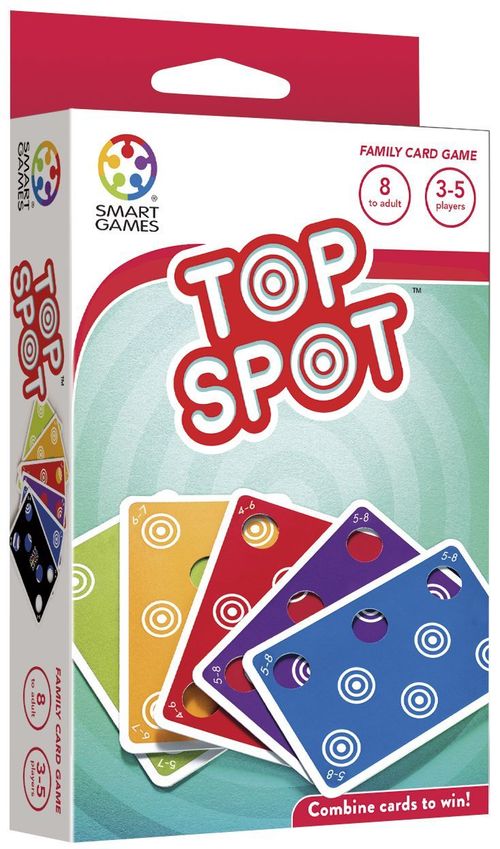
Top Spot
Top Spot Rulebook
Table of Contents
Table of Contents
Terms
ROUND = a round consists of each player taking one turn playing a card or combination of cards. The player with the highest value play wins that round and scores 1 point.
GAME = a game is a series of rounds. A game starts with the dealer distributing the cards and ends when a player wins a round with their last card(s). The number of rounds in a game can vary. After each game, players' points are counted and then a new game with a new dealer begins.
MATCH = a match is a series of games. Players can choose how many games they want to play before the match ends.
Before you start
Top Spot includes 5 sets of 12 cards with spots and holes in different configurations. The number of players determines the number of sets/colours to be used.
- 3 players: 3 sets/colours
- 4 players: 4 sets/colours
- 5 players: 5 sets/colours
So, when playing with 4 or 3 players, remove 1 or 2 sets before you start.
Except for the colour, each set is identical. The numbers in the corners of the cards indicate their value. The first number indicates the number of spots on that card. The second number indicates the number of spots + holes, which is the maximum value of that card when played in combination with other cards.
Top Spot also includes 5 identical JOKER cards. These are not used in the JUNIOR level, but only in the EXPERT level.
Junior Game Rules
Playing a round
The dealer shuffles the cards (mixing colours together) and gives each player 12 cards face down. Players take their cards in hand and should hide the value and colour of their cards from the other players.
Each game begins with the player to the dealer's left. Play moves clockwise from there.
- On their turn players play 1 or more cards.
- When playing multiple cards, cards must be the same colour. These cards need to be placed so they are aligned behind each other.
- The number of "visible" spots on the card(s) is the value of your play. When you combine cards, this is the number of spots on the top card in addition to the number of spots on the underlying card(s) that are visible through the holes.
(Example on the sheet: three blue cards combined, with visible spots counted through the holes, give a value of 7 — "Blue 7".)
- Players should not combine cards only to get rid of them faster (see 'END OF A GAME' to understand why this is important)! Each card you use in a combination should increase the value of your play and result in more visible spots.
- The first player chooses which colour he wants to play. This becomes the "colour in play." All other players must play cards of the same colour during that round. When a player does not have any cards of the colour in play, he must play one card of a different colour. At that point he cannot win the round, regardless the value of the play.
- Players always have to play (unless they don't have any cards left). "Passing your turn" is not allowed.
Winning a round
The player who played the card (or combination of cards) with the highest value wins that round and is awarded 1 point. He plays first the next round and chooses the colour in play.
Each round is worth 1 point, regardless of the value of the winning play or the number of cards that were played during the round. The winner of a round removes all played cards and collects them in a stack. We suggest making a separate stack for every round won to easily count how many points were gathered at the end of a game.
Ties
When 2 or more players have the same high score at the end of a round, the first player with the highest score is the winner of that round. For that reason players normally try to avoid ties.
End of a game
A game continues as long as the last winner of the previous round still has cards.
- A game ends when a player wins a round with his last card(s), even if other players still have cards. If a player plays their last card(s) and loses the round, the other players continue the game.
- When a player wins a round and is the only player with cards left, each of his cards that have not been played scores 1 additional point, the equivalent of winning a round for each remaining card!
End of a match
At the end of a game all players count the number of rounds they have won (indicated by the number of card stacks they have). This score is written down, then the cards are dealt again by the next dealer for a new game. A match should consist of enough games so that every player has an equal number of opportunities to be the dealer. For example with 4 players a match should include 4, 8, 12, 16... games.
At the end of the match the player with the highest points total wins!
Expert Game Rules
The EXPERT game rules are identical to the JUNIOR game rules, except for the following:
Joker cards
Take 1 JOKER card for each player and shuffle them together with the coloured cards before the start of a game. Each player gets 13 cards, so some will receive no JOKER cards, and other players will receive 1 or more.
JOKER cards don't have a specific colour. The player who plays a JOKER can choose its colour. When you are the first player in a round and use a JOKER, you must clearly state which colour is in play. When you are not the first player, your special JOKER combination follows the colour in play.
You can play your joker as a single card. Although a single JOKER card has a value of zero, you can still win a round if you are the first player and you choose a colour in play that nobody can follow.
When you combine the JOKER card with other cards, the combination can be played as any colour. This can be ANY colour, it doesn't need to be one of the colours of the cards you combine. You can also combine cards with different colours together with the JOKER card:
- The only condition is that the JOKER card is on top of the combination.
- The value of the combination is the number of spots of the other cards that are visible through the holes of the JOKER card. The maximum value will be 6, because there are only 6 holes in the JOKER card.
(Example on the sheet: a JOKER combined with other cards gives a value of 5, but any colour, e.g. Green 5.)
Ties
The rules for ties are different for the EXPERT level:
When 2 or more players have the same high score at the end of a round, the winner of this round is determined by playing extra "Tiebreaker" rounds:
- The Tiebreaker rounds are played in the same order and with the same rules, but only by the players involved in the tie. The player who is first chooses the colour to start (which can be different from the colour of the original round).
- If the result is again a tie, new Tiebreaker rounds follow until a winner is found.
- The winner of the Tiebreaker makes one stack of all cards that have been played in the original and the Tiebreaker round(s) and scores 1 point, regardless of the number of intermediate rounds or cards played.
- A player automatically loses the Tiebreaker if he runs out of cards and the Tiebreaker round results in a new tie. If all Tiebreaker players run out of cards during a Tiebreaker round without a winner, nobody scores a point that round. The remaining players keep on playing, starting with the last winner of a round before the tie.
- If a player wins a Tiebreaker round with his last card(s), he ends the game as in a normal round.
- If a game ends in a tie and nobody has cards left, nobody scores a point that round.