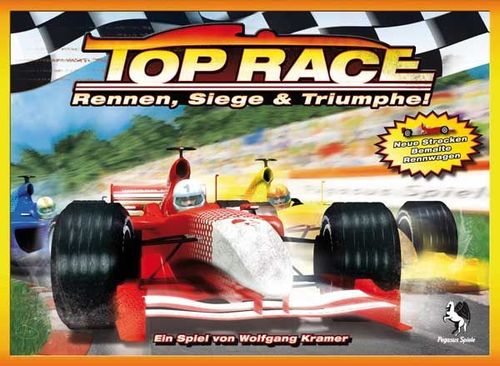
Top Race
Top Race Rulebook
Table of Contents
Table of Contents
Game Idea
Depending on the number of players, one or more race cars will take to the starting line for you. You steer the cars by playing speed cards. The tricky part: with many cards, you must also move your opponents' cars forward! Only if you cleverly use curves and chicanes to slow down the other racers will you emerge victorious and celebrate great triumphs in the end. But watch out that you aren't caught off guard by a surprise breakdown or a sudden sprint from a fellow player.
The goal of the game is to drive your own race car (or cars) into the leading positions in order to win as much prize money as possible. You can increase this winnings even further with two variants: betting on the race outcome, or trading stocks.
Game Board
The game board shows the following elements:
- Tip lines for the Tips variant – these lines do not represent spaces of their own.
- The spot where you place the race cars according to their finishing order.
- The discard pile for speed cards.
- The start/finish line.
- The overview of sprint/breakdown cards.
- The name of the racetrack.
- The starting spaces, with arrows showing the direction of travel.
Components
- 2 game boards, printed on both sides, with a total of 4 racetracks: Speed Street, Lake Lane, Desert Drive, Turbo Town
- 6 race cars, in various colors
- 120 banknotes: 30 x 10,000, 20 x 50,000, 30 x 100,000, 20 x 500,000, 20 x 1,000,000
- 6 race car cards, matching the race cars
- 48 speed cards
- 18 pit stop cards
- 6 stock boards
- 36 race markers
- 18 tip markers
- 36 stands for the race markers
About This Rulebook
This rulebook is divided into different sections. First you will find all the rules for the base game. Then follow the special rules for pit stops. At the end you will find two variants: Tips and Stocks. If this is your first time playing Top Race, we recommend that you play only by the base game rules.
Setup
Spread out one of the four racetracks – Speed Street, Lake Lane, Desert Drive, or Turbo Town – in the middle of the table.
If this is your first time playing Top Race, we recommend playing on the Speed Street track. The Turbo Town track works especially well with the "Pit Stop" special rules (see page 8).
Each player receives a starting capital of 200,000 Top Race Euro. Put the remaining money aside, sorted, next to the board as the bank.
Shuffle all the speed cards and deal them to the players as follows:
| Number of players | Cards per player |
|---|---|
| 2 | 24 |
| 3 | 16 |
| 4 | 12 |
| 5 | 9 |
| 6 | 8 |
With 5 players, 3 cards are left over. Place these face down in the box; they are not needed in this race.
Each player takes their cards into their hand. It is recommended to sort the cards by the topmost color of the race car shown on each card.
Lay out all 6 race car cards face up next to the game board, along with the matching race cars.
Put all remaining materials in the box; you do not need them for the base game. The pit stop cards are only needed for the Turbo Town racetrack (see page 8). The stock boards, tip markers, race markers, and stands are only needed for the "Tips" variant (see page 9) or the "Stocks" variant (see pages 9-11).
Auction of the Race Cars
There are 6 auctions in a row, even if fewer than 6 players are taking part. The winner of each auction receives a race car of their choice, with the selection getting smaller and smaller.
Determine, in any way you like, a player with whom the auction starts. This player must make an opening bid of at least 10,000 Top Race Euro; they may not pass. After that, each player in turn, clockwise, has the option to make a higher bid or to pass. Once a player has passed, they can only rejoin at the next auction. All bids must be 10,000 Top Race Euro or a multiple thereof.
As soon as all players have passed, the first auction ends. If you made the highest bid, you pay the bid amount to the bank. Then you choose a race car card of your liking and place it face up in front of you. You are now the proud owner of the car shown on it. Place the car on a numbered, free starting space of your choice. In addition, as the winner of the first auction, you are also the starting player of the race.
If you are unsure which race car to choose, first analyze your speed cards. The best chances belong to the car for which you hold the most high values. These values indicate how many spaces the race cars may move forward when the card is played. The values are 1-6, as well as 10.
Conduct the remaining 5 auctions the same way. The opening bid of at least 10,000 Top Race Euro must each time be made by the player sitting to the left of the winner of the previous auction. But watch out: every player must own at least one race car by the end of the auction! So if you have already won a car at auction, you may only keep bidding if there are still more race cars up for auction than there are fellow players who do not yet have a car. Should the duty to make the opening bid fall to a player who is no longer allowed to bid further, it passes clockwise to the next player who does not yet own a race car.
Example: In a four-player game, you have won the first two auctions and thus own 2 race cars. You have 3 fellow players, but there are still 4 cars available. So you may keep bidding. Should you win a third car, you may not bid further after that. If another player wins 2 more cars, you likewise may not bid further, since then only one race car would remain for each of the other players.
If you still do not own a car at the start of the auction for the last race car, you must buy this car without an auction for a fixed price of 30,000 Top Race Euro.
This ends the auction. The race begins.
Race Sequence
Going clockwise in turn, each player plays exactly one speed card and then moves forward all the race cars shown on the card.
If you won the first auction, you are the starting player. Choose exactly one speed card from your hand and play it. You must now move forward all the race cars shown on the card. You must move the cars in the same order in which they are shown on the card, from top to bottom. The number in front of a car indicates how many spaces you must move that car. Once you have moved all the race cars, place the played speed card on the discard space.
Every car must be moved the full number of spaces, if possible. You always move a car straight ahead or diagonally forward, never sideways or backward. You may change lanes as often as you like while doing so.
Example: Blue moves forward 4 spaces. You may move Blue onto space (1), since it lies diagonally forward. However, you may not move onto space (2), because it lies to the side. You also may not move onto space (3), because the car would then be blocked, yet you must move the full number of spaces, if possible.
An exception applies to some curve spaces. Here a car may also change lanes sideways, if the front edge of the space the car is moving onto lies further ahead than the front edge of the space the car is moving from.
Example: Yellow moves forward 5 spaces. Yellow may first move onto space (1), because the front edge of (1) lies further ahead than the front edge of the space Yellow is on. The same applies to space (2). The lane change from space (4) to (5) is possible for the same reason. Green could not move onto space (2) or (6) in this situation, since neither space ends further ahead than Green's current space.
If the track is blocked by other race cars, you may only drive up to the blockage. Any remaining movement spaces are then forfeited.
Example: You play the shown card. First you must move the red race car forward 6 spaces. Then you move the yellow car 4 spaces, then the black car 2 spaces, and finally the blue car 1 space forward. Then you place the card on the discard space.
Example: Purple must move forward 5 spaces. Since Blue is blocking the track, Purple only moves 3 spaces; the remaining two movement points are forfeited.
White Joker Color
On some cards a white race car is shown; this counts as a joker. With it, you may move forward any race car of your choice. However, you may not choose a car that is already shown on the same speed card.
Example: With this card you first move the purple race car forward 6 spaces, then the yellow car 4 spaces. Now, with the joker, you may choose to move the red, green, or black car 2 spaces. You may not choose the blue, yellow, or purple car for the joker, since these are already shown on the card. Lastly, you move the blue car 1 space forward.
You may also choose a race car for the joker that has already reached the finish or that has a breakdown (see below). In this case, the joker's movement points are forfeited.
Sprint/Breakdown Cards
Among the speed cards there are 3 special cards, each showing 2 race cars with an arrow between them: Blue with Red, Yellow with Black, Purple with Green. Such a card may be played either as a Sprint or as a Breakdown, as you choose. If one of the two cars shown has already finished, the action is forfeited.
On each game board you will find an overview showing which two cars appear together on each Sprint/Breakdown card.
Sprint
Whichever of the two race cars is further behind performs a sprint. Move it forward until it is level with the other car shown.
Example: You play the Blue/Red card as a Sprint card. Now you move Blue forward until the car is level with Red.
This only works if the track is clear. Should a blockage bar the way, then move the car as far as possible and end the move behind the blockage.
Example: You play the Blue/Red card as a Sprint card. Since Purple and Green are blocking the track, you only move Blue up to space (1). Were Black on space (2), you could move Blue only 3 spaces forward.
Breakdown
Whichever of the two race cars is further ahead has a breakdown. Place it, right where it currently is, beside the racetrack. Here the car must wait until the other car shown reaches or passes this position, that is, has driven at least level with it. Then place it back on the track, on one of the spaces beside which it was waiting, chosen by its owner. Should all these spaces be occupied, place the car on the next free space behind them. While broken down, all of this car's movement points are forfeited.
Example: You play the Blue/Red card as a Breakdown card. Place Red beside the track. The car must wait there until Blue reaches at least one of spaces (1), (2), or (3). Then place it on one of spaces (1), (2), or (3), chosen by its owner. If these are all occupied, place the car on one of spaces (4), (5), or (6).
Finish
As soon as the first race car crosses the finish line, place it on the space for 1st place. Place the second car to finish on 2nd place, the third on 3rd place, and so on. The owners of the cars receive the prize money indicated on the spaces, i.e. 200,000 Top Race Euro for the winner, 150,000 for second place, and so on.
Example: You play the shown card. First you move Yellow forward 6 spaces. In doing so, Yellow crosses the finish line, so you now place the car on 1st place. Next you move Red forward 4 spaces. Red also reaches the finish and lands on 2nd place. (The fact that Red ends up one space further ahead than Yellow has no significance. What matters is the order in which the cars were moved.) Finally you move Black forward 2 spaces, but that is not yet enough for Black to reach the finish.
Movement points of cars that have already finished are forfeited. If all the race cars you own have already finished, you no longer take part in the race. Your remaining speed cards have no effect.
As soon as the fifth car finishes, the race ends. Place the last car still on the racetrack on 6th place.
The race also ends when the players have played all their speed cards. In this case, place all race cars still on the track onto the placement spaces according to their position. A car is considered better placed if the front edge of its space lies further ahead. If two or more cars are level, the one positioned further to the inside is better placed. On a straight section, the next curve determines which car is further to the inside.
Example: All players have played all their speed cards; the race has ended. 3 cars have not reached the finish. Place Black on 4th place, Blue on 5th, and Green on 6th. (Blue is positioned further to the inside than Green, since the next curve is a right-hand curve, and is therefore better placed.)
End of the Game
After all 6 placements have been determined and you have paid out the prize money, a race ends. If you now end the entire game, the player with the most money wins.
But you can also race one or more additional races. Shuffle the speed cards again and deal them out. The race cars are also auctioned off again. However, you do not receive new starting capital! After a previously agreed number of races, whoever has the most money is the overall winner.
Pit Stop
The pit stop is an expansion rule, developed specifically for the Turbo Town racetrack. This track has more spaces than the other tracks. You can certainly play with pit stops on the other tracks too, but Turbo Town is best suited for it.
All base rules apply, with the following changes and additions.
When dealing out the speed cards at the start of the game, lay some cards face up next to the racetrack. These cards form the box.
| Number of players | Cards per player | Box |
|---|---|---|
| 2 | 21 | 6 |
| 3 | 14 | 6 |
| 4 | 10 | 8 |
| 5 | 8 | 8 |
| 6 | 7 | 6 |
Before the race starts, each player receives 3 pit stop cards, which they place in front of themselves. You can use these cards during the race to take a speed card from the box, or the top card of the discard pile, into your hand. Once you have given up all your pit stop cards, you can no longer make a pit stop.
The tables on the back of the pit stop cards have no meaning here; they are for the "Tips" variant (see page 9).
There are two possible moments at which you can make a pit stop:
- A fellow player places a speed card on the discard space
- Your turn begins
1. A fellow player places a speed card on the discard space
As soon as a fellow player has moved all their cars and placed their just-played speed card on the discard space, you may announce a pit stop in order to take that card into your hand. First, however, you must wait to see whether other players also want to make a pit stop for this speed card. In that case, the player who comes earlier in turn order is given priority.
If you are allowed to make the pit stop, place the speed card face up on one of your pit stop cards. The next time it is your turn, you do not play a speed card! You do not move any race cars this round. Instead, you now take the speed card lying in front of you into your hand and put the pit stop card into the box (the game box). This ends your turn.
Caution: You may not take a card into your hand this way that you yourself just played!
It is possible that more than one speed card lies on your pit stop cards at the start of your turn, if you made several pit stops within one round. In that case you may only take one of these cards during your turn. The next time it is your turn, you again do not play a card, but instead take the next speed card into your hand.
2. Your turn begins
At the start of your own turn, you may make a pit stop in order to take either any card from the box or the top card of the discard pile. No fellow player can dispute this with you. Take the desired card into your hand and put a pit stop card into the box for it. This ends your turn — you do not play a speed card! You also do not take any speed card that may be lying in front of you from a previous pit stop.
Caution: Here it is also allowed to take a card from the discard pile that you yourself played, for instance because other players made a pit stop before you.
Other notes
If you play a Sprint/Breakdown card while one of the two cars shown already has a breakdown, the action is forfeited.
If you have played all your speed cards but still own at least one pit stop card, you continue to take part in the race, provided not all your own race cars have finished yet. When it is your turn, you may choose whether to make a pit stop or to pass. As soon as all your cars have finished, you no longer take part in the race.
Note: If all players have no more speed cards, but someone still owns a pit stop card, then the game ends once all players have passed once in turn.
Variant A: Tips
During a race, you place tips on which race car you expect to be far ahead at the end. With good tips you can earn a lot of money and win the game even if your own cars don't quite make it to the front. However, with bad tips you can also lose money, and in the worst case even go bankrupt...
The races become even more interesting with this variant. You can play Tips with all 4 racetracks, including Turbo Town and Pit Stop. However, you should not combine Tips with Variant B: Stocks.
All base rules apply, with the following changes and additions.
At the start, each player receives 6 race markers (one of each car), 3 tip markers (one of each value), and 1 tip table. (If you are playing with Pit Stop, simply turn one of your 3 pit stop cards over to its back.) Place your race markers face down in front of you (unless they are in the stands — in which case, set them up so your fellow players cannot see the front of your markers).
As soon as the first race car crosses the yellow "1st Tip" marking line, briefly pause the race. Each player now places a secret tip. To do so, choose a car that you believe will win the race, or at least finish in one of the leading positions. Place the tip marker numbered 1 next to the race marker of the corresponding car.
This tipping process repeats when the first car crosses the "2nd Tip" or "3rd Tip" marking line. Then place the tip markers numbered 2 or 3 next to the race marker of the car you are tipping on. You may tip however you like — even 3 times on the same car, or on 3 different cars, exactly as you wish.
At the end of the race, reveal your race markers. Depending on what place the car you tipped on finished in, you now receive money from the bank — or may even have to pay money. The tip table tells you how much money you receive or must pay.
Example: For the 1st tip you bet on Blue, for the 2nd tip on Red, and for the 3rd tip again on Blue. Blue finishes the race in 2nd place, Red in 5th place. You receive 60,000 Top Race Euro for the 1st tip on Blue, you pay 30,000 for the 2nd tip on Red, and you receive 20,000 for the 3rd tip on Blue. In total you receive 50,000 Top Race Euro for your tips.
Caution: Unlike in the base game, you continue to take part in the race even if all your race cars have already finished! In further turns, you may decide anew each time whether to play a card or would rather pass. This way you can still influence the race in favor of your tips. As soon as all players have passed once in turn (or 5 race cars have finished), the game ends.
Variant B: Stocks
In this variant, the auction at the start of the race is omitted. Instead, each player receives stocks from all 6 race cars. During the race, you can sell stocks and buy others in exchange. Your goal is to own as many stocks as possible of the cars that finish in the leading positions.
The appeal of the stock game lies in not knowing which cars your fellow players are backing, since the stocks are held face down. You can play Stocks with all 4 racetracks, including Pit Stop. However, you should not combine Stocks with Variant A: Tips.
All base rules apply, with the following changes and additions.
Setup
Each player receives 6 race markers (one of each car) and a stock board. Put the race markers into a stand each, if this has not already been done. Then place all 6 race markers on the column of your stock board marked with the number 5, so that your fellow players cannot see the front of your markers. The markers now indicate that at the start of the game you own 5 stocks of each car.
The starting capital is, as usual, 200,000 Top Race Euro for each player.
From the speed cards, pick out the 3 Sprint/Breakdown cards and lay them face up next to the racetrack. Shuffle the remaining speed cards and deal them to the players as follows. Then, depending on the number of players, lay out additional cards next to the Sprint/Breakdown cards to form an offer row:
| Number of players | Cards per player | Offer row |
|---|---|---|
| 2 | 22 | 4 |
| 3 | 15 | 3 |
| 4 | 11 | 4 |
| 5 | 8 | 5 |
| 6 | 7 | 6 |
With 5 players, 3 cards are left over. Place these face down in the box; they are not needed.
Auction
An auction takes place as in the base game. However, it is not the race cars that are auctioned, but the offer row and the seating order! If you win the first auction, you become the starting player of the race. In addition, you may choose a card from the offer row and take it into your hand.
The player to your left must then, as in the base game, make the opening bid for the next auction; they may not pass. The winner of the second auction likewise chooses a card from the offer row and takes it into their hand. Then they sit down in the seat to the left of the starting player. The other players shift correspondingly to the left.
In this way you auction off, in turn, the seating order along with one card from the offer row each time. As soon as a player has won an auction, they may no longer keep bidding. (An exception exists in a two-player game: here both players keep bidding until one of them has taken 2 cards from the offer row. The other player then receives the remaining card(s) without having to pay anything for them.)
Since the race cars were not auctioned, they race without an owner. Determine the starting spaces of the cars by shuffling the 6 race car cards and revealing them one at a time: the first car goes on space 1, the second on space 2, and so on. After that, the race car cards are no longer needed for this race.
Race Sequence
The game is divided into race rounds and stock rounds, which alternate. You start with a race round, in which all players in turn play a speed card and move the race cars forward accordingly, as described in the base game.
After each player has had a turn, a stock round follows. Each player must secretly sell 2 stocks and buy 2 stocks. To sell, move a race marker back 2 spaces, or 2 markers back 1 space each. To buy, move your markers forward correspondingly.
You may buy and sell the same stocks within one round. You may decide anew in each stock round which stocks to sell and which to buy. So you can buy back a stock you sold in an earlier stock round, and vice versa. The total number of stocks always stays constant at 30. You may not own more than 15 or fewer than 0 stocks of any one car.
Example: In the first stock round, you sell one stock each of Purple and Black. In exchange, you buy two stocks of Blue. You move the race marker for Purple from 5 to 4, for Black from 5 to 4, and for Blue from 5 to 7.
Players may trade their stocks simultaneously. Once all players are finished, a race round follows again, then a stock round, and so on. As soon as the first car crosses the finish line, no further stock rounds take place.
End of the Race
The race ends, as in the base game, either as soon as 5 cars have finished, or when all the speed cards have been played. Since you do not own your own race car, you take part in the race until the very end and must play a card each time it is your turn.
Now your stocks are settled. For each stock of a car, you receive the prize money of the space that car is placed on. The player with the most money wins. In case of a tie, whoever owns more stocks of the car in 1st place decides it. If there is still a tie, the car in 2nd place is considered, and so on. If players own exactly the same stocks, the player who sits furthest clockwise from the starting player wins, i.e. whose turn in the seating order comes latest.
Example: The race cars finish in the following order: Red / Yellow / Blue / Black / Purple / Green. Based on your stock holdings, you receive the following payouts:
| Place | Race car | Prize money | Your stocks | You receive |
|---|---|---|---|---|
| 1 | Red | 200,000 | 7 | 1,400,000 |
| 2 | Yellow | 150,000 | 5 | 750,000 |
| 3 | Blue | 100,000 | 11 | 1,100,000 |
| 4 | Black | 60,000 | 2 | 120,000 |
| 5 | Purple | 30,000 | 4 | 120,000 |
In total you receive 3,550,000 Top Race Euro. At the auction at the start of the game you spent 60,000, leaving you a remaining capital of 140,000. You therefore end the race with 3,690,000 Top Race Euro.
Stocks & Pit Stop
If you play the Stocks variant together with Pit Stop, change the distribution of cards at the start of the game as follows. Make sure that the 3 Sprint/Breakdown cards always remain in the offer row!
| Number of players | Cards per player | Offer row | Box |
|---|---|---|---|
| 2 | 19 | 4 | 6 |
| 3 | 13 | 3 | 6 |
| 4 | 9 | 4 | 8 |
| 5 | 7 | 5 | 8 |
| 6 | 6 | 6 | 6 |
Further Variants
Further variants for Top Race can be found on the internet at:
- www.pegasus.de/topRace
- www.kramer-spiele.de under "Varianten"