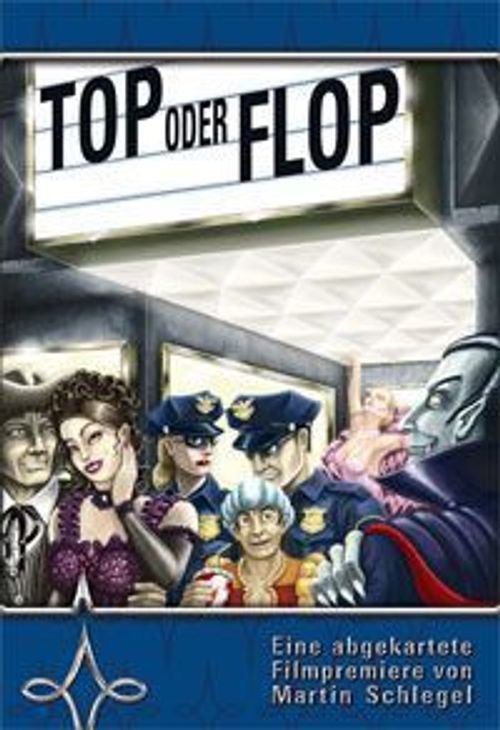
Top oder Flop
Top oder Flop Rulebook
Table of Contents
Table of Contents
Game Material
Film Posters, Influence Cards, Markers, Change Cards.
Object of the Game
At the end of the game players get victory points for the films where they have a majority of influence points. How many points this will be depends on the quality of the films.
The player who gains most victory points can call himself a film tycoon ... until the beginning of the next game.
Game Preparation
Put the five film posters in the middle of the table. Leave enough space to the left and right for three rows of cards, which will be placed there during the game (the "Film Display"). Additionally, there should be some space left in front of each player for their Personal Display.
The Influence Cards and the Change Cards are shuffled together. Each player gets eight cards and the remainder are placed in reach of all the players as the Card Deck. Additionally, players get two markers if there are two or three players, or one marker if there are four or five players.
Whoever has been at a film's opening night most recently becomes start player. Beginning with the start player and following clockwise, all players lay one of their influence cards face up in front of themselves in their Personal Display. Most influence cards show two films, so players decide which film to take influence on by placing them in the "proper" direction — with their choice towards the middle of the table. Then in a second round, an additional influence card is played: this has to be for a different film. At the end of this all players have six cards in their hands, two cards lying face up in front of them and one or two markers.
Diagram labels: Personal Display, Film Display, Card Deck.
Game Turn
Beginning with the start player and then in clockwise order, each player in turn may either
- play an influence card,
- play a change card, or
- play a marker.
Then the next player plays a card.
Playing a card into your Personal Display affects the influence you have on that film and may bring you victory points at the end of the game. Playing a card into the Film Display influences the value a film has at the end of the game (who benefits or suffers from this is decided by the players' Personal Display).
Players cannot play cards into the Personal Displays of other players.
Playing Influence Cards
An influence card may be placed into your own Personal Display or into the Film Display. If it is placed in the Film Display, the player draws a new card from the Card Deck. But if it is placed in the Personal Display, no new card is drawn and the player has one card less in their hand for the rest of the game.
Influence cards have to match the film they are played on (that is, the name of the film the card is played on has to be on the card). In most cases, players have two options and the card will be played in so that the appropriate film title shows.
The first influence card for each film placed in the Personal Display is played face up (one can place influence cards for all five films into one's Personal Display), so that all players can see it. All additional influence cards played on the same film are placed face down (so that they cover the lower half of the first card, leaving the film title visible to the other players).
If an influence card is played into the Film Display, it increases the value of the film by the number of points shown on the card if it is placed on the "Top" side of a film. It decreases the value of the film if placed on the "Flop" side (the value of a film may become negative due to this).
A maximum of three cards may be placed on each side of a film. However, cards can be replaced, provided the value of the new card is higher than the lowest of the three cards already on that side of the film in the Film Display. The lowest card (player's choice if more than one card has the lowest value) is replaced by the new card and the replaced card is added to the player's Personal Display. The replacement card may be added to a film the player already has in their Personal Display, or may be the first card for a film that player had no influence on before. If the card shows two film titles, the player may decide which one to use. And the player draws a new card from the Card Deck! (Only if a card is played directly from the player's hand into the Personal Display is no new card drawn — as a small compensation, the value of a card played directly from a player's hand remains unkown to the other players.)
Playing Change Cards
A change card may be played on the Film Display or into the Personal Display. Placed into the Personal Display, it increases or decreases the influence on one film (it does make sense to have negative influence on films with negative value). Like influence cards, change cards are placed face down on influence cards already lying in one's Personal Display, covering the lower half of the card. Change cards may only be played on a film the player has already played at least one influence card on.
If a change card is played on the Film Display, the appropriate action is conducted and the change card is discarded.
The change cards have the following actions:
- Move any influence card from Top to Flop: The lowest value card on the Top side of any film in the Film Display is moved to either the Flop side of that film or the Flop side of the other film shown on the card.
- Move any influence card from Flop to Top: The lowest value card on the Flop side of any film in the Film Display is moved to either the Top side of that film or the Top side of the other film shown on the card.
- Move one influence card: The lowest card from either side of any film is moved to any other space in the Film Display it fits in (i.e. it has to be placed at a film which is shown on the card).
If the moved card would be the fourth on one side of a film, it replaces a card, following the same rules as above: it has to be higher than the lowest influence card already there, which is replaced by the new card, and the replaced card is taken into the player's Personal Display.
Playing Markers
Markers may only be played into the Film Display. They are placed either on the Top side or the Flop side of one film. The pictures shown on both sides of a marker have different meanings:
- "Times two" side: doubles the value of all cards lying on that side of the film (Top or Flop).
- "Stop" side: means that no further changes to this side of the film are allowed (Top or Flop).
Cards on the side of a film bearing a "times two" marker may still be moved or replaced (but the marker remains there). But quadrupling the value is not possible, so a second "times two" marker cannot be played on the same side of one film. However, it is possible to play a "times two" marker on the other side of the same film, or to play a "stop" marker next to a "times two" marker already lying on one side of a film. Markers cannot be moved, not even by change cards.
If a player has placed a marker, they draw a card from the Card Deck and end up with one card more in their hand than they had before.
Ending Films
A film is finished when
- three cards lie on both sides of the film (3 on the Top side, 3 on the Flop side),
- there is a "stop" marker on both sides of a film, or
- one side has three cards, and the other side has a stop marker.
The film is turned over to the "Last Take" side. No additional cards or markers may be placed on this film in the Film Display, and cards for this film can no longer be changed. However, players may still place cards for this film into their own Personal Display.
Example
Bettina wants to bring "Arabische Abenteuer" to a good end and plays a Change Card "move one influence card". Of course she would like to move the four from "Tanjas Traum" to "Arabische Abenteuer", but that is not allowed — she would have to take the "one" from the Top side (always the lowest card). The Flop side also contains a four, but she cannot move that to "Arabische Abenteuer" (the card may only be moved to "Tanjas Traum" or "Rauchende Revolver", the two films shown on the card). So she decides to take the three from the Top side of "Rauchende Revolver", as it shows the proper film title on the other side. This completes "Arabische Abenteuer", as there are three cards on the Top side, and the Flop side has a stop marker. The film is turned over to show the "Last Take" side and no further changes may be made to it.
Stephan wants to get some influence on the quite successful "Arabische Abenteuer" (the value of the film is fixed now) and plays a Change Card "move any influence card from Flop to Top". He moves the three from the Flop side of "Rauchende Revolver" to the Top side of "Draculas Diner". As this card is higher than the lowest cards lying there, he may replace either of the two "two" cards. He decides to take the one with "Arabische Abenteuer" as its second title and places it in his Personal Display. As he does not have influence on "Arabische Abenteuer" yet, he places it face up.
Diagram captions: Bettina's move, Stephan's move.
Manuel thinks that he could do well with "Draculas Diner" while Bettina and Stephan compete for "Arabische Abenteuer" and plays a five point "Draculas Diner" card into his Personal Display. He does not draw a new card.
End of the Game
The game ends as soon as the last film is finalised, or if one player has no cards and no markers left. The game round is not finished, and the game ends immediately.
Players who still have cards or markers get two victory points for each card and each marker.
Then the films are evaluated. For each film, the values of the cards on the Top side are added (and doubled, if a "times two" marker is present). Do the same for the Flop side and subtract this from the "Top" value. The result is the value of the film (which might be negative). All players reveal their influence on the film. The player with most influence on this film gets the full value of the film as victory points; the player with the second most influence gets half the value of the film (rounded up) as victory points.
In case of a draw, the points are shared. If two players come second, both get one fourth of the film value. If two players share the first place, the full and the half film value are added and divided by two (everybody else gets nothing). Fractions are always rounded to the benefit of the players.
Once all films are evaluated, players sum up their victory points. The player with most victory points wins the game.
Example
Stephan plays his last card. As he also has no marker left, the game immediately ends. Bettina still has one marker and gains two victory points for it, Manuel still has two cards and gets four victory points.
Then "Coole Cops" is evaluated. On the Top side are a three, a five and a stop marker — eight points in total. On the Flop side are a two, a three, a one and a "times two" marker, which makes twelve (2x6) points. This means that the film has a value of minus four points — it can really be called a flop!
Bettina has not played an influence card on "Coole Cops", so she has zero influence points on this film. Stephan and Manuel both have an influence card on "Coole Cops" with two points in their Personal Display. Manuel had also played a second card, which he reveals now: a minus three! So he ends up with minus one influence points on "Coole Cops", and Stephan gets minus four victory points. And the minus two victory points for the second place go to Bettina, as zero influence points are more than minus one!
Next, "Arabische Abenteuer" is evaluated. The film has a value of seven points. Bettina and Stephan both have four influence points and Manuel has only three. So Bettina and Stephan both get six victory points (7 + 4 (3.5 rounded up) = 11, and 11 : 2 = 5.5, rounded up to 6), and Manuel gets nothing.
The remaining films are evaluated in turn, the points on the victory point sheet are added, and the winner is determined.