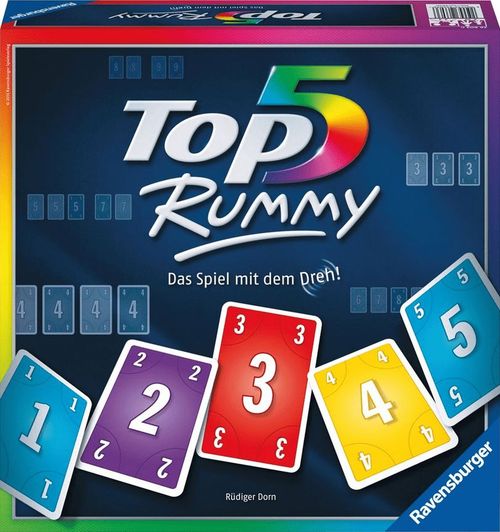
Top 5 Rummy
Top 5 Rummy Rulebook
Table of Contents
Table of Contents
Contents and Set-up Overview
- 1 game board (the "price wheel" and card display area)
- Price wheel (shows how much the cards cost)
- 80 number cards (2 each of the values 1 to 10 in the colors yellow, red, purple and blue)
- 20 playing pieces (5 each in the colors black, white, pink and turquoise)
- 48 chips (30 of value 1 and 18 of value 5)
- 9 double-sided task tiles (each with 4 discard spaces)
- 20 overview cards (multilingual)
Before the first game, assemble the board as shown in the illustration. Please stick the adhesive dots on the back of the large game board.
Object of the Game
The players collect number cards in order to fulfil 5 of the available tasks as quickly as possible. For most of the fulfilled tasks there is a bonus, which is higher the earlier the task is fulfilled. This creates an exciting race for the tasks between the players. Whoever is first to get rid of their 5 playing pieces on the task tiles wins the game.
Set-up
- Each player receives 5 playing pieces of one color.
- The game board is placed in the middle of the table. All 80 cards are shuffled well. Then one card is placed face up on each space of the board. The remaining cards are placed as a face-down draw pile next to the board.
- From the task tiles, pick out the 7 with the silver-rimmed discard spaces and lay them out in a half circle around the board, so that the silver-rimmed discard spaces are visible. The remaining 2 task tiles are not needed and stay in the box.
- Each player receives 5 cards from the draw pile as a hand, so that the other players cannot see them.
- The youngest player is the starting player and receives chips worth 4. The players following clockwise each receive one chip more, i.e. 5/6/7 in a game of 2/3/4 players. The remaining chips are placed next to the board as the supply.
Course of Play
Play proceeds clockwise. The player whose turn it is must carry out one of the following three actions:
Either a) Sell 1 card or b) Buy 1-2 cards or c) Fulfil 1 task.
After that, the players continue to take turns clockwise until someone has won.
a) Sell 1 Card
The player takes any 1 card from their hand and places it face up on a space of the board on which so far there are no cards or at most 1 card. If a second card is placed there, it must be placed so that the number value of the first card remains visible. The player receives for this the amount shown on the price wheel from the supply.
A maximum of 2 cards may lie on each space of the board. If this is already the case, no further card may be sold for this price.
Example: Anna sells a yellow 9. She decides to place the card on the space next to the value 6. She now receives chips worth 6. If the next player now also wants to sell a card, they may not place it next to the 6, since it is already occupied by 2 cards.
b) Buy 1-2 Cards
The player chooses any space of the board and buys the cards lying there, that is, one or two cards. In doing so they proceed in the following order:
- The player takes all cards of one space into their hand. They pay the price shown on the price wheel in the form of chips into the supply. Even if they buy two cards, they pay only the single price. Note: 5-chips can be exchanged for 1-chips at any time.
- Then they turn the price wheel one position further in the direction of the arrow, so that the prices of all remaining cards change. Attention: The price wheel is turned exclusively when cards are bought.
- If 3 or more directly adjacent spaces of the board have no cards left, they fill all empty spaces with one card each from the draw pile (beginning with the lowest value of the price wheel, etc.).
c) Fulfil 1 Task
The player fulfils a task by playing out the card combination required on a task tile. Then they place one of their playing pieces on a free discard space of the fulfilled task tile and take the corresponding bonus or pay the corresponding malus. (An overview of the tasks as well as the bonuses and maluses can be found on page 4 of the rulebook.)
If a player cannot "pay" the complete malus of the discard space in order to fulfil a task, they may not fulfil the task.
The cards played out are placed on the discard pile.
Example: Anna has the matching cards in her hand to fulfil the task "Straight with 5 cards". She plays 5, 6, 7, 8, 9 (one card in each of the colors purple, blue, purple, yellow and purple as shown; the red 2 stays in her hand). She places one of her playing pieces on a free space of the task tile and receives the bonus shown (chips worth 5 from the supply).
Important: Each task can be fulfilled by each player only once. A maximum of one playing piece per color may lie on a task tile.
Tasks (page 4)
Task tiles
- 8 cards of any kind: Collect 8 cards of any kind. Colors and numbers of the cards are irrelevant (e.g. 3, 4, 6, 9, 1, 9, 10, 5).
- 5 cards with even numbers (color irrelevant): Collect 5 cards with even number values (e.g. 2, 8, 4, 4, 6), whereby the colors of the cards play no role.
- 5 cards with odd numbers (color irrelevant): Collect 5 cards with odd number values (e.g. 1, 3, 9, 9, 7), whereby the colors of the cards play no role.
- 6 cards of the same color (number irrelevant): Collect 6 cards in any one color (e.g. 6 yellow cards), whereby the numbers of the cards play no role.
- Sum of 2 cards equals 11 (color specified): Collect 2 cards in the specified color whose sum is exactly 11.
- Sum of 4 cards less than or equal to 7 (color irrelevant): 4 cards whose sum is less than or equal to 7. The colors of the cards play no role.
- Sum of 4 cards greater than or equal to 37 (color irrelevant): 4 cards whose sum is greater than or equal to 37. The colors of the cards play no role.
- Straight with 5 cards (color irrelevant): Collect 5 cards with ascending number values (e.g. 3, 4, 5, 6, 7). The colors of the cards play no role.
- Straight with 4 cards of the same color: Collect 4 cards with ascending number values in one color of your choice (e.g. red 5, 6, 7, 8).
- Three of a kind and a pair (color irrelevant): Collect once 3 identical numbers (three of a kind) and once 2 identical numbers (pair) (e.g. 2, 2, 2, 9, 9). (Attention: 5 identical numbers are not permitted here.) The colors of the cards play no role.
Bonus/Malus
| Symbol | Effect |
|---|---|
| Draw X cards | Draw X cards from the draw pile. |
| Discard X cards | Lay X cards from your hand onto the discard pile. |
| Take X chips | Take chips worth X from the supply. |
| Give up X chips | Put chips worth X into the supply. |
| Take 1 card from the display | Take 1 face-up card from the game board for free. Refill if 3 adjacent spaces are empty. |
| Another turn | Immediately carry out another complete turn after this one. |
End of the Game
The game ends immediately when a player places their last playing piece on a task tile. That player is the winner of the game.
Special Situations
If a player, when it is their turn, has no hand cards and also does not have enough chips to buy a card, they skip their turn and take a 1-chip from the supply.
If the draw pile is used up, the discard pile is shuffled well and made ready as a new face-down draw pile.
Recommendation for Further Games
Here, 7 of the 9 task tiles are drawn at random and laid out around the board with any side facing up.
Alternative end of the game: If a player places their 5th playing piece, the game does not end immediately, but the current round is played to the end. If several players have then placed their 5 playing pieces, the one of them who has more hand cards wins. In case of another tie, whoever still owns the higher total value of chips decides. If there is still a tie, all players concerned win.