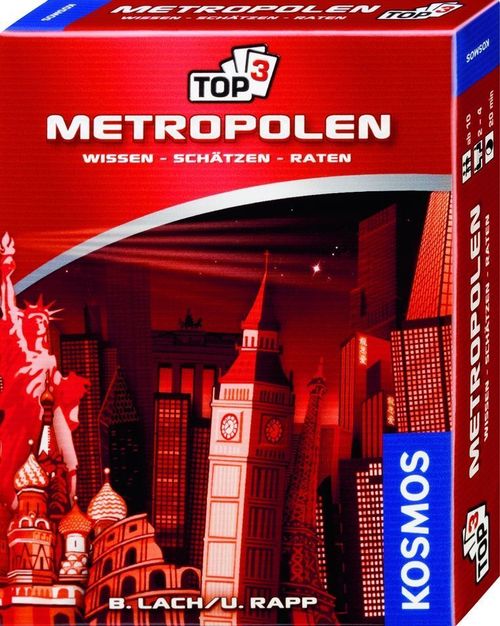
Top 3: Metropolen
Top 3: Metropolen Rulebook
Table of Contents
Table of Contents
Components
The game contains 89 cards:
- 45 Metropolen cards (city cards)
- 24 order cards (6 per player)
- 12 prediction cards (3 per player)
- 5 category cards
- 3 number cards
Each player receives a set of 9 cards in one colour: 6 order cards (e.g. 1-2-3) and 3 prediction cards (e.g. "Only I am right").
Object of the Game
In Top3 Metropolen, each round players try to put three randomly chosen cards into the correct order within one of five categories. Whoever correctly determines the order receives points for it (in the normal case). Further points can be earned by correctly laying out prediction cards. Whoever has collected the most points after 15 rounds wins.
Game Setup
- The three number cards are placed in the middle of the table in the order 1-2-3.
- The 45 Metropolen cards are shuffled and placed as a stack, back side up (the back shows the name of the metropolis).
- The 5 category cards are shuffled and placed as a face-down stack.
- Each player receives a set of 9 cards in one colour: 6 order cards (e.g. 1-2-3) and 3 prediction cards (e.g. "Only I am right").
Gameplay
In each round, the three top Metropolen cards are drawn from the stack and placed face down, assigned to the number cards 1, 2 and 3 that are already on the table. (It does not matter which card is assigned to which number.) Each card is thus assigned to exactly one number. Then the top category card is revealed.
Each player now secretly chooses, from their six order cards, the one that they think shows the order of the three Metropolen cards in the current category. The first number states which of the revealed Metropolen cards has the highest value, the second states which has the second-highest value, and the third states which has the lowest value.
As soon as all players have chosen a card and placed it in front of them, the three Metropolen cards are turned face up and the order in the current category is determined.
Example:
The Metropolen cards "London", "Paris" and "Buenos Aires" were drawn and assigned to the number cards 1, 2 and 3 in that order. The category drawn is "Tallest Building". Markus believes that of these three metropolises, London has the tallest building, Paris the second tallest and Buenos Aires the lowest. He therefore chooses the order card 1-2-3. Michael also believes in London, but sees Buenos Aires in second place and Paris in third. He therefore chooses the order card 1-3-2. The three Metropolen cards are then turned face up. London has the tallest building at 235 metres, Paris the second tallest at 210 metres and Buenos Aires the lowest at 170 metres. Markus, with the order 1-2-3, was therefore correct.
It can easily happen that two (or even all three) cards show the same value. If this happens, all cards with the same value are considered equal.
Example:
This time "London" (1), "Buenos Aires" (2) and "Auckland" (3) are laid out. The category is again "Tallest Building". The tallest buildings in Buenos Aires and in Auckland are each 170 metres high. London, at 235 metres, is again the tallest building. The two other metropolises both have a building of equal height. Therefore both the order 1-2-3 and the order 1-3-2 are correct.
The Categories in Detail
Tallest Building
The height in metres of the tallest building is sought. Only completed buildings count. Television towers, radio masts and similar structures are not included. The decisive measure is the building structure (the so-called structural height). Any antennas are therefore not taken into account, but a spire that is part of the building's structure is.
Average Daily Temperature
The average daily temperature in degrees Celsius is sought. The stated value is made up of the average values over the last 30 years.
Expenses for a Short Stay
The stated costs refer to the following expenses: one night's stay for two people in a first-class hotel, two dinners with a bottle of house red wine, one taxi ride, the hire of a passenger car for 100 kilometres, two theatre tickets, journeys by public transport, and various smaller expenses, for example for a paperback or a telephone call.
Holiday Days
The number of holiday days per year (paid working days off) is sought.
Annual Net Wage of a Female Worker
The average annual wage of a semi-skilled or unskilled female helper in a medium-sized company, preferably in the textile industry, who is about 25 years old and single, is sought.
Data Sources
The data are based on various sources accessible on the internet. For the categories "Expenses for a Short Stay", "Holiday Days" and "Annual Net Wage" the 2006 study "Preise und Löhne" (Prices and Wages) on www.ubs.com was used. For the category "Temperature" the climate database on www.wetter.com was used. For the category "Tallest Building" the information comes from various sources: www.emporis.com; www.skyscraperpage.com; www.wikipedia.org and www.thehighrisepages.de. Status: October 2007.
Awarding Points
- If only one player has laid out the correct order, that player receives two of the three Metropolen cards and places them in front of themselves. Each such collected card counts 1 victory point at the end of the game. The third Metropolen card is placed on a discard pile. (The first card not awarded founds this pile.)
- If several players, but not all players, have laid out the correct order, each of these players receives one Metropolen card.
- If all players have laid out the correct order, no player receives a Metropolen card, and all three cards go to the discard pile.
- If no player has laid out the correct order, all three Metropolen cards likewise go to the discard pile.
Example:
Since in the previous example only Markus had laid out the correct order, he receives two of the three Metropolen cards. He chooses "London" and "Paris". The card "Buenos Aires" is placed on the discard pile. Michael goes away empty-handed this round.
Continuing Play
After awarding points, each player takes their laid-out order card back into their hand, so that all options are available to them again for the next round. Then three new Metropolen cards are revealed and the next category card is drawn. The players again choose an order card, and so on.
After five rounds, the stack of category cards has been played through once and is reshuffled.
Prediction Cards
Each player has, in addition to their order cards, received three prediction cards. These show the texts "Everyone is right", "Only I am right" and "Nobody is right". In addition to his order card, each player may also lay out one of his prediction cards. After the order has been evaluated, the prediction cards that were played are evaluated:
- If a player has made a correct prediction, that player receives one Metropolen card from the discard pile.
- If several players have made a correct prediction, all of these players receive one Metropolen card each.
- All players who made no prediction, or who laid out an incorrect prediction card, receive no cards.
Unlike with the awarding of points for the order, the cards won through predictions are taken from the discard pile. If there are not enough cards in the discard pile to pay out all players, no player receives a card for predictions.
Important: the awarding of points for the order is completely finished before the predictions are evaluated. If not all cards were awarded to players as points for the order, the cards not awarded are already available for the evaluation of the prediction.
After evaluation, all laid-out prediction cards are removed from the game (returned to the box). Each player therefore has only three opportunities during the game to earn points through predictions.
Game End
The game ends after 15 rounds, once all 45 Metropolen cards and the category stack have been played through for the third time. Each player now counts their collected Metropolen cards. Each card counts one victory point. The player with the most points is the winner. In case of a tie, these players share the victory, or the placement.