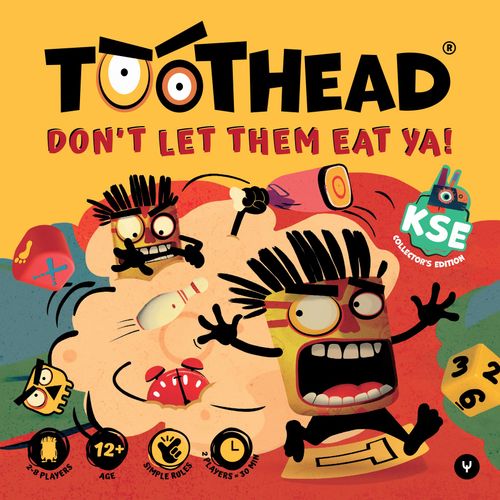
Toothead
Toothead Rulebook
Table of Contents
Table of Contents
What Kind of Game Is This?
Toothead teaches assertiveness and the art of survival in a competitive environment. It's a simple and fun card-dice-board game with a high dose of player interaction. Designed for both younger and older players, it offers fantastic entertainment during family gatherings and parties with friends. It's also an excellent tournament game.
The Goal of the Game
Eat or be eaten. Scour for better weapons, land precise hits, and torment your fellow players with sneaky tricks. And when everyone sharpens their teeth for you, play special cards or count on the mercy of the island. In short: do whatever it takes to survive. The game ends with the victory of the last player left at the table.
Team Mode
Toothead offers gameplay in both individual and team modes. The game rules remain unchanged in both variants - the only differences are the order of dock selection and the victory condition. For team mode, the Glutton Invasion expansion is recommended, as it enhances cooperative gameplay.
Selecting Docks in Team Mode
Each player rolls the D12 die. The player with the highest number receives the initiative token and selects their Toothead's dock first. Then, the player with the second-highest number chooses their dock, and so on, until all players have made their selections. In the event of a tie, the tied players roll again until the tie is resolved.
Victory Condition in Team Mode
In team mode, players divide into teams, which battle until only one victorious team remains in the game. It is recommended that each team has an equal number of players, though this is not a strict requirement.
Components
- 1 game board
- 1 pawn
- 8 Player Docks
- 32 slices (4 per player)
- 48 trick cards
- 48 hit cards
- 24 weapon cards
- 6 fight tokens
- 21 special cards
- 24 island cards
- 1 initiative token
- 4 d6 dice, 4 d8 dice, 4 d10 dice, 4 d12 dice
- 1 island die
Game Setup
- Lay the board in a location accessible to all players. It will serve as the main game area.
- Place the pawn on the eating phase. The pawn is used to track the game phases. The player holding the initiative token for the current round is responsible for moving it.
- Place the 6 fight tokens on the circle with the fist icon. The fight tokens are double-sided markers that will be used during fights.
- Place the island die on the space with the island die icon, and put the remaining dice in a location accessible to all players.
- Shuffle all yellow "Toothead" cards and place them face down in the designated area. This forms the bonfire (the draw pile).
- Shuffle the island cards and place them face down in the designated area.
- After the game is set up, each player rolls a D12. The player with the highest number receives the initiative token and selects their Toothead's dock first, placing it in front of them. The remaining players then select their docks in clockwise order. If multiple players roll the highest number, they re-roll until the tie is resolved.
- Finally, deal 5 cards from the bonfire to each player, handing out one card at a time. These cards form the player's pocket (their hand). There is no limit to the number of cards a player can have in their pocket.
The board is double-sided, but the rules remain the same on both sides. The side with the volcano indicates that the game includes additional character docks and cards from the HEROES expansion.
Dock
A dock represents the player's character and serves as the area for playing cards. Each dock is characterized by a unique name and knack.
- Dock Name
- Meat: the slot for storing meat acquired during the game.
- Mega-trick: the slot for playing mega-tricks. There is no limit to the number of mega-tricks a player dock can contain.
- Knack: a unique ability granted to the player by their chosen dock.
- Weapon: the slot for a weapon card. Each dock can hold only one weapon card at a time.
- Toothead die: each player has one Toothead die, and its type depends on the number of slices the player possesses.
- Slices: slices represent the health of a Toothead. At the start of the game, each player fills their dock with 4 slices (placed with the meat side face down).
Game Details
The game is played in rounds. A single round consists of a complete rotation around the board, divided into 4 phases. Each phase begins with the player holding the initiative token, and the order of the remaining players continues clockwise. The cycle repeats until only one player remains in the game.
At the beginning of the turn of the player with the initiative token, they move the pawn to the next phase.
- 1 Round = 4 Phases
- 1 Phase = 1 Turn per Player
- 1 Turn = All movement options available to the player in that phase
Phases
During the Digestion Phase, Appetite Phase, and Hunger Phase, players can perform movement options indicated by icons on the board. These activities are optional and can be performed in any order. The Eating Phase, however, does not allow any movement options, and activities must be resolved in a set sequence: eating, passing the initiative token, and discarding all mega-tricks from the docks of all players into the bin (the discard pile).
The board guides players through the following phases:
Digestion Phase
In this phase, players can perform two actions and use the phase bonus, which allows them to exchange cards. For every 2 cards discarded from the pocket, 1 card may be drawn from the bonfire. Each player can perform this exchange only once during their turn.
Appetite Phase
In this phase, players can perform one action, make one attack, and use the phase bonus, which allows them to play an island card. To play an island card, the player draws the top card from the island deck and places it face up on the green rectangular space.
Hunger Phase
In this phase, players can perform one action, make one attack, and use the phase bonus, which is determined randomly for each player by rolling the island die.
The bonus could be:
- An extra attack
- An extra action
- The ability to play an island card
- No bonus
Eating Phase
This phase serves only to conclude the current round and begin the next one. Players do not take turns or perform any movement options, but they can play special cards.
What happens during the Eating Phase?
- Eating: The player holding the initiative token collects one piece of meat from each player (starting with the player to their left) and discards it into the bin. If a player has no meat, they must give up one of their slices. Losing your last slice results in elimination from the game. The player with the initiative token discards their meat last. This is crucial in scenarios where no player has any meat, and only one slice remains on a player's dock. In this case, the player holding the initiative token wins the game.
- Passing the initiative: The player holding the initiative token passes it to the player on their left. If the player with the initiative token is eliminated during the game, the initiative token immediately passes to the player on their left. The player holding the initiative token not only begins the round, moves the pawn along the board, and discards meat last during the Eating Phase, but also resolves any disputes between players.
- Discarding mega-tricks: Each player discards all mega-tricks from their dock into the bin.
Moves
Action
During an action, a player can perform one of the following:
- Play a card from their pocket
- Draw a card from the bonfire and add it to their pocket
- Draw a card from the bonfire and play it directly onto the table
Attack
Attack any other player.
Phase Bonus
An additional movement option available during the specific phase.
Meat
The main source of meat is your own slices or those of other players.
How to Consume Meat
Meat is consumed during the Eating Phase to proceed to the next round. Consuming meat involves discarding it into the bin. During the Eating Phase, you must discard meat into the bin. If a player has no meat, they must discard one of their slices instead.
If a player has both meat and the Canned food card, they may decide which to discard.
How to Obtain Meat
Transforming a slice into meat involves flipping the slice token face down (meat side up). Place meat in the upper-left corner of your dock, where it is visible to other players.
- Win a fight against another player and take their slice.
- Accept a bribe from the defending player in the form of meat.
- Use cards, such as Mushrooms or Canned Food.
How to Discard Slices
Slices must be discarded in ascending order. Losing the last slice results in elimination from the game. All cards from an eliminated player's pocket and dock, along with collected meat, must be discarded into the bin.
Card Mechanics
Drawing Cards from the Bonfire
As an action: A player may draw one card from the bonfire and either add it to their pocket or immediately play it onto the table (on themselves or on another player).
As a card effect: A player draws the number of cards specified on the card from the bonfire. These cards go exclusively to the pocket and cannot be played directly from the bonfire onto the table.
During a fight: Instead of playing a hit card from the pocket onto the fight token, a player may draw a card from the bonfire and place it face-down on their own fight token. After the fight ends, this card is added to the player's pocket. The drawn card can be viewed, and if it is a hit card, it may be played face up onto the fight token, treating it as a hit card played from the pocket.
Playing Cards from the Pocket
- Trick cards: Playing a trick card costs the player one action and must occur during their turn. Players can play trick cards on themselves or on other players.
- Weapon cards: Playing a weapon card costs the player one action and must occur during their turn. Players can only play weapon cards on themselves.
- Special cards: Playing a special card is free and can occur at any time during the game.
- Hit cards: Hit cards can only be played during a fight on the player's active fight tokens.
Discarding Cards into the Bin
After a card's effect resolves, it must be discarded into the bin (the discard pile). Cards in the bin are generally no longer part of the game and only return to play if the bonfire (draw pile) runs out of cards.
If a player does not have enough cards in their pocket to meet the required effect, discarding all cards from their pocket neutralizes the effect for that player only.
Refilling the Bonfire with Cards
If the bonfire runs out of cards, shuffle the cards from the bin and place them face down in the designated bonfire area.
Cards
There are four types of bonfire cards and two types of island cards:
- Bonfire cards: trick, special, weapon, hit
- Island cards: event, permanent
Trick Cards
Trick cards enable advanced actions, such as increasing your strength, protecting yourself from attacks, provoking attacks, or even eliminating other players from the game.
There are two types of trick cards:
- Mini-tricks: Resolved immediately after being played and then discarded into the bin.
- Mega-tricks: Played onto the dock and remaining active for the player until the end of the round. Mega-tricks are discarded during the Eating Phase or after playing a card that eliminates them.
Special Cards
Special cards can be played during any player's turn without costing an action. They can be played on the player themselves or other players in any quantity and at any moment in the game (unless stated otherwise on the card).
Special cards are resolved immediately after being played and then discarded into the bin. This means they should not be played in advance, but rather used at the right moment to trigger the effect described on the card.
Special cards played during a fight remain on the table until the fight ends and are discarded into the bin during cleanup.
Special cards with negative values are used to reduce the fight pool of the player they are played against. They can also modify the outcome or strength of a card's effect by lowering the value of the card's die roll.
Hit Cards
Hit cards can only be played during a fight on active fight tokens. Hits enhance the fight pool or interact with it in more nuanced ways, such as allowing a player to avoid the strength of an opponent's weapon, or modify the number of fight tokens.
Weapon Cards
Weapons only work when their owner is involved in a fight. This means that weapon dice or weapon specialties cannot be used outside of your own fights, e.g., during other players' fights. Each weapon has a die and a specialty.
- Weapon die: The assigned die roll for the weapon, and its result is added to your fight pool.
- Weapon specialty: An additional effect triggered by the weapon, represented by an icon on a purple background along with a description of its effect.
Swapping Weapons in the Dock
Only one weapon can be held in a player's dock at a time. Playing a new weapon card onto the dock causes the current weapon card to be discarded into the bin.
Island Cards
Playing an island card involves revealing the top card from the island deck and placing it on the green rectangular space. If there are no cards left in the island deck, shuffle the discarded cards from the green rectangular space and place them face down in the designated area.
There are two types of island cards:
- Event cards: These take effect once and cease to influence the game after being resolved.
- Permanent cards: These remain in effect until a new island card appears.
Dice
The dice system is based on 4 types of die: D6, D8, D10, D12. These dice are used as: Toothead die, weapon die, card die.
Dice cannot have negative values, meaning that any modifications can only lower their values to zero.
Toothead Die
Each player has a Toothead die corresponding to the number of slices their Toothead possesses. A fully healthy Toothead (with all slices) uses a D6, while a Toothead on its last slice rolls a D12. The fewer slices a Toothead has, the more vicious it becomes.
- 4 slices: D6
- 3 slices: D8
- 2 slices: D10
- 1 slice: D12
Weapon Die
This die determines the amount of damage dealt by the weapon. Some weapon cards have a specialty that enhances their effectiveness during defense (e.g., pan). There are also weapons that do not use a weapon die in the attack (e.g., pillow, skunk).
Card Die
This die determines the effect or strength of a given card. If the die roll value is changed by a special card to less than 1, the triggered card has no effect.
If during the resolution of a card effect, multiple players tie, all tied players re-roll their dice until the tie is resolved.
Island Die
This die is used to determine the bonus during the Hunger Phase.
Fight
Fighting is the most effective way to acquire meat and avoid having to sacrifice a slice in the Eating Phase. During a round, a fight can be initiated using the Attack movement option, or provoked by using cards.
Attacking
A fight is initiated by an attack, which is a voluntary movement option. This means that when the pawn stops in a phase allowing for an attack, the player may (but does not have to) attempt a fight during their turn. There is no limit to attacks - during the current phase, each player can make as many attacks as allowed by their movement options and the cards they possess.
Bribing the Opponent
If the defender does not wish to fight, they can give the attacker meat from their dock, provided they have any. In this case, the attacker must accept the meat and abandon the fight. Bribing the opponent is only possible during the attack stage (before the fight starts).
Victory - Defeat
The player with the larger fight pool wins the fight. The player who loses the fight must give up a slice from their dock. It cannot be meat previously acquired. Therefore, it's important to carefully consider the decision to enter a fight.
If the player with the initiative token is eliminated during the game, the initiative token immediately passes to the player on their left.
Tie
If the fight pools of the fighting players are equal, the duel ends in a tie, and neither player loses a slice or gains meat.
Fight Pool
Each of the following elements can affect the fight pool:
- knacks
- hit cards
- weapon die and weapon specialty
- Toothead die
- special cards
- island cards
Stages of the Fight
Order
The attacking player initiates each stage of the fight (they play cards first, roll dice, etc.), as they were the one to start the conflict. The fight progresses through four stages:
- Attack
- Start of the fight
- During the fight
- After the fight
1. Attack
The attacker announces their intent to attack and selects the player they are attacking. For the defending player, this is the moment when they can either accept the fight or attempt to neutralize the attack by using cards, weapon specialties, or bribery.
There is no option to withdraw from the fight once it has started.
2. Start of the Fight
If the fight begins, the attacking player places six fight tokens (three for the attacker and three for the defender) on the table, laid out parallel to each other. This is also the moment when weapon specialties and mega-tricks related to this stage of the fight can be resolved.
3. During the Fight
During the fight, players play hit cards and roll their weapon dice and Toothead dice.
Fight Tokens
Each fighting player has three fight tokens at their disposal. Only one hit card from a player's pocket or one card from the bonfire can be played on a single fight token. Players take turns playing one card at a time on any of their active fight tokens, starting with the attacking player.
There is no obligation to play hit cards from one's pocket. If a player cannot (or does not want to) play a hit card from their pocket, they may draw a card from the bonfire. If the drawn card is a hit card, they may play it or place it face down on an active fight token. If the drawn card is not a hit card, the player must place it face down on an active fight token.
Neutralizing Fight Tokens
Each fight token can be neutralized, indicated by flipping it to show a crossed-out fist. Hit cards or cards from the bonfire cannot be played on neutralized fight tokens. If a card has been played on a fight token, that fight token can no longer be neutralized.
Dice
Once all fight tokens have been resolved, we proceed to the dice roll. If the weapon die and Toothead die are of different types, they can be rolled simultaneously. Otherwise, the weapon die is rolled first, followed by the Toothead die. The distinction between the dice must be made before rolling, as certain weapon specialties or cards allow re-rolling of specific dice.
4. After the Fight
Fight Resolution
At this stage, the outcome of the fight is decided, and weapon specialties and mega-tricks related to this stage of the fight are resolved.
To determine the winner, the fight pool of both players is calculated. This is done by adding the values from:
- hit cards
- weapon die
- mega-tricks cards
- Toothead die
- special cards
- knacks
- island cards
The player with the highest fight pool wins and takes a slice from the loser, converting it into meat. If the fight pools of both players are equal, a tie occurs, and neither player loses a slice or gains meat.
If the fight pool is negative, it is treated as zero. This means that a player with a fight pool of -1 will tie a fight with a player whose fight pool is -3.
Cleanup
At the end of the fight, played hit cards and special cards go into the bin, and face-down cards from the fight tokens are placed into the respective players' pockets. Then, the fight tokens are returned to their designated space on the board.
Meaning of Icons
Player's knack; Action; Mega-trick card; Slice; Phase bonus; Island card; Meat; Bin (the discard pile); Island card (event); Player or player's Toothead die; Card; Island card (permanent); Opponent or opponent's Toothead die; Random card; Strength expressed as a fixed value added only to defense; Each player; Opponent's card; Strength expressed by die; Each opponent; Random opponent's card; Strength expressed as a fixed value (e.g. +4); Player's pocket; Fight tokens; Maximum value; Opponent's pocket; Weapon specialty; Player's card draw or discard quantity (1); Island die; Attack; Opponent's card draw or discard quantity (2); D6 die; Initiative token; Card review; Universal die symbol; Weapon card; Ban; D8 die; Special card; Exchange; D10 die; Hit card; Re-roll/exchange; D12 die; Mini-trick card; Effect direction.
Game Add-ons
- Heroes expansion: Adds 4 new characters, 55 cards, and 6 dice. Supports 2-12 players.
- Trash Booster: Includes 10 additional special cards.
- Glutton Invasion: Allows eliminated players to influence the game. Includes 40 Eaten markers.