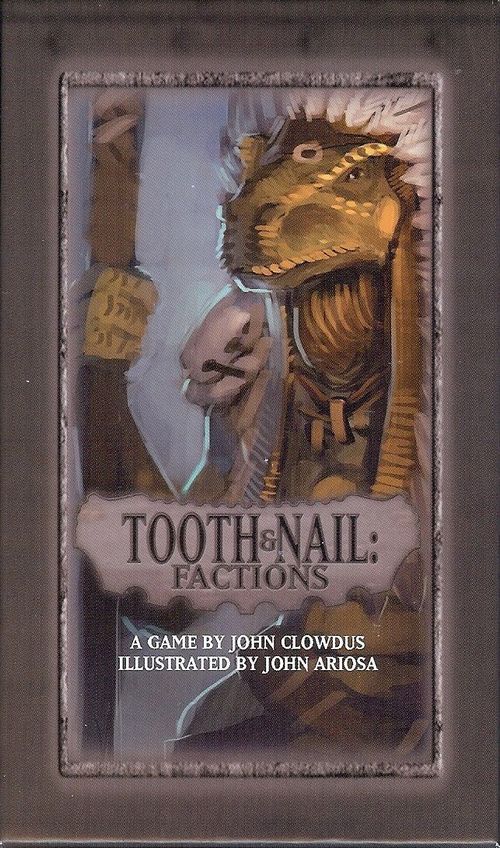
Tooth & Nail: Factions
Tooth & Nail: Factions Rulebook
Table of Contents
Table of Contents
- Standard 2 Player Game Set Up
- Object of the Game
- The Factions
- The Cards
- Playing Tooth & Nail: Factions
- Important Game Terms
- Command and War Zones
- Troops in the Command Zone
- Troops in the War Zone
- Ending the Turn
- Ending the Game
- Standard 3 Player Game
- Alliance: Alternate 2 Player Rules
- The Enemy of My Enemy: 4 Player Game Set Up
- Important Things to Remember
Standard 2 Player Game Set Up
Separate the 6 Factions into their respective decks and place them to the side of the play area (for more information about the Faction Decks, refer to the Factions section). Place the 6 Faction Command Cards to the side of the play area. Set the 5 Action Point Cards to the side of the play area.
Determine who will be the start player using whichever method the players can agree on. Once the start player has been determined, the other player takes the Faction deck of his choice and the Faction Command Card of the chosen Faction. The start player then does the same.
Each player places his chosen Faction Command Card face up in his play area, shuffles his deck, and the game begins.
Object of the Game
Getting the other player's deck to zero cards before he can do the same is the goal of the game. The game ends when a player has no cards left in his deck, with the other player being the winner.
The Factions
There are 6 unique Factions in Tooth & Nail: Factions. Each Faction has its own Faction Deck, which includes: 6 Unique Troop Cards (5 copies of each) and 1 Faction Command Card. Each Faction also has its own unique Faction Icon.
The Cards
Tooth & Nail: Factions uses several different types of cards. Cards in a player's hand are kept secret from the other players. There is no maximum hand size.
Action Point Cards (5 Cards)
These cards are used by the player to dictate the use of Action Points during his turn. Each Action Point card represents 1 Action Point. As the player uses Actions, these cards are discarded from his hand to the side of the play area. Additionally, each of these Action Point cards act as a reference card for the game, as each card lists the possible actions available to the player during his turn. A player can never have more than 5 Action Point Cards in his hand.
At the end of a player's turn, he discards all remaining Action Point cards from his hand to the side of the play area.
The Action Point card reads:
- (This card counts as 1 Action Point.) Discard this card from your hand to the side of the play area to: Play a Troop from your hand into your Command Zone. -or- Play a Troop from your hand into your War Zone. -or- Initiate a Non Formation Attack. -or- Initiate a Formation Attack.
- It does not require any Action Points to: Use a Troop's Command Ability -or- Use your Faction's Command Ability.
- At the end of your turn, this card and all other Action Point cards remaining in your hand are returned to the side of the play area.
Faction Cards
Faction Command Cards
Each Faction has an oversized, unique Faction Command card. These cards grant the Faction a unique Formation Attack and Faction ability.
Example (Ostra Vulture): WAR SCREECH (Arcane, Tech): The opposing player discards 1 card at random from his hand. ASSIMILATION: Drain 2 Troops in your Command Zone: Search your deck for a non-(Faction Icon) Troop and place it in your hand.
Troop Cards
Each Faction Deck contains 6 unique Troop cards, with 5 copies of each, for a total of 30 Troop cards per Faction Deck. The game revolves around playing these Troop cards in a variety of ways to bring the opponent's deck to zero cards while preventing the opponent from doing the same.
Each Troop Card contains important information.
- First, each Troop has a name. A Troop's name impacts the game in several ways, as several actions require the use of cards in the player's hand that match a card in play.
- Next, each Troop has a Faction Icon which denotes the Faction the Troop belongs to.
- Below the Faction Icon is the Troop's Strength Value. This determines how much damage the Troop will do to the opposing player's deck when it attacks.
- The last icon is the Troop Type Icon. These dictate whether the Troop is an Arcane Troop or a Tech Troop. Many abilities refer to these icons.
- Finally, each Troop has a Command Ability. These are powerful abilities that aid the player in achieving victory, or preventing his defeat. However, a player can only use abilities of Troops in his Command Zone; once a Troop is played in the War Zone, its Command Ability is ignored.
Playing Tooth & Nail: Factions
Tooth & Nail: Factions is played over a series of turns. Each player takes a turn performing Actions, and once he is done, his turn ends and the other player takes a turn. This continues until a player has no cards remaining in his deck.
During a player's turn, he is referred to as the Alpha Player. The other player is referred to as the Opposing Player.
Each turn is broken into 2 steps, taken in the following order: Recharge and Action. Once a player has completed these 2 steps, his turn ends.
Recharge Step
During the Recharge Step, the Alpha player prepares his Faction for the rest of the turn and does several things in the following order:
- Draws 1 card from his deck and gains 1 Action Point Card
- Draws 1 card from his deck or gains 1 Action Point Card for each Troop in his Command Zone.*
- Recharges all Troops in his Command Zone
- Recharges 1 Troop in his War Zone
*The player may draw cards from his deck or gain Action Point Cards in any combination and/or order he chooses. For example, Scout has 3 Troops in her Command Zone. For the first Troop, she chooses to draw 1 card from her deck. For the second Troop, she again chooses to draw 1 card from her deck. Finally, for the third Troop, she chooses to gain 1 Action Point Card.
During the Recharge Step of each player's first turn of the game, he draws 5 cards and gains 3 Action Point Cards.
Once the Alpha player has completed the above list, he begins the Action Step of his turn.
Action Step
The bulk of the game's action will take place in the Action Steps. During the Action Step the Alpha player may perform a variety of actions.
The following is a list of actions that can be performed by the Alpha player, and the number of Action Points he must use to perform them. These actions are covered in detail later in the rules:
For 0 Action Points, the player may:
- Use the Command Ability of a Troop in his Command Zone
- Use his Faction's Ability
For 1 Action Point, the player may:
- Play a Troop card from his hand into his Command Zone or War Zone
- Initiate an Attack
There is no order to the above actions, and the Alpha player may perform any actions, any number of times, in any order during his Action Step. The Alpha player is limited only by the number of Action Point Cards he has to spend, the cards in his hand, and the Troops he has in play.
As the player performs Actions, he discards Action Point Cards from his hand to the side of the play area.
Once the Alpha player has taken all of the Actions he wishes to take, he discards any remaining Action Point cards from his hand to the side of the play area, and his turn ends.
Important Game Terms
There are 2 game terms which show up quite frequently in the rules and on the cards: Drain and Recharge. Unless otherwise stated, when a Troop is played, it enters play right-side up.
Throughout the course of the game, for a variety of reasons, Troops will be rotated 90 degrees clockwise. This is referred to as Draining the Troop, and Troops that have been rotated in this fashion are Drained Troops. Generally, a Drained Troop cannot be used by the player. However, there is a way to turn Drained Troops right-side up.
When a Troop is Recharged, it is rotated 90 degrees counter clockwise to its original right side up position.
Another important game term is Destroy. When a Troop is Destroyed, it is sent from play to the top of the player's discard pile. It is very important to not change the order of the cards in the discard piles.
Often, an ability or action states that a card needs to be "removed from the game." When a card is removed from the game, it is moved to the side of the play area.
Command and War Zones
There are 2 distinct game zones in Tooth & Nail: Factions: the Command Zone and the War Zone. Throughout the game, the player will play Troops from his hand into these two Zones.
Each player has his own Command Zone and War Zone. He also has his own deck and discard pile.
Troops that are played into the Command Zone grant the player access to powerful abilities. Additionally, the number of cards in the player's Command Zone increases the number of cards he can draw and/or Action Point cards he can gain during his Recharge step. A player can never have more than 3 Troops in his Command Zone.
Troops in the player's War Zone are used to attack the other player. A player can never have more than 6 Troops in his War Zone.
Important Game Term: Dealing Damage
Throughout the game, players will be dealing damage to each other's decks. When a deck is dealt damage, a number of cards equal to the damage is moved from the top of the player's deck to his discard pile.
For example, Chip is dealt 2 damage by Joren. Chip puts the top 2 cards of his deck into his discard pile.
Troops in the Command Zone
Having a strong and varied Command Zone is vital to playing and winning Tooth & Nail: Factions. Aside from granting the player access to powerful abilities, the number of Troops in a player's Command Zone dictates the number of extra cards he will draw and/or Action Point Cards he will gain during his Recharge step.
Playing a Troop into the Command Zone
It costs the Alpha player 1 Action Point to play a Troop into his Command Zone. A player may never have more than 3 Troops in his Command Zone.
Using Command Abilities
It costs the Alpha player 0 Action Points to use the Command Ability of a Troop in his Command Zone. To use a Troop's Command Ability, he drains the Troop and performs the Troop's ability. Then, he must remove the Troop from the game, unless he can discard a Troop of the same name from his hand. If he is able to discard a Troop of the same name, the Troop in his Command Zone remains in play.
The Alpha player may use the ability of any of the Troops in his Command Zone on each of his turns. He may even use all of them if he so chooses. Command Zone Abilities are performed one at a time.
Command Ability Example
For example, Hank uses the Command Ability of a Red Claw Elder in his Command Zone. He Drains the Troop, and completes the Troop's Command ability. He does not have another Red Claw Elder in his hand to discard, so the Red Claw Elder is removed from the game.
Using Faction Abilities
Each Faction Command Card grants the player a unique Faction Ability. It costs the player no Action Points to use his Faction Ability. However, it does require the player to Drain 2 Troops in his Command Zone to use the ability.
In the event that a Command Ability or Faction Ability would cause the rules to be broken, the Command Ability is followed to the best of the player's ability without breaking the rules.
Troops in the War Zone
While playing Troops into the Command Zone is important, playing Troops in the War Zone is pivotal to winning Tooth & Nail: Factions. Attacking with Troops in the War Zone will be the main way to deal damage to the opposing player.
Playing a Troop into the War Zone
Playing a Troop into the War Zone requires the Alpha player to discard 1 Action Point card from his hand.
A player cannot play a Troop into his War Zone (from anywhere) if it would cause him to have more than 6 Troops in his War Zone.
Initiating Attacks
The Troops in a player's War Zone serve an important purpose: to attack the opposing player. There are 2 different types of Attacks, Non-formation Attacks and Formation Attacks. It requires 1 Action Point to initiate either type of Attack. Only Non-Drained Troops can be used to Attack.
Non-formation Attacks
Non-formation Attacks are the easiest for a player to initiate, as they only require a single non-drained Troop.
To initiate a Non-formation Attack, the Alpha player announces which Troop he is attacking with, discards 1 Action Point card from his hand to the side of the play area, and Drains the Troop. The Troop deals an amount of damage to the opposing player's deck equal to the Troop's Strength value.
Additionally, a Non-formation Attack can be Boosted. To Boost a Non-formation Attack, the Alpha player removes 1 card from his hand from the game that matches the Attacking Troop's Troop Type. Boosting an Attack adds 1 to the damage that is dealt. An Attack can only be Boosted once. Boosting an Attack is optional.
Example: Jeb initiates a Non-formation Attack against Justin with his Thunderfoot. The Thunderfoot is an Arcane Troop with a Strength Value of 2. He Drains the Thunderfoot and discards 1 Action Point card from his hand to the side of the play area. He doesn't have any other Arcane cards in his hand, so he cannot Boost the Attack. The Attack deals 2 damage to Justin's deck. Justin puts the top 2 cards of his deck into his discard pile.
Formation Attacks
Formation Attacks are generally more powerful than Non-formation Attacks. These attacks allow the Alpha player to attack with more than a single Troop, but still only cost him 1 Action Point. Formation Attacks can never be Boosted.
Formation Attacks are granted by the Faction Ability cards. Each Faction has its own unique Formation Attack. To initiate a Formation Attack requires a certain combination of Troops to be used. These attacks may increase the amount of damage that is dealt or cause some additional effect.
To initiate a Formation Attack, the Alpha player announces which Troops he is attacking with, discards 1 Action Point card from his hand to the side of the play area, and drains the attacking Troops. The attacking Troops deal an amount of damage to the opposing player's deck equal to the combined Strength Values of all Troops in the Formation Attack. Then, any additional damage from the Formation Attack is added, and any effect is applied.
Example: Jeb initiates the Dread March Formation Attack against Justin. The Dread March Formation Attack requires an Arcane Troop and a Tech Troop. He drains his Tuh-Tusk Shaman, an Arcane Troop, and an Icewind Captain, a Tech Troop. He moves 1 Action Point card from his hand to the side of the play area.
The Marauders card reads: DREAD MARCH (Arcane, Tech): Return an opposing Troop to the opposing player's hand. SPREADING CHILL: Drain 2 Troops in your Command Zone: The opposing player discards a card from his hand at random.
He deals a total of 2 damage to Justin's deck with this attack: 1 from his Tuh-Tusk Shaman, 1 from his Icewind Captain. Additionally, he chooses 1 of Justin's Troops and returns it to Justin's hand, which is the additional effect of the Dread March Formation Attack.
Ending the Turn
Once the Alpha player has completed all of the Actions he is able to, or wishes to, his turn ends. He returns any unused Action Point cards from his hand to the side of the play area. The other player becomes the Alpha player and takes his turn.
Note that it is very rare that Alpha player will not use all of his Action Point cards during his turn.
Ending the Game
A game of Tooth & Nail: Factions ends immediately when a player has no cards remaining in his deck, regardless of when the player has no cards remaining in his deck.
The player with no cards remaining in his deck has failed to hold off the attack and balance his forces, and has lost the battle. The other player wins the game.
Standard 3 Player Game
Tooth & Nail: Factions can be played with 3 players. The rules for the game are identical to the rules of the Standard 2 Player game, with the following exceptions:
- Player turns take place in clock-wise order. The start player is the last player to choose his Faction.
- Command Abilities and Faction Abilities that affect "the opposing player" affect all opposing players.
- When a player has 0 cards remaining in his deck, he is eliminated from the game. However, on what would be his next turn, he deals 1 damage to the player of his choice's deck for each card in his hand.
- The game ends when 2 players have 0 cards remaining in their decks. The remaining player wins the game.
Alliance: Alternate 2 Player Rules
Alliance allows 2 players to draft and combine 2 different Factions each for an exciting twist on the Standard game. This version of the game opens up new strategies and poses new challenges for the players.
Alliance: Set Up
Set up the game as you would in a Standard game. After the start player has chosen his first Faction, the other player chooses a second Faction. Then, the start player chooses a second Faction. Each player should end up with 2 Factions and 2 Faction Command Cards. Each player then shuffles together his chosen Faction decks and removes the top 10 cards of the deck from the game and sets them face down to the side of the play area.
Faction Ability Cards
One of the advantages of using the Alliance rules, is that each player has a Faction Command Card from each of his drafted Factions. At the beginning of the game, before the start player takes his first turn, the players decide which Faction Command card he will use.
He sets one of his Faction Command cards face up in his play area, and returns the other Faction Command card to the side of the play area. Faction Ability cards are set for the entirety of the game, and cannot be changed by the players once the game begins.
Once each player has set up his Faction Command Cards, the game begins.
Game Rule Changes
Due to the larger decks the players are using, players may have up to 8 Troops in the War Zone and up to 4 Troops in the Command Zone.
Playing and Ending an Alliance Game
An Alliance game is played and ends the same exact way as a Standard Game. Aside from the rules covered in this section, the different game modes are identical.
The Enemy of My Enemy: 4 Player Game Set Up
Using these rules, 4 players can play Tooth & Nail: Factions. There will be 2 teams. Teams will share a large deck comprised of 3 Factions. The object of the game is to get the other team's deck to zero cards.
The oldest player is the Alpha player, and the player to his immediate right is on his team, which is the Alpha Team. The other 2 players form the Other Team.
Beginning with the Other Team, each Team chooses a Faction, and takes that Faction's Deck and Faction Command Card. This continues until each Team has selected 3 Factions.
Next, each Team shuffles together all 3 of the Faction decks it selected, forming 1 large deck. Place this deck between the 2 team members. Then, each player selects a Faction Command Card from the cards that were selected by his team. The remaining Faction Command Card is moved to the side of the play area and the game begins.
Playing the Game
Most of the rules from the Alliance game are intact, however, there are a few things that are different.
While each Team shares a deck and discard pile, each player still has his own turn, and his own War Zone and Command Zone that is independent from his teammate's. Abilities that affect an opposing player affect the opposing player of the player's choice. Abilities that affect the player's own Troops affect only his Troops, not his teammate's.
Turns alternate between Teams, and Team turns alternate between teammates. For example, Jeb and John are on a team and Britt and Jackie are on a team. Jeb would take a turn, then Britt, then John, and then Jackie.
The game ends immediately when a team has 0 cards remaining in its deck. That team loses the game.
Important Things to Remember
- The player who is taking a turn is the Alpha player and only the Alpha player may perform actions
- During the Recharge step, the Alpha player recharges all Troops in his Command Zone, and 1 Troop in his War Zone
- The game ends immediately when a player has no cards left in his deck and that player loses the game
- Troops enter play right side up, or Non-Drained
- It costs 1 Action Point to play a Troop in the player's Command Zone or War Zone
- The most Troops a player can have in his Command Zone is 3
- The most Troops a player can have in his War Zone is 6
- It costs no Action Points to use the Command Ability of a Troop in the Command Zone or to use a Faction Ability
- It costs 1 Action Point to initiate any type of Attack
- Only Non-formation Attacks can be Boosted, and only once
- Cards that are used to Boost Non-formation Attacks are removed from the game
- Not every combination of Factions in the Alliance game is optimal; there are 15 potential combinations, discovering which Factions work well together is part of the game