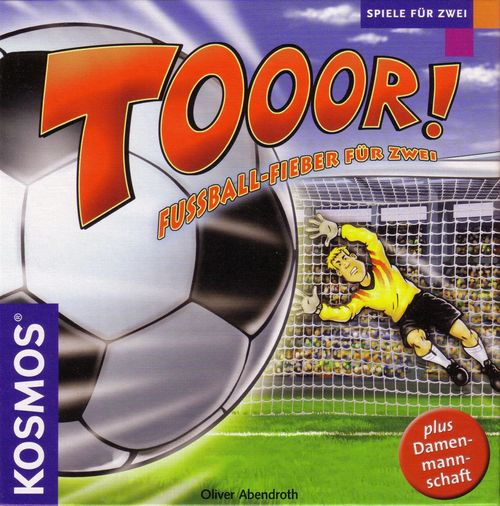
Tooor!
Tooor! Rulebook
Table of Contents
Table of Contents
Game Components
- 22 football players (male) on one side and 22 football players (female) on the other
- 12 tactic cards
- 6 position arrows
- 1 small game board
- 2 number dice (values 0, 1, 1, 2, 2, 3)
- 1 event die
- 2 football tokens for the goal tracker
- 6 wooden marker stones
- 12 "Yellow Card" tokens and 10 "Injured" tokens
- 1 referee's whistle (which can really be blown)
Note: wherever the rules speak of "football players", female players are always meant as well.
Object of the Game
Each player coaches a football team. Six periods of 15 minutes each are played. The coach who has scored the most goals wins.
The coaches may agree at the start that a tie is followed by extra time of two more periods. If the score is still tied after that, a penalty shootout decides the game.
Note: the first game should be played without extra time and penalty shootout. In that case the game may end in a draw.
Setup
Setup with starting line-up
- Before the first game, carefully remove all parts from the frames.
- Place the game board crosswise between the two coaches. The side on which the fields 15 to 90 (minutes) are shown in the middle faces up. The other side is only used for extra time.
- Sort the football players by jersey colour. Each coach receives:
- the 10 outfield players and the goalkeeper of one colour,
- the matching set of 6 tactic cards,
- 3 position arrows in three different colours,
- his or her 3 marker stones, and
- his or her number die.
- Lay out the position arrows in front of the coaches so that there is enough room beside them for three rows of football players (see illustration). The top row (red) stands for the attack ("Sturm"), the middle row (blue) for the midfield ("Mittelfeld") and the bottom row (yellow) for the defence ("Abwehr").
- Before the game, each coach decides whether to play with his or her women's team (beige background) or men's team (blue background), and lays the cards out with the matching side up. A coach who wishes may also field a mixed team.
- In the first game a fixed starting line-up is used. The outfield players are sorted by the coloured crests on their jerseys. These show which row each player is placed in. Which position a player takes within the row does not matter. In later games the outfield players are distributed freely among the three rows. Each row must contain at least 2 outfield players.
- Place the goalkeeper below the three rows.
- All players are placed on the playing area so that they are "the right way round", that is, with the face toward their coach.
Further setup
- Place the referee's whistle on field 15 of the time track.
- Place the football tokens on the "0" spaces of the goal tracker at the edge of the board.
- Place the event die, the "Yellow Card" and "Injured" tokens beside the layout, ready to hand.
Game Sequence
Round sequence
Playing tactic cards
- Each coach has 6 tactic cards, which show the positions Attack, Midfield and Defence. They determine from which rows the players are used.
- At the bottom of each tactic card are 1 to 3 players that the attacker may deploy, and at the top are the same number of players that the defender may deploy.
- At the start of each round both coaches choose one tactic card and place it face down beside the game board. Both cards are then revealed at the same time. The coach with the higher card value (the number in the jersey) is the attacker. If the values are equal, the attacker is decided by a roll of the dice. The higher number rolled wins.
Attack
- Only the attacker's tactic card applies to the attack. The defender's card is turned over.
- The attacker must now choose some players from his or her position rows, as shown on the card. He or she chooses as many players as are shown on the card. To mark that a player is in play, the attacker places a marker stone on that football player.
- The attacker then adds up the current strength of his or her deployed players, that is, the footballs that point toward the opposing coach, and announces the total strength. The defender then does the same on his or her side.
- Both coaches roll their number dice and add the dice values to their strengths (see example below).
- If the attacker has the higher result, the attacker has a shot on goal (see page 4).
- If the attacker has the same or a lower result, the attack has failed. The defending coach then has a counterattack (see page 4).
- After the attack, both coaches turn their deployed players 90° clockwise (in the direction of the arrow). This gives the players a new strength. During the turn the coach may need to make an event check (see page 4). The attacker performs all turns and checks first, then the defender.
Example of an attack:
The coach of the orange team chooses 2 midfield players (blue) and 1 striker (red) and marks them. He announces a total strength of 10. His opponent must deploy 2 midfield players and 1 defender and mark them (not shown). Suppose he reaches 9. Both roll a 2 (12 : 11). Because orange has the higher result, the orange coach now has a shot on goal.
Shot on goal
- If a coach has attacked successfully, he or she chooses one of the players he or she has just deployed, or any striker. A die roll is added to this player's strength once more. The opposing coach adds a die roll to the strength of his or her goalkeeper.
- If the attacker achieves a higher result, he or she has scored a goal. To show this, the football token on the goal tracker is moved one field further, that is, from "0" to "1" for the first goal, and so on.
- If the attacker's result is equal or lower, the shot has been saved and the round is over.
Note: after the shot on goal, the deployed player and the opposing goalkeeper are also turned 90° clockwise, and a possible event check for the player is carried out.
Counterattack
- Before the defender's counterattack, both coaches set their marker stones aside and the roles of the players are exchanged.
- The former attacker becomes the defender. His or her tactic card that was in play no longer applies and is returned to the box. The former defender becomes the attacker, and the tactic card that he or she played at the start of the round now applies and is turned face up again.
- The same rules apply to the counterattack as to the attack (see page 3), and if it succeeds there is a shot on goal.
- If the counterattack also fails, the round is over. No further counterattack takes place in this round.
Note: after the counterattack, the deployed players are also turned 90° clockwise and any possible event checks are carried out.
The event check
Some outfield players have one or two symbols in the corners of their cards. If such a symbol appears at the top of the player card when the player is turned, the turn is first interrupted. The coach must now make an event check with the event die to see whether the event shown on the card occurs. This happens only if the die shows the same symbol as the one at the top of the card. If a different symbol or a blank side is rolled, the coach has been lucky and nothing happens to the player. Only after the event check is the player card turned further, so that the new strength now faces the opposing coach.
The following events exist:
- Sending off (Platzverweis) (1 x): The player is shown the "Red Card". His coach must remove the player from the playing area (back into the box). He may, however, move another of his outfield players into the row of the sent-off player. He may not turn the player card while doing so.
- Warning (Verwarnung) (2 x): The player is shown the "Yellow Card". To show that the player has received a yellow card, a "Yellow Card" token is placed on the player. If this player later receives another yellow card, it means a sending off.
- Injured (Verletzt) (1 x): From now on, the player counts one football fewer for the rest of the game than is currently shown on the card. If the player is injured again, he counts one more football fewer, and so on (but strength cannot fall below "0"). To show that the player is injured, an "Injured" token is placed on the player.
Example of an event check:
The player must make an "Injured" check. His coach rolls the "Injured" symbol and places an "Injured" token on the player.
End of a round and start of the next round
At the end of a round, each coach sets his or her marker stones aside again. The referee's whistle is moved one field forward. Any tactic cards still on the table are returned to the box. From their remaining tactic cards, the two coaches again each choose one card and reveal these simultaneously. The game then continues as described above.
Half-time, Extra Time and Penalty Shootout
Half-time
- After 3 rounds it is half-time. The referee's whistle is placed on the field with the referee picture. Now each coach may distribute his or her outfield players again among the three positions Attack, Midfield and Defence, but the player cards may not be turned during this. "Yellow Card" and "Injured" tokens remain on the players.
- The referee's whistle is then moved on to the field marked 60.
Extra time (if the score is still tied after 6 rounds)
- The game board is turned over. The football tokens are placed on the same goal values as on the front side, and the referee's whistle is placed on field 105.
- Each coach now draws 2 of his or her 6 tactic cards "blind", with which he or she plays the next two rounds. The sequence is the same as in the other rounds. As at half-time, the coaches may reposition their players again without turning them. All "Yellow Card" and "Injured" tokens remain in place.
Penalty shootout (if the score is still tied after extra time)
- Each coach selects 5 players and lays them out in the order in which they will take on the opposing goalkeeper. The current strength of the players may not be changed during this.
- "Injured" tokens must still be taken into account when determining strength.
- The coach who rolls the higher number begins. Shots are taken alternately (strength + die roll).
- After each shot, only the respective goalkeepers are turned 90° clockwise.
- If no decision has been reached after each team has taken five penalties, both coaches choose one more player from their team. This continues until one team, with an equal number of penalties taken, is one goal ahead.
End of the Game
After 6 rounds, the coach whose team has scored the most goals wins. If both teams have scored the same number of goals, the game ends in a draw.
If the two coaches agreed at the start, there is extra time, and if there is another draw, a penalty shootout follows. The coach who has scored the most goals after that wins the game.