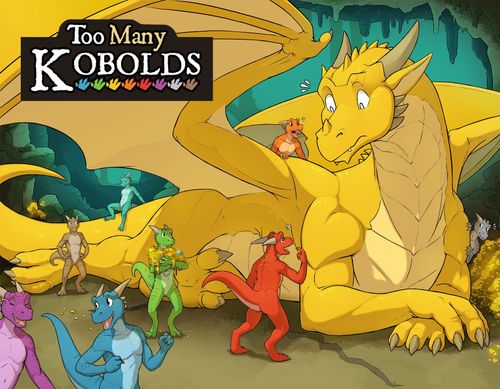
Too Many Kobolds
Too Many Kobolds Rulebook
Table of Contents
Table of Contents
Game Content
- 49 base Kobold cards
- 7 Dragon cards
- 15 Dragon Power cards
- 5 Kobold Mom cards
- 3 Mushroom Fetcher cards
- 4 Dragon Fan cards
- 4 Kobold Kids cards
- 1 Egg-keeper card
- 4 Goblin cards
- 1 Rules sheet
Setup
Each player chooses a Dragon card and places it in front of them. This card represents the Dragon they embody and is the first occupied slot in their cave. During the game, the adopted kobolds will be positioned around the Dragon, until the cave is completely filled.
Each player then receives three Dragon Power cards (one of each type) and a Kobold Mom card. Put the unused Dragon Power and Kobold Mom cards back in the box.
Take the deck of cards containing the kobolds (and goblins) and shuffle it. Place it in the middle of the table, with the "shy" side facing up (the shy side displays a zero or negative value in red, as opposed to the "happy" side which displays a positive value in white). This deck of cards is the queue of kobolds who responded to the dragons' classified ad and came to be adopted. Take the first four cards of the kobold queue and place them in a row next to the deck to form the Head of the Queue; these frontrunners are ready for adoption.
Choose who will be the first player. During the game, players take turns to adopt kobolds either from the head of the queue or the first kobold on top of the kobold queue, playing clockwise.
The Dragons' Cave
- Each Dragon plays in a cave which is five cards wide and three cards high.
- The Dragon is the first card of the cave but it does not need to be in the center.
- The game is over when all players have put a fifteenth card in their cave and have filled it.
The Kobold Cards
The cards display three pieces of information:
- Each kobold has a colour and a symbol corresponding to a type of resource it provides (crystals-purple, water-blue, moss-green, etc.). Note: the Dragon cards also provide a resource corresponding to their colour.
- On the "shy" side, each card displays from 0 to 4 resources which are the resources the kobold would like to get around him to become happy.
- Each card finally displays a value (positive, zero or negative) used to count points at the end of the game.
Adopt a Kobold
During your turn, you always have to adopt a new kobold (or play your Kobold Mom). Take one kobold card from the head of the queue, or the first kobold on the top of the kobold queue, respecting the placement rules.
Placement Rules
- Each player plays in their own cave.
- You always must place your kobolds on the "shy" side so that it is directly adjacent to a card already placed in your cave (you cannot isolate a kobold by placing it diagonally).
- Once a kobold has been adopted and placed in your cave, you cannot remove it or move it (except when using a Dragon Power).
- If you have adopted a kobold from the Head of the Queue, take the first card on top of the Kobold Queue and fill the Head of the Queue back to four cards.
Make a Kobold Happy
As a Dragon, it is important to have many kobolds. But it is even more important to have happy kobolds!
When you adopt new kobolds and place them in your cave, they all bring resources with them. Some kobolds are happy with just having a spot in your cave; others need resources around them to become happy.
- When a card provides a resource, it provides it to all eight cards directly placed around it (the neighbours).
- When a kobold is surrounded by cards providing all the resources they ask for, you have made them happy! Flip the card on to the "happy" side (without moving or removing it).
- Kobolds always provide their resources for their neighbours, regardless of them being "shy" or "happy".
- If a kobold asks for a resource but a card providing said resource is not directly next to them, it is too far away and cannot help make the kobold happy.
In this example, the gray kobold provides stone to the purple kobold but not to the blue kobold: they are not neighbours.
Happy Dragon
If your Dragon is surrounded by eight happy kobolds, flip your card. You will earn 5 extra points at the end of the game.
Kobolds
The base kobolds are divided into seven colours/resources:
- Stone (Gray)
- Moss (Green)
- Coins (Yellow)
- Fire (Orange)
- Meat (Red)
- Crystals (Purple)
- Water (Blue)
Chromatic Bonus
At the end of the game, if you have at least one card (Dragon included) of each of the seven base resources in your cave, you earn 10 extra points.
Triple Bonuses
If you have the same resource (Dragon included) three times, this grants you 5 extra points at the end of the game. The kobolds do not need to be happy for the bonuses to be effective. This bonus can be completed multiple times with different resources.
- 2nd triple: +7 bonus points (12 points in total)
- 3rd triple: +8 bonus points (20 points in total)
Kobold Mom
During your turn, you can place your Kobold Mom card instead of adopting one of the kobolds from the queue. The Kobold Mom is played like a standard card but she acts like a joker and replaces one resource of your choice to help make each kobold around her happy.
The replaced resource can vary from one card to another.
In this example, the gray kobold asks for fire (orange) and water (blue). His diagonal neighbour the blue kobold asks for crystals (purple) and meat (red). The Kobold Mom replaces one missing resource for each kobold around her, both the blue and gray kobolds become happy.
To become happy, the Kobold Mom wishes to be put next to Kobold Kids, or next to the Egg-keeper.
Kobold Kids and Egg-keeper
To be happy, these kobolds must be placed next to other kids, or next to the Kobold Mom. If you have the Egg-keeper and two Kobold Kids cards, you get the triple bonus.
Dragon Fan Kobolds
To be happy, these kobolds must be placed directly around the Dragon. The Kobold Mom replaces any resource, except for the "Dragon": she cannot make a Dragon Fan kobold happy.
Mushroom Fetchers
These kobolds are looking for hidden mushrooms on the cards of the other kobolds (from 0 to 2). They are happy as soon as one of their neighbours has got one mushroom.
At the end of the game, you get 1 point per mushroom present on the cards around the Mushroom Fetchers. The Kobold Mom counts as providing one mushroom to the Mushroom Fetchers, and two neighbouring Mushroom Fetchers give each other one mushroom.
Disguised Goblins
Facetious goblins have disguised themselves as kobolds to try to get adopted by the Dragons! Be careful! Goblins do not give any points and cannot be made happy. However, they still count as a resource for the triple bonus.
Dragon Powers
During your turn, before adopting a kobold, you can play one or more of your Dragon Powers. Each Dragon Power card can be used only once: discard them after use.
Players keep their Dragon Power cards hidden throughout the game. You have to remember if a player has already used one of their powers!
Two-player variant: each player can start the game with two cards of each Dragon Power.
Dragon's Choice
(play instead of adopting a kobold from the head of the queue or top of queue)
Announce a colour (or resource) which is not displayed in the Head of the Queue and search the Kobold Queue; take the first card corresponding to this colour. You have to adopt this kobold. Do not shuffle the kobold queue afterwards.
Cave Rearrangement
Take a kobold card already placed in your cave and move it elsewhere respecting placement rules. Moving a happy kobold does not make them shy again. Happy kobolds which were around them also remain happy. You cannot move your Dragon or the Kobold Mom.
Dragon's Roar
You roar so loudly the walls of the cave shake, which agitates all the kobolds who came to get adopted. Shuffle all the cards from the Kobold Queue and the Head of the Queue. Take the first four cards of the deck to form a new Head of the Queue.
End of the Game
The game ends when all players have filled their cave by placing a fifteenth card. At 5 players, the end of the game corresponds to the end of the deck of kobold cards. You are obligated to play your Kobold Mom in order to fill your cave.
To count the points, proceed in this order:
- Count points given by Mushroom Fetchers.
- Add points granted by chromatic bonuses (10 points) and triple bonuses (5, 12 or 20 points).
- Add the points given by each happy kobold and remove the negative points from shy kobolds.
The Dragon with the most points wins the game! If you score at least 65, you are an excellent Dragon!