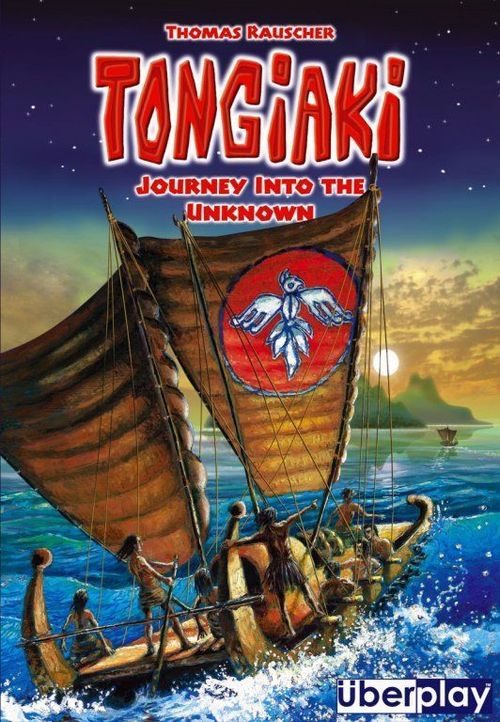
Tongiaki: Journey into the Unknown
Tongiaki: Journey into the Unknown Rulebook
Table of Contents
Table of Contents
Components
- 90 ships in 6 different colors (15 per player)
- 16 island cards (1 starting island Tonga, 3 worth 2 points, 4 worth 3 points, 5 worth 4 points, 3 worth 5 points)
- 16 water cards
Game Idea and Goal
Over the course of the game, players place more and more ships on the beaches of the islands. As soon as a beach is completely occupied, those ships set out and sail to a new island. To do this, a new ocean card (island or water) is usually revealed and attached.
Players score points at the end of the game for every island on which they are represented by at least one ship. Whoever has the most points at the final reckoning wins.
Setup
Each player receives the 15 ships of one color.
The starting island Tonga is picked out (easily recognizable by its back) and placed in the middle of the table. The remaining cards are shuffled and placed nearby as a face-down stack.
Tonga has six beaches, each with three mooring spots. Starting with the youngest player (the start player), all players in turn each place one ship on a free spot on Tonga, until every player has placed two ships. At least one mooring spot must remain free on each beach while doing this.
Once this placement is complete, the start player begins, and after them the other players follow in clockwise order.
Sequence of Play
A player's turn begins with reproduction of their ships. After that, under certain conditions, emigration, seafaring, and landing follow.
Instead of a normal turn, a player may instead found a king island or take all of their ships off the board and place one ship anew ("resettlement").
1. Reproduction
The active player decides on one of the islands on which at least one of their ships is already standing. There, they place as many new ships of their color as are already on the island in their color — but no more than the island has beaches. They may place at most one ship on each beach of this island.
No player may reproduce on a king island (see "Founding a King Island").
2. Emigration and Seafaring
If not all the spots are occupied on any beach, the turn ends and the next player takes their turn.
But if at least one beach is complete, all the ships on that beach set out to sea:
The player reveals the top ocean card from the stack and attaches it, red-crest edge first, to the pier of the complete beach. If a card is already lying at that pier, no new card is revealed, and the player moves the ships onto the card that is already there (see "Landing").
If a beach has several piers, or if several beaches are complete after reproduction, the player may freely decide from which beach and via which pier they emigrate first. However, they must decide and announce, before revealing the cards, where the next revealed card will be attached.
If the player reveals a water card, or carries out the emigration over a water card that is already lying there, the ships travel along the white wake across the ocean. Such a voyage only succeeds, however, if the required number of different colors travel together in the group of ships! The number on the wake indicates the danger of the route:
- No number: any group of ships can travel here without risk.
- 2: a group of ships must contain at least two different colors.
- 3: here at least 3 different colors are required.
- 4: at least 4 different colors are required.
Example: Yellow has completed a 4-beach and sets out to sea with two yellow ships, one orange ship, and one green ship. The wake of the revealed water card shows a "4." Since only three different colors (= the ships of three players) are traveling in the group of ships, the ships cannot pass and the crossing fails. If one of the yellow ships were purple instead, the ships could cross the water card unhindered.
Tactical note: it is always risky to travel alone through the South Seas. If you reveal a water card, the odds are poor that you'll also be able to pass it — because only about a quarter of the water cards show wakes with no number, and are therefore manageable for a player traveling alone.
If the crossing succeeds, the player places the ships at the other end of the white wake (without turning), and reveals another card. This card, too, they attach — again with the red crest — there. A player keeps revealing new cards until the ships either reach an island or a crossing fails.
If the crossing fails because too few different colors are traveling together, the ships are removed from the game board and their owners get them back.
The player may still make further emigrations if applicable (e.g. from other beaches of their island of origin), but this particular emigration is then finished.
3. Landing
If the revealed card shows an island, or if the emigration leads to an island card that is already lying there, the active player distributes all the emigrating ships onto the beaches of the new island. In doing so, they first place one ship on each free beach, provided enough ships are available. If ships remain after that, they may distribute them freely. It makes no difference whether ships of the same color are already there.
If there are not enough free mooring spots available, the surplus ships go back to their owners. The active player may choose which ships these are.
Distributing the ships when landing on an already-lying card works the same way.
Chain Move
After landing, it can again happen that all mooring spots are occupied on one or more beaches. Then the player remains on turn and begins again with emigration, and so on. The chain move continues for as long as no beach is still completely occupied.
The active player may freely choose the order of emigrations within a chain move.
End of Turn
A player's turn ends when they were unable to complete any beach, or when they have finished all their emigrations. Then the next player in clockwise order is on turn.
Founding a King Island
If only ships of the active player (one or more) are standing on an island, they may declare this island a king island and thereby secure its points.
They place one ship from the beach onto the mask in the middle of the island and take the remaining ships back to themselves. Founding a king island counts as a complete turn. The player may therefore not also carry out a reproduction, etc., in this turn. The following rules apply to a king island for the rest of the game:
- No player may enter or cross it.
- No reproduction may take place there.
- No ships may land there. Any group of ships that tries to land on a king island moves back and lands again, by the same route, on the island it came from.
Tonga cannot be declared a king island. A player may found at most two king islands in total.
Tactical note: founding king islands is usually worthwhile for 4- or 5-point islands. For 2- or 3-point islands, the negative effect of the missed reproduction, etc., is probably stronger than the points secured until the end of the game. But there can also be strategically important spots in the island world where even 2-point king islands make sense — there, you can block other players and then try to populate the "sealed-off" area by yourself.
Resettlement
Instead of a normal turn, the active player may take all their ships off the game board (except from king islands) and place one ship on a new island. To do this, they reveal ocean cards and attach each one at a place on the board of their choosing. As soon as the first island comes up, they place a ship on any beach there, and their turn is over.
End of Game
The game ends as soon as the last water card or the last island card has been revealed and attached (that is, once 16 water cards or 16 island cards are lying on the table). The active player's turn is still carried out in full; after that the game is over.
If the last card is an island, the landing on it still takes place.
If the last card is a water card, the ships still set out to sea. Even if the crossing over this water card does not fail, the ships remain standing on the water card.
All players now total the value of all the islands on which they are represented by at least one ship. The player with the most points wins. If two or more players are tied on points, whichever of them has their ships spread over the most islands wins. If it is still tied, the player with the fewest ships on the game board is the winner.
Special Situations
Tongiaki for Two
With two players, the rules apply unchanged. More sea routes become impassable, and the game feels more direct than with three or more players.
No Ship on the Board
If, at the start of their turn, the active player has no ship on the game board, they must either:
- place two new ships on Tonga, or
- place one new ship on another island.
They may not carry out a reproduction afterward, but may carry out emigration, seafaring, and landing if applicable.
All Ships on the Board
If, at the start of their turn, all of the active player's own ships are standing on the game board, they may take one ship of their color from any island (except a king island) and use it for reproduction.
Too Few Ships?
If a player would have to place more ships during reproduction than they have available in front of them, they may only place as many ships as are available.
Infinite Chain Move (Very Rare)
An infinite chain move can arise when:
- an island is surrounded exclusively by cards that lead back to the same island, and
- the active player attempts an emigration from this island.
In that case, all ships on this island are returned to their owners, and the island card is removed from the game. Should this result in:
- no revealed island remaining on the game board, or
- the active player getting all their ships back through this action,
then they keep revealing ocean cards until an island comes up. Any water cards revealed in the process, and the island, may be attached by the player anywhere they like among the cards already in play. Once the island has been placed, the next player is on turn.
If several islands are affected at the same time, the rule applies accordingly.
A chain move does not count as infinite if only one of the active player's alternatives is infinite, but they have one or more additional options for emigration on the same island. In that case, they must first carry out a different emigration.