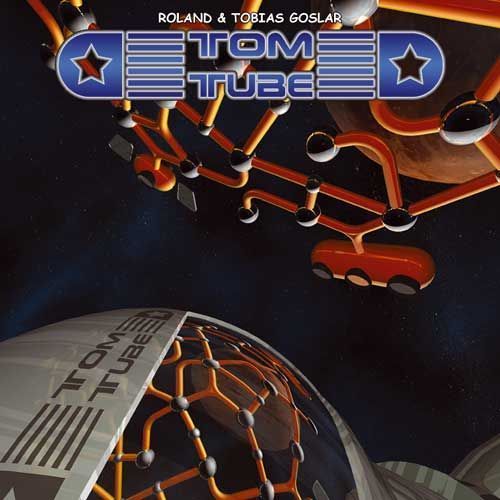
Tom Tube
Tom Tube Rulebook
Table of Contents
Table of Contents
Contents
- 1 game board
- 40 rhombs
- 18 triangles
- 2 astronauts
- 4 solar counters
- 24 energy counters
- 8 control counters
- 6 alien counters
- 1 set of rules in German
- 1 set of rules in English
Getting Started
Place the game board on the table.
Shuffle the rhombs and stack them face down beside the energy, control and alien counters. Place Tom and Dave onto their bases with one energy counter each. Place the solar counters on the same-coloured solar modules. Both players receive 9 triangles: 6 with tubes of their colour and 3 without tubes. The triangles are placed face up.
One Turn
The game is played in turns. The younger player starts. In one turn a player must either
A. place tubes or B. move his astronaut.
If a player is not able to take his turn, the other one must take his turn.
A. Placing Tubes
1. Always placing exactly one rhomb
The player picks up a covered rhomb and places it face up somewhere on two free neighbouring space triangles. A free space triangle is always framed by 3 space edges, which are marked as gray lines on the board. Depending on the position triangles and counters must be placed accordingly.
2. Placing triangles if necessary
Placing of rhombs may cause the isolation of space triangles, onto which further rhombs cannot be placed. In this case the active player must select and place own triangles on the isolated space triangles. If he has no more triangles, the other player may place some of his.
3. Placing counters if necessary
Counters must be placed on certain spheres, which are created due to the placing of tubes. The counters can be picked up by the astronauts in successive turns.
Sometimes energy spheres appear at the centre of rhombs. They are marked by a cross. A yellow energy counter is placed onto energy spheres.
By placing rhombs and triangles onto the board spheres develop. A sphere is complete, if all six space triangles around a knot are occupied by rhombs or triangles or if the sphere is completely drawn on the game board from the beginning of the game.
If a complete sphere results from placing rhombs or triangles connected by exactly one tube, this sphere is a control sphere. A blue control counter is placed onto control spheres. The complete spheres on the game board near bases and solar modules can never be control spheres.
If a complete sphere results from placing rhombs or triangles connected by no tube, this sphere is an alien sphere. A green alien counter is placed onto alien spheres.
B. Moving the Astronauts
In one turn an astronaut moves from one complete sphere to another complete sphere. Spheres and tubes, which are drawn on the game board, may be entered by both astronauts. An astronaut may never enter the other astronaut's base or solar modules.
An astronaut moves either
- by drifting through own and neutral tubes or
- by drifting through tubes of all colours or
- by a space jump along one space edge.
In one turn an astronaut may choose exactly one of these movements.
If the astronaut hits a counter, he must stop his movement. He picks up the counter and puts it onto his base.
A sphere occupied by one astronaut cannot be entered or be drifted through by the other astronaut.
1. Drifting through one's own and neutral tubes
An astronaut can drift through same coloured tubes and through neutral, striped tubes for free. An astronaut can drift through one or more complete (!) spheres without stopping, if he does not make a change of direction in the spheres. An astronaut can terminate drifting on each attainable sphere. At a ramification without a sphere the astronaut chooses a direction and must neither stop nor turn back.
2. Drifting through tubes of all colours
If an astronaut returns a control counter to the stock before he moves, he may drift through his own, neutral and other tubes within the same turn.
3. A space jump
If an astronaut returns an energy counter to the stock before he moves, he may jump through space within the same turn from one complete sphere to a neighbouring complete sphere along exactly one space edge. Thereby he must not cross any rhomb and he cannot jump from or to energy spheres, bases or solar modules.
Changing Alien Counters
An alien counter can always be exchanged into one control counter plus two energy counters from the stock. No other exchange is allowed.
End of Game
End with Bonus
The game ends with a bonus, if an astronaut has collected his two solar counters and has returned home into his base, as long as further rhombs can be placed. The slower astronaut finally counts the turns he needs in order to return home to his base. Thereby he may neither place new rhombs nor collect solar counters. The number of turns for his return is the bonus for the faster astronaut. Collecting and spending of energy, control and alien counters remain unchanged.
End without Bonus
The game ends immediately without a bonus, when no more rhombs can be placed and one astronaut returns to his base. The astronauts can return without any solar counter.
Stranding
In addition the game ends immediately, if an astronaut has no more possibility of returning to his base. The astronaut is lost in space.
Evaluation
Each energy counter on the base counts 1 point, each control counter 2 points, each alien counter 5 points and each solar counter likewise 5 points. If an astronaut has collected his two solar counters and has returned home into his base, as long as further rhombs can be placed, additional turns of the second astronaut for his return count 1 point bonus each for the faster astronaut.
The winner is the astronaut with the higher sum of points.
| Counter / Move | Value |
|---|---|
| Energy counter | 1 point |
| Control counter | 2 points |
| Alien counter | 5 points |
| Solar counter | 5 points |
| Move lead | 1 point |
Playing with Beginners
Different strengths in gaming can be balanced by additional launch energy counters (e.g. two) for the less experienced player. For each lost or won game a further counter can be given or taken away.
Furthermore the game can be started without the use of alien and control counters.