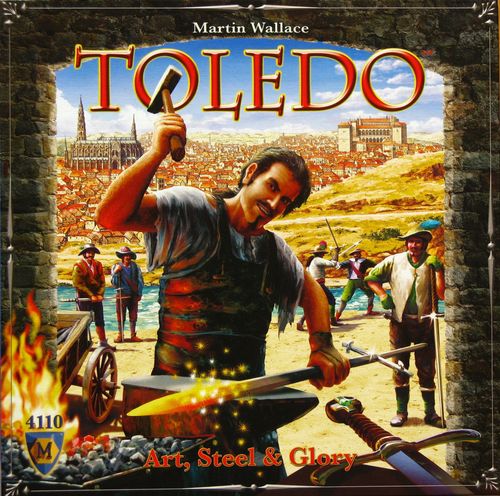
Toledo
Toledo Rulebook
Table of Contents
Table of Contents
Game Overview
Travel the hilly streets of Toledo to acquire the fine metals and gems you need for the manufacture of these beautiful swords. Get your swords forged and carry them up to the grand Alcazar palace. You might also visit the storied artist studio of El Greco to buy some of his works. But beware! Toledo can be a dangerous place. You may face duels - swordfights to protect your honor! In the end, whomever presents the best set of swords to the Emperor claims victory.
Game Components
- 20 Playing Pieces (5 each in 4 player colors)
- 32 Business Tiles (8 each in 4 player colors)
- 90 game cards (84 movement cards and 6 El Greco paintings)
- 16 skill tiles (12 fencing skill tiles and 4 move skill tiles)
- 19 Sword Tiles
- 23 Steel Counters
- 20 Gems
- 1 Game Board
Preparatory Steps
- Before embarking on your first game, carefully remove the punched pieces from their cardboard.
- Place the game board in the center of the table.
- Sort the 6 art cards (El Greco paintings) by their values (1 at the bottom, 3 on top) and place them as a face-up stack on the appropriate space on the board, next to the Cathedral.
- Select a set of 5 playing pieces in one color, placing them on the Cathedral (the start space). In addition, take the 8 business tiles in your color, keeping them near you.
- Shuffle the movement cards thoroughly. Deal out 5 movement cards to each player.
- Place the remaining cards in the space provided to form the deck.
- Place the sword tiles and the skill tiles on the respective spaces of the board.
- Place the steel counters and gems on the appropriate spaces on the bottom right-hand corner of the board.
The board lays out a Destination Space (the Alcazar) and a Start Space (the Cathedral).
Gameplay
The youngest player will take the first action. The other players take their turns in a clockwise direction, each performing an action. Continue until one player has managed to get 3 of his pieces to the Alcazar palace, then determine the winner.
When it is your turn you must perform one of the following actions:
- Take 2 movement cards, or
- Place 1 business tile (Note: Mostly in the beginning), or
- Move 1 or more of your pieces and trade with them, or
- Move 1 piece back to the Cathedral (Note: Only in rare cases! See "Returning Your Own Playing Piece to the Cathedral" below)
The Actions in Detail
Take 2 movement cards
You take the top two cards from the deck. If the deck is exhausted, shuffle the discard pile to form a new deck. You may hold as many cards as you like in your hand.
Place 1 business tile
You place one of your business tiles in an empty space on the board. You cannot place a tile on another business tile, even one of your own. You cannot place a tile on a tavern or the artist space. You have four different types of business that you can place. For descriptions of these, see "The Businesses" below. You have two of each type of business, one with a single circle on it, and the other with two circles on it. These circles limit the number of playing pieces that can use that tile. It is up to you which of these you place.
You should also note that Toledo is divided into three areas. Where you place your business tile will determine the price at which you sell your goods or services to others. Using your own business tile is always free.
Move 1 or more of your pieces
You start the game with five playing pieces in the Cathedral. You play movement cards to move them.
You play one card at a time. The first card you play should be placed in front of you. You must then move one of your pieces the number of spaces exactly equal to the value on the movement card. You must always move in a direction that takes you towards the Alcazar.
Your piece may move across empty spaces (counting each as a space), but it must always end up on a space containing a business tile, a tavern space, or the artist space. It may also end up on one of the two Alcazar circles (or, in rare cases, go back to the Cathedral). After moving a piece, you may carry out a trade where that piece lands.
Then you have the option of (1) moving the same piece again or (2) moving a different piece. If you wish to move again you must play another card. This card must have the same value as the card you first played. You can move the same piece or a different piece with this card. You can play as many cards, and make as many moves, as you like in your turn, as long as each card played has the same value. A piece can move after trading, which means you can perform a series of moves and trades.
If you wish to trade on the space you have landed on, you must move your piece to an empty circle on the business. You must also move your piece to an empty circle if you intend to move no further, i.e., all pieces must end up in a circle at the end of the current player's turn. Moving to a circle does not force you to trade; you can choose not to. See "The Businesses" below for more details on trading.
Note that you always keep the first card you played on display until the end of your turn, to remind you what additional cards you can play. Any further cards that you play should be placed on the discard pile. When you have decided to end your turn, you also place the first card you played on the discard pile.
Business is occupied: If the business space on which you land does not have a vacant circle, you must either play a further card and move on, or challenge the player occupying the circle to a duel (see "Duels" below). Note: It is not possible to issue a challenge to a piece of your own color. In such a case you must move on. If you cannot continue moving, you are not allowed to make the move to the space in the first place.
- If, on a two-circle business tile, one of these circles is occupied by another player's piece and the other one is vacant, you must move to the vacant circle.
- If both circles are occupied by other players' pieces, you must announce which of the two you will challenge.
The Businesses
- In order to trade at a business, a tavern, or the artist space, you must move your piece onto a vacant circle. It is not enough that the piece is already sitting there at the beginning of your turn - you must move a piece before it can trade!
- Trading at one of your own businesses is free of charge.
- If you wish to trade at another player's business, money will need to change hands. You must hand to the owner of the business one and only one movement card (not several!) with a value corresponding to at least the cost of the row in which the business is located. In the bottom row this is at least one, in the middle row it is at least three, and in the top row at least five. You may hand out a higher-value movement card, but you lose the change!
- To trade at a tavern, you discard a card with a value equal to or exceeding the value of the row the tavern is located on, which is either one or three.
- To buy artwork from the artist space, you must discard a card with a value of three or more.
Note: The owner of a business tile cannot refuse to trade. What you get in return for your card depends on the business tile you have landed on, as described below:
Steel Merchant: You take one steel counter from the stockpile and place it in front of you.
Gem Merchant: You take one gem from the stockpile and place it in front of you.
Swordsmith: The swordsmith takes your steel and gems and fashions them into a sword. Each sword tile has a cost in steel and gems. Some swords only require steel. You select a sword tile and hand in the number of steel counters and gems as indicated on the tile. These are returned to the stockpile. Keep the sword in front of you. Each sword has a point value, which you score if you manage to present it to the Emperor (you score half the value if you do not succeed in presenting it).
Fencing Master: The fencing master will improve your fencing skills and teach you to move more efficiently. You choose one of four skill tiles available. Three of these will improve your chances of winning a duel. The other will help you move more quickly through the streets of Toledo. You can only have one of each type of tile. You cannot have more than three such tiles. You may discard a tile to take a different one if you already have three tiles.
Note: If you end the game with the move skill tile, you lose two points (it's a very powerful skill). However, you can get rid of it by exchanging it for a different skill tile if you already have three tiles.
Tavern: A drink at the tavern will help you regain energy and find out about the best businesses to visit. This increases your ability to move, so you take the top three movement cards from the deck. This requires the usual payment of one card. You may immediately use any cards gained in the tavern to move in the present turn, as long as you obey all other movement rules.
Artist: El Greco is Toledo's most famous artist. You can buy one of his paintings in exchange for a movement card of three or more. You take the top card from the stack of art cards. You score the points on such a card at the end of the game.
Entrance to the Alcazar
To present a sword to the Emperor you must move one of your pieces to the Alcazar. When your piece ends its move exactly on one of the two entrance circles to the Alcazar, it immediately moves forward to the Alcazar. If you have already acquired a sword tile, you may place this tile under the playing piece (each piece may only present one sword to the Alcazar).
Note: You are allowed to move a piece to the Alcazar without a sword. Once a piece is in the Alcazar, it remains there until the end of the game.
Duels
When a player moves onto a business, a tavern, or artist space on which there is no vacant circle and does not immediately move on, he must challenge the other player to a duel. If two circles are occupied by different players, you must choose which one you want to duel with.
A duel consists of up to 3 fencing rounds. In each fencing round, the challenger (attacker) draws the topmost card from the movement cards. The bottom section of the card indicates the result of that round of the duel. Each round is won by the player who has a skill tile in his possession that matches the color on the drawn card. If both or neither of the players have a matching tile: the attacker wins the round if the highlighted figure on the card is in attacking pose (left figure); the defender wins if the highlighted figure is in defending pose (right figure).
Note: If the background of the drawn card is neutral (i.e., has no corresponding fencing skill), you can immediately see whether the attacker or defender is the winner of the round.
The next card is then revealed, to resolve a second round. A player who wins twice wins the duel. If the position is a draw after the second round, a third card is revealed in order to determine the winner. The loser must place his piece back onto the Cathedral. If the defender wins, he remains on the circle. If the attacker wins, he takes the vacated circle - and may trade at that business, tavern, or artist space.
Whatever the result, it is still the challenger's turn and he can trade and/or play further movement cards according to the normal rules.
Example of a Duel: Red Player begins at the Cathedral and moves to a gem merchant where both circles are occupied by other players. Since Blue Player has one fencing skill tile and Green Player has none, Red decides to challenge Green. The first card is revealed. It shows a purple fencing skill tile, which Red owns. This means 1:0 for Red. The next card shows a brown fencing skill tile - not owned by either of the two rivals. Since the figure in defending posture is clearly shown, the Green Player (defender) wins. The duel is now tied 1:1. The next card has a neutral background, and again it is the defender that is clearly shown. As a consequence, the duel ends 1:2 for Green. Red must return his piece to the Cathedral, but continues his turn. If Red has the correct cards, he can again move to the gem merchant, challenging Green to another duel.
The Move Skill
The move skill allows you to play one movement card of your choice that does not follow the normal rules of the game. The value of this card does not have to match the value of the first card you play in a given turn. You can use this skill in the turn in which you gain it. To show that you have used the skill you should flip your move skill tile to its other side. At the end of your turn flip the tile face up again.
Alternatively you can state that the first movement card you play uses this skill, which means you would take your initial move and then discard the movement card used. You could then play a movement card which would become your initial card, thus restricting all following move cards played.
Example: You play a 1 and move to a steel business. You then play another 1 and move to a fencing master and obtain a move skill tile. You now play a 3 (only allowed because you possess the move skill tile) and move another of your pieces to the tavern. There you obtain three new cards, one of which (the 1) you use to move yet again.
Second Example: You play a 3 and move. You state that you are using your move skill to play this card. You discard the card. You then play a 2 card and move. You then play a second 2 card. You could play as many 2 cards as you like, but you may play no more 3 cards.
Important: The move skill is a great advantage during the game, but carries a penalty of -2 points at the end.
Returning Your Own Playing Piece to the Cathedral
You may choose, as your sole action during a turn, to return one of your pieces that have not yet reached the Alcazar to the Cathedral. As this will cost an entire turn, you should use this option relatively rarely. It may come in handy when you have moved your pieces a long way along and have little opportunity to obtain crucial metal or gems.
End of the Game
Once a player has three or more pieces in the Alcazar, the game is close to ending. The other players each take one more turn. At that point the game ends.
Now you add up the points you have scored, as follows:
- You score the full value marked on each sword you have presented to the Emperor. You score half of the value (rounded down) marked on each sword you have not presented to the Emperor.
- You score the points on each art card (painting) you purchased.
- You score 1 victory point for every 2 gems you have.
- You deduct 2 victory points if you have a move skill tile.
The player who has the most points is the winner. In case of a draw, the winner is the player with the most movement cards. If this too results in a draw, the winner is the player with the most movement cards and who has the highest total value of movement cards.
Scoring example: The player has managed to take one sword with the value 12 to the Alcazar. He has another sword still in front of him, with the value 7 printed on it - which counts as 3 (half the value, rounded down). In addition, he has acquired two paintings, each with a value of 2, plus 3 gems (two of which score 1 point). He also has a move skill tile. The player thus has 12 + 3 + 4 + 1 - 2 = 18 victory points.
Hints for Your First Game
We recommend that you place some of your business tiles during the first rounds of the game, before moving your pieces. More pieces will land on businesses in the bottom row than in others and thus those businesses will be good earners. On the other hand, businesses in the middle and top rows earn more per business; and if you own them, using them costs you nothing. Steel and gem merchants are good businesses early in the game, particularly in the bottom row. If you start off by placing businesses with two circles, you increase the potential acquisitions - but bear in mind that you are also making it easier for your rivals to acquire materials.
The movement skill tile can give you a considerable advantage, though it may cost you dearly at the end of the game (2 minus points). That's why it makes sense to get rid of the tile before the end of the game.