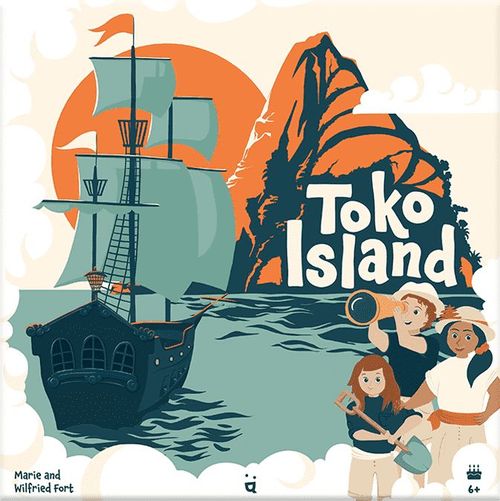
Toko Island
Toko Island Rulebook
Table of Contents
Table of Contents
Components
- 1 game board (the island) with recesses of different sizes for treasure tokens
- 1 ship board (made of 2 parts)
- 40 treasure cards
- 1 double-sided collection board
- 36 treasure tokens (small, medium and large size); the face shows a treasure, the back shows an X
- 16 tool tokens
- 7 special action tokens
- 12 trophy cards (regular and shiny side)
- 1 trophy book
Goal of the Game
Together, collect 10 treasure cards before you run out of tools.
Setup
This is the setup for your first game. Missions and the scholars they are named after are described later.
- Assemble the ship from its two parts in the center of the table.
- Take the tool tokens (hereafter simply "tools"), shuffle them and place them face down on the matching spaces of the ship's deck: 4 tokens in the cargo bay at the bow of the ship ("x1") and 6 tokens each in the cargo bays "x2" and "x3" in the middle of the deck. Then turn the tokens face up.
- Take the 10 treasure cards that correspond to your chosen mission and difficulty level. We recommend starting with the easy level of the Jean-Baptiste Lamarck mission. Put the remaining treasure cards back in the box. Shuffle the 10 chosen cards, place them face down as a pile at the stern (rear) of the ship and turn the top card face up.
- Put the trophy cards, the trophy book and the special action tokens back in the box.
- Place the island in the box, and put the box in the center of the table.
- Randomly place the treasure tokens face down in the special recesses of the island of the matching size, so that every token lies in a recess (1, 2 or 3 tokens in each).
- Place the collection board next to the box, side A up.
- The first player is whoever most recently found some treasure.
Missions and Difficulty Levels
The backs of the treasure cards contain two types of information. The missions are named after great scholars.
- Missions: Lamarck, Kablik, Herschel, Darwin (each has its own symbol).
- Difficulty levels: Easy, Medium, Hard (shown by color).
Round Structure
Players take turns clockwise, trying to find the treasures shown on the face-up treasure card.
On your turn, first choose one of the tools on the ship. The number next to the spaces of each cargo bay on the ship shows how many times you can use the chosen tool. Move the tool toward the number so you do not forget which tool you chose.
Depending on the chosen tool, you can or cannot explore certain parts of the island:
- The rake lets you explore the beach.
- The shovel lets you explore the jungle.
- The pickaxe lets you explore the mountains.
Then turn face up any visible treasure token in the area of the island that matches the chosen tool. Place the revealed treasure token next to the place where you revealed it. Keep revealing tokens in that area (depending on the number on the ship's bay you may reveal 1, 2 or 3 tokens). You may continue exploring the same recess where you started, or choose another place.
If the treasure you revealed matches the picture on the card, place that card next to the ship.
Then place the found treasure token on the corresponding space of the collection board. This helps you track which treasures remain on the island. After that, reveal a new treasure card.
Note: if the new card matches a treasure that you found earlier in this round, the treasure is not counted automatically. However, if you still have at least one action left this round, you can use it to count the previously revealed token toward the new treasure card, instead of revealing a new token.
At the end of the round, return all treasures you did not collect face down to their places. Discard the tool you used (you cannot use it any more). The turn passes to the player on your left.
End of the Game
The game can end in one of two ways:
- You managed to collect all 10 treasure cards. Congratulations, you won! Count how many points you scored and find out whether your mission became legendary (see the mission descriptions below).
- There are no tools left on the ship, but at least one treasure card remains. Too bad! Perhaps you will be luckier next time. Try again right now!
Types of Treasure
- Tiki statuette: This wooden statuette is a classic figure in the culture of the peoples of Oceania. Tiki means "man" or "god".
- Mask: Maori masks were carved from wood. They served as decorations and as protective charms for houses, canoes and various objects.
- Jade stone (nephrite): These stones were often used by the Maori in their jewelry. In the Maori language, jade is "pounamu".
- Necklace: This necklace is made of paua shells, which are found on the coast of New Zealand.
- Fossil: Giant fossils of this shape have been found in the Pacific Ocean.
- Kea feather comb: These feathers belong to the kea, a parrot living in New Zealand. The kea is the only parrot in the world that lives in the mountains.
Mission Descriptions and Earning Trophies
The game has several missions: Lamarck, Kablik, Herschel and Darwin. Each mission has three difficulty levels (easy, medium, hard). Having chosen a mission and a difficulty level at the start of the game, sort out the cards with the symbol of your mission in the matching color.
When you successfully complete a mission, take the trophy card (with the symbol of your mission and difficulty level) and insert it into the matching slots of the trophy book. If you completed the mission with a "legendary" result, insert this card into the trophy book shiny side up.
When you complete all missions of a certain difficulty or type, you can receive special action tokens (see page 8, below) that will help you in your next adventures. Only the most legendary explorers will manage to fill the book with shiny trophies!
Mission: Lamarck
Jean-Baptiste Lamarck is a French naturalist and one of your oldest friends. He is interested in everything and has no special requests. He relies entirely on whatever treasures you bring him, and the size does not matter to him. Jean-Baptiste is famous for his knowledge of invertebrates. Many consider him a founding father of biology.
Rules: The rules of the base game apply (see above).
- Regular achievement: On completing the Lamarck mission, receive the trophy card of the corresponding difficulty level. Insert the card into the trophy book regular side up.
- Legendary achievement: If on completing the Lamarck mission you have at least 6 tools left, receive the trophy card of the corresponding difficulty level. Insert it into the trophy book shiny side up.
Mission: Kablik
Josefina Kablik is a Czech botanist who adores small objects. She is passionate about the heritage of the Pacific islands and wants you to bring her as many small treasures as possible. Josefina is known for her extensive collection of plants and fossils, which were later named in her honor.
Rules: The rules of the base game apply. At the end of the game, count your victory points to find out how well you did. The treasures you collected score: 1 point for each large treasure, 2 points for each medium treasure and 3 points for each small treasure.
If your result is:
- 22 or more points: receive the trophy card of the corresponding difficulty level.
- 24 or more points: incredible! Receive the corresponding trophy card shiny side up. This is truly a legendary achievement!
Mission: Herschel
Caroline Herschel is a German astronomer who collects only special specimens for her collection. To complete the collection she looks for objects of a particular size. Caroline discovered a number of celestial bodies, including comet Herschel-Rigollet, which was also named after Roger Rigollet, who observed it 150 years after Caroline.
Rules: Setup: turn the collection board to side B. During the game the base rules apply, except for the placement of treasure tokens. When you place a treasure in the collection, choose a space of the matching token size in any row or column. At the end of the game, count your victory points to find out how well you did. Add up points only for completed rows and columns.
If your result is:
- 24 or more points: receive the trophy card of the corresponding difficulty level.
- 30 or more points: incredible! Receive the corresponding trophy card shiny side up. This is truly a legendary achievement!
Mission: Darwin
Charles Darwin is an English naturalist and paleontologist. He is a friend of your family and a lover of treasures. He is very curious and asks you to bring as many objects as possible. Charles is best known for his theory of evolution and natural selection.
Rules: The rules of the base game apply. Some cards show two or three treasures. Each time you discover one of these treasures, you may move on to the next card or try to find the remaining treasures from that card. At the end of the game, count your victory points to find out how well you did. Each treasure scores 1 point.
If your result is:
- 13 or more points: receive the trophy card of the corresponding difficulty level.
- 15 or more points: incredible! Receive the corresponding trophy card shiny side up. This is truly a legendary achievement!
Trophies
The trophy cards depict the following scientific instruments:
- Graphometer: This instrument was used for topographic measurements and for measuring angles.
- Microscope: Modern microscopes use the same mechanism that was invented back in the 1800s.
- Camera: The first camera was invented in the early 1800s.
- Vials: Vials made it possible to transport liquids, but they were also useful for taking samples in field conditions.
- Refracting telescope: Large refractors were first used in the 1800s. The main element of a refractor is its lenses. They should not be confused with ordinary telescopes, in which light is gathered with a system of mirrors.
- Lyre: The lyre is a musical instrument with 4 or 7 strings which make characteristic sounds when plucked. The lyre was invented long before our era and still serves as a symbol of inspiration and enlightenment.
- Compass: The compass was used to indicate the four cardinal directions, which made it easier to determine one's location.
- Magnifying glass: A magnifying glass allows you to examine even the tiniest objects (or their parts) in the smallest detail.
- Sextant: The sextant lets you measure the angle between two objects to determine geographic coordinates. Even today it is considered a reliable navigation instrument.
- Sundial: Sundials were used to tell the time of day. They were fitted with a compass so they could be oriented easily.
Special Action Tokens
Trophy cards can earn you special action tokens. For each row or column that you manage to fill in the trophy book, you receive the indicated special action token.
Once you have received at least one special action token, add the following step to the setup:
- Choose one of the special action tokens you have received. Place it on the hexagonal area at the bow of the ship.
On your turn you can use this token together with any tool. Apply the effect of the special action token, and then discard it: you can use it only once per game.
| Token | Effect | How to earn |
|---|---|---|
| +2 | You may use the chosen tool 2 more times. | Complete all easy missions. |
| x2 | You may double the number of actions for the chosen tool. | Complete all medium missions. |
| +3 | You may use the chosen tool 3 more times. | Complete all hard missions. |
| Extra card (card with a plus) | You may reveal one more treasure card. Place it next to the pile on the ship and look for treasure for any of the revealed cards. Resolve the task on the top card of the pile, revealing a new card regardless of whether you found the treasure for the card next to the pile. | Complete all Lamarck missions. |
| Rake | You may use any tool as a rake. | Complete all Kablik missions. |
| Shovel | You may use any tool as a shovel. | Complete all Herschel missions. |
| Pickaxe | You may use any tool as a pickaxe. |