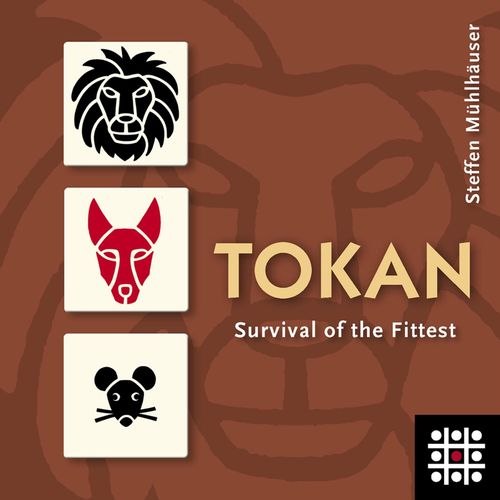
TOKAN
TOKAN Rulebook
Table of Contents
Table of Contents
Components
- 30 tiles: 15 with red and 15 with black illustrations. Per colour: 3 mice, 7 jackals, 5 lions.
Aim of the Game
Thirty red and black animals meet in the tightest space and in a randomly arranged pattern. With their nimble moves, players try to "eat" as many of the opponent's animals as possible, and to keep alive their own animals. The only thing that counts is what remains at the end.
Preparation
Players choose their colour. The 30 tiles are shuffled face down and arranged, slightly apart, into a 5 x 6 grid. All the tiles are then flipped over, without changing their random pattern. The first player is determined randomly.
(When playing, the motifs do not have to be arranged as uniformly as in the picture.)
Game Tiles
There are three different animal species in red and black. Each animal has its own range. The mouse advances 1 space, the jackal 2 spaces, the lion 3 spaces. The animals must always be moved the full distance.
Play
Players take turns moving one tile of their own colour. The player on turn moves any animal of his/her own colour towards another animal. The following rules apply:
- The move can be completed horizontally or vertically. Diagonal moves are not allowed.
- Each animal must advance, according to its ability, exactly one, two or three spaces.
- The move must always finish on another tile. This tile can belong to either the player or the opponent. Taboo: covering the tile just moved by the opponent is not allowed.
- At the end of its move, a tile must be at least one level higher than before. A tile is not allowed to move on the same level or descend to a lower level.
- Jumping over higher stacks is allowed.
- If a move creates a gap, all the tiles and/or towers behind move forward in this direction, so the gap is closed again.
- If no tile can move forward (e.g., spaces at the edge), a permanent gap can be created. Gaps cannot be jumped over.
- It is allowed to lift up the tiles of a stack to check which animals are underneath.
Example for 3: The black jackal is not allowed to move up or down, because there is no tile on the target space.
Example for 4: The jackal is on the 2nd level and is hence only allowed to move (as usual, 2 spaces) to the right. After the move, the jackal is higher (3rd level) than before. With the move to the left, the level stays the same (2nd level).
Example for 5: Same example as above (middle row), side view.
Carrying
Lions and jackals may carry underlying tiles with them as they move. The jackal can carry one underlying tile when moving. The lion can carry one or two underlying tiles when moving.
(Note: moving tiles as a stack is never compulsory, unless the player can only move his last tile by carrying one or two tiles with it.)
Carrying makes it possible for a tile to ascend to a higher level, even though it is initially on a higher level than the tile it is moving to.
Game End
The game carries on for as long as the players can move tiles according to the rules. If a move is possible, the player on turn must make this move, even if it is disadvantageous for them. The game is finished when either player can no longer move any tile.
Scores
A tower belongs to whoever owns the highest tile in the tower. Each player stacks all their towers (stacks of at least 2 tiles) on top of each other. Single tiles are not scored. The winner is the player with the highest stack. If both stacks are the same height, the game ends in a tie.
Example for final position: black 15 points, red 9 points.
Game Variant - Every Head Counts!
The game rules stay the same; the scoring at the end of the game changes, and so do the strategies. All the animals still visible at the end are scored depending on their range. A mouse scores 1 point, a jackal 2 points and a lion 3 points. (Single tiles are also scored.) The winner is the player with the highest number of points.
In case of a draw, tower sizes are compared and the winner is whoever has the highest tower. In case of a tie, the second highest towers are compared, etc.
Players should agree beforehand which game variant they will play.
Example for final scores: red 16 points, black 12 points.