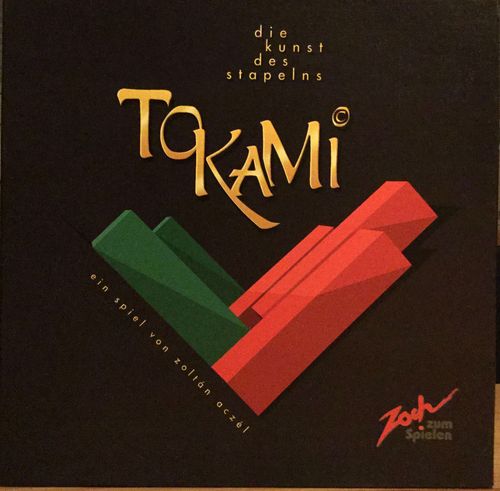
Tokami
Tokami Rulebook
Table of Contents
Table of Contents
Components
- Two interlocking boards (black), assembled into an X
- 36 sticks
- These rules
Setup
The two black boards are slotted together to form an X. The 36 sticks are shuffled and piled into the upper quarter of the X. All players may help with this. There is no fixed setup rule: basically anything goes. Ideally, the sticks are placed crisscross (Fig. 1a/1b).
Game Play
The game is played in turns.
1. Raising a Stick
The player whose turn it is takes any stick of their choice from the pile and places it back into the X so that its highest point now lies higher than before (see Fig. 2-4).
2. Drawing a Winning Stick
If the raise succeeds without any sticks falling off the X, the player may draw another stick of their choice from the X and set it aside next to them as a winning stick. The turn is then over.
If this seems too risky, the player may end their turn without taking a winning stick.
Each winning stick is worth 1 point in the final count. Only the red sticks are worth zero points.
3. Sticks Falling Down
a) If any sticks fall off the X, the player must stop the attempt immediately. The player must take all fallen sticks as minus sticks and keep them clearly separated from their winning sticks. Each minus stick scores 1 minus point in the final count, including the red ones. In this case the player does not receive a winning stick. If the player has already drawn a stick, that stick also becomes a minus stick.
b) If a player has drawn a stick at the start of their turn, but then cannot raise the X higher with it, they must place this stick with their minus sticks. The turn is then over.
Returning Minus Sticks
If a player wins a blue winning stick, they may return all blue minus sticks collected so far (put them back into the Tokami box). The same applies to every other colour, including red. The stick won in this way may be placed with the player's winning sticks.
Example: A player already has 4 yellow, 2 red and 1 green minus stick in front of them. They succeed in taking a yellow winning stick. They place this yellow stick with their winning sticks as usual, and may return the 4 yellow minus sticks to the game box.
Taboo Stick
The stick that the previous player raised is taboo for the next player: they may neither raise it higher nor take it as a winning stick. Only the player after that may use it again.
Exception: a player who does not dare to draw a stick at the start of their turn must take the taboo stick as a minus stick. The turn is then over.
Removing and Drawing Sticks
On their turn, a player may try one stick to see whether it can be removed. If this seems too risky, the player must take the taboo stick as a minus stick. Therefore, only one stick may be tried; this also applies when drawing a winning stick.
Shifting
Sticks on the X may slide around freely. The attempt only fails when sticks fall off the X.
End of the Round and Winner
A round ends when only four sticks remain on the X. The winner is the player with the most points. Each red winning stick is worth zero points. All other winning sticks are worth 1 point each. Each minus stick (including the red ones) counts as 1 minus point.
It is suggested to note down the scores and play several rounds.
Examples of Correct Raising (Fig. 2-4)
The source shows three diagrams of correct raises. It also shows one incorrect raise: here the highest point of the moved stick lies lower after the move than before. Such a move is invalid. If a player cannot raise the stick higher, they must take it as a minus stick.