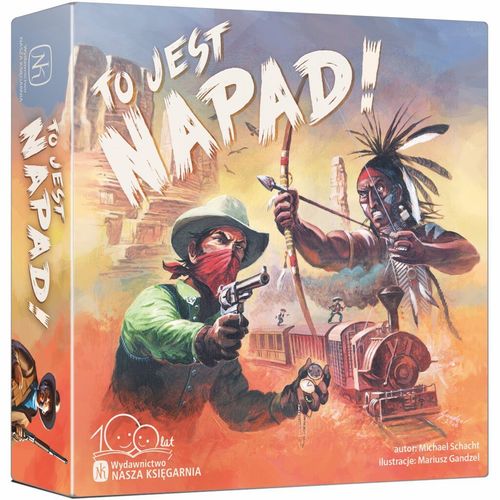
To jest napad!
To jest napad! Rulebook
Table of Contents
Table of Contents
Components
- 60 gang cards, 15 per gang: cowboys, Mexicans, deserters and Indians.
- 18 wagon cards, 6 per cargo type: gold, dynamite and money. The sample wagons on the component page are valued gold 4, dynamite 3 and money 2.
- 1 locomotive card.
- 1 help card (karta pomocy).
- 1 starting player marker (znacznik gracza rozpoczynającego).
Gang cards have two halves, each with a colour (yellow, red or green), a value in the corners, and bullets shown on the card. The rulebook's component page shows one sample face per gang. The card-by-card values are not listed in the rulebook text and are not transcribed here. In the basic game the bullets on the cards are not used; they are used only in the harder variant at the end of the rulebook.
Goal of the Game
The game lasts 6 rounds. Each round is a robbery on a train carrying gold, dynamite and money. Players lead gangs attacking the trains: cowboys, Mexicans, deserters and Indians. During each robbery, players decide which members of their gang to send to the appropriate wagons. The gang that captures a wagon takes the cargo carried in it.
After the sixth robbery, players receive points for the loot they have gathered. The player with the most points wins.
Setup
A. Sort the wagon cards into 3 stacks by cargo: gold, dynamite and money. Shuffle each stack and place it face down. These stacks are called the treasury (skarbiec).
B. Place the locomotive card below the treasury. Leave room behind the locomotive for the cards that will be laid out from the treasury during the game.
C. Sort the gang cards by type: cowboys, Mexicans, deserters and Indians. Each player takes the cards of their chosen gang, shuffles them, forms a stack and places it in front of them face down. Each of these stacks is called the gang's hideout (kryjówka). If playing with fewer than 4 players, return the unused gang cards to the box.
D. Take 5 cards from your gang's hideout. Hold them so that your rivals cannot see them.
E. The player who most recently watched a western (or the oldest player) takes the starting player marker.
F. Place the help card where all players can see it. During the game you may refer to it to recall the sequence of play and the scoring rules.
Help Card (Basic Version)
The help card is printed as follows:
Sequence of play
- Attach 3 new wagons. Add 1 wagon from each stack to the train.
- It's a robbery! Send your gang members to the robbery one at a time, or pass.
- Divide the loot. Check which gangs capture the gold, dynamite and money.
- Arrival of reinforcements. Take 2 cards from your hideouts.
Scoring points
At the end of the game, add up the value of all the wagons you have captured. The player with the highest score wins.
Sequence of Play
The game lasts 6 rounds (6 robberies on the train). Each round consists of 4 phases, played in this order:
- Attach 3 new wagons
- It's a robbery!
- Divide the loot
- Arrival of reinforcements
Phase 1. Attach 3 New Wagons
Wagons full of gold, dynamite and money are rolled out of the treasury. They are attached to the train, which sets off across lands controlled by gangs of outlaws.
Reveal 1 card from each stack in the treasury and add them to the locomotive.
Remember that in phase 1 you always attach 3 wagons from the treasury, regardless of how long the train is at that moment.
Phase 2. It's a Robbery!
A train emerges from behind the hill. The gangs attack the individual wagons.
Starting with the player holding the starting player marker, each player takes a turn. On their turn, a player may:
- SEND 1 GANG MEMBER TO THE ROBBERY, or
- PASS.
Sending one gang member to the robbery
The player chooses 1 gang card from the cards in their hand and places it in front of them, picture side up.
Each gang card consists of 2 parts. Depending on how the player places the card, it sends a gang member to rob a wagon of the matching colour (see the example below).
Note! A played card may not be turned around later in the game!
Example:
A. Placing this card with its yellow part up sends a gang member to rob a wagon carrying gold.
B. Placing it with its red part up sends a gang member to rob a wagon carrying dynamite.
(The rulebook prints no example for the green part. By the same pattern, the green part sends a gang member to rob the money wagon, since the three colours correspond to gold, dynamite and money.)
Note! These markers tell the player what is on the lower part of the card. This is useful when the card is held in hand.
In the rest of the rulebook, a card placed yellow side up is called a yellow card, a card placed red side up is called a red card, and a card placed green side up is called a green card.
Arrange the played gang cards as in the example in the rulebook illustration, so that all players can see how many cards each player has played in each colour and what their values are.
Passing
If a player passes, they give up playing further cards in the current round. Cards they have played so far remain on the table.
The other players continue until all players have passed.
The earlier a player passes, the fewer cards they play in the round (and the fewer gang members they send to the robbery). It may happen that a player plays no card at all, because they chose to pass on their first turn.
The player holding the starting player marker must play a card on their first turn. They therefore may not pass at the start of the round. The other players have no such obligation.
Phase 3. Divide the Loot
Where several fight, the stronger takes everything!
Players check which of them sent the strongest gangs after gold, dynamite and money. Below is an example of checking the yellow cards. Players proceed in the same way with the red and green cards.
- Each player adds up the value of their played yellow cards.
- The player with the highest total puts those yellow cards into the box and captures all the yellow wagons from the train. They place them in front of them in a stack, picture side down. During the game, players may look at the treasure cards they have captured, but must not show them to opponents.
- The yellow cards played by the other players return to their owners' hands (they are not put into the box!).
- In the case of a tie, no player captures the yellow wagons; they remain part of the train for the next round. All players take their played yellow cards back into hand.
Example:
The yellow wagon is captured by the Indians (total 11). The player playing the Indians takes the yellow wagon and places it face down in front of them. They put their played yellow cards into the box.
The other players (in this case only the player playing the Mexicans) take their played yellow cards back into hand.
Nobody captures the red wagon, because the strength of the red Indians (4) equals the strength of the red cowboys (4). All players take their played red cards back into hand. The red wagon stays on the table.
The green wagon is captured by the Mexicans (total 7). The player playing the Mexicans takes the green wagon and places it face down in front of them. They put their played green card into the box. The other players (in this case only the player playing the cowboys) take their played green cards back into hand.
Phase 4. Arrival of Reinforcements
More trains are coming soon, so it is time to call up reinforcements from the hideouts.
Each player, regardless of the number of cards in hand, takes 2 cards from their hideout (from the top of their gang's stack) and adds them to their hand.
At the end of the round, the starting player marker passes to the player seated to the left.
End of the Game
The game ends after 6 rounds (6 robberies on the train).
Players add up the value of the gang cards of the wagons they have captured. The player with the highest score wins.
In the event of a tie, the winner is the player with more gang cards left in hand.
Tips from an Experienced Outlaw
- You cannot capture wagons in every round. In some rounds it is worth giving up the fight for wagons, so that you have more cards in hand later and can capture more valuable wagons.
- Sometimes it is worth passing early, so as not to reveal your cards to rivals and to keep them secret for the next round.
Harder Variant
A. Scoring with bullets
Setup and the sequence of play are the same as in the basic version. Points at the end of the game are counted differently. Each player performs the following steps:
- Counts the number of yellow wagons they captured (for example, 2 cards).
- Checks the highest value among their captured yellow wagons (in our example: 4).
- Counts the yellow bullets on all of the cards they have captured (for example, 3 bullets).
The player with the most yellow bullets adds 1 to their highest-value yellow wagon (in this case 1 + 4 = 5). In the event of a tie in the number of bullets, each tied player performs this step.
Then each player multiplies the number of yellow wagons by their highest value (2 × 5 = 10 points). The result is the number of points scored for yellow wagons.
Players count points for red and green wagons in the same way.
- The player with the highest total of points for wagons in all 3 colours wins. In the event of a tie, the winner is the player with more gang cards left in hand.
B. Bonus points for wagons of value 2
In the harder variant you may also use an additional way of scoring points: for wagons of value 2. Setup and the sequence of play are the same as in the basic version. At the end of the game, count the number of captured wagons of value 2:
- The player who captured the most wagons of value 2 (regardless of colour) receives 1 additional point for each of them.
- In the event of a tie in the number of wagons of value 2, all tied players receive the additional points.