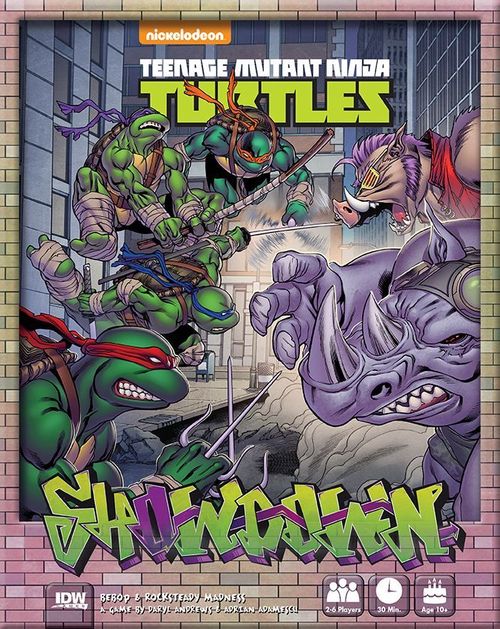
Teenage Mutant Ninja Turtles: Showdown – Bebop & Rocksteady Madness
Teenage Mutant Ninja Turtles: Showdown – Bebop & Rocksteady Madness Rulebook
Table of Contents
Table of Contents
Summary of Play
There are two teams: Turtles and Villains. The Turtles’ team takes the first turn of the game.
On your team’s turn, decide together which player on your team will take a turn. The chosen player must have a ready (face-up) Character card. The chosen player takes their turn, and then flips their activated Character card to its exhausted (facedown) side. Then, it is the other team’s turn.
When a team has exhausted all of their Character cards, all of their Character cards immediately flip to their ready (face-up) sides.
Play continues in this way until a team wins:
- The Turtles win immediately if they run around the Game board and bring 3 Allies to the Turtles’ Home tile before Game board fills with Map tiles.
- A team wins immediately if they reach the “10” space on their Showdown track, as they’ve knocked the opposing team unconscious.
- If the Game board is filled with Map tiles, compare the teams’ Showdown tracks. The Turtles win if they are higher on their Showdown track. The Villains win if they are higher or tied on their Showdown track.
Game Components
- 1 Rulebook
- 1 Game board
- 2 Six-Sided dice (1 green and 1 purple)
- 48 Ability tokens (16 Nunchuks, 16 Chainsaws, and 16 Grenades)
- 2 Showdown tracks (1 Hero and 1 Foot)
- 2 Showdown Track markers
- 16 Pizza tokens
- 4 Ally standees (April O’Neil, Casey Jones, Master Splinter, and Angel Bridge)
- 4 Turtle standees (Leonardo, Raphael, Donatello, and Michelangelo)
- 2 Villain standees (Bebop and Rocksteady)
- 10 Plastic stands
- 12 Character cards (2 cards for each Turtle and Villain)
- 44 Map tiles (42 Sewer tiles and 2 Home tiles)
Character Cards
The printed page shows the front of one Character card for each Turtle and Villain. The stats below are read from the card faces in the order of their icons: Attack (sword), Defense (shield), Tiles (tile grid), and Movement (cross arrows). The rulebook does not label these icons.
| Character | Card | Attack | Defense | Tiles | Movement | Ability |
|---|---|---|---|---|---|---|
| Michelangelo | Skateboard | 2 | 3 | 1 | 3 | Take 1 additional movement this turn. |
| Raphael | Rage | 3 | 2 | 1 | 2 | As the attacker in a Showdown, you can roll two dice instead of one die. |
| Donatello | Technology | 1 | 4 | 1 | 2 | Move any empty played tile to an empty space. |
| Leonardo |
Editor's note: the Hammer Smash card is printed only in the “Placing Tiles” example on page 8. Each character has two Character cards, but the rulebook prints the face of only one card for Michelangelo, Raphael, Donatello, Leonardo and Bebop, and only the Grenade and Hammer Smash cards for Rocksteady. The second card for those other characters is not shown anywhere in this rulebook.
Game Setup
- Choose teams and Character cards: The players choose which characters they are playing, and take the matching Character cards based on the number of players, as described below. The Turtles are Michelangelo, Raphael, Donatello, and Leonardo. The Villains are Bebop and Rocksteady.
- 2 players: One player controls all 4 Turtles, choosing 1 Character card for each Turtle. The other player controls both Villains, taking both Character cards for each Villain.
- 3 players: Two players control the Turtles, each playing 2 Turtles, taking both Character cards for each Turtle. The other player controls both Villains, taking both Character cards for each Villain.
- 4 players: Two players control the Turtles, each playing 2 Turtles, taking both Character cards for each Turtle. A third player controls Bebop, taking both of Bebop’s Character cards, and a fourth player controls Rocksteady, taking both of Rocksteady’s Character cards.
- 5 players: Four players control the Turtles, each playing 1 Turtle, taking both Character cards for each Turtle. The fifth player controls the Villains, taking both Character cards for each Villain.
- 6 players: Four players control the Turtles, each playing 1 Turtle, taking both of the Turtle’s Character cards. The fifth player controls Bebop, taking both of Bebop’s Character cards, and the sixth player controls Rocksteady, taking both of Rocksteady’s Character cards.
- Place Ally standees: Place 1 Ally standee on each of the four corner spaces of the Game board (see diagram on pg. 5).
- Place Home tiles: Place the Turtles’ Home tile and Villain’s Home tile on their starting locations (see diagram on pg. 5).
- Place Turtles: Place the 4 Turtle standees on the Turtles’ Home tile (see diagram on pg. 5).
- Place Villains: Place the 2 Villain standees on the Villains’ Home tile.
Terminology
The remaining rules use some terminology that we must discuss before continuing.
- The Game board is a collection of spaces, which are gradually filled with Map tiles during play.
- A space may only hold Pizza tokens and Ally standees placed during setup. After setup, nothing can be placed on a space except a tile.
- A tile may hold tokens and standees. Each tile is composed of sewer paths and pipes.
- 2 tiles are adjacent when their orthogonal edges touch. 2 tiles are not adjacent if only their corners touch.
- 2 adjacent tiles are connected on an edge when a sewer path of 1 tile touches a sewer path of the other tile.
- 2 adjacent tiles are blocked on an edge when 1 tile has no sewer paths that touch a sewer path of another tile.
- An activated character is the Character standee matching the current activated Character card.
Playing Your Turn
On your turn, first choose 1 of your ready Character cards to activate.
During your turn you must place tiles (page 8) and move at least 1 tile (page 7). You may also use your ability (page 8) or attack (page 9) at any time during your turn.
Turn Requirements
During your turn, you must move at least 1 tile. You may end your turn on the same tile that you began your turn on, as long as you moved. During your turn, you must also place the number of Map tiles listed on your activated Character card.
Taking Another Turn
At any time during your turn, you may spend a Pizza token to immediately take another turn, activating any of your Character cards. To spend a Pizza token, you must have fulfilled your turn requirements of movement and tile placement.
Note: Pizza tokens can only be shared between characters of the same team by having both characters on the same space.
Ending Your Turn
At any time after you have moved at least 1 tile and placed the required number of Map tiles, you may end your turn. When you do, flip your activated Character card facedown to its exhausted side.
Moving
Your activated Character card shows that character’s movement. Moving from your Map tile to an adjacent Map tile costs 1 movement.
- You can move up to the number of tiles indicated by your character’s movement number.
- You can only move orthogonally, not diagonally.
- You must move between tiles connected by sewer paths or through connected pipes. Villains cannot move through pipes. You cannot move through waterways or spaces without tiles.
- Villains cannot move onto the Turtles’ Home tile, and Turtles cannot move onto the Villains’ Home tile.
- If you move onto a tile holding a Pizza token, you take it.
If your activated character starts on the same Map tile as an opponent—or on an adjacent, connected tile—then you must choose to flee from this opponent or face them in a Showdown (page 09) before you can move away. You may flee only if your first movement means your activated character is no longer on the same tile as your opponent, or on an adjacent, connected tile. If you cannot flee, you must face your opponent in a Showdown.
Rescuing Allies (Turtles Only)
If a Turtle moves onto a tile holding an Ally standee, or onto an adjacent connected tile, place that Ally in front of that Turtle’s player. At any time during a Turtle’s turn, the acting Turtle may give an Ally to another Turtle on the same tile or an adjacent connected tile, moving the Ally in front of the other Turtle’s player. That Turtle may immediately give the Ally to another Turtle in the same way.
When a Turtle rescuing an Ally moves onto or adjacent to the Turtles’ Home tile, place the Ally standee on the Home tile. If the Turtles have 3 Allies on their Home tile, the Turtles win immediately.
Tip: You can create a line of Turtles to hand off an Ally multiple times at once, but remember that each of Turtles will be alone and vulnerable in a Showdown.
Placing Tiles
When you want to place a tile, draw a Map tile from its stack and place it on the space closest to your activated character. If multiple spaces are equally close, you choose which space to place the tile on. Also, you choose the orientation of the tile. If you place a Map tile on a space with a Pizza token, pick up the Pizza token and place it on the tile.
If the Game board is filled with Map tiles, compare the teams’ Showdown tracks. The Turtles win if they are higher on their Showdown track. The Villains win if they are tied or higher on their Showdown track.
Remember: Not all characters place tiles, and Rocksteady places 2 tiles during his turn, so pay attention to which character you are activating before drawing Map tiles.
Using Your Ability
Once per turn, you can use the ability listed on your activated Character card. A single character can have multiple Character cards, each with a different ability.
Placing Tokens
Certain character abilities will have you placing Nunchuk, Grenade, or Chainsaw tokens on the Game board. Use these tokens to block connected pipes, or to create an opening between two non-connected sewer paths (see example below).
Editor's note: the Chainsaw token is shown on the components page by its artwork only. The file carries an unrendered text layer with a Chainsaw placement effect that does not appear on any printed card or token face, so it is not transcribed.
Showdown
During a Showdown, the player taking a turn is the attacker, and the other player is the defender. The attacker rolls a die and adds the result to their character’s base Attack stat to get their Total Attack. Likewise, the defender rolls a die and adds the result to their character’s Defense stat to get their Total Defense. If multiple Turtles are on the same Map tile and being attacked, add all of their Defense stats to the roll result.
Remember: Turtles are more powerful together!
However, if these Turtles lose the Showdown, these Turtles all return to their Home tile.
Note: If multiple Villains are on the same Map tile, choose 1 to be the defender. Do not add together their Defense stats.
Note: Donatello’s Fling ability does not cause the flung Turtle to enter a Showdown if the Turtle goes through or lands on a space with a Villain.
Editor's note: no Character card printed in this rulebook has a Fling ability; the printed Donatello card (see Character Cards above) has the Technology ability. The Donatello note is transcribed as printed.
Attacker Wins
If the attacker’s Total Attack is greater than the defender’s Total Defense, the attacker wins. The defender places all carried Ally standees onto the character’s current tile and returns their character to his team’s Home tile. The attacker remains on their current Map tile and moves their team’s Score Track marker up on their Showdown track by 1 space per opponent defeated. If the Showdown marker moves onto a Score Track space with a Pizza token on it, the attacking player takes that pizza token. If the attacker’s Scoring Track marker moves onto the 10 space of the Score track, the game ends immediately and the attacker’s team win.
Defender Wins
If the attacker’s Total Attack is less than the defender’s Total Defense, the defender wins. Both the attacker and defender remain on their current Map tiles. The attacker’s turn ends immediately.
Tie
If the attacker’s Total Attack is equal to the defender’s Total Defense, there is a tie. The attacker and defender re-roll to determine new Total Attack and Total Defense.
Turn Example
1: It is the Turtles’ turn. Michelangelo has taken his turn, so his Character card has been exhausted and cannot be used. The other 3 Turtles have ready Character cards.
2: The Turtles decide that Raphael will take his turn. Raphael only has the “Rage” Character card in play, so it is the only 1 he can use.
3: First, Raphael places a tile before moving 2 tiles through the sewer paths.
4: After moving, Raphael is on the same tile as Rocksteady, so they enter a Showdown.
5: Raphael has 3 Attack. Rocksteady has 4 Defense.
6: Because of his Rage ability, Raphael can roll 2 dice, instead of 1 die. He rolls a “2” and a “4” for a total of 6, which he adds to his 3 Attack, giving a Total Attack of 9.
7: Rocksteady rolls a “5”, which he adds to his 4 Defense, giving a Total Defense of 9.
8: They tied, so they must re-roll. This time, Raphael rolls a “1” and a “4”. Added to his Attack, he gets a Total Attack of 8. Rocksteady rolls a “6”. Added to his 4 Defense, he gets a Total Defense of 10. Rocksteady, the defender, wins! All characters stay where they are.
9: If Rocksteady had lost the Showdown, Rocksteady would have returned to the Villains’ Home tile, and the Turtles would have advanced 1 space on their Showdown track.
10: At the end of the turn, the Raphael card flips to its exhausted side. It is the Villains’ turn next.
Win Conditions
The game can end in one of three ways:
- If the Game board is filled with Map tiles, immediately compare the teams’ Showdown tracks. The Turtles win if they are higher on their Showdown track. The Villains win if they are higher or tied on their Showdown track.
- The Turtles win immediately if they have 3 Ally standees on their Home tile.
- A team wins immediately if they reach the “10” space on their Showdown track.