Tixel
Tixel Rulebook
Table of Contents
Table of Contents
Components
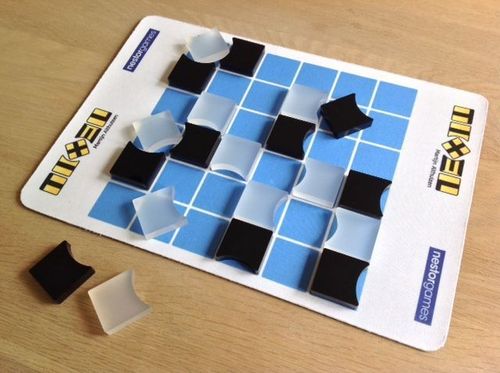
- Board (6x6)
- 20 pieces in 2 colors (10 each)
- Carrying case
Game Rules
Each player has ten pieces of one color. Initially all the pieces are off the board, forming players' pools.
White always moves first. After the first move, players alternate turns throughout the game.
Pieces
An on-board piece can be either active or inactive. Active pieces are those pivoted by 45 degrees, whereas inactive ones are aligned to the grid.
Only active pieces can be moved (see "Sliding pieces"). The corners of an active piece stick out to the four orthogonally neighbouring spaces. No other active pieces can rest on those spaces. Therefore, two active pieces can never be orthogonally adjacent to one another.
Figure captions: "Active pieces" and "Inactive pieces".
A Player's Turn
In his turn a player must either place or slide a piece.
Placing Pieces
In a turn, a player is allowed to place a new piece only if he has at least one other active and slidable piece on the board at the beginning of the turn (excluding placement of the first piece of each of the players, of course).
A player takes a piece from his pool and places it on an empty board space.
If all of the spaces orthogonally to the chosen space are empty, the piece has to be placed in the active stance.
If an orthogonally adjacent space has an inactive piece on it and its hollow side is facing the newly placed piece, the new piece must also be placed in the active stance.
Figure captions: "Valid placement" (several examples); "Invalid placement; a piece placed on this space has to be made active."
Sliding Pieces
An active piece can be slid any number of empty spaces in a row or column.
The sliding piece is first pivoted to an inactive stance (aligned to the grid in order to fit between neighbouring inactive pieces), then slid to the desired space and activated if possible.
A piece may be pivoted any amount before sliding.
Any active piece that is adjacent to the slide path gets deactivated by the sliding piece. Adjacent pieces are deactivated by pivoting them in clockwise or anti-clockwise fashion, depending on how the sliding piece passes them.
You can only slide to a space in front of another active piece if the hollow side of the sliding piece is facing the active piece.
Figure captions: "The white piece wants to slide to the space in front of the black piece." / "The piece cannot slide there ..." / "... unless its hollow side is first pivoted to face the black piece." / "Step 1; Temporarily pivot the piece to an inactive stance." / "Step 2; Slide the piece towards the desired space ..." / "... whilst deactivating all the pieces that are adjacent to the slide path." / "Step 3; At the desired space, pivot the piece back to an active stance (if possible)."
Sacrificing Pieces and Bonus Moves
When a player slides a piece in such a way that it becomes inactive, he gets a bonus move. This is called sacrificing a piece.
If this situation repeats, the player gets another bonus move, and so on, as long as he keeps sacrificing pieces.
Figure captions: "The white piece cannot be sacrificed by sliding it next to the black piece. It remains active after the slide." / "Now though, the white piece can be sacrificed. It cannot remain active as there now is another active piece on an adjacent space."
Figure captions: "The white piece is sacrificed by sliding it next to the rightmost black piece." / "That same white piece (which was just sacrificed) cannot be picked up in the resulting bonus move." / "The black piece on the left side is sacrificed ..." / "... but it cannot be picked up. Then the black piece on the right side is sacrificed ..." / "... and now the black piece that was initially sacrificed can be picked up."
The bonus move is optional, a player may choose to end his turn instead.
As a bonus move, a player may do one of the following:
- Place a piece (see "Placing pieces").
- Slide a piece (see "Sliding pieces").
- Activate an inactive piece.
- Pick up a piece (and put it back in his pool).
- Pivot an active piece to reorient its hollow side (the piece remains active).
Pivoting Pieces
A player may pivot one of his active pieces in quarter turn increments so that its hollow side points in a different direction.
A piece that is pivoted must remain active. It may not be pivoted to an inactive stance.
Figure captions: "Active pieces must be pivoted in quarter turn increments ..." / "... so that they remain active." / "Pivoting pieces so that they take on an inactive stance ..." / "... is not allowed."
Activating Pieces
A player may pivot one of his inactive pieces to any desired active stance.
The piece to be activated may not be adjacent to other active pieces.
If an adjacent space has an inactive piece on it, its hollow side must be facing the piece that the player wants to activate.
Figure captions: "These pieces can be activated." / "These can't."
Picking Up Pieces
A player may pick up one of his on-board pieces and put it back in his pool.
The piece that was sacrificed to gain the bonus move cannot be picked up straight away.
Ending the Game
When a player is unable to make a legal move, he loses. Players can agree to declare a game a draw.
Expansion Sets
There are two sets of expansion pieces available for Tixel:
- Tix expansion pieces
- Poka Yoke expansion pieces
Tix Expansion Pieces
The Tix expansion set consists of four light and four dark square-shaped pieces (eight in total). For each Tix expansion piece used, remove a similarly colored Tixel piece from the players' pools.
Compared to Tixel pieces, Tix expansion pieces have less tactical potential because they cannot be placed (in an inactive orientation) next to an active piece, nor can they be sacrificed by sliding them next to other active pieces that are in the same row or column.
You can also play the original Tix game with 2 sets of this expansion.