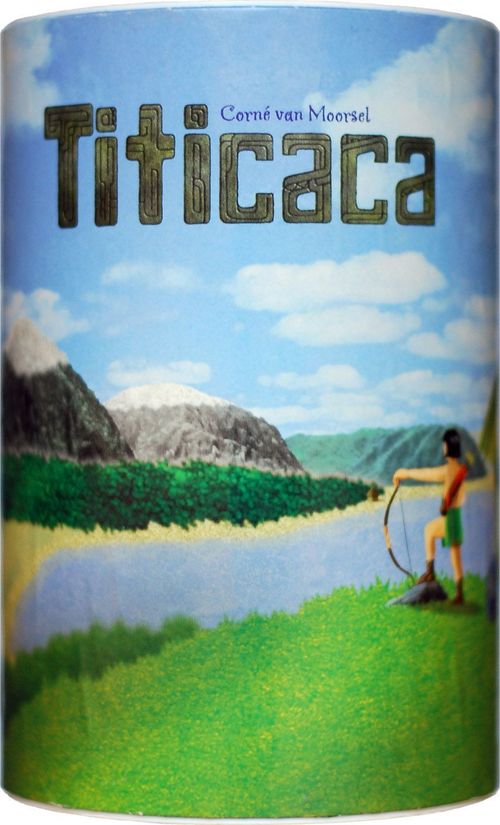
Titicaca
Titicaca Rulebook
Table of Contents
Table of Contents
Game Components
- 12 game tiles, each showing lakes and land fields:
- 15 lakes, numbered 1 to 15
- 33 land fields (hexagons), consisting of 5 different types of landscape (hereafter "land types")
- 45 black border sticks
- 41 weapon tokens in the values 1 (shield), 2 (swords), 4 (spears) and 6 (arrows and bow)
- 10 temples (grey tokens; 5 show "+1" and 5 show "+2" on the reverse side)
- Settlements (houses) in the 5 player colours: 16 yellow, 16 red, 13 orange, 11 purple and 11 pink
- A two-part scoring table
- 1 arrow token
- 5 rules summaries
Setup
- Each player takes the houses of one colour. In a two-player game only the colours red and yellow are used; in a three-player game red, yellow and orange are used.
- Each player receives weapons worth 20: 2 shields, 2 swords, 2 spears and 1 arrow and bow. (Weapons may be exchanged for an equivalent combination of other weapons at any time.)
- Each player receives 2 temples: one showing "+1" and one showing "+2" on the reverse side.
- The 12 game tiles are laid out face down at random to form a "circular" landscape. The tiles are then turned face up, so that the landscape of lakes and land fields of the different types is visible.
- Note: in a three-player game the tile with lake 1 is not used. In a two-player game the tile with lake 7 is also left out.
- The scoring table is placed next to the landscape, and one house per player is placed next to the scoring table.
- The black border sticks are placed next to the landscape.
- One player receives the arrow token.
- The rules summaries are handed out.
Object of the Game
Victory points are awarded twice during the game, followed by a final scoring at the end of the game. The player with the highest total number of victory points wins.
The best way to learn the game is to first read the section "Victory Points in the Countries" with the accompanying examples 2a to 2e, and then read the complete rules.
Game Rounds
In each round, free land fields (short: "fields") are contested on the shores of a lake. In the first round this takes place on the free fields around lake number 1; in the second round on the fields around lake 2; and so on up to lake 15. (If a lake has no free neighbouring fields, the respective round is omitted.)
Choosing Weapons (Example 1)
Each round begins with every player secretly choosing any quantity of weapons from their supply. Each player places the chosen weapons in front of them, near the landscape. (!)
- The player who chose weapons with the highest total value takes the first turn (see "Turn" below). The player with the next-highest total takes the next turn, and so on.
- At least weapons worth 1 (a shield) must be bid to take a turn at all.
- Bid weapons are handed in at the start of the player's own turn. (!)
- If there are fewer free fields than bids, one or more players will not be able to take a turn. These players take their chosen weapons back into their supply.
If weapons of equal total value were chosen: the arrow token determines the order. Its owner is stronger than the other tied players, and the tied players that follow in clockwise order rank after them. This order continues so that the player to the right of the arrow token's owner is always the weakest in a tie.
At the end of each round the arrow token goes to the player who was last to take a turn in that round.
Turn
The player on turn (determined by the weapons bid) carries out the following action(s), in the order given:
-
The player places one of their houses on a free neighbouring field of the current lake of this round. (Example 4, Part 1.) This newly occupied field forms a new land the size of one field. A land is bounded by lakes and by the black border sticks. To achieve this, border sticks are placed on the borders of the newly occupied field toward neighbouring land fields where none are yet placed.
-
(Optional) The player may connect the new land with a land that has at least one directly neighbouring field. (Example 4, Part 2.)
So that this is possible, the new land must consist of a land type that is not yet found in the land it is to be connected with. If this is the case, the border sticks between the two lands can be removed; this creates a larger land.
-
(Optional) The player may connect 2 other lands that share at least one border stick. (Example 4, Part 3.) For this, the following 3 conditions must be met:
- At least one of the two lands must contain a house of the player.
- At least one of the two lands must be adjacent to the land that contains the player's newly occupied field. (For adjacent lands see Example 3.)
- Both lands contain at least one land type that is not found in the other land.
To connect two lands, the shared border sticks between these lands are removed.
-
(Optional) The player may build one temple on one of their fields. (Example 4, Part 4.) The field may be:
- in the land that contains the newly occupied field, or
- in a land that is adjacent to the land with the newly occupied field. (Example 3, adjacent lands.)
Each field can hold only one temple. The "+1" and "+2" temples are placed face down.
Victory Points in the Countries (see examples 2a to 2e)
Each land is scored as follows:
- Most houses in one land type: points = the number of fields the land consists of.
- Most houses in total: points = the number of lake fields that border this land.
In case of a tie between 2 or more players in the number of houses in one land type, or in total in the land: (Examples 2c, 2d and 2e.)
For each participating player, the number of lake fields adjacent to their fields (of the land type currently being scored, or of the land in total) is determined, together with the value of the temples on those fields (the temple tokens are turned face up). The player with the highest resulting total of adjacent lakes plus temple value receives the points. If the tie persists, the points are divided equally among all players involved, rounded down; any remainder is lost.
Example: 5 points divided between 2 players gives 2 points to each of the two players.
Scoring
Points after Lake 5 and Lake 10
Each player receives:
- victory points equal to the total value of the weapons still in the player's supply;
- the victory points for the lands that are adjacent to lake 5, and later to lake 10 (see "Victory Points in the Countries"). The temples from these lands are returned to the players for later reuse.
Points are also awarded if rounds 5 or 10 were skipped, because no free fields were available at the corresponding lake.
Final Scoring
Each player receives:
- 1 victory point for each of their own houses on the board;
- 3 victory points for each house in the longest chain of their own houses (the houses of this chain may stand in different lands);
- victory points equal to the total value of the weapons still in their own supply;
- the corresponding victory points for the scoring of all lands (see "Victory Points in the Countries").
New Weapons
After lake 5 and after lake 10, each player receives new weapons:
- weapons equal in value to the number of their own houses on the board;
- for each house in the longest connected chain of their own houses, weapons worth 3. (These houses may stand in different lands.)
Example: after round 5 a player has 4 houses on the board, and none of them stands directly next to another. They therefore receive weapons worth 4 + 3 x 1 (the longest chain consists of one house) = 7.
The new weapons are added to the player's supply. The distribution takes place after the "Points after Lake 5 and Lake 10" have been calculated.
End of the Game
The game ends when no free fields remain after a round. If free fields are still available after lake 15, play continues until all fields are occupied or no player has any weapons left. In these additional rounds, the player on turn may choose any field that is still free.
Special Rule: Too Few Houses
(Only to be used when really necessary.)
If a player's houses do not suffice, two neighbouring fields of that player can be marked by placing a house exactly on the border between the two fields. This has no further effect on the game: each of the two fields is treated as if a house stood on it.
Hint for the First Game
Think about how many weapons you will need later on, and do not bid too many.
Reference: Game Material
(Summary sheet printed with the examples.)
- Weapons: shield = value 1; swords = value 2; spears = value 4; arrow and bow = value 6
- Arrow token
- Fields: grassland (Wiese), forest (Wald), mountains (Gebirge), savanna (Savanne), pampa (Pampa)
- Lakes, houses, temples, border sticks
The border sticks and lakes delimit a land. A land shown with 4 fields therefore consists of 4 fields.
Examples
Example 1: Turn Order
We are in round 8, and lake 8 has 3 neighbouring free fields. Klaus, Wolfgang, Reiner and Alan simultaneously choose weapons. They choose weapons worth 6 (Klaus), 3 (Wolfgang), 2 (Reiner) and 3 (Alan).
- Klaus bid the most, so he goes first.
- Wolfgang and Alan bid the same amount. In such cases the arrow token decides the order, clockwise. At the moment Wolfgang has the arrow token, because he was last to take a turn in the previous round. So Wolfgang plays second and Alan third.
Then all free fields are occupied. Reiner cannot take a turn; he takes his bid weapons back into his supply.
Example 2: Victory Points in the Lands
The scoring rules are:
- Most houses in one land type: points = the number of fields in the land.
- Most houses in total: points = the number of lake fields adjacent to the land.
Example 2a: Land size 1 field.
- Forest: 1 point for Yellow.
- Neighbouring lake fields: 3. Yellow also receives these 3 points.
Example 2b: Land size 3 fields.
- Pampa: 3 points for Red.
- Grassland: 3 points for Yellow.
- Forest: 3 points for Red.
- Neighbouring lake fields: 5. This means 5 points for Red, because Red has the most houses in the land.
Example 2c: Land size 2 fields.
- Pampa: 2 points for Orange.
- Forest: 2 points for Purple.
- Neighbouring lake fields: 3. This means 3 points for the player with the most houses in total, which is both Orange and Purple. In a tie, the player with the higher total of temple points and adjacent lake fields around their field is determined. Neither player has a temple, and both have two neighbouring lake fields. The 3 points are therefore divided, rounded down: each player receives 1 point.
Example 2d: Land size 4 fields.
- Savanna: 4 points for Orange.
- Pampa: Red and Yellow each have 1 house on pampa fields. They have no temples. Yellow has the most neighbouring lake fields and receives the 4 points.
- Grassland: 4 points for Purple.
- Neighbouring lake fields: 3. Four players each have 1 house and there are no temples. Yellow has the most neighbouring lake fields and therefore receives a further 3 points.
Example 2e: Land size 8 fields.
- Savanna: 8 points for Orange.
- Pampa: 8 points for Red, because Red has 2 houses and Yellow only 1 house in the pampa.
- Grassland: Yellow and Purple each have a house on the grassland. Purple has 2 neighbouring lakes and a "+1" temple (worth 3); Yellow has 3 neighbouring lakes and a "+2" temple (worth 5). Yellow therefore receives the 8 points.
- Forest: 8 points for Red.
- Mountains: 8 points for Yellow.
- Neighbouring lake fields: 7. Red and Yellow each have 3 houses in total. Red's houses have 2, 2 and 1 neighbouring lake fields (together 5). Yellow's houses have 2, 3 and 3 neighbouring lake fields (together 8) and Yellow also has a "+2" temple (total 10). Therefore Yellow receives the 7 points.
Tip: to mark land types that have already been scored, place the respective houses on their side.
Example 3: Adjacent Lands
Rule: two lands are adjacent if they share at least one lake or one border stick.
- Land X is adjacent to land Y. They share a border stick and 2 common lakes (lakes 4 and 8).
- Land Y is also adjacent to land Z, since these lands share common lakes (lakes 1, 3 and 10).
- Land X is not adjacent to land Z, since they have neither a common border stick nor a common lake.
Example 4: A Complete Turn
Part 1 and the optional parts 2, 3 and 4.
Part 1. We are in round 8, so the free fields around lake 8 are being contested. The red and lilac houses stem from round 3. Orange, as the first player, has already placed a house in round 8; now Yellow is on turn. Yellow has two possible free fields (savanna or forest) and decides for the savanna field. Yellow places a border stick to mark off the new 1-field land.
Part 2. Now Yellow can connect the new 1-field land to another land. The three lands A, B and C each share a border with the new land. Land C is not considered, because a savanna field is already present in it. Lands A and B do not yet have a savanna field. Yellow decides to connect the new land and land B, which then forms a land of 2 fields.
Part 3. Now Yellow can connect two other lands. Yellow's land B has 5 neighbouring lands (A, C, D, E and F). (E and F are adjacent to B through common lakes; for example, lake 6 is shared by E and B.)
- Yellow cannot start with lands A and C, since these share no border sticks with other lands.
- Land F cannot be connected with land E, since there is no land type in F that is not already present in E.
- Lands D and E, however, share a border stick, and in both lands there is a land type that is not found in the other land (grassland and savanna). Yellow connects lands D and E, which results in a land of 4 fields.
Part 4. Now Yellow can place a temple on the new field in land B, or in a land adjacent to land B. In the example these are lands A, C and F, and the newly formed 4-field land. Yellow has houses in this 4-field land and places a temple there.
Tactics: in Part 2, the 3-field land A would have been more profitable for Yellow to connect with the new land. But Yellow decided for land B, which places Yellow in a land adjacent to lands D and E. This allowed Yellow to connect D and E in Part 3, which gave Yellow a majority there. The temple (Part 4) counters the potential tie with Red in the mountains.
English Edition: Components, Examples and Clarifications
The final pages of the rulebook give the English text of the components, examples and rule clarifications. It is transcribed here as printed; where it repeats the examples above, it is the English wording of the same examples.
Components (English)
- Weapons: shield = value 1; swords = value 2; spears = value 4; arrow and bow = value 6.
- Arrow token.
- Fields: grassland, forest, mountain, savanna, pampa.
- Settlement, lakes, temple, border stick.
The sticks and the lakes form the frontiers of countries. So the country shown contains 4 fields.
Example 1: Order of Turns (English)
Suppose it is round 8 and lake 8 has 3 empty adjacent fields for the players. Claus, Wolfgang, Reiner and Alan choose an amount of weapons simultaneously. They choose respectively 6, 3, 2 and 3 weapon points.
Claus bid the most, so he gets the first turn.
Wolfgang and Alan share the second place. In such cases the arrow token decides the order, clockwise. Wolfgang has the arrow token, because he had the last turn in the former round. So Wolfgang is the second player to play his turn, and Alan the third.
Then all empty fields are occupied, so Reiner withdraws and takes his chosen weapons back into his stock.
Example 2: Counting Points in Countries (English)
- Most houses in a type of land: points = number of fields in the country.
- Most houses in total: points = number of lakes bordering the country.
Example 2a
- Country size: 1 field.
- Forest: 1 point for Yellow.
- Adjacent lake hexes: 3 lakes. These 3 points are for Yellow too.
Example 2b
- Country size: 3 fields.
- Pampas: 3 points for Red.
- Grassland: 3 points for Yellow.
- Forest: 3 points for Red.
- Adjacent lake hexes: 5 lakes. Thus 5 points for Red, because Red has the most settlements.
Example 2c
- Country size: 2 fields.
- Pampas: 2 points for Orange.
- Forest: 2 points for Purple.
- Adjacent lake hexes: 3 lakes. That means 3 points for the player with the most houses in total, but Orange and Purple are tied. Then you look which player has the most temple points plus lakes around his field. Neither player has a temple, and both players have 2 adjacent lake hexes. Then you divide the 3 points. Both get 1 point (rounding down).
Example 2d
- Country size: 4 fields.
- Savanna: 4 points for Orange.
- Pampas: Red and Yellow both have 1 settlement on pampas fields. They don't have temples. Yellow has the most adjacent lakes (3), so Yellow gets the 4 points.
- Grassland: 4 points for Purple.
- Adjacent lake hexes: 3 lakes. 4 players have 1 house each. There are no temples. Yellow has the most adjacent lakes, thus gets 3 points.
Example 2e
- Country size: 8 fields.
- Savanna: 8 points for Orange.
- Pampas: 8 points for Red, because Red has 2 houses and Yellow 1 on pampas fields.
- Grassland: Purple and Yellow have 1 house in grassland. Purple has 2 adjacent lakes and a "+1" temple (makes 3). Yellow has 3 and a "+2" (makes 5). So the 8 points go to Yellow.
- Forest: 8 points for Red.
- Mountains: 8 points for Yellow.
- Adjacent lake hexes: 7 lakes. Red and Yellow both have 3 houses in total. Red has, around his houses, 2 plus 2 plus 1 lake hex (makes 5). Yellow has 2 plus 3 plus 3 (makes 8) adjacent lakes and a "+2" temple (makes 10). So the 7 points for the total majority go to Yellow.
Tip: turn the houses in calculated types of land on their sides, to see which are calculated.
Example 3: Adjacent Countries
Rule: two countries are adjacent if they share at least one border stick or border lake.
- Country X is adjacent to country Y. These countries share a border stick and have 2 border lakes in common (lake 4 and 8).
- Country Y is adjacent to country Z too, because these countries share border lakes (lake 1, 3 and 10).
- Country X is not adjacent to country Z, because these countries do not have a border stick or lake in common.
Example 4: A Complete Turn (English)
Part 1. It is round 8, for the empty fields around lake 8. The red and purple house were placed in round 3. Orange was the first to place a house in round 8, and now it is Yellow's turn. Yellow has 2 possible places (savanna and forest) for a settlement and chooses the savanna field. He places a black border stick to border Yellow's new 1-field country.
Part 2. Now Yellow can add his new 1-field country to another country. Three countries have an adjacent field: A, B and C. But country C is no option, because that country already has a savanna field. Countries A and B do not have a savanna field yet. Yellow chooses to combine his country with country B to make it one 2-field country.
Part 3. Then Yellow can combine 2 other countries.
- Yellow's new shared country B has 5 adjacent countries (A, C, D, E and F). (Country E and F are adjacent to country B because they have a border lake in common: lake 6 in the case of E and B.)
- Yellow cannot do anything with country A and C (see above), because these countries do not have a neighbouring other country with adjacent fields.
- Country F cannot be combined with country E, because country F has no type of land which isn't in country E.
- But country D and E have adjacent fields, and both countries have a type of land which isn't present in the other country (grassland and savanna).
- Yellow combines those countries to make it one 4-field country.
Part 4. Yellow's last option is to place a temple in his new field in country B or in a country adjacent to country B. Country B has 4 adjacent countries now: country A, C and F (see above) and the new 4-field country. Yellow has settlements in this 4-field country and places a temple there.
Tactics: in Part 2 the 3-field country A seemed to be more profitable for Yellow to combine with his new 1-field country. But Yellow combined with country B in order to be in a country adjacent to country D/E. Then he could combine country D and E in Part 3 to get a majority there. The temple (Part 4) gives Yellow the majority over Red in mountain fields.