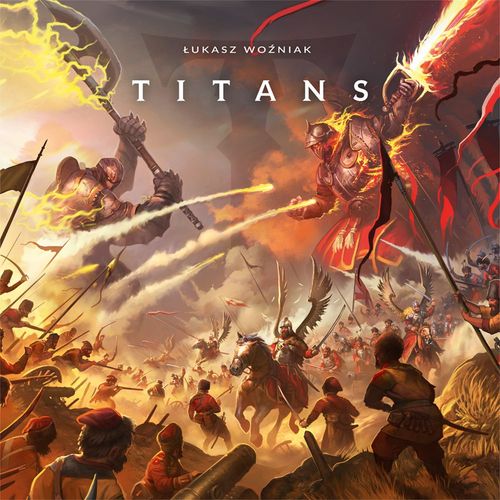
Titans
Titans Rulebook
Table of Contents
Table of Contents
Game Overview
In Titans, each player leads a Nation into war. Players will use a shared deck of Order Cards that will allow them to recruit units, awake the Nation's Army and lead the army into battle. The game is divided into Rounds and after each Round players collect Victory Points for their Regions. Winning Battles also earns players Victory Points. The player with the most Victory Points at the end of the game is the winner.
Below you will find the rules for the Standard Game Variant.
On your first game you may consider trying the Simplified Game Variant.
Game Contents
Titans is a game for 1-4 players, ages 13+, with a playing time of 80-160 minutes. It was designed by Łukasz Woźniak.
- Main Board – double-sided
- Nation Boards – 4 Boards
- 13 Units per Nation (52 Unit Miniatures): a. 6 Infantry Units b. 4 Cavalry Units c. 2 Artillery Units d. 1 Titan (also considered as a Unit)
- Strongholds – 3 Miniatures
- Control Tokens – 7 Tokens per Nation (28 Tokens)
- Capitol Tokens – 1 Token per Nation (4 Tokens)
- Battle Strength Cubes – 2 Cubes per Nation (8 Cubes)
- Order Cards (small) – 16 Cards
- Secret Objective Cards (small) – 18 Cards
- Support Cards (large) – 32 Cards
- Nation Cards (large) – 10 Cards per Nation (40 Cards)
- Battle Dice – 2 sets of 8 Dice (16 Dice) a. 3 Infantry Dice b. 2 Cavalry Dice c. 1 Artillery Dice d. 2 Titan Dice
- Victory Point Tokens – 80 Tokens with 1, 2 or 5 value
- Starting Player Token – 1 Token
- Inactive Region Tokens - 13 Tokens
- Round Tracking Token – 1 Token
Game Setup
- Place the Main Board on the table. a. Place the Round Tracking Token on the "1" spot.
- Prepare the Main Board.
a. First, you need to choose one of the Main Board Setups appropriate for the number of players.
b. Main Board Setup shows:
- Nations that are involved in the game as well as the starting turn order. All the Nation components for the remaining Nations are placed back in the box.
- Starting positions for each Nation – it contains starting Regions, Capitol and Units deployed at the beginning of the game.
- Inactive Regions – some of the Regions in a 2/3-player game are inactive. c. Set up the Nations:
- Place the Capitol Token on the Map, as shown on the Main Board Setup.
- Place the Units on the Map, as shown on the Main Board Setup.
- Place the Nation Boards with its Nation Cards, remaining Units, Control Tokens and Battle Strength Cubes on the side of the table. Keep the order shown on the Main Board Setup.
- The first Nation also gets the Starting Player Token. Whoever chooses it, will take their Turn first in the game. d. Players place 1 Inactive Region Token on the Inactive Regions and place any unused Tokens back in the Box.
- Pick the Nation to lead in the game. a. Players will choose the Nations to lead in the game based on their age. The youngest player will go first, the second youngest person goes second, etc. Players may also randomly pick the order of choosing the Nations. b. When it is his turn to choose, the player chooses one Nation to lead in the game. c. After choosing a Nation, the player takes a seat in front of the appropriate Nation Board and other Nation components. d. At the end of that step, each player shuffles his Nation Cards and places them on the side of his Nation Board – that creates the Nation Deck.
- Prepare the Order Deck. a. In a 2-player game take out all the Order Cards marked "3+ players" and "4 players" and place them back in the game box. In a 3-player game take out the Order Card marked "4 players" and place it back in the game box. In a 4-player game use all the Order Cards. b. Shuffle the Order Deck and place it on the Main Board on the designated spot.
At this point each player has 3 Secret Objective Cards in their hand.
- Place the Victory Point Tokens within easy reach.
- Place two sets of Battle Dice separately within easy reach.
Now you are ready to start the Game!
Reading this Rulebook is sufficient to play the game, but if you have any specific questions regarding most important game terms and components, they can be found in the separate "Glossary and Solo Mode" book.
Gameplay
The game of Titans is divided into 3 Rounds. Players will take their Turns starting with the person who has the Starting Player Token. Players take turns in a clockwise order.
The length of a Round is determined by the Order Deck. When the Cards in the Order Deck run out, the Round is over. At the end of each Round players score Victory Points (VP) for player's Regions, and prepare for the next Round. Players will also gather VPs for winning Battles and accomplishing Secret Objectives.
After the final Round, players reveal collected Victory Points and the player who has gathered the most VP is the winner.
Managing the Order Cards
At the beginning of the first Round, the Starting Player draws cards from the Order Deck equal to the Order Pool Size for a particular number of players.
| Number of players | Order Pool Size |
|---|---|
| 2 | 4 |
| 3 | 5 |
| 4 | 4 |
Above that Pool, the player places the same number of Order Cards – it is an Upcoming Order Pool.
Starting player will take the first Turn in the Round. Players take their Turns in a clockwise order for the entirety of the Round. Each Turn is divided into four steps and one Order Card is used by the player in his Turn.
After there is only 1 Order Card available in the Pool it is discarded. Then players slide down the Upcoming Order Pool and it becomes the available Order Pool. Then players draw new Order Cards equal to the Order Pool Size and place them as an Upcoming Order Pool. If there are no cards in the Order Deck, the Upcoming Order Pool is not created at this point.
When the second-to-last Order Card has been played, and the last Order Card is discarded, the Round ends after the Active Player completes his turn.
2-player game exception: After the Order Pool is depleted for the second time in the game, there are only 3 Order Cards remaining, instead of 4. The Order Pool is smaller near the Round end in that case.
Examples:
3-player game example
- 5 cards available (player A)
- 4 cards available (player B)
- 3 cards available (player C)
- 2 cards available (player A)
- Last card discarded, 5 cards are moved down and 5 new cards are drawn to the top row
- 5 cards available (player B)
2-player game example
- 4 cards available (player A)
- 3 cards available (player B)
- 2 cards available (player A)
- Last card discarded, 4 cards are moved down and 3 new cards are drawn to the top row
- 4 cards available (player B)
- 3 cards available (player A)
- 2 cards available (player B)
- Last card discarded
- 3 cards available (player A)
- 2 cards available (player B)
- Last card discarded
Playing the Game (Player's Turn)
The player currently taking the Turn is called the Active Player.
Player's turn is divided into four Phases. The Main Board contains a visual reminder of the four Phases that a Player takes in their turn. Those Phases are done in this specific order:
- Order Phase – The main part of Player's Turn, where he chooses 1 Order Card from the Pool and executes the available Actions.
- Resolving Battles – Movement Actions will often end in Battle. Player now resolves any Battles he may have instigated.
- Draw 1 Support Card – After resolving Battles (if any), Player draws 1 Support Card. He chooses one from the 4 available or from the top of the Deck.
- Clean-Up Phase – The last Phase of Player's Turn requires him to discard down to Support Card Hand Limit. If the player has a defeated Titan on his Board he either places him upright (if he was laying down) or deploys it onto any controlled Region (if it was already standing upright).
Additionally, a player may accomplish 1 Secret Objective on his Turn. He shows the Card, gets the appropriate number of Victory Points, and discards the Secret Objective Card.
A) Order Phase
The main part of a player's turn is the Order Phase, when the player chooses one Order Card from the Pool. Each Order Card has a list of different Actions that the player may take in his turn.
After choosing one Order Card, the player may perform Actions shown on said card in any order. The player may decide not to use some of the Actions on the chosen Order Card.
After choosing the Order Card and executing the Actions, the Card is placed on the Order Deck Discard Pile.
The available Order Card pool is not replenished after a player takes his turn. It means that each next player will have fewer Order Cards to choose from. Players should choose Order Cards taking into consideration possible actions that following players may take.
A player may not decide to skip the Order Phase in his turn.
Order Cards: Each Order Card contains 1 or more Actions. When a player executes the Order, he may decide to use the Actions in any chosen order. A player may decide not to use some of the Actions on the chosen Order Card. In this section all the Actions on the Order Cards are explained.
Movement Actions
Movement Order Card icons allow a player to:
- Move one Infantry Unit to a neighboring Region (i.e. cross one border between two Regions).
- Move one Cavalry Unit to a neighboring Region (i.e. cross one border between two Regions).
- Move one Artillery Unit to a neighboring Region (i.e. cross one border between two Regions).
- Move the Titan to a neighboring Region (i.e. cross one border between two Regions).
- Move one chosen Unit to a neighboring Region (i.e. cross one border between two Regions).
- Move from 1 to 4 Units from one Region to one chosen neighboring Region. A player may decide to move all the Units from one Region (up to 4). The Titan may be one of the Units that are being moved.
Basic Rules for Movement:
- If Regions are separated by a border line, they are considered neighboring.
- When a player leaves the last Unit from a Region, he places a Control Token in that Region – he still controls that Region.
- A player may take back any of his Control Tokens from the Regions with his Units – those Regions remain under his control.
- A player may not take back Control Tokens from the Regions with no Units.
- The Capitol counts as a Control Token.
- If a player enters a Region with enemy Units he initiates a Battle. Battles are resolved in step B of the Player's Turn.
- Attacking Units should be kept on the border between the exited Region and the one that is being attacked.
- It is possible to trigger more than one Battle in one Turn. In that case, the Active Player will choose in which order those Battles are resolved.
- If a player enters an empty enemy Region, the owner of that Region takes back his Control Token.
Unit Deployment Actions
Unit Deployment Actions allow a player to enlist new Units from his reserve on the Main Board.
A player has a limited amount of Units at his disposal and when he runs out of Units of some type, he simply cannot deploy any new Units of that type.
One Order may allow a player to deploy one or two Units.
A player may deploy new Units to his existing Armies, or place them on empty Controlled Regions.
- A player deploys an Infantry Unit on one controlled Region.
- A player deploys a Cavalry Unit on one controlled Region.
- A player deploys any one Unit on one controlled Region. A player may deploy the Titan if it is kept at the Nation Board at this point, but the Titan will be deployed regardless in Phase (D) of the Player's Turn.
Purchasing Nation Card Action
Purchasing Nation Card Action allows a player to add 1 new Nation Card to his pool.
To purchase a Nation Card, a player picks up the top 3 Nation Cards from their Deck. As stated earlier, a player may look at the top 3 Nation Cards freely at any time.
Most of the Nation Cards require paying a number of Support Cards, as shown on the top of that Card.
To pay the cost, the player chooses Support Card(s) from his hand and places them on the Support Card Discard Pile. After paying the cost in Support Cards (if any), the player places the Nation Card on the side of the Nation Board.
There is no limit on the number of Nation Cards that a player may purchase during the game.
In the 3rd Round the Nation Card cost is lowered by 1 Support Card. It is marked on the Round Track on the Game Board.
If the cost of purchasing the Card goes below 0 it is treated as a 0-cost Nation Card.
After purchasing a Nation Card, the player may decide to place one of the remaining Nation Cards from their hand on the bottom of their Nation's Deck. The remaining Nation Card(s) in the player's hand are placed on the top of the player's Nation's Deck.
A variant of this Action works exactly like the one explained above, but the player gets an additional 1 discount to the Support Card cost.
Stronghold Construction Action
That Action allows a player to construct one Stronghold in one of his Regions. The player chooses a Region with his Units or Control Token and places a Stronghold Token in that Region.
Each Stronghold has some special abilities that affect the Battle in that particular Region:
- Immediately after a Region with a Stronghold is attacked, the Defender draws 1 Support Card from the top of the Support Card Deck.
- The Battle order is changed giving the Defender an additional advantage.
- If a player takes control of an enemy Region with a Stronghold, he is awarded 1 additional Victory Point and the Stronghold is destroyed.
- When the Region with a Stronghold is empty, enemy Units may enter it without starting a Battle. In that case the player takes over the Stronghold.
B) Resolving Battles
Movement Actions in the (A) Order Phase may initiate one or more Battles. When the Active Player has moved any Unit(s) onto a Region with an opposing Army he initiates a Battle. The Active Player may initiate one or two Battles in one turn and he chooses the order of resolving those Battles.
Battle Rules
General Battle rules:
- A player is limited by the 8 Dice in one set: 3 Infantry Dice, 2 Cavalry Dice, 1 Artillery Dice, 2 Titan Dice. These 8 Battle Dice are considered his Reserve for the duration of the Battle.
- If a player were to take a particular Battle Die that is not available in his Reserve, he may not replace that Die with any other Die nor take that Die from the opponent's Reserve.
- All of the Dice have a different number of "success symbols" on each side, that shows the Battle Strength a Die will bring the player. Dice have different symbols to differentiate them from one another.
- The Dice are shown in detail on the Nation Board.
- Even though a player has 2 Titan Dice, he only rolls 1 if his Titan is in the Battle. A player can gain the Titan Die by other means (like playing Support Cards or using Nation Cards). He can even gain 1 or 2 Titan Dice without having the Titan in the Battle.
- The player who gathers higher Strength in the Battle becomes the winner. In case of a tie, the Defending player is the winner.
Rules for using Support Cards, Nation Cards, Nation Starting Ability or Titan Ability:
- If during a Battle a Unit moves into the Battle, the player immediately rolls that Unit's Dice and adds it to his Pool.
- After a Unit moves into the Battle, both players in the Battle need to check if any of their [1 / Battle] Nation Cards requirements have been met by that. If so, the player may use that Nation Card, even if he has ended his Battle Stage.
1) Beginning of the Battle
Each player takes all the Dice corresponding to his Units in Battle and any [1 / Battle] Nation Cards he may have. Battling players roll the Dice simultaneously and keep them in front of themselves – that's their Dice Pool.
Both players add the Strength Value of their Dice Pool and any bonus they may have from their Nation Starting Ability. That's their current Battle Strength.
The Defender first takes his Battle Stage, then so does the Attacker. After those two Battle Stages, players move to the Battle Resolution Stage.
2) Defender's Stage
In his Battle Stage the Defender may decide to take any of the following actions, in any order, as many times as he wishes:
- A. Playing Support Card(s) from the hand
- B. Discarding Support Card(s) from the hand
- C. Using Nation Card(s)
- D. Using the Titan Special Ability (once per Battle)
- E. Using the Nation Starting Ability (once per Battle)
A. Playing Support Card(s) from hand
Each Support Card has a requirement marked in the top left corner, below the card ability icon. The requirement can show a unit icon with a black background – that means that the player has to have that type of Unit in his own army – or it can be red, meaning the player's opponent has to have that type of Unit in his army.
If the requirement is met, the player may play the card in front of himself and use its Ability. There are 3 different Support Card Effects in the deck:
- Move 1 Unit – Player moves 1 Unit from a neighboring Region into the Battle. The player chooses 1 of his Units from any one of the neighboring Regions and moves it to the border to show that it has joined the Battle. The player then rolls the corresponding Die and adds it to his Dice pool (if he has such a Die available). Each player may only play 1 "Move 1 Unit" Support Card in a single Battle.
- Add a Die – That Support Card can be played as a single card, or in a set of 2 Cards. Playing a single Card has a different effect than playing a set. Both Cards in a set need to have the exact same Effect (i.e. Add a Die) but they don't need to have the same Requirement (both Requirements have to be met). Playing a single Card gives the player 1 Infantry Die. Playing a set of 2 Cards gives the player 1 Titan Die. The player takes a Die from the Reserve, rolls it and adds it to his Pool. A player may play multiple single "Add a Die" Cards and/or multiple sets.
- Add Strength – That Support Card can be played as a single card, or in a set of 2 or 3 Cards. The Effect differs, depending on the number of Cards played in a set. All Cards in a set need to have the exact same Effect (i.e. Add Strength) but they don't need to have the same Requirement (all Requirements have to be met). Playing a single Card gives the player 1 Strength. Playing a set of 2 Cards gives the player 3 Strength. Playing a set of 3 Cards gives the player 5 Strength. A player may play multiple single "Add Strength" Cards and/or multiple sets.
B. Discarding Support Cards from hand
Each Support Card can be discarded without having to meet the Card's requirement.
Discarding one Support Card allows the player to reroll any of the Dice in his Pool once. The player chooses Dice from his Pool, rerolls them and places them back into the Pool. The player may not go back to the previous results.
C. Using Nation Cards
A player may decide to use his Nation Cards in Battle, if he meets the requirement of said Card(s).
If a player decides to use a card that works once-per-Battle he applies its effect and he should remember that such a card has already been used.
If a player decides to use a card that works once-per-Round, he rotates the Card by 90 degrees and applies its effect.
If a player ceases to meet the Nation Card requirement that he had already used in that Battle he doesn't lose said Card's ability.
All of the Nation Cards are explained in detail in the "Glossary and Solo Mode" booklet.
D. Using the Titan Special Ability (once per Battle)
Once per Battle a player may use the Titan Special Ability if he has the Titan in his Army. A player may decide to forgo using the Titan Ability.
The Strength gathered by the Defender on the Dice, Support Cards and Nation Cards is considered his Battle Strength.
E. Using the Nation Starting Ability (once per Battle)
Once per Battle a player may use the Nation Starting Ability if he meets the requirements of said ability. A player may decide to forgo using the Titan Ability.
If a player ceases to meet the requirement of the Nation Starting Ability, he doesn't lose the bonus it provides.
The Strength gathered by the Defender on the Dice, Support Cards and Nation Cards is considered his Battle Strength.
Battle Strength Cubes: Each Nation has 2 Cubes that can be used to track the Battle Strength on the Nation Board. Players may do without them in smaller, faster Battles, but it may be helpful in bigger Battles.
3) Attacker's Stage
In his Battle Stage the Attacker may decide to take the same actions as the Defender. The Attacker has a significant advantage since he responds to the Defender's Strength.
4) Battle Outcome
After the Attacker is done with his Stage, players move to the Battle Outcome.
If the Attacker was not able to exceed the Defender's Battle Strength, the Defender is the Winner of the Battle. If the Attacker has exceeded the Defender's Battle Strength, he is the Winner of the Battle.
After declaring the Winner, players resolve the Battle. Depending on the Strength difference between the Winner and the Loser there is a different Battle outcome:
A. Losing player has to destroy Units according to the Battle Outcome Card
The losing player has to destroy Units depending on the Strength difference: for a Strength difference of 3-4 he has to destroy 1 Unit, and for a Strength difference of 5 or more he has to destroy 2 Units.
The losing player chooses which of his Units to destroy. All the destroyed Units go back to the player's Unit Reserve.
If the losing player was not able to destroy 2 Units (with a 5+ Strength Difference), he destroys only 1 Unit. In that scenario, for the remaining steps of the Battle Outcome, treat the Strength Difference as if it was 4.
If the Titan is destroyed in the Battle, the player places it on his Nation Board. If the Attacker has lost the Titan, he places it on its side on the Nation Board. If the Defender has lost the Titan, he places it standing on the Nation Board.
B. Losing player withdraws his Units
The player that has lost the Battle has to withdraw his Units from the Region.
If the Attacking player has lost the Battle, he withdraws the Units into the Region(s) from which he has moved into the Battle. That's why the Attacking player should keep all the Units moving into the Battle on the appropriate border between Regions.
If the Defending player has lost the Battle, he retrieves his Units into a single Region that he controls that is adjacent to the Battle Region. If he doesn't control any Regions adjacent to the Battle Region he withdraws his Units into a single Empty Region. If there are no adjacent Regions that are controlled by that player nor Empty ones, all of his withdrawing Units are destroyed.
The Defending player may not decide to retrieve his Units to an empty adjacent Region if he controls an adjacent Region. A player may not divide the retrieving Units into multiple Regions.
C. Losing player gains Support Card(s)
The player that has lost the battle draws 1, 2 or 3 Support Card(s) from the Deck, according to the Battle Outcome Card.
D. The Winner is awarded Victory Points according to the Battle Outcome Card
The Winner is awarded 1, 2 or 4 Victory Points depending on the Strength difference between his Battle Strength and the Strength of the losing player.
If the losing player has had a Titan destroyed, the Winner is awarded 1 additional Victory Point.
Stronghold in Battles
Stronghold gives the Defender two advantages in Battle:
- Immediately after a Region with a Stronghold is attacked, the Defender draws 1 Support Card from the top of the Support Card Deck. He may exceed his Support Card Hand Limit for the rest of the Battle.
- The Battle order is changed and the Attacker first takes his Phase, and the Defender goes after him. The Defender has an advantage since he responds to the Attacker's Strength.
- After the Defender with a Stronghold loses the Battle, the Stronghold is destroyed, and the Token is placed back in the Game Box. The Attacker is granted 1 additional Victory Point.
Capitol
The Capitol is placed on the Main Board at the beginning of the game as shown on the Game Setup. The Nation Capitol remains in that Region for the entirety of the game.
The Capitol is considered a Control Token.
The Capitol has the two defense abilities that a Stronghold has.
If a player gains control of the Region with an enemy's Capitol, that token is flipped to the damaged side. The player that has taken control of the Region gains immediately 3 Victory Points.
After a player has had his Capitol destroyed, it remains destroyed for the rest of the game and he may not restore it in any way.
Last Region
Although it's very unlikely, a player may be left with only 1 Region he controls in the game. In that scenario, that Region may not be attacked by any other player. If a player has 2 Regions, other players may attack 1 of them in one turn.
C) Draw 1 Support Card
After resolving Battles (if any) in step (B), the Active Player draws 1 Support Card. The player chooses 1 out of the 4 Cards available, or draws the top Card from the Deck. If the player chooses to draw the top Card from the Deck, he is not required to show it to other players.
Replenishing the Support Card pool: Any time a player draws Support Card(s) and chooses it/them from the pool, new Support Cards are drawn, so there are 4 cards in the pool.
Whenever the Support Cards Deck is empty, the discard pile is shuffled to form a new Deck.
D) Clean-Up Phase
At this point the Active Player should check 2 things:
Support Card Hand Limit: Each Nation Board has a Support Card Hand Limit. If a player's hand exceeds the Limit, he has to discard excess Support Cards.
Titan Deployment: If the Active Player has had his Titan destroyed in the current Turn, it should be on its side on the Nation Board. In that case the player now raises it to a standing position. If the Active Player has a Titan standing on the Nation Board, the player deploys it on any controlled Region.
End of the Turn
At this point, the active player has finished his Turn and the next player in clockwise order takes his turn.
End of the Round
When the second-to-last Order Card has been played, and the last Order Card is discarded, the Round ends after the Active Player completes his turn.
After the end of the Round, players take a few steps to summarize the current Round and prepare for the next one. The End of the Round Summary is depicted on a table on the Game Board.
If this was the last Round of the game, players award Victory Points in step 1 and skip all the other steps.
1. Awarding Victory Points for Regions
A player gets 1 Victory Point for each Region he controls.
In the last Round, players should keep those Points separate from all other Victory Points that they have, since they may be used as a tie-breaker.
2. New Starting Player | New Round
The Starting Player Token is passed to the next player in counter-clockwise order.
Players move the Round Tracker by 1.
3. Reinforcements
All players now have a chance to get Reinforcements. Each player gets 2 Reinforcements and each of them gives him a number of options.
Starting with the current Starting Player, players will decide on the Reinforcements that they get. The player gets both of the Reinforcements and then, the next player in clockwise order does the same, until everybody has completed that stage.
1st Reinforcement: Player chooses 1 of 2 options:
- Get 2 Support Cards, either from the 4 available or from the top of the Deck, or 1 from each.
- Draw 2 Secret Objective Cards, keep 1 and place the other on the bottom of the Deck.
2nd Reinforcement: Player chooses 1 of 2 options:
- Purchase a Nation Card. After the end of the 2nd Round, the Round Tracker was already moved to the 3rd Round, and the 1 Card Discount applies.
- Discard 1 Support Card and add any 1 Unit onto a controlled Region.
4. Preparing Cards for the new Round
- Players discard the 4 visible Support Cards that are in the Pool and reveal 4 new Support Cards from the Deck.
- The Order Cards are shuffled back together and placed in a face-down Order Deck.
- Players rotate all of the once-per-Round Nation Cards back if they have been used.
End of the Game
The game ends after 3 Rounds.
Players reveal all the Victory Points that they have collected and add them. The player who has gathered the most Victory Points during the game is declared the winner.
If two or more players have gathered the same exact amount of Victory Points, the winner is the tied player who controls more Regions on the map.
If there still is a tie, the winner is the tied player who controls more Units on the map.
If there is still a tie, the player who was taking their turn in the last Round earlier is the winner.
Game Variants
Simplified Game Variant
To set up the game quicker and make the gameplay easier, you may decide to incorporate two changes into the Setup and Gameplay:
- Players don't choose the Nation Cards to purchase during setup. They just pick the Nation Card marked with an (X) symbol and draw 2 Support Cards instead of 3.
- Players don't draft Secret Objective Cards nor do they have an option to get new ones during the Round Summary.
Extended Gameplay
To play a longer game, players may decide before starting the game to play 4 Rounds instead of 3. Players use a different discount for Purchasing Nation Card, since they play 4 Rounds:
- Round 1 & 2: no discount
- Round 3: 1 Support Card discount
- Round 4: 2 Support Cards discount
Main Board Setup
The Main Board is double-sided, and each side offers several player-count-specific setups. Each setup shows the participating Nations (in starting turn order), their starting Regions, Capitol and Unit placement, and which Regions are inactive for that player count. The full visual setup diagrams are printed on the board and in the rulebook; the Nations and turn order for each configuration are as follows.
2-player game:
-
- Polish-Lithuanian Commonwealth; 2. Tsardom of Russia
-
- Polish-Lithuanian Commonwealth; 2. Ottoman Empire
-
- Kingdom of Sweden; 2. Tsardom of Russia
-
- Tsardom of Russia; 2. Ottoman Empire
-
- Kingdom of Sweden; 2. Ottoman Empire
3-player game:
-
- Polish-Lithuanian Commonwealth; 2. Tsardom of Russia; 3. Ottoman Empire
-
- Kingdom of Sweden; 2. Tsardom of Russia; 3. Ottoman Empire
4-player game:
-
- Kingdom of Sweden; 2. Tsardom of Russia; 3. Ottoman Empire; 4. Polish-Lithuanian Commonwealth (two alternate setups of this configuration are provided, one per side of the board)
The Team
- Game design and development: Łukasz Woźniak
- Artwork: Piotr Krężelewski
- Graphic design: Dawid Bartłomiejczyk
- Story: Łukasz Malinowski
- Rulebook: Christian Reyes, Frank Regan, Arkadiusz Maj
- Lead playtesting and development: Przemek Ciemniejewski, Łukasz Simiński, Paweł Podgrudny
- Playtesters: Wojciech Tukan, Piotr Kopciński, Dawid Bartłomiejczyk, Szymon Woźniak, Tymo Mysakowski, Przemek Wojtkowiak, Dominik Kurowski, Michał Tukan, Piotr Gruchała, Adam Hadrian, Paweł Ciemniejewski, Ola Woźniak, Paulina Rurek, Konrad Grondys, Maciej Białecki, Monika Kamińska, Michał Cyranek, Marek Kruczyński, Lidia Górowska, Adrian Lipko, Bartłomiej Minorczyk, Artur Mikucki, Mateusz Krysztof, Piotr Woś, Piotr Piechowiak, Krzysztof Głośnicki, Paweł Kaczmarek, Tomasz Dobosz, Tomasz Łapiński, Bartosz Chlebicki, Marcin Krupiński, Samuel Skrzypkowski, Michał Kasztelan, Mateusz Aftanas, Kacper Mandziuk, Stanisław Szostakowski, Brad Osterman, Carlos Pyrcz, Filemon Szaded, Piotr Jasik, Maciej Prostak, Kuba Czajka