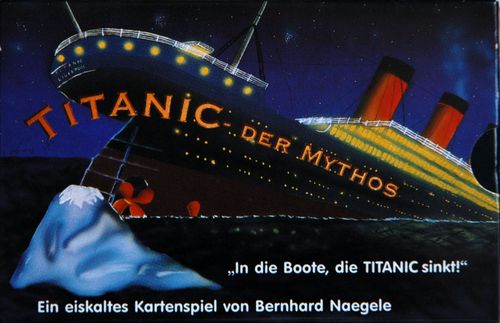
Titanic: Der Mythos
Titanic: Der Mythos Rulebook
Table of Contents
Table of Contents
Contents
- 9 ship cards (2 bow cards, 1 stern card, 6 ship elements, of which 4 are broken-funnel cards)
- 8 lifeboat cards (I.–III. Class)
- 45 passenger cards (in 5 colours, with values 1–9)
- 1 iceberg card
- 1 set of rules
Object of the Game
Round by round the TITANIC sinks piece by piece. The players try to score as many points as possible with their lifeboats.
But beware! If lifeboats are overloaded, there are minus points.
Setup
The TITANIC is laid out from the 9 ship elements with the coloured side facing up, as follows:
- First, the two bow cards are put together.
- Then the 6 middle ship elements are shuffled with the coloured side up and lined up next to the bow cards already lying down.
- The stern card completes the TITANIC.
- Now the 8 lifeboat cards are shuffled with the printed side face down, and with the printed side face up, starting with the 2nd bow card, one of each of the 8 following ship elements is assigned alternately (see Diagram 1).
Diagram 1: The ship is laid out with the bow at left and the stern at right. Lifeboat cards are placed above and below the ship elements, numbered 1 to 8 in order from the bow, with the odd-numbered positions above the ship and the even-numbered positions below it.
For the players:
- First, each player is given 9 passenger cards of one colour.
- Then the youngest player takes one card of each colour and swaps one of them with the iceberg card.
- These cards are shuffled face down and dealt to all players.
- The players who received a passenger card take the matching colour set of passenger cards into their hand.
- The player who received the iceberg lays it in front of themselves (it is no longer needed), and receives the remaining complete set of passenger cards, along with paper and a pencil.
- This player is allowed to note the points.
Course of Play
- A game consists of 9 rounds.
- At the end of each round the TITANIC sinks - starting from the bow - piece by piece, and the corresponding ship element is turned over (so in round 1 the 1st bow piece, in round 2 the 2nd bow piece, in round 3 the 3rd ship element, and so on).
- From the 2nd bow card onwards, each round lifeboats are placed. Alternatively, they capsize when overloaded and are then turned over. So in each round both a ship element and a lifeboat card are moved (except in round 1).
- Points are written down immediately after each round.
Round 1: the first lifeboat is lowered with passengers at around 00:45. Women and children are given priority.
Round 1
- All players lay a passenger card face down in front of themselves and turn these over simultaneously.
- The player with the lowest card is noted for 6 minus points.
- If two or more players played the lowest card, each of these players receives 3 minus points.
- Each player collects the passenger card they played, face down, in front of themselves on the table. Each passenger card is used only once in the game.
Rounds 2 - 9
- In each round, lifeboats are filled, where a certain number of passengers should not be exceeded.
- For this, each player places the lifeboat for that round face down with one of their passenger cards.
- Then, after the cards are revealed, the total of all passengers on the cards is determined.
Scoring: Lifeboats Placed
- If this total does not exceed a certain value, all players receive victory points. This value depends on the number of players:
- 2 players: max. 12
- 3 players: max. 18
- 4 players: max. 24
- 5 players: max. 30 (passengers per lifeboat card)
- The victory points for each individual player are calculated by multiplying their passenger card by the lifeboat card. Example: passenger card 5 x II. Class = 10 victory points.
- The ship element corresponding to the round number is turned over.
- Then the victory points for each player are written down.
- If the broken funnel is visible on the back of a card, no victory points are noted but minus points (see Special Case: Funnel).
- Afterwards, the lifeboat card is turned 90 degrees and placed against the ship element that was just turned over (see Diagram 2).
Diagram 2 labels (as printed): "lifeboat lowered (victory points)"; "capsized boat (minus points)"; "not yet played boats"; "already played rounds"; "rounds not yet played".
Slowly everyone on board realises the full extent of the catastrophe. The crew sees that the lifeboats are not enough for all passengers. Nevertheless, most boats are lowered underfilled. The 3rd class gangways are blocked so that the others have an easier way into the boats. Some barriers are broken through, and the chase for the boats is in full swing; the first boats capsize in the general panic ...
Minus Points: Lifeboats Capsize
- If the value on a lifeboat is exceeded, there are no victory points but minus points.
- These result from the simple value of the passenger card placed.
- Then the ship element corresponding to the round number is turned over.
- If the broken funnel becomes visible, there are no simple minus points but minus points as described under Special Case: Funnel.
- Finally the lifeboat card is turned over (see Diagram 2).
The TITANIC sinks ever faster from the bow. One of the 4 giant funnels is torn from the hull and the chaos on deck increases. The fight for the last places becomes ever more hectic.
Special Case: Funnel (only possible in rounds 3 - 8)
- If turning over a ship element reveals the broken funnel on the back of the broken funnel card, all players receive minus points, regardless of whether the lifeboat was overloaded (which would have resulted in minus points anyway) or not.
- The minus points for the broken funnel are calculated as follows: the placed passenger card x the lifeboat card = minus points. These are likewise noted immediately.
- Finally the corresponding lifeboat card is turned over (see Diagram 2).
Game End
The player with the most victory points wins the game.
Notes
- It is recommended to arrange the passenger cards so that no boats are overloaded. Should overloading occur (which cannot be ruled out), the players with a small passenger card have an advantage, because they receive correspondingly fewer minus points.
- Of course, a player with a small passenger card may unintentionally help players with high passenger cards to high plus points, because then the boat is not overloaded and is scored.
- If you have difficulty adding plus and minus points, the round scoring may also be simplified as follows (which of course reduces the appeal of the game somewhat). In this version only plus points are awarded, and no points at all for overloaded lifeboats. Minus points still apply only to the first bow card and to the broken funnel: for the broken funnel, only the simple value of the card placed is counted.
- If there are problems assigning lifeboat cards to ship elements exactly, you may also pull apart the 9 ship cards.
Other Information
- This game can also be played with more than 5 players, but then you will need a second copy of the game and should observe the following:
- Maximum value for lifeboats: number of players x 6.