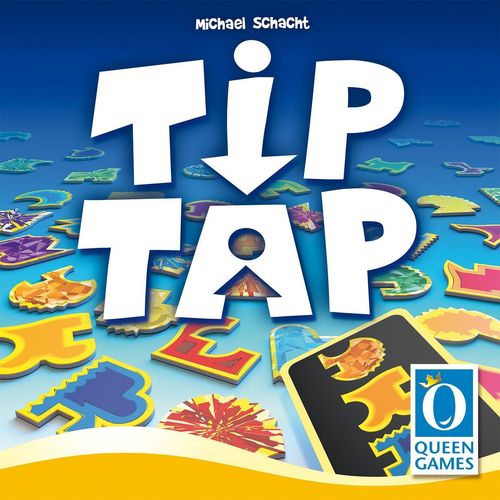
Tip Tap
Tip Tap Rulebook
Table of Contents
Table of Contents
Object of the Game
The players try to find as fast as possible the shapes shown on the cards among the shapes spread on the table, and then tap on the shape with their index finger. This way a player claims that shape, getting nearer to victory. The first player who has claimed 8 shapes is the winner of the game. But beware; claimed shapes may be lost again …
Components
- 45 TipTap-shapes
- 55 cards
- 45 TipTap-frames (used for the variants only)
- 1 rules booklet
Set-up (Basic Game)
- Spread the 45 shapes on the table, colored side up, and in good reach of all players. They may be in wild disorder or neatly arranged in a rectangle.
- Mix all cards, then stack them on the table, dark side up.
- Determine a lead player randomly.
Sequence of Play
Tip Tap is played over a series of game rounds. At the beginning of each game round, all players put their hands under the table, except the lead player. Then, the lead player reveals the top card from the stack, and places it on the table in good view of all players. When revealing the card, the lead player grabs the card at the far side from their point of view, thus they will be the last player to see its front side (colored shapes). Of course, the lead player may flip the card as fast as possible so they don't suffer too big a disadvantage compared to the other players. Finally, the lead player puts both their hands under the table as well.
At once, all players try to find the shapes depicted on the card. If a player thinks they have found the shape among those spread on the table, they pull their hand from under the table and tap the shape with their index finger. The first player to tap a particular shape must leave their finger there in order to claim that shape. No other player is allowed to tap that shape.
Even if a player detects that their finger is on the wrong shape, they are not allowed to remove their finger. If several players try to tap the same shape simultaneously, the first player to actually tap that tile will claim it. The other players must put their hand back under the table before they try to claim another shape with that hand.
Very skilled and fast players may claim two shapes simultaneously, one with each index finger.
Example: The players have to find two shapes. One player mixed up the yellow shape, but has to keep his index finger on that tile. For the rest of this round, he has only one hand to find the shapes.
After all shapes have been spotted or no player has a free index finger, the shapes are dealt to the players. All players who have claimed legal shapes take these and keep them in front of them, visible for all players and still in good reach for everybody!
Example: The green player spotted a wanted shape. If the shapes are dealt to the players, he takes this shape and places it in front of himself (reachable for every other player).
If a card shows a shape that is in front of a player, the players may try to claim that shape by putting their index finger on it sooner than the current owner, if they want to keep it for themself.
Example: The green player spotted the wanted shape from the collected shapes of player red. The red player didn't recognize that and spotted the other shape (from the center).
If all shapes are dealt, the next player in clockwise direction is the new lead player and starts the next game round.
End of the Game and Winner
The game ends at the end of a game round, if at least one player has at least 8 shapes in front of them. The player with the most shapes is the winner of the game. In case of a tie the tied players share the victory.
Variants
The Dark Side
- Changes during set-up: The shapes are spread on the table with their dark side up. The cards are stacked with the colored side up.
- Changes during sequence of play: No changes in sequence of play. The players must try to spot the shapes without seeing the helpful colors.
Framework
- Changes during set-up: Instead of the shapes, the frames are spread on the table with their colored side up. The cards are stacked with the dark side up.
- Changes during sequence of play: No changes in sequence of play. The players must detect the frames matching the shapes shown on the cards.
Dark Frames
- Changes during set-up: The frames are spread on the table with their dark side up. The cards are stacked with the colored side up.
- Changes during sequence of play: No changes in sequence of play. The players must try to spot the frames without seeing the helpful colors.