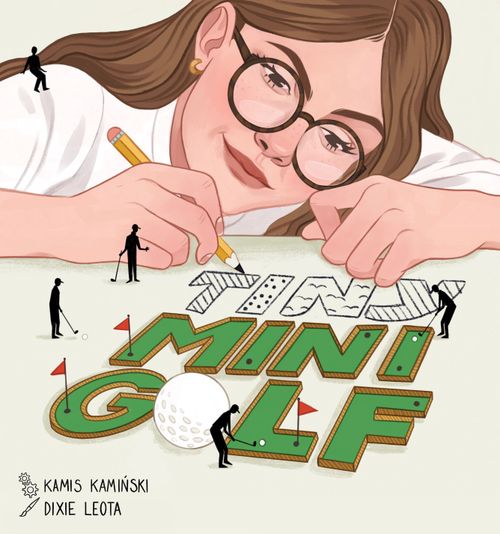
Tiny Mini Golf
Tiny Mini Golf Rulebook
Table of Contents
Table of Contents
Components
- Game sheets
- 6x terrain die (pictures: water, sand, wall)
- 3x power die (light, medium, heavy)
- 1x accuracy die
- Something to write with
Don't feel like making your own dice? Don't despair: just download the Custom Image Dice app and import the dice files provided (download links in the rulebook).
Overview
The game consists of two phases: drawing the course and playing the hole.
In the first part, all players simultaneously draw a course, so that it is as difficult as possible. At the start of the second phase, all players send their creations to the player sitting on their left. That player now tries to beat the hole in as few strokes as possible.
The final scoring may differ slightly depending on the number of players, but always, as is usual in golf, the player with the lowest score wins.
Setup
- Each player takes one game sheet and a pencil.
- All dice are placed in the middle of the table.
- Each player draws anywhere on the plan a goal (a hole with a flag) and a starting position (a circle with a "0" inside). The hole and the start must not be directly adjacent in a perpendicular direction (orthogonally).
Phase 1 - Drawing the Course
The first phase consists of 8 rounds. In each round, all players draw a piece of terrain on the game sheet.
One of the players (it does not matter which) rolls all the terrain dice. The players look at the result of the roll and each chooses one type of terrain (water, sand, wall). Then all players draw the chosen terrain on their sheet. You must draw the terrain over at least one square. The maximum size of the new "object" is as many squares as the number of the chosen terrain type rolled in that round on all dice.
The object being drawn may have any shape, provided that these two conditions are met:
- All terrain squares drawn in this turn together form one continuous object/shape connected by edges, not merely by corners (it does not need to connect to objects from previous rounds).
- After the object (shape) is drawn, at least one possible path remains that connects the starting position and the hole. For a route to be considered "possible", you must be able to connect at least two neighbouring (orthogonally or diagonally) central circles without crossing any piece of terrain. You can read more about this in the description of the second phase.
Walls always have the shape of a square or a triangle. Both options are considered the same type of terrain and so may be drawn continuously, as long as neighbouring squares/walls touch each other with a whole edge/wall. Connection by corners only is not allowed.
Example: the player decided to use all four rolled walls.
Water and sand are drawn gradually as a continuous shape, whose size is limited by the number of the relevant symbols rolled in the current round.
The edge of an object does not reach into the corners of the squares in which it is drawn, see the illustration.
Example: the player decided to use all four rolled water and drew this shape.
Rounds and Repairs
In each round someone rolls all the terrain dice and the players draw their chosen terrain onto their sheets. (Everyone chooses their own terrain, but all may well choose the same.)
In the first five rounds everyone draws on their own sheet. In the sixth round the players send their sheets to the player on their left. In the sixth and seventh rounds the players therefore draw on other players' sheets and try to "repair" the hole so that it is as easy as possible (because they will play this hole in the next phase). In the eighth round each player returns the sheet to its original owner, so that in the last drawing round they can still make things a bit harder for their opponents.
The gear symbols mark the "repair" rounds, where the player helps themselves.
Phase 2 - Playing the Hole
Once the holes are prepared (all 8 rounds have been played), all players send their sheet to the player sitting on their left. Now the players try to beat the hole they received in as few strokes as possible.
The game can be played in three ways: Cheering, Race and Simultaneous play. More information about the individual modes can be found in the section "Game Modes". However, all modes use the same core rules:
Stroke
When making a stroke, the player announces aloud the strength of the stroke and its direction. The player marks the direction on the sheet with a small tick from the current position of the ball to the edge of the square. The direction may only be along perpendicular and diagonal lines.
The announced stroke strength is always a number from 0 to 12. Then the player rolls a power die, choosing its colour according to the stroke strength just chosen:
- LIGHT (GREEN) for stroke strength 0-1
- MEDIUM (YELLOW) for stroke strength 2-3
- HEAVY (RED) for stroke strength 4-12
The player adds the result of the roll to the announced stroke strength and draws a line starting in the marked direction that connects (crosses) as many circles (inside the squares) as the resulting stroke strength.
WARNING: If a circle is covered even by a small piece of a wall, it cannot be used. See the section BOUNCING for details.
The last circle is at the same time the new position of the ball. The player shows this by tracing over the circle with the pencil. In the circle the player writes a number one higher than that in the previous circle (stroke counter).
The dice for strokes are not the same - the stronger the stroke, the less accurate it is.
Bouncing
While a stroke is being drawn, the ball automatically bounces off the walls and the edges of the course. As in the real world, oblique impacts have a bounce at an angle of 90 degrees. If the ball hits perpendicularly (or there is no other option), it bounces straight back.
The bounce itself is never counted as a separate movement. Only the crossing of a circle (that is not covered by a wall) is counted. And yes, this means that several consecutive bounces can be used to get the ball further!
Water
Whenever the ball falls into water, the player simply loses a stroke and continues with the next shot.
"+1" Marking
For each repeated stroke from the same position, the player marks one "+1" icon in the lower part of the record sheet, so as not to have to remember it. The next stroke is then made simply as if the previous failed one had never happened. The player adds the spoiled strokes at the end of the game. (The +1 is most often used when falling into water.)
Sand
If the ball falls into sand, it stops immediately. A shot from sand proceeds identically to the others, only if a MEDIUM or HEAVY stroke is used (that is, the player announces a strength higher than 1), the accuracy die must also be rolled (see below).
WARNING: If you shoot the ball from a square with sand across another square with sand, the ball always stops on the nearest new square with sand, as with any other stroke.
Accuracy Die
The accuracy die represents rare edge cases in mini golf, when it is almost impossible to predict the path of the ball.
There are three types of situations in which this die needs to be used, but each time it is used in the same way: the active player (the shooter) rolls the die, and if the result is HIT, the ball continues in its direction. If the result is MISS, the player who originally designed the hole decides the next direction.
-
CORNER BOUNCES: Every time the ball hits the corner of a wall, the accuracy die must be rolled. The relevant player then decides which circle the ball bounces to - but it must always be the one nearest to the corner.
Example: the player decided to use strength 2, a light stroke. On the power die +1 was rolled, so the resulting stroke strength is 3. The player draws a line of length 1 and then hits the corner of a wall. They roll the accuracy die and the result is HIT, so they may continue as they see fit. If the result had been MISS, the original designer of the hole (the player to the right) would decide; most likely they would choose a bounce back, so the ball would actually end up at the starting position.
-
SHOOTING FROM SAND (with strength two or more): If the player decides to play from sand with strength 2 or more, they must also roll the accuracy die along with the power die (yellow or red). If MISS is rolled, the opponent on the right decides in which of all eight possible directions the ball goes. The rest of the stroke is resolved entirely as standard.
-
OVERSHOOTING (putting): If the stroke is too strong and the ball jumps over the hole (crosses its square), the player must use the accuracy die to resolve the further movement. If MISS is rolled, the opponent on the right decides in which of all eight possible directions the ball continues. The rest of the stroke is resolved entirely as standard. This simulates the ball hitting the flag or sliding along the edge of the hole.
WARNING: When overshooting the hole and/or hitting a wall corner, a case may arise where the accuracy die has to be resolved several times in one turn. In these situations it is rolled again each time and the direction is evaluated completely independently.
Game Modes
Here are described three different ways to play the second phase of the game.
Cheering Mode (default style for 3 or more players)
At the start of the second phase, once everyone has finished their courses and sent them to the player on their left, the least experienced player decides who begins (or decide randomly). The chosen player plays the whole hole from beginning to end. The other players do not play and only watch how the active player struggles with the obstacles and cheer. Only after the hole is completely finished does the next player continue, clockwise. Once all players have got their balls into the holes, the final scoring takes place.
Race Mode (default style for 2 players)
At the start of the second phase, once everyone has finished their courses and sent them to the player on their left, the least experienced player decides who begins (or decide randomly). The chosen player plays exactly one stroke, then the player counter-clockwise (on their right) plays a stroke, and so the game continues until all players have finished their holes (or reached twelve strokes).
Simultaneous Mode (alternative way of playing; faster but less interactive; not recommended for the first game)
At the start of the second phase, once everyone has finished their courses and sent them to the player on their left, all players start playing the holes they received at the same time. The game dice must be shared, and occasionally one has to wait a short while. Whenever a MISS on the accuracy die needs to be resolved, the rolling player simply asks another player to resolve the result = to determine the direction.
This mode is suitable for groups of players who want the game to be less emotional, less interactive and a little faster. It can also be a suitable solution for groups of six or more players.
Final Scoring
The game ends as soon as all players have finished the holes they received. If at any moment a player makes a twelfth stroke, they do not continue any further and the hole automatically counts as 13 strokes.
Now the players can score:
2 players: With two players, each player gets as many points as strokes they played until finishing the hole (after counting the "+1" icons). The lower score wins. In case of a tie, the player who had the longest stroke wins. If the stroke lengths are also equal, the game ends in a draw.
3+ players: Each player gets as many points as strokes they played until finishing the hole (after counting the "+1" icons). Now each player subtracts from their score a bonus for the design of the hole they designed in the first phase: they subtract a number equal to the score of the player sitting on their left (the person for whom they designed the hole). This can lead even to a negative result.
These symbols can be ignored in a two-player game, since the design bonus is not counted.
After the adjustment of scores, the player who reaches the lowest score wins. In case of a tie in points, the player with the better base (shooting) score wins. If there is again a tie, the player who had the longest stroke wins. In case of a further tie, the game ends in an overall draw.