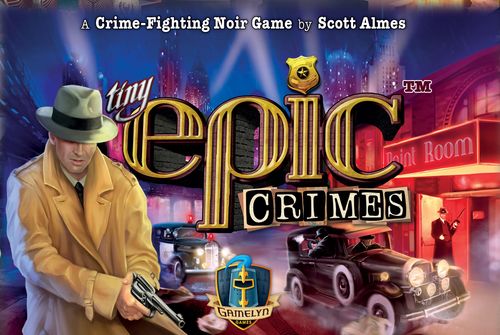
Tiny Epic Crimes
Tiny Epic Crimes Rulebook
Table of Contents
Table of Contents
- Components
- Game Objective
- Choose Your Game Mode
- Standard Game Setup
- Gameplay Overview
- Solve Evidence
- On Your Turn
- Step 1: Drive (optional)
- Step 2: Perform 1 Action (mandatory)
- Action: Arrest (Daytime or Nighttime)
- Action: Coffee Break (Daytime or Nighttime)
- Action: Call for Backup (Daytime)
- Action: Catch Informant (Daytime)
- Action: Catch Witness (Nighttime)
- Action: Search Scene (Daytime)
- Action: Stakeout (Nighttime)
- Action: Bring in for Holding (Nighttime)
- Action: Rest Your Case (during Hours 43-48)
- Game End: The Accusation
- 2-Player Game Variant
- Cooperative Game Mode
- Cooperative: Game Setup Changes
- Cooperative: Gameplay
- Cooperative: Arresting Mobsters
- Cooperative: Gaining Suspects' Alibis
- Cooperative: Too-Many-Events Penalty
- Cooperative: Out-of-Time Marker
- Cooperative: Force Cards
- Cooperative: Solving Evidence
- New Officer Ability: Leg Work
- Cooperative: The Accusation
- Solo Game Mode
- Quick Reference
Components
1 HQ Card, 16 Suspect Cards, 24 City Block Cards, 12 Force Cards, 8 Ability Cards, 18 Event Cards, 4 Officer Mats, 1 Murderer Envelope, 5 Evidence Envelopes, 1 Magnifying Glass, 2 Bullet Dice, 10 Die Tokens, 20 Event Tokens, 5 Evidence Tokens, 25 Clue Tokens (Informant, Witness, Search, Stakeout, Holding), 15 Mobsters (Blue Bee, Red Rhino, Gray Gangster), 4 Cars, 4 Time Trackers, 4 Badges, 1 Bag, 2 Time Mats, 4 Player Aids (Front/Back).
Game Objective
Players are officers of the law, working to crack a murder case and thwart mobster activity in the city. The game is won if the murderer is correctly identified once time runs out. Each player only gets one guess, so cracking the case may require some cooperation, such as collecting evidence or "sharing" suspects' alibis—but don't give up too much information. The right balance of secrecy and helping others is needed to win the game! There are three exciting game modes to choose from, each with different game setups, rules, and objectives.
Choose Your Game Mode
Standard Game Mode ("Competitive," see next page): In Standard Mode, players are Detectives, each looking out for themselves. All Detectives can perform any action, so long as it is the right time of day. However, keep as much knowledge secret as you can, as there is only one winner—the player that correctly identifies the murderer and has the highest rank. However, if the case goes unsolved when time runs out and the murderer goes free, all players have let the department down and lose the game.
Cooperative Game Mode (see pg 18-19): In Cooperative Mode, players work as a team, with the challenge of performing different roles in the police force: Sheriff, Detective, Analyst, and Patrol Cop. Throw all secrecy out the window, as you and your fellow officers share Suspect Cards, tackle the case together, and stake all of your careers on a single accusation.
Solo Game Mode (see pg 19): It's a lonely job holding this city together, but someone's got to do it!
Standard Game Setup
- Place the HQ Card (labeled "HQ") in the center of the table.
- Shuffle the 24 City Block Cards, placing them randomly face-up to form a 5x5 grid with HQ in the center. This is called the "city" and each individual card is called a "block."
- Place the 10 Die Tokens next to each block on 2 of the city's sides, in numerical order:
- 3A. Top: 5 White Dice (1-5).
- 3B. Left: 5 Black Dice (1-5).
- Place the 5 Informant Tokens, one next to each Black Die Token.
- Place the 5 Witness Tokens, one next to each White Die Token.
- Shuffle the 7 Search Tokens face-down and place them on the 7 blocks that show a Search icon.
- Shuffle the 5 Stakeout Tokens face-down and place them on the 5 blocks that show a Stakeout icon.
- Place the 3 Holding Tokens on the 3 Holding icons on the HQ.
- Set up the Time Track: Arrange the 2 Time Mats next to each other, each "Standard-side" up (listed in the upper left) to form a track.
- Place the 5 Evidence Tokens nearby in reach of all players.
- Place the 2 Bullet Dice nearby in reach of all players.
- Fill the Bag with all of the mobsters. Shake, and then one-at-a-time pull 3 to place in the city: Roll both dice to determine the block where that mobster is placed (see Mobster Roll, pg 16). If a "6" or "3-3" is rolled, or if there already is a mobster there, then reroll. Repeat this until all 3 mobsters are in the city.
- Give each player an Officer Mat (flipped to the "Standard" side), a Player Aid, and a matching color Time Tracker, Car, and Badge.
- 13A. The Player Aid can be flipped to either side throughout the game to best read the information.
A Note on Taking Notes
This game does not provide tools to take notes with, so you have to rely on your memory to keep track of solved evidence and suspects' alibis. However, if players would like to keep notes, you can each use paper and pen/pencil to secretly do so. You are never required to share these notes with another player.
We recommend having the 5 evidence shapes at the top that you can fill in for tracking evidence and the letters "A" through "P" for crossing out names of suspects who you learn are not the murderer.
Gameplay Overview
Instead of taking turns clockwise, the officer who gets the next turn is determined by players' Time Tracker position on the Time Track. The player with the tracker furthest behind (closest to "1") takes the next turn. If multiple trackers are on the same spot, the player whose tracker is on top takes the turn. Your turn has the following steps:
- Drive* (optional), see pg 11
- Perform 1 Action* (mandatory), see pg 11-14
- Draw an Event (conditional), see pg 15-16
- Mobster Roll (mandatory), see pg 16
*During Steps 1 and 2 (driving and performing an action) you must spend time measured in hours. After Step 2, advance your tracker one space for each hour that you spent.
Crack the Case
The overall goal of the game is to correctly identify the murderer—the Suspect Card in the Murderer Envelope. There are two paths that lead you to discovering the murderer: Gaining Suspects' Alibis (see below) and Solving Evidence (see next page).
Gain Suspects' Alibis
Suspect Cards in the Suspect Deck are innocent of the murder, since they each have an alibi, and you'll have opportunities throughout the game to collect alibis. You can do this in two ways:
- Draw the top Suspect Card from the deck (if there are no cards in the deck, you must do #2).
- Look at a Suspect Card from another player: they hold their cards in their hand, backs facing you, and you pick one to look at. Use the Magnifying Glass to reveal the name in the card's center; do not read the name aloud to other players! Keep your own collected Suspect Cards face-down in front of you, secret from other players. You may reference your own cards using the Magnifying Glass at any time.
Solve Evidence
On the Murderer's Card there are 5 different types of evidence that, taken together, identifies them (hidden by the Tiny Epic Decoder System).
- GANG: Red Rhinos or Blue Bees
- RANK: Boss or Underboss
- FORENSICS: Fingerprints or Shoeprints
- GETAWAY: Car or Motorcycle
- WEAPON: Gun or Knife
The murderer above, Aaron Ace, is a Blue Bee at the rank of Boss, who left Fingerprints at the crime scene, fled on a Motorcycle, and used a Gun for the murder.
Collect Clues
Perform specific actions to collect Clue Tokens (placing them on your Officer Mat), and when enough tokens of an evidence's type has been collected by all of the players combined, then it is solved.
For example, when players perform Catch Informant 5 times and have collected 5 Informant Tokens, the Rank Evidence is solved.
Process Evidence
The player that collected the final Clue Token:
- Takes the matching Evidence Token and places it on their Officer Mat. This marks that they hold the Evidence.
- Then they take the matching Evidence Envelope, and peek at the Solved Evidence: Carefully remove the Murderer's Card from its envelope, without revealing its back side.
- A. Slide it into the Evidence Envelope so that the white arrow on it is still visible through the opening.
- B. Flip the envelope to secretly reveal the Evidence's icon through the window. For instance, this murderer's Rank is revealed to be "Boss."
- Once done peeking, flip the envelope again and carefully remove the card without revealing it. Slide it back into the Murderer Envelope, so the arrow is again visible.
Players with Clues
All players who contributed to Solving Evidence—that is have at least one Clue Token of that type—gain 1 Suspect Card (only 1, no matter how many tokens they have collected).
Peek at Solved Evidence
Only the holder of an Evidence Token may review that Evidence at any time. However, all other players might be able to peek at Evidence as a reward for resolving Events. When you resolve an Event, the "Peek at 1 Solved Evidence" icon listed in your reward means you may exchange information with a player who has an Evidence Token. You look at the Murderer's card in the Evidence envelope that the player has, while that player randomly selects and looks at one of your Suspect Cards. You must have at least one suspect to do this, and it may be one that the other player has already seen. Whether or not to do this, and which envelope to look at (if the other player has more than one token), is your choice; the evidence's holder cannot refuse it. Take care to not reveal any other information to yourself or the other players.
Cooperative Mode: All Evidence knowledge is shared between players. Ignore the reward for all Event rewards.
Advance 1 Badge Level
When you collect any type of Clue Token (Informant, Witness, Search, Stakeout, or Holding), or when an Event rewards you by increasing your Badge Level by 1, advance your Badge 1 space on its track on your Officer Mat. If it lands on a space with an icon, then immediately gain that bonus:
- Gain a Suspect Card
- Interrogate, see pg 14
- Evidence holder picks 1
If your Rank ever exceeds "9," then flip the badge to its "10+" side and place it back on the large badge image.
On Your Turn
When your Time Tracker is the furthest behind on the Time Track, it is your turn. Follow these four steps:
Step 1: Drive (optional)
You may move your car as many adjacent blocks as you wish around the city. Movement must be orthogonal (not diagonal). Each block moved costs 1 hour, and after performing an action in Step 2 you will advance your Time Tracker that number of spaces (see below).
For example, moving 3 blocks costs 3 hours.
If you wish, you may remain in the same block without moving, and you spend zero hours.
Step 2: Perform 1 Action (mandatory)
Next, you must perform one action on your turn, which costs a specific amount of hours (all listed on the Player Aid). After completing your action, advance your Time Tracker that many spaces on the track, plus the hours for blocks moved in Step 1: Drive. If you end up at a space that has another player's Tracker, place yours at the top of the stack.
Action: Arrest (Daytime or Nighttime)
If on the same block as a mobster, spend 1 hour to Arrest them.
- A. Remove the mobster's token from its city block and place it on the open space to the right side of your Officer Mat that matches that mobster's color.
In the example on the right, you spend 1 hour to use this action to Arrest this Blue Bee mobster. It is placed on the matching color spot on your mat. If you already have a mobster of the same color on your mat, you instead return it to the bag.
- B. Once all 3 spots (Blue Bee, Red Rhino, and Gray Gangster) have been filled, you advance 1 Badge Level and return all 3 mobsters to the bag.
Note: "Arrest" (the Arrest action) is a specific action (see above), while "apprehend" means picking up one or more mobsters, whether by Arrest, Bring in for Holding, Call for Backup, or any similar action. When you apprehend a mobster, return it to the bag unless the action description gives instructions otherwise.
Action: Coffee Break (Daytime or Nighttime)
Spend 1 hour to take no action on your turn, effectively doing nothing. Although rare, this action can be useful for certain circumstances.
Action: Call for Backup (Daytime)
If the block you are on and/or adjacent blocks have mobsters, you can "risk" time to apprehend them all. Declare to the other players how many hours to spend: choose from 1 to 6. Then, roll one die:
- The die result is less than or equal to the number of hours risked: it is a success! You apprehend all mobsters from your block and adjacent blocks, returning them to the bag, and then gain a Force Card.
- The die result was more: you fail. You apprehend a mobster on your block (if there is one), but not any adjacent mobsters, and do not gain a Force Card.
In the example above, you risk 4 hours to Call for Backup. You roll a 3: Success! Remove all 4 mobsters and gain a Force Card.
Note: Succeed or fail, advance your Time Tracker the hours you risked.
Action: Catch Informant (Daytime)
If on the same block as a mobster, and there is an Informant Token in the row of blocks you are on, spend 2 hours to apprehend the mobster AND collect the token. Return the mobster to the bag, place the token on your Officer Mat, and advance 1 Badge Level.
Action: Catch Witness (Nighttime)
If on the same block as a mobster, and there is a Witness Token in the column of blocks you are on, spend 2 hours to apprehend the mobster AND collect the token. Return the mobster to the bag, place the token on your Officer Mat, and advance 1 Badge Level.
Action: Search Scene (Daytime)
If on the same block as a Search Token, spend 2 hours and flip the token to reveal the result:
- Success! Place it on your Officer Mat, success-side up.
- Failure. Place it on your Officer Mat, failure-side up.
Whether succeed or fail, advance 1 Badge Level.
Note: Only 3 are needed to solve Forensics. Once 3 are revealed, discard all remaining from the city.
Action: Stakeout (Nighttime)
If on the same block as a Stakeout Token, you may declare 1 to 5 hours that you wish to risk, and then secretly reveal the token to yourself:
- The token's number is less than or equal to your hours risked: it is a success! Show it to the other players, and then place the token on your Officer Mat. Advance 1 Badge Level.
- The token's number is more: it is a failure. Return the token face-down to the block, and do not tell the other players the number. You do not advance on your Badge Level.
In the example above, you risk 2 hours on a Stakeout. You peek at it and reveal a "1" so it is a success! Reveal the number to everyone else.
Note: Only 3 are needed to solve Getaway. Once 3 are revealed, discard all remaining from the city.
Action: Bring in for Holding (Nighttime)
This is a 2-step action that takes two turns, each during nighttime, to complete (you cannot complete this action's second turn if it has turned to day; you must wait to finish this action until it is nighttime again).
- If on the same block as a mobster, spend 2 hours to apprehend the mobster, placing it on the Holding Spot on your Officer Mat (not on the 3 slots on the right side). You cannot have more than 1 mobster on the Holding Spot at a time.
- On a later nighttime turn while at HQ, you may spend 2 hours to return that mobster to the bag. Place the Holding Token from the HQ Card that matches the mobster's color (Blue Bee, Red Rhino, or Gray Gangster) on your Officer Mat. Advance 1 Badge Level. If the mobster's color of Holding Token has already been taken, gain 1 Force Card instead, but do not advance on the Badge Level.
In the example above, you spend 2 hours to apprehend a mobster and place them on the Holding spot on your mat. Then as a subsequent nighttime action when you are at HQ, spend another 2 hours to return that mobster to the bag and then collect the matching color's Holding Token.
Note: Only 3 are needed to solve Weapon. Once solved, players may still Bring in mobsters, but they instead gain a Force Card as a reward (it still costs 4 hours total).
Action: Rest Your Case (during Hours 43-48)
This is the final action you take. When you end your turn and your Time Tracker is on a "red space" (hours 43-48 on the track) then you may choose to end your game. Indicate this by laying your car on its side. You do not take any further turns, but other players continue to play and you still participate in their information exchanges, gain rewards from Events you contributed to, etc. Once all players have laid their cars down, it is time for everyone to make their accusations against who they think the murderer is (see Game End: The Accusation, pg 17).
Note: Your tracker cannot go beyond the 48-hour mark of the Time Track. If your action would cause your token to go past that mark, you must choose another action.
Bonus Action: Interrogate
As a bonus for advancing your badge onto some spaces on your Badge Level Track, you may immediately interrogate another player's Suspects: Choose another player, who holds all of their Suspect Cards in a hand in front of you showing only their card backs. Pick one card at random to look at by using the Magnifying Glass. Afterward, return the card to its owner. If it is a card you have already seen, you do not get to pick another.
Action: Resolve Event
Along with cracking the case, officers have a duty to serve Echo Ridge. Up to 3 Events can be active at one time, and each has a unique setup, a negative effect, and a requirement for resolving it. Typically, Events require you to perform an action or move to a specific block on your turn. When you resolve an Event:
- Gain the reward listed on the bottom of the card. The reward for the player that resolves the Event ("Only player that resolves") is listed. If "Any other player that contributed" is included on the card, then any other player that contributed an action or is on a block necessary to resolve the Event also gets a reward. Be honest about your contribution to resolving the Event.
- Discard the Event's card and any tokens it required. If mobsters were placed on the card, return them to the bag.
Limited Rewards: If there is not enough of a reward for each recipient, players select in Time Track order, furthest back first.
Event Reward Icons: Gain a Suspect Card, Gain a Force Card, Advance 1 Badge Level, Peek at 1 Solved Evidence.
Step 3: Draw an Event (conditional)
After Steps 1 and 2, your Time Tracker advances for your hours spent. If your tracker is the first of all players to pass a red Event Line on the track, then a new Event is drawn. First, note if there is an open Event Slot under the Time Track (there are 3 slots): If a slot is open, draw and reveal the top Event of the deck, read it aloud, and place it face-up into the lowest-number open slot. Then follow the steps to set up the Event. If instructed, roll to add mobsters or tokens:
- Reroll any "6's" (there is no reprieve like for Mobster Rolls).
- If a roll would place a mobster into a block with another mobster, reroll to place it into another block until the mobster gets placed. Do not then draw an additional Event like for a Mobster Roll.
- If you roll a double, do not then add an additional mobster like for a Mobster Roll (see next page).
- Tokens and mobsters can never be placed on HQ unless the Event setup specifies it (reroll if the HQ is the location).
If there are no open slots, then chaos grips the city! Take the Too-Many-Events Penalty (see next page).
If a Timed Event (one with a clock icon) is revealed when at least one Officer's tracker is on hours 39-48 of the Time Track (spaces marked with an icon) then discard that Event and draw a new one.
Time of Day
Certain actions (listed on your Officer Mat) can only be performed during either the daytime or the nighttime, for which spaces are marked on the Time Track. In order to perform a daytime action, your tracker must be on a daytime space at the start of your turn; likewise for nighttime actions.
Drive, Arrest, and Coffee Breaks can be performed at any time, as long as it's your turn.
Officer Abilities
Each player has a unique Ability Card that gives an additional benefit. Your card details your effect and when it can be used.
Force Cards
Each has a powerful effect for an officer. When one is used, place it into a face-up discard pile next to the draw deck. If the draw deck is ever empty, shuffle the discards to form a new deck.
Note: You can hold a maximum of 2 Force Cards. If you gain a third, you must discard that new card or one from your hand.
Too-Many-Events Penalty
If there are already 3 Events active, and a fourth Event would be drawn, instead discard the top Suspect Card from the game without revealing it. If no Suspect Cards remain in the deck, advance each player's Time Tracker 1 on the Time Track (but not one that is on the 48-hour mark).
Step 4: Mobster Roll (mandatory)
The final step of your turn is to perform a Mobster Roll.
Roll both dice: the black and white die results determine the column-row coordinates (using the Die Tokens) of the block where a new mobster is placed. For example in the image on the right, black-2 and white-4 would be this block.
- If that block does not have a mobster: Pull a mobster from the bag and place it into that block.
- If that block already has a mobster: Do not pull a mobster, but instead draw a new Event Card. If there are already 3 active Events, then take a Too-Many-Events Penalty (see top of this page).
- Reprieve: If a "6" die or a "3-3" (the HQ's block) is rolled, do not add a mobster and continue to the next turn.
- Crime Spree: If double 1's, 2's, 4's or 5's are rolled, apply the results of the roll, and then perform another Mobster Roll (double 3's and 6's do not trigger a Crime Spree). Multiple Crime Sprees can occur.
- There can only ever be one unapprehended mobster on any block at a time. Effects from Force and Event Cards cannot overrule this.
- If at any point in the game you must pull a new mobster and there are none left in the bag, then apply a Too-Many-Events Penalty (see top of this page).
Next Turn
After completing all the steps on your turn, then it is the turn of the player whose Time Tracker is furthest back on the track (the lowest hour). If there are multiple players on that space, the topmost tracker's player takes the next turn.
Game End: The Accusation
Once all players' Time Trackers are in the final 43-48 spaces on the track, and they have ended their game, it is time for all players to accuse a suspect and reveal the Murderer. Flip your Player Aid to the suspect side and take your Car from the city. Then using your hand to shield your accusation from other players, place your Car on the suspect you believe to be the Murderer. Once all players are ready, simultaneously reveal your accusations. The Murderer's card is then removed from its envelope and revealed using the Magnifying Glass. If only one player accused the correct suspect, that player is the winner! If multiple players accused the correct suspect, among the tied players:
- The tied player with the highest Badge Level wins. If there is still a tie, eliminate the untied players at each step:
- Player with the most time remaining (fewest hours spent) wins.
- Player with the most Evidence Tokens wins.
- If any players are still tied, they share the victory.
If no one accused the correct suspect, all players lose.
2-Player Game Variant
For both Standard and Cooperative Modes:
- Place only 3 Informant Tokens next to Black Die Tokens 1, 3, and 5.
- Place only 3 Witness Tokens next to White Die Tokens 2, 3, and 4.
In this game, only 3 Informant Tokens are needed to solve Rank, and only 3 Witness Tokens are needed to solve Gang (noted on the envelopes). Return unused tokens to the box after setup.
For Standard Gameplay: At the start of the game, deal 4 face-down Suspect Cards to a separate pile between both players with an unused Car Token on top. This marks it as the alibis for a "ghost officer." When Interrogating, you may shuffle these cards, and draw one to peek at instead of choosing from the other player's cards, returning the card face-down to the pile when done.
Cooperative Game Mode
Instead of the high-stakes drama of Standard Mode, the game can be fully cooperative, where all Solved Evidence and Suspects' Alibis are shared by all players, and collectively one accusation is made!
Cooperative: Game Setup Changes
- Flip to the "Cooperative" sides of the Officer Mats, noting the player counts listed in the upper-left corners:
- 2 players: use Detective and Patrol Cop
- 3 players: use Detective, Patrol Cop, and Analyst
- 4 players: use all four officers.
- Flip to the "Cooperative sides" of the Time Track Mats.
- Before adding mobsters to the bag, remove mobsters from the game, leaving them in the box. The amount removed is based on the player count:
- 2 players: remove 1 Gray Gangster
- 3 players: remove 1 of each color
- 4 players: remove 2 of each color
- Taking from the removed mobsters, place 1 Gray Gangster in the open area directly next to the 48-hour mark on the Time Track. This is the Out-of-Time Marker.
Cooperative: Gameplay
Each role has access to a limited number of actions, listed on each Officer Mat. For example, the Patrol Cop can only Catch Informant, Stakeout, and Bring in for Holding. All officers can Drive, Arrest, Call for Backup, and Coffee Break. Actions are no longer restricted by day or night.
Cooperative: Arresting Mobsters
Officer Mats do not have spots on the right side where mobsters are placed when arrested. Instead, mobsters are returned right to the bag.
Cooperative: Gaining Suspects' Alibis
Whenever Suspect Cards are gained, they are placed face-up for all players to see and the suspect's name is read aloud.
Cooperative: Too-Many-Events Penalty
When a fourth Event Card is to be played, or if there are not enough mobsters in the bag to add to the city, instead of discarding a Suspect Card from the deck you move the Gray Gangster mobster backward 1 space on the Time Track.
Cooperative: Out-of-Time Marker
The Gray Criminal on the Time Track marks the track's end. Treat the mobster's space as the final hour.
Cooperative: Force Cards
- In a 3- or 4-player game: Force Cards are treated the same as Standard Mode. However, players can publicly share what cards they have.
- In a 2-player game: Players combine their Force Cards in a shared pool of up to 4 cards, and both players have access to any available card.
Cooperative: Solving Evidence
Whenever any Evidence is solved, players do not gain a Suspect Card for having Clue Tokens—the knowledge is instead shared.
New Officer Ability: Leg Work
When playing as the Detective or the Analyst (listed on their mats), whenever you would gain a Force Card, you instead may spend 3 hours to gain a Suspect Card (do not draw the Force Card).
Cooperative: The Accusation
Players now win or lose the game together as a team. Once all players' Cars are lying on their sides, it is time to make one collective accusation. A single suspect is chosen by the team, and the Murderer is then revealed: if correct, all players win! If incorrect, then all players lose.
Solo Game Mode
Set up a 2-player, Cooperative game. All rules for a 2-player Cooperative game apply, and you track each officer's actions and components individually. For an added challenge, you can set up a 3- or a 4-player game, playing with even more officers. Good Luck, Officer!
Time to call in the Patrol Squad, an elite task force trained to topple nefarious Kingpins. A new breed of well-funded criminal is loose in the streets. Can you truly trust your fellow officers to meet duty's call?
Quick Reference
Turn steps: Step 1: Drive (optional). Step 2: Perform 1 Action (mandatory). Step 3: Draw an Event (conditional). Step 4: Mobster Roll (mandatory).
At the start of your turn, move your car, spend 1 hour per block.
- Drive: move, 1 hour per block.
- Arrest: 1 hour. You apprehend a mobster on your block.
- Coffee Break: 1 hour. Do nothing as your action.
- Catch Informant: 2 hours. You apprehend a mobster and collect the Informant Token from that row.
- Catch Witness: 2 hours. You apprehend a mobster and collect the Witness Token from that column.
- Search Scene: Risk 1-5. You peek at a Search Token: succeed if the number is less than or equal to your risked hours.
- Stakeout: 2 hours. You flip a Search Token: succeed or fail.
- Bring in for Holding: 2 hours. You apprehend a mobster, placing it on your mat's Holding slot (limit 1). Then: 2 hours. While at HQ, return the mobster to the bag and collect the Holding Token of its color.
- Call for Backup: Risk 1-6. Roll less than or equal to apprehend mobsters from your block and each adjacent block to the bag, then gain a Force Card. Roll more: only apprehend mobster on your block.
Resolved Event Rewards: Only player that resolves / Any other player that contributed — Gain a Suspect Card, Gain a Force Card, Advance 1 Badge Level, Peek at 1 Solved Evidence.
Clue Tokens/Evidence: Informant (GANG), Search Scene (FORENSICS), Witness (RANK), Stakeout (GETAWAY), Holding (WEAPON).
Hour - Time spent. Move your Time Tracker forward.
Daytime/Nighttime - Actions can only be performed when your tracker starts there.
Evidence types:
- GANG: Red Rhinos or Blue Bees
- RANK: Boss or Underboss
- FORENSICS: Fingerprints or Shoeprints
- GETAWAY: Car or Motorcycle
- WEAPON: Gun or Knife
If your tracker was the first to pass an icon, draw an Event Card. Roll dice to add a new mobster to the city.