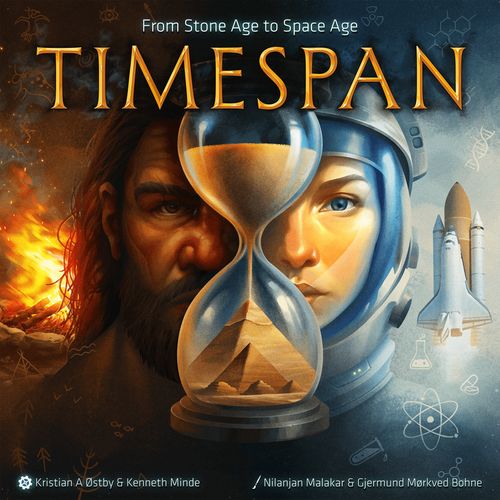
Timespan
Timespan Rulebook
Table of Contents
Table of Contents
Setup
- Place the game board in the middle of the table.
- Separate the 144 history cards by age (I, II, III and IV). Shuffle them separately and place each deck in its matching deck holder.
- Shuffle the 16 wonder cards and the 12 vision cards separately and place them in two face-down decks.
- Draw two wonder cards and place them face-up in the two slots in the middle of the game board. These are the two neutral wonders.
- Place the hourglass on the first space on the time track.
- Sort the 56 discovery tiles by age (I, II and III). Shuffle each stack separately and place them in three face-down stacks near the game board.
- Sort the 108 luxury tiles and place them next to the game board as a common supply.
- Place the 24 gear tokens and the 36 workers in two piles.
- Sort the 21 upgrade tiles and place them next to the game board.
If you have limited space, you can use the smaller game board printed on the back of the board. The two neutral wonders must then be placed next to the game board.
Individual setup for each player
Take 4 player markers in your player color: Place one disc in the start space of each of the point track, the culture track and the science track. Place the last disc on space 1 of the peace track.
Take one of the 6 civilization boards and one of the 6 technology boards (either choose, or draw one randomly). Return any remaining boards to the game box. Place your technology board above your civilization board.
Place one storage board to the right of your civilization board.
Take 8 storage cubes. Place one cube on each of the starting resources shown in the top left section on your civilization board and place the remaining cubes in the storage room at the bottom of your storage board.
- The Chinese civilization also starts with one random card drawn from the Age I stack. Take the card into your hand.
- The Vikings civilization starts with one movement on the ship track: Place your ship on the first space (do not take any reward for this movement).
Take 1 ship, 1 balloon, 1 spaceship, 1 camel in your chosen player color. Place them in front of your storage board.
Place 3 starting cards (starting cards are marked "S" on the back side) in your timeline: Place the "Shaman", the "Fire" and the "Wheel" face-up on the corresponding spaces (marked "S" for Shaman, "F" for Fire and "W" for Wheel).
Take 3 workers and place them in the ready area (top left section) on your civilization board.
Draw 2 wonder cards and 2 vision cards: Choose one wonder card and one vision card to keep in your hand. Return the other cards to the bottom of their respective decks. Keep cards in your hand hidden from other players.
In your first game (and when playing with new players), it is fine to just deal each player a single random wonder card and to place a single random vision card between each pair of players.
When all players have chosen cards, all players simultaneously reveal their chosen vision card and place it face-up to the left of their civilization board, between themselves and their left-hand neighbor. This way all players will have two vision cards that they can try to fulfill during the game: one card to their left and one card to their right (chosen by their right-hand neighbor).
Changes to solo games are described in the Solo Rules section below.
Each of your workers has a happy side and a sad side. This has absolutely no effect on gameplay but serves as a reminder that people are complex and beautiful.
How to Play
The game is played over three ages, each consisting of several alternating phases: Income, Discovery and Action. The position of the hourglass on the time track shows the current age and phase.
In each discovery phase players take turns in player order, while in income and action phases all players act simultaneously. When all players have completed a phase, advance the hourglass to the next space on the time track.
Ages: The number above the hourglass indicates the current age. When an effect in the game tells you to gain a history card or discovery tile from the current age, it refers to this number. If an effect tells you to gain a card from the future age, it means you must take the card from the next age. At the beginning of the game, the current age is Age I, while the future age is Age II. Cards from Age IV can only be gained through certain effects or as future cards during Age III.
Income Phase
There is no income phase at the beginning of the game; you start with the discovery phase.
All players simultaneously gain all visible income effects shown in their play area (income printed on their civilization board, on cards in their timeline, on luxury tiles in their graveyard, and on activated technologies).
Players then adjust the position of their marker on the peace track: count all visible peace symbols in your play area (peace is mainly gained from played wonders, history cards in your timeline and some luxury tiles in your graveyard). Place your marker on the space matching this number on the peace track. Then score 1 point for each peace symbol (you never score less than 0 or more than 10).
Note: Peace is not accumulated like the other tracks. Instead, count the number of peace symbols you currently have and place your marker on that number. The peace counter is capped at 10, and all peace above 10 is ignored.
Important: You only gain income and peace from symbols already visible at the beginning of the income phase. E.g. if an effect allows you to play a card during the income phase, do not count income or peace symbols on that card.
Peace is recalculated at the beginning of each income phase for scoring and determining the player order. During the game, whenever an action refers to your peace, recount the number of visible symbols in your play area at that moment (maximum 10).
Player Order
The players' order on the peace track is recalculated each income phase and dictates the player order during the following discovery phase.
Players take their turns in order from highest to lowest peace. If two or more players are tied (or if they both have more than 10 peace), their order is determined by the numbers shown in the top left corner of their civilization boards — lowest numbers going first.
Note: In the very first discovery phase, all players have 1 peace, and the play order is fully determined by the numbers on the civilization boards. When players are tied, you can stack their markers on the peace track in order of the number on their civilization boards (lowest number on top) to clearly show the player order.
Discovery Phase
Place a number of offers next to the game board, using cards and discovery tiles from the current age (this will be from Age I at the beginning of the game). There should be one more offer than the number of players. (With 4 players, place 5 offers.)
Each offer consists of 1 face-down history card, 1 face-up history card and 1 face-up discovery tile. The card type symbol on the back side of face-down cards should be visible.
In player order, each player picks one of these offers. Take the two cards into your hand and immediately gain the reward shown on the discovery tile. Then return the discovery tile to the bottom of its stack. When all players have taken an offer, discard the remaining unchosen offer (return its cards/tile to the bottom of the corresponding deck/stack).
Some discovery tiles in Age III have a clock symbol. These tiles do not have to be activated right away; you may instead keep them for later use.
Action Phase
The action phase begins with a camel movement, followed by worker activation.
All players play simultaneously, but no one should begin their worker activation until everyone has moved their camel.
If this is your first game or you're playing with new players, take turns activating workers one by one in player order — this helps everyone get a feel for how the game works.
Camel movement
Each player moves their camel once.
You can either move your camel to one of the two neutral wonders or the marketplace (on the gameboard), or to any wonder built by another player (not possible at the beginning of the game). You can never move your camel to one of your own wonders.
You must always move your camel to a different location than where it is currently located (you can never visit the same wonder twice in a row). Multiple camels may visit the same wonder.
If you visit one of the neutral wonders, you must pay 1 coin (as shown on the game board).
If you visit a wonder belonging to another player, that player gains 2 victory points (as indicated on top of the wonder card).
Immediately gain the effect shown in the action box of the chosen wonder/marketplace.
Example: Elizabeth moves her camel to visit the Pyramids and activates its effect. As the Pyramids belongs to Winston, he gains 2 victory points. The next time Elizabeth moves her camel, she must move it to a different wonder (or the marketplace).
Marketplace: The marketplace works as a neutral wonder, but it is free to visit. When visiting you must choose to gain one of the three options: 1 coin and 1 fur luxury tile; 1 point and 1 pottery luxury tile; or 1 silk luxury tile.
Worker activation
Before worker activation, all players retrieve their workers (from cards, action boxes and the sleeping area), placing them in the ready area (top left section) of their civilization board.
During worker activation, you may perform the following actions as often as you like, in any order you prefer. All players play simultaneously.
- Play a card — Pay the required resources to play a card from your hand.
- Activate an action box — Place an available worker from your ready area onto an action box on your civilization board, on one of the cards in your timeline, or on one of your own built wonders. Only one worker can be placed on each action box.
At any time during the game, during any phase, you may also carry out these four support actions: discard cards, deliver or discard luxury tiles, and convert resources (see Resources and Luxury Tiles). A reminder of this is shown on your storage board.
Play a card: To play a card from your hand, pay the resources shown in the card's top left corner. If you play a history card, place it into the leftmost space on your timeline. All other cards in your timeline are pushed one space to the right. A card in the rightmost space will be pushed to your graveyard. If you play a wonder card, place it face-up above your storage board. It will remain here until the end of the game. You can activate your own wonders with your workers, and other players may visit it with their camels.
If the card had a worker on it, the worker is placed in the sleeping area on your storage board. It remains here until the next action phase.
Timeline: Each civilization board has four spaces for cards. These spaces represent your current "timeline." When you play a new card, it is placed in the leftmost space of your timeline, pushing other cards in your timeline to the right.
Activate an action box: There are action boxes on your played cards (history cards and wonders) and on your civilization board. Activate an action box by placing one of your unused workers on it and gain the rewards shown. You can only place one worker on each action box.
If you activate the action box of a card that has any luxury tiles on it, you also gain the reward shown in the lower-right corner of the luxury tile(s). All effects are optional, and you can take the rewards in any order you want.
Example: By activating the Fire card, you gain one wood resource. Because the card has a luxury tile on it (fur), you also gain the tile's reward (2 coins).
Graveyard: When a card is pushed out of the rightmost space in your timeline, it is flipped face-down and placed in your graveyard (on your storage board). Cards in your graveyard do not provide income and cannot be activated, but they are worth points at the end of the game.
If the card had any Luxury tiles on it, the luxury tile(s) is flipped over and placed in the top section of your storage board. The tile will generate income in future income phases.
End of action phase: When all players have completed their worker activations, advance the hourglass to the next phase.
- End of Age I: At the end of the second action phase (when Age II begins), each player takes a balloon/space upgrade tile and places it on their ship action box, with the balloon side facing up.
- End of Age II: At the end of the fourth action phase (when Age III begins) each player must flip this upgrade tile to its spaceship side.
Game Ends
After the fifth action phase, the game ends, and all players conduct the final scoring:
- Update the peace track and score 1 point for each visible peace symbol in your play area (maximum 10).
- Gain income from all your income symbols. However, each income that would normally advance you on a track (culture, science, ship or balloon) provides 1 victory point instead.
- Score 2 points per gold in your storage (you may discard remaining cards and luxury tiles, and convert resources as normal).
- Score 3 points for each delivered Umulium luxury tile in your timeline and graveyard.
- Score the victory points shown in the top-right corner of all your played cards (including played wonder cards and all history cards in your timeline and graveyard).
- Evaluate the two vision cards adjacent to you (one to your left, one to your right). Score the indicated points for each card whose requirements you meet.
The player with the most points wins the game. In case of a tie, the tied player who is furthest ahead on the peace track wins (if still tied, the tied player with the lowest numbered civilization board wins).
History Cards
When you gain a new history card, it goes into your hand (there is no limit to how many cards you can have in your hand). Cards in your hand are inactive, and they must be played into your timeline before you can use their active effects or benefit from their income effects.
- Cost — During worker activation, pay this cost to play the card into your timeline.
- Card type — Construction, Person, Invention, Special, Next-gen.
- Luxury requirement — A matching luxury tile can be placed on this card at any time.
- Action box — During worker activation you may place a worker here to activate it.
- Discard effect — At any time during the game you may discard a card to gain this reward (return the card to the bottom of its corresponding deck).
- Victory points — Scored at the end of the game.
- Peace symbol.
- Income — Reward gained in the income phase.
Card abilities
- When played: Gain the shown reward once when the card is played into your timeline. It is not activated if the card is discarded or sent directly to your graveyard.
- When complete: Gain the shown reward once all required luxury tiles have been placed onto this card.
- When moved: Gain this reward every time the card is moved to a new position in your timeline, including when it is pushed out of your timeline into your graveyard. It does not activate when the card is built and not if the card is sent directly to your graveyard through other effects.
- Death effect: Gain the shown reward once when the card is moved to your graveyard (no matter how it was moved there). The effect represents the character's legacy.
Tucked cards: Some effects let you play a card under another card in your timeline. Slide the tucked card under the top card so only its action box is visible. The action boxes of the two cards merge into one large action box. Placing a single worker on the top card activates both action boxes. You cannot place a worker on the bottom card separately. All covered symbols on the bottom card (luxury requirements, peace, income, card type, death and "when played" effects) are ignored. The tucked card moves along with the top card whenever it shifts positions or moves to the graveyard, and it is scored normally during end game scoring.
Note that both cards must share the same type (person, construction or invention). Cards with purple banners (special and next-gen) can never be tucked. You can never tuck more than one card under a single card.
Wonder Cards
You begin the game with one wonder card in hand and can gain more by advancing on the culture track.
- Cost to play the card during worker activation. Pay the shown resources and place the card in front of your storage board.
- You can activate the action box on your own wonders with a worker during worker activation.
- You can activate the action boxes on neutral wonders and other players' wonders by using your camel.
- Victory points gained when another player visits your wonder with their camel.
- Victory points scored at the end of the game.
- Peace symbol: Only applies to the owner of the wonder, not to players who visit with camels.
Resources
When you gain a resource, take a cube from your storage room and place it in the space of the gained resource. This cube now represents one resource of that type. Whenever you spend a resource, return its cube to your storage room. Cubes in your storage room are not considered resources. Think of them as empty crates, representing your unused storage capacity.
During the game, when you gain an upgrade effect, you may move a single cube on your board one space upward (to the space directly above).
Convert resources: At any time during the game you may perform the following conversions:
- Spend two coins to gain one basic resource (wheat, stone or wood).
- Spend an upgraded resource to gain 1-3 upgrade effects (as indicated on the right side of your storage board). Return the cube to your storage room before taking the upgrade effects.
You can never have more than 8 resource cubes on your board. If you gain a resource that you cannot store, you may first spend another cube for its upgrade effects (or return any cube to your storage room) before taking the new resource, or simply forfeit the new resource.
Example: Winston spends one metal for two upgrade effects. He upgrades one wheat to sheep and one cube from his storage room to a coin.
Luxury Tiles
When you gain a luxury tile, place it luxury-side facing up in the ready area of your civilization board. At any time in the game, you may use a luxury tile from your ready area in one of two ways:
- Either discard the luxury tile to immediately gain 1 upgrade effect.
- Or deliver the luxury tile by placing it onto a card in your timeline that requires that specific luxury.
You may only place one luxury tile per card, unless the card specifically requires two (or more) luxury tiles (in which case you may deliver one or both of these luxury tiles independently, at any time).
Placing a luxury tile permanently improves the card's effect: from now on, each time you activate the card's action box with a worker, you also gain the reward printed in the lower right corner of the luxury tile. Once placed on a card, a luxury tile cannot be discarded.
If a card with a delivered luxury tile is moved to your graveyard, flip the luxury tile face-down and place it in the topmost section of your storage board. The tile generates income in all future income phases.
The book luxury: If you activate a card with a book tile on it, you also activate the action box below that card (on the civilization board). You activate the action box below even if it has already been activated with a worker. Clever use of books therefore allows you to activate action boxes on your civilization board several times in the same round.
Each book moved to your graveyard provides one extra peace symbol for the rest of the game.
The six luxury types are: fur, pottery, silk, gem, book and Umulium.
Advancing on Tracks
As you move along the tracks (culture, science, ship, balloon and space), you gain the rewards shown in all spaces you land on or move through.
With your first movement on the ship/balloon/space track, place your figure on the first (leftmost) space on the track. Each subsequent move advances your figure forward along the track (always moving to the right). At certain points you must choose between two or three possible rewards.
The first time you move your ship, you must choose between one of three shown luxury tiles. With your next move, you must either choose a fur luxury tile or a movement on the science track.
Reaching the end of a track: Once your figure reaches the final space of a track, it cannot move any further. Any subsequent move on that track instead grants you the victory points displayed next to the final space.
The first player to reach the end of each track gains the blue bonus points in addition to the normal end space reward (a luxury tile and green points). Any other player who reaches the end of the same track within the same phase (before the hourglass is moved on to the next phase), also receives these blue bonus points. As soon as the hourglass is moved, no other player can claim the blue bonus points from this specific track.
The culture and science tracks share their blue bonus points. Once the phase ends in which a player reached the end of either the culture or science track, the blue bonus points for both tracks are no longer available.
Tip: When the hourglass is advanced, use any piece that has reached the end of a track to cover the blue points on that track (these points are no longer available to other players).
Science Track & Technology Board
As you advance on the science track, you will occasionally trigger effects that allow you to unlock technologies. Take a gear token from the supply and place it on an empty matching (white or black) gear slot on your technology board. This unlocks the technology below.
Reaching certain spaces lets you unlock a white technology on your technology board.
Most technologies are one-time effects, and some provide an additional bonus resource (indicated to the right of the gear slot) when unlocked. For example, unlocking "Currency" immediately provides 2 coins (shown to the right of the covered gear symbol) as well as letting you place a "gold upgrade tile" on the corresponding space on your civilization board.
Some technologies provide an upgrade tile. Place the shown tile onto the corresponding action box on your civilization board to improve that action (note that some civilization boards may have small variations to the upgradable spaces). If there was a worker on the upgraded action box, move it to your sleeping area. When placing upgrade tiles, note that some covered spaces look slightly different on the Egyptians/Greece civilization boards.
Some technologies provide income when unlocked (in all future income phases).
Ceremonial Burial has a permanent ongoing effect. Utopism unlocks a permanent Peace symbol.
Actions on the Civilization Boards
Common actions
- Gain 2 coins.
- Upgrade 2 resources.
- Advance your marker once on the science track and gain 1 coin.
- Advance your marker once on the culture track and once on the score track.
- Pay 1 wood to advance your ship twice.
- Choose one of the shown card types (person, construction or invention) and draw cards from the current deck until you get a card of the chosen type. Return the other cards to the bottom of the deck.
Unique actions
- Egyptians: Gain 3 coins.
- Greece: Pay 1 coin to advance twice on the science track.
- Vikings: Move twice on the ship track (do not pay wood).
- Babylonians: Either draw a card (as explained under common actions) or instead move your camel once.
- Mexica: Draw 2 cards from the future deck, choose 1 to keep and discard the other.
Variants
Wandering Wonders: At the end of Age I and Age II, shuffle the neutral wonders back into the deck of wonder cards, then deal two new neutral wonders. Camels that were standing on the neutral wonders are returned to their owners (in the next camel movement they can be placed on any wonder).
Time is of the Essence: Start a timer at the beginning of worker activation. In Age I and II, set the timer to 5 minutes. In Age III, set the timer to 10 minutes. When the timer runs out, everyone has 30 more seconds to finish their actions before the action phase ends (the players may count down loudly).
Sneaky Camels: With this variant the camel movement is no longer simultaneous and is instead carried out in player order (according to the peace track). Whenever you move your camel to a wonder where other players' camels are already present, the owners of those camels gain 1 point each.
Civilization draft: During setup, reveal a number of civilization boards equal to the number of players +1. Reveal the same number of technology boards. Choose a random first player. In clockwise order, each player chooses one civilization board. Then, reversing the order (starting with the last player and moving counter-clockwise), each player chooses a technology board.
Civilization bids: If your group feels that certain combinations of civilizations and technologies are exceptionally powerful, you can use this auction variant to balance the start of the game: During setup, randomly draw and place 5 civilization boards on the table. Pair each one with a randomly drawn technology board. Choose a random first player. Players take turns bidding in a clockwise order. On your turn to bid, place your camel next to a civilization/technology pair, and move your score marker backward on the score track to indicate your bid (e.g. move back 3 spaces for a bid of 3 points). You may bid 0 points by leaving your marker on the starting space. If you want to bid on the same civilization/technology pair as another player, you must outbid them by bidding a higher number of points than their current bid. If you do, they return their point marker to the starting space and may bid on the same or a different pair on their next turn. Continue until all players have bid for a different civilization/technology pair. All players then collect their civilization board and technology board, and you continue with the setup.
Card Clarifications
The following clarifications are from the reference sheet.
History Cards
- Artificial General Intelligence (Age IV): Place one or two cards from your hand directly into your graveyard. Gain the death effect of the cards (if any).
- Autonomous vehicle (Age IV): Gain 3 victory points whenever this card moves. If the card is completed (i.e. you have played a Umulium luxury tile on the card), gain 1 additional point whenever the card moves.
- Black Hole Generator (Age IV): Gain 1 victory point for each Umulium you have delivered (count all Umulium tiles in your graveyard and on cards in your timeline).
- Cannon (Age II): When you play the cannon, choose any one card currently in your timeline and move it to your graveyard. Place the cannon into the timeline slot that was just emptied. You gain the death effect of the moved card (if any).
- Crane (Age I) / Library (Age I) / Radar (Age III): Activate the action box (printed on the civilization board) directly above and/or below this card (as described on the card). You activate the action box even if it has already been activated with another worker. Note that there are no action boxes above the two leftmost spaces in your timeline.
- Flying cars (Age IV): Gain 1 victory point for each space your balloon has moved on the balloon track.
- Flying Object (Age III): Advance your balloon 1 space whenever this card moves. If the card is completed (i.e. you have played a Umulium luxury tile on the card), also gain 1 point whenever the card moves.
- Guillotine (Age II): Place one person card from your hand directly into your graveyard. You immediately gain resources equal to the card's building cost, and you also trigger the card's death effect (if any).
- Henrik Ibsen (Age III): Move one or two books from your ready area to your graveyard.
Wonders
- Abu Simbel / The Pyramids / The Sphinx: Pay the shown resource to play one card of the indicated type from your hand into your timeline. You do not pay the card's normal cost.
- Petra: Move one luxury tile from your ready area to your graveyard (flip the tile over) and gain 2 coins.
- Templo Mayor: Place one invention card from your hand into your graveyard. Activate the card's action box.
- Oracle of Delphi: Play a person, construction or invention card from your hand and tuck it under another card of the same type in your timeline. You do not need to pay the card's cost.
Vision Cards
- All-Knowing: Reach the end of the science track.
- Ein bißchen Frieden: Have at least 7 visible peace symbols in your play area at the end of the game. Do not count peace symbols on face-down cards in your graveyard.
- Eureka!: Play 6 or more invention cards. Count all played cards (including cards in your graveyard, and the Fire starting card).
- Golden Age: Reach the end of the culture track.
- Metropolis: Play 6 or more construction cards. Count all played cards (including cards in your graveyard, and the Wheel starting card).
- No Borders: Reach the end of the balloon track.
- Opulence: Deliver at least one of each type of luxury tile. Count tiles in your graveyard and on cards in your timeline.
- Outer Worlds: Reach the end of the space track.
- Population Boom: Play 6 or more person cards. Count all played cards (including cards in your graveyard, and the Shaman starting card).
- Refined Taste: Deliver 4 or more luxury tiles of the same type. Count tiles in your graveyard and on cards in your timeline.
- State of the Art: Play 6 or more cards in total from Ages III and IV. Count all played cards (including cards in your graveyard).
Technologies
Common technologies
- Art / Mathematics / Currency / Efficiency: Place the shown upgrade tile onto the matching space on your civilization board. If there was a worker in the upgraded space, move it to your sleeping area.
- Breakthrough: Draw two history cards from the deck of the next age. Choose one to keep, return the other to the bottom of the deck.
- Construction: Play one history card from your hand into your timeline for free.
- Cultural Exchange: Draw three discovery tiles of the indicated age, choose two and gain their rewards, then return all tiles to the bottom of their stack.
- Education: Play a person, construction or invention card from your hand and tuck it under another card of the same type in your timeline. You do not need to pay the card's cost.
Unique technologies
- Astral Ascendance: Pay one sheep to advance your spaceship once.
- Ceremonial burial: Permanent effect: Whenever you move a card with a death effect to your graveyard, gain the card's death effect twice.
- Chemistry: Gain one gem and one Umulium luxury tile.
- Human Rights: Gain one book luxury tile and advance twice on the culture track.
- Logistics: Move your camel once, following the normal rules for camel movement.
- Masonry: Draw two wonder cards and choose one to keep, then return the other to the bottom of the deck.
- Mining: Gain one metal in all future income phases (you also gain 1 metal right away).
- Navigation / Aeronautics: Advance your ship / balloon once in all future income phases.
- Public Health: Pay one sheep resource to gain a new worker (place it in your ready area).
- Utopism: Draw two vision cards from the deck and choose one to keep, then return the other to the bottom of the deck. The chosen vision card is secret, applies only to you, and is scored at the end of the game if you meet its requirements. Additionally, you gain +1 permanent peace symbol.
Solo Rules
In a solo game you can choose to either play a random setup or use one of the scenarios listed below.
Setup
For a random setup, follow the standard rules for setup, but instead of drawing 2 vision cards, draw 3 cards and choose two.
For a scenario setup, choose a scenario from the table below and start with the indicated boards and cards.
Discovery Phase
Your position on the peace track determines how many offers you place. Choose one offer and discard the remaining ones.
- 0-1 peace: 2 offers
- 2-3 peace: 3 offers
- 4-5 peace: 4 offers
- 6 or more peace: 5 offers
End of Action Phase
At the end of each action phase, draw and place one additional wonder card next to the game board. These become neutral wonders that you can visit with your camel at the cost of 1 coin.
Win Condition
To win a solo game, you must fulfill both vision cards. If you in addition manage to score at least 100, 125, 150 or 175 points, you may also cross off a medal achievement (Bronze 100vp, Silver 125vp, Gold 150vp, Platinum 175vp).
Scenarios
- A New Dawn — Technology board: Ambitious. Civilization: Babylonians. Starting wonder in hand: Hanging Gardens. Starting neutral wonders on game board: Great library, Acropolis. Vision cards: Refined Taste, All-Knowing.
- Tapestry — Technology board: Spiritual. Civilization: Mexica. Starting wonder in hand: Templo Mayor. Starting neutral wonders on game board: The Great Wall, Valhalla. Vision cards: Golden Age, Through the Ages.
- Mosaic — Technology board: Prosperous. Civilization: Greeks. Starting wonder in hand: Acropolis. Starting neutral wonders on game board: Oracle of Delphi, Great Lighthouse. Vision cards: All-Knowing, Opulence.
- Clash of Cultures — Technology board: Visionary. Civilization: Chinese. Starting wonder in hand: Terracotta Army. Starting neutral wonders on game board: The Great Wall, Abu Simbel. Vision cards: Golden Age, Population Boom.
- Race for the Galaxy — Technology board: Spiritual. Civilization: Vikings. Starting wonder in hand: Valhalla. Starting neutral wonders on game board: The Sphinx, Stonehenge. Vision cards: Outer Worlds, State of the Art.
- Concordia — Technology board: Enlightened. Civilization: Babylonians. Starting wonder in hand: Petra. Starting neutral wonders on game board: Great Library, Hanging Gardens. Vision cards: Refined Taste, Opulence.
- Epochs — Technology board: Visionary. Civilization: Egyptians. Starting wonder in hand: Abu Simbel. Starting neutral wonders on game board: Great Lighthouse, The Pyramids. Vision cards: Metropolis, Eureka!.
- Beyond the Sun — Technology board: Expansive. Civilization: Vikings. Starting wonder in hand: Oracle of Delphi. Starting neutral wonders on game board: Area 51, Colossus. No vision cards. Special rule: Gain one movement on the space track if you reach 50 victory points (before end game scoring). To win, you must reach the end of the ship, balloon and space tracks.
Create your own scenarios and share them with #TIMESPAN or on boardgamegeek.com.