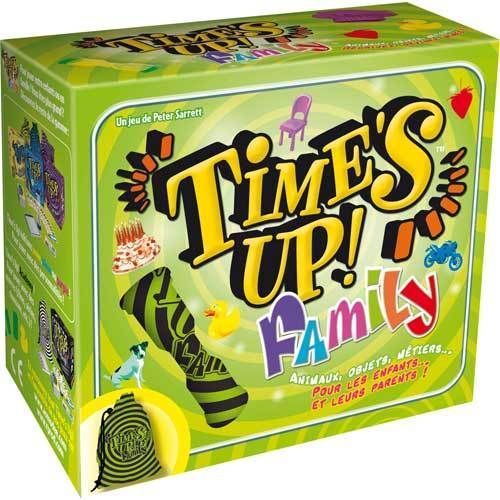
Time's Up! Family
Time's Up! Family Rulebook
Table of Contents
Table of Contents
Setup
Divide into teams with team members sitting across from each other. Time's Up! works best when played in teams of two players each. (See end of rules for larger groups and odd numbers of players.) Choose a player to keep score.
Decide whether you'll be using the ORANGE or the BLUE words. Make sure everyone knows which color you're using! Do not mix colors within the same game.
Deal out 40 cards evenly among all players (for a longer game, deal out more cards). Then deal two more cards to each player. The rest of the deck won't be used and should be put back in the box.
Each player may look at their cards and discard two of them. (Players should not reveal their cards to each other.) All remaining cards are then shuffled together and stacked face down in the center of the table. This is the game Deck, which will be used for all three rounds of the game.
Choose a starting team to take the Deck. The next team clockwise from the starting team takes the timer and will use it to time the other team's turn.
How to Play
Round 1 — Almost Anything Goes
Almost anything goes with cluegiving but passing is not allowed.
On each team's turn, one member of the team is the Cluegiver and the rest are the Guessers. (On successive turns, the Cluegiver will be a different member of the team.) The Cluegiver takes the Deck, draws the top card from it, and looks at the word in the color everyone agreed upon at the start. Once the Cluegiver has looked at the word, the next team says, "Go!" and starts the timer. The Cluegiver begins giving clues to their teammate(s). The Cluegiver can say or do almost anything: they can make sounds, point, charade, give descriptions of the word, etc.
The only restrictions are:
- No singing or humming of music is allowed.
- No part or variant of the word can be used in the clue. Ex: You can't use "Willy" or "Bill" to get the Guesser to say WILLIAM.
- "Rhymes with" clues are acceptable, provided the Cluegiver doesn't actually say the rhyming word. Ex: "Sounds like the animal that oinks" would be OK, but not "Sounds like pig."
- No spelling of the word is allowed, nor is any clue designed to give away specific letters of the word (the only exception is for words using initials, such as H.G. WELLS, although for such words the cluegiver is still forbidden to say the initials outright).
The Guessers try to guess the word on the Cluegiver's card. The Guessers can make as many guesses as they wish; there is no penalty for a wrong answer. Guessers must say the full word as printed on the card, although words in parentheses are optional. If the Guessers call out the correct word, the Cluegiver sets the card aside, draws a new card from the Deck, and begins giving clues for the word on that card.
The Cluegiver cannot pass and move on to a new word until the Guessers call out the correct word. If the Cluegiver doesn't recognize the word drawn, they'll have to be more resourceful with their clues. (See Tips on the next page.)
If the Cluegiver gives an illegal clue, their turn ends immediately and the card they goofed on is returned to the Deck.
When time expires, the Cluegiver shuffles the card they were currently working on back into the Deck. Each card that was guessed correctly is put into a score pile near them. Pass the Deck to the next team clockwise, who in turn passes the timer to the next team clockwise from them.
Important: If time runs out before a word is guessed, players may NOT discuss the word with each other. The cluegiver can't reveal who they were trying to convey, and players on other teams who think they figured it out can't tell their guesses to each other. A card may come up multiple times before it is guessed correctly.
Continue this process until all words have been guessed and the deck is empty. When the deck runs out and all words have been guessed, pause the timer immediately. The current team will take the first turn in the next round, using only the remaining time on the timer. If they feel there is not enough time left to use, they can pass to the next team who will start the round with the timer reset back to 30 seconds.
Each team now adds up all the cards they collected and score 1 point for each card. The scorekeeper tallies the score. After scoring, each team reads aloud all the words from their pile of cards to refresh everyone's memory about which words are in the game. When all words have been read, put all the cards back into the Deck and shuffle well. The team after the last team to play starts round 2.
Round 2 — One Word
Round 2 plays just like Round 1, with the following changes:
The Cluegiver may not use more than one word per card to describe each word. The same word may be repeated as often as desired, but once a word is said only non-verbal clues may be added. If the Cluegiver accidentally uses more than one word they must set the card aside face down, draw a new one from the Deck and continue with the new word.
Each team may make only 1 guess per card. If the guess is incorrect, the Cluegiver must set that card aside face-down, draw a new one and continue with the new word.
The Cluegiver may pass during this round. Simply say "Pass", set the card aside face-down, draw a new one from the Deck and continue with the new word. At no point are Guessers ever allowed to Pass.
At the end of the turn, any cards set aside due to passes, clue goofs, or incorrect guesses are shuffled back into the Deck. There is no penalty for such cards.
If a Cluegiver finishes the deck during their turn, their turn is over. They are not allowed to revisit cards that they set aside due to incorrect guesses, passes, etc.
At the end of the round, don't bother reading all the words aloud again; everyone should know them by now. Tally each team's score pile then shuffle all the cards back into the Deck again as before.
Round 3 — Gestures Only
Round 3 plays just like Round 2, with the following change: The Cluegiver may not use any words at all. Only sounds and pantomime.
Winning: The team with the highest score after all three rounds is the winner.
Advanced Play: Freeze Round!
We've added an optional 4th round for even more hilarious fun! Play the same way as Round 3, except the Guesser starts with their eyes closed. The Cluegiver looks at a card and must then freeze in a pose. Once frozen they shout OPEN! and the Guesser opens their eyes and must give one Guess. The Cluegiver then shouts CLOSE! and the Guesser closes their eyes again while the Cluegiver looks at the next card and repeats the process. Once the Guesser's eyes open, the Cluegiver must not move at all until he says Close! Also, the Cluegiver can not make any sounds at all in this round.
Rules for 3, 5, or 7 Players
With an odd number of players, you can play Time's Up! slightly differently. Do not make teams, but instead play as individuals. On your turn with the deck, you will be the Cluegiver to the person on your left. When your time is up, pass the Deck to the person who is to the left of your Guesser. This way when the deck reaches the person to your right, you will be their Guesser.
Each time you score cards, place them between you and your 'teammate'. At the end, each player scores all the cards on their right and left. So for example the Green player scores the cards in pile D and pile C. Whoever has the highest total is the sole winner!
Rules for Teams with 3+ Players
When playing in large groups, try breaking into 2 or 3 equal teams of 3 or 4 players each. Sit so that each person is between players of the other team(s). For example, three teams of three players each, or two teams of four players each. The deck will be passed around clockwise and when a player has the deck, he gives clues and all of his teammates can answer together.
Tips
If you don't recognize a word you draw, break it into parts. Possible approaches include: Does something else use the same words? Ex: "It's got the same last name as the first President of the United States."
If you get stuck, give clues to specific parts of the words.
In rounds 2 and 3 if you draw a word that you don't know how to convey, pass quickly rather than waste time trying to figure something out. Then think about how to do it while you wait for your next turn. That way you'll be prepared if you draw it again.
Round 3 is the most fun, but it can also be the most difficult. Harder words can be made much easier if gestures are incorporated into 1st and 2nd round clues. If you hold your hands to look like scissors when giving a clue for SCISSORS in the early rounds, for example, that gesture will become a shorthand for scissors in the final round.