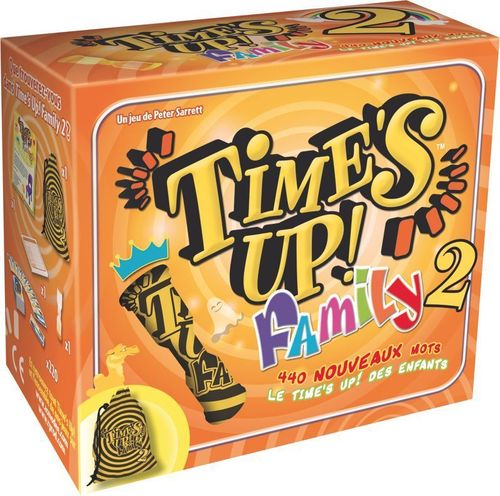
Time's Up! Family 2
Time's Up! Family 2 Rulebook
Table of Contents
Table of Contents
Contents
- 220 cards showing 440 words;
- a score pad;
- a 40-second sandglass;
- a storage bag;
- these rules.
A Game of Time's Up! in Brief
A game proceeds as follows:
- Gather friends, relatives and pals and form teams.
- Select cards.
- In the first round, a player tries to make as many cards as possible guessed by the members of their team within 40 seconds. To do so, they may speak freely.
- As soon as the 40 seconds have run out, the next team takes its turn.
- The first round ends as soon as all the cards have been found. The points are then counted (the number of cards guessed), then the cards are shuffled and play starts again.
- In the second round, play proceeds as in the first round but saying only a single word. The partners of the active player may make only one guess per card.
- As in the first round, the teams play in turn until all the cards have been found. Then the points are counted and the cards are shuffled again.
- In the third round, play proceeds as in the first round but only by miming, humming a song and using sounds.
- Once all the cards have been found, the points obtained over the three rounds are added up to learn who the great winners are.
Setting Up the Game
1 - Forming Teams
The first thing to do is to form teams of players. Preferably, distribute adults and children evenly among the teams.
If you are:
- 4 players: two teams of 2 players;
- 6 players: three teams of 2 players;
- 8 players: four teams of 2 players;
- 9 players: three teams of 3 players;
- 10 players: two teams of 3 and two teams of 2;
- 11 players: three teams of 3 and one of 2;
- 12 players: four teams of 3 players.
If you are 5 or 7 players, two solutions are open to you: either form several teams of different sizes, or refer to the paragraph "Specific rules for 5 and 7 players" found at the end of these rules.
Use any method of your choice (drawing lots, etc.) to form the teams. Sit around the play area so that teammates face each other. For example, if you are 9 players, seat teammates in a triangle (every 3 chairs).
2 - Setting Up the Game
Take 30 cards and deal them among the players (not everyone may get the same number). Then deal 2 additional cards per player.
Each card has 2 colours. Choose the words on the blue background or on the yellow background. Make sure everyone has understood the colour chosen for the game. The whole game will be played with this colour.
Each player secretly looks at their cards and removes 2 cards of their choice, which are put back in the box (they will no longer be used during the game). Gather the selected cards and shuffle them. This deck forms the draw pile.
The player wearing the biggest sombrero starts. If nobody is wearing a sombrero, it is the oldest player. They will be the speaker for the start of the game.
Everything is ready to begin.
Playing a Game
A game of Time's Up! has 3 rounds. A round takes place over a certain number of turns. Each team plays in turn. The other players are spectators and may not say anything (they may of course laugh). The player to the right of the speaker is the sandglass keeper; they turn the sandglass over while shouting: "Go!" ("c'est parti").
(Layout diagram: skipped or failed cards, current card, found cards, draw pile, sandglass.)
The speaker then has 40 seconds to get their team to discover as many cards as possible.
- During the first round, the speaker speaks freely.
- During the second round, the speaker may say only one word per card.
- During the third round, the speaker may not speak but may use mime, hum a song and make sound effects.
1 - First Round
In the first round, the speaker may speak freely but must nevertheless respect a few rules explained below.
The speaker's teammate(s) may make as many guesses as they wish. As soon as the word is found, the speaker puts the card face up in front of them. They turn over the next card and try to make them guess it.
As soon as the time is up, shout "Time's Up!". This team's turn stops instantly and no further guesses are accepted. The current card is put back on top of the draw pile. All the cards guessed (cards turned face up) are kept by the team. They are no longer used in this round.
All the face-down cards (cards not found, passed, as well as faults) are gathered, added to the draw pile, which is shuffled for the next speaker.
Play passes to the next team. The speaker becomes the sandglass keeper and the player to their left becomes the new speaker. Continue like this until the draw pile is exhausted.
During the first round, the speaker may not:
- say parts of, or diminutives of, the words shown on the card, even in another language (for example: "vacherie" or "cow" to make "vache" guessed);
- list letters of the alphabet (for example: it is forbidden to say "it starts with a B" or "it starts with the 2nd letter of the alphabet").
If the speaker commits a fault, the card is passed but the turn is not over.
When the draw pile is exhausted, the round is over. Each team counts the number of cards it has guessed. These points are written on the score pad. Then each team reads aloud the words it found.
The draw pile is rebuilt and shuffled (exactly the same cards are used for all three rounds). The first speaker of the second round is the next in turn order.
Playing tips: read the word calmly. Do not speak too fast. Try to give useful information that puts your teammates on the track of the word. If you do not know what the word means, you may use charades or riddles; if you cannot manage, you may pass the card.
2 - Second Round
The second round is identical to the first except for the following changes:
- the speaker may say only one word per card;
- the speaker's team may give only one guess per card. Careful: when teams have more than 2 people, only the first guess counts. Even if a second guess turns out to be correct, the card is not won.
In case of a correct guess, the speaker puts the card face up and turns over the next card. In case of an error, the speaker puts the card face down next to the draw pile and turns over the next card.
At the end of the turn, all the face-down cards (cards not found, passed, as well as faults) are gathered, added to the draw pile, which is shuffled for the next speaker.
The final count is identical to that of the first round. The next speaker begins the third round after the words are read out once more.
During the second round, the speaker may not:
- say more than one word (compound words are accepted);
- say parts of, or diminutives of, the words shown on the card, even in another language.
3 - Third Round
The third round is identical in every respect to the second round except that the speaker may no longer speak. They may only mime, hum a song and make sound effects (onomatopoeia). For example, "woof woof", "meow", "bang", "boom".
We advise you to stand up when you are the speaker. It is then easier to mime.
4 - Victory Conditions
At the end of the three rounds, the team with the most points wins the game. Don't forget that the important thing is to take part and have fun!
Specific Rules for 5 and 7 Players
The 5- and 7-player configuration is slightly more complex and we advise you to play your first games with the basic rules.
With 5 or 7 players, the rules are identical except that there are no longer any teams; you play sometimes with your right-hand neighbour, sometimes with your left-hand neighbour.
Indeed, when you hold the draw pile and are the speaker, you make your left-hand neighbour guess the cards; the guessed cards are then placed between the two of you. These are shared points.
At the end of the sandglass, you do not pass the draw pile to your left-hand neighbour (after all, they have just played) but to the second player to your left.
Small hint: later in the game, the draw pile will come back to your right-hand neighbour. They will be your speaker and will make you guess the words. You will again keep the successful cards between the two of you.
At the end of each round, each player adds the number of cards to their right to the number of cards to their left. This sum is the number of points they won in that round. For example, the points collected by the yellow player equal E + A.
Notes
- For easier games, deal 4 extra cards instead of 2. Each player removes 4.
- For more complex games, play with 40 (or even 50) cards and forbid yourselves to pass cards in the first round. If you want to increase the difficulty even more, feel free to discover the other versions: Blue, Yellow, Purple and Academy.
- The cards of the different editions can be identified by the following pictograms: Blue / Yellow / Purple / Party / Academy / Best of / Family.