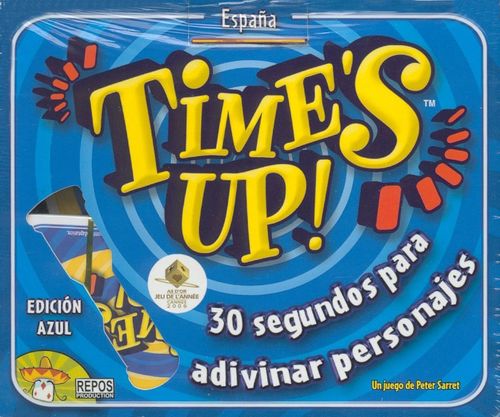
Time's Up! Edición Azul
Time's Up! Edición Azul Rulebook
Table of Contents
Table of Contents
Objective
Time's Up! is a team game that lasts 3 rounds. During each round, try to guess as many cards as possible!
Setup
Split into groups formed of at least 2 players each. Decide whether you will use the yellow side or the blue side of the cards.
Deal 40 cards among the players. Each player looks at their own cards in secret. If a card isn't to a player's liking (too hard, they don't know the name...) they may exchange it for a new one.
Once everyone has read their cards, gather all the cards together and shuffle them into a single deck. Choose which team will go first.
The game can begin!
First Round: Speak Freely
A player has the time of one turn of the sand-timer to make their team guess as many cards as possible.
The player draws a card and may say whatever they want. But they may not:
- Pass on a card if the team is not able to guess it.
- Use words that share the same root as, or are otherwise associated with, the word printed on the card.
- Use words that "sound similar" to the word on the card.
- Translate the card into another language.
- Spell out the word using sounds or letters of the alphabet.
The player's team may attempt to guess as many times as they want.
When the word is guessed, the player places the card face up on the table and moves on to the next card.
When time runs out, the player hands the deck of cards to the next team, who continues with the current card.
When there are no more cards left to guess, each team records the number of cards it has guessed, and the next team begins the second round.
Second Round: One Word
Take the 40 cards from the previous round and shuffle them.
This round is the same as the previous one, except for the following changes:
- The player explaining the card may only use a single word per card.
- Their team may only make one attempt to guess per card.
- The player may pass on a card.
When time runs out, the current card, the cards that were not guessed, and the cards that were passed are gathered with the deck, which is shuffled for the next team.
When there are no more cards left to guess, each team records the number of cards it has guessed, and the next team begins the third round.
Third Round: Mime
Take the 40 cards from the previous round and shuffle them.
This round is the same as the previous one, except for the following changes:
- The player explaining the card must act it out in mime.
- The player may hum and make sound effects (onomatopoeia).
- The player may not speak.
When there are no more cards left to guess, each team records the number of cards it has guessed.
The game is over!
Who Has Won?
The team that has collected the highest number of cards, summed across all three rounds, wins the game!
If you have doubts, check the Frequently Asked Questions.
Frequently Asked Questions
My team has more than 2 people. Who gives the valid answer during rounds 2 and 3? Only the first answer counts. Even if a second answer is correct, the card is not considered guessed.
What should we do if the player explaining the card does something forbidden during their turn? Place the card at the bottom of the deck. The round continues as normal.
Can I make gestures or noises during the first 2 rounds? No, gestures and sound effects are reserved for the 3rd round.
Can we choose which team member explains the card? No, each team member has to explain cards following a set order.
If there are no more cards left in the deck, can I explain to my team cards that we failed or passed on this turn? No, cards that were failed or passed cannot be used again this turn.
How do we play with an odd number of players? Teams do not have to be made up of the same number of players. Make sure each team plays when it is their turn. You can also use the Expert Variant for 5 and 7 players.
Expert Variant for 5 and 7 Players
The rules are the same, but you no longer play in teams. Each player plays with the player to their left and the player to their right. Points are scored individually.
When a player has the deck, they try to explain the cards to the player on their left. Guessed cards are placed between the two players.
When time runs out, hand the deck to the player on the left of the player who was trying to guess the cards.
When there are no cards left, each player's score is the sum of the cards to their left and the cards to their right.