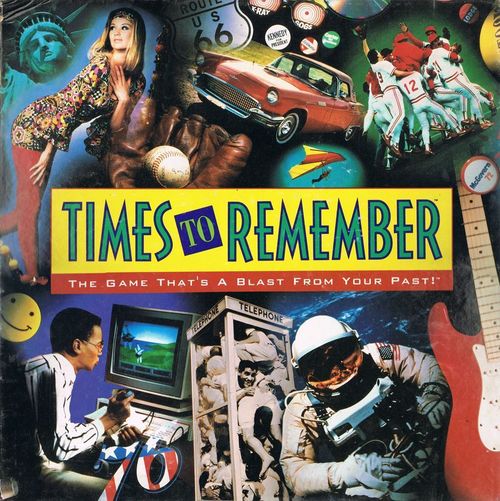
Times to Remember
Times to Remember Rulebook
Table of Contents
Table of Contents
Contents
230 double-sided cards with 2,300 events, 2 year-number gameboards, 14 Year Frames (2 sets of 7), 2 Year Frame holders, 1 card box, 1 category die, 1 sheet of stickers.
Object of the Game
Be the first team to discard all your Year Frames by assigning the correct years to spectacular events.
Before the Very First Game
- Apply the stickers to the category die as shown in Figure 1. It does not matter which category goes on which side.
- Apply the sticker to the card box as shown in Figure 2. The top edge of the sticker must line up with the small rib near the top of the box.
- Sort the 14 Year Frames by color into two sets of 7.
- Apply the stickers with the numbers 1 to 7 to the frames according to size. Before sticking, make sure the molded number on each Year Frame matches the number on the sticker: once stuck, there is hardly any going back! Line up the notch in the sticker with the nose on the Year Frame, as shown in Figure 3.
Before Each Game
- Divide the players into 2 teams (Team Red and Team Gold). It does not matter if one team has one more player. The teams must sit opposite each other.
- Fill both holders with the matching Year Frames, as shown in Figure 4.
- Give each team its holder with 7 Year Frames and a year gameboard.
- Place the card box and the die within easy reach between the two teams.
And Now Let's Go
The game is played in rounds. In each round both teams answer the same question, each team choosing one of its Year Frames and placing it on its year gameboard.
Every round follows the same sequence:
- Roll and read aloud.
- Choose a Year Frame.
- Reveal the answers.
1. Roll and Read Aloud
One of the teams is designated to roll. A member of that team rolls the die and reads out the category rolled. A member of the opposing team reads the corresponding event on the visible card in the card box.
IMPORTANT: The card must not yet be taken out of the box for reading.
EXAMPLE: Frank of Team Red rolls TELEVISION and announces this category. Hanni of Team Gold reads the corresponding event: "Wolf-Dieter Herrmann spreads boundless sunshine on the breakfast television of SAT 1."
If "WILD" is rolled, the rolling team may freely choose a category. The opposing team still does the reading aloud. (So the rolling team can choose a supposedly easy category, but cannot pick the "easiest" event on the card!)
The teams, and the individual players, take turns from round to round rolling and reading.
2. Choose a Year Frame
Both teams now try, simultaneously and secretly, to determine the year of the event read aloud as precisely as possible. Discussion is allowed. BUT: take care that the opposing team cannot draw conclusions from it for its own answer!
Your team's answer can span a period of one to seven years. As soon as your team has agreed, choose the matching Year Frame and slide it onto your year gameboard so that it marks off the suspected period. But beware: the opposing team must not yet see your answer.
NOTE: The entry 1990+ on the year gameboard covers the year 1990 and all years after it.
Year Frames
The number on each Year Frame corresponds to the span of years that this particular frame can show. The Year Frame with the number 7, for example, leaves open a span of 7 years in which the event may have taken place.
STRATEGIC TIP: Always use the smallest Year Frame with which you can narrow down the year you are looking for. If you are unsure, rather use a larger Year Frame.
EXAMPLE: Team Red is sure that Wolf-Dieter Herrmann first hosted the breakfast television on SAT 1 in either 1986 or 1987. So the team places Year Frame number 2 on its year gameboard so that both years remain open.
Team Gold only knows that the event took place sometime in the late 80s. So it chooses its Year Frame number 4 and narrows the span down to 1987 through 1990+.
3. Reveal the Answers
When both teams have placed their Year Frames on their gameboards, they reveal their answers simultaneously: first by ANNOUNCING the chosen period, then by laying the gameboards down so that all players can see them.
Only now does the reader take the card out of the box and read the correct year aloud. Afterwards he turns the card over and puts it back at the very back of the box, behind all the other cards.
Did you estimate the year correctly?
If the correct year can be seen anywhere within your Year Frame, your answer counts as correct! Remove the Year Frame from your gameboard and lay it face down on the table.
EXAMPLE: Hanni reads from the card that Wolf-Dieter Herrmann first hosted the breakfast television in 1987. So both teams have the correct solution! Team Red can discard its Year Frame number 2, Team Gold its Year Frame number 4.
Oops! Wrong answer?
If the correct year does NOT appear within the Year Frame you placed, the answer is wrong. Too bad! Remove the Year Frame from your gameboard and put it back in your holder. You must wait for a new chance to discard.
The game continues round after round until one of the two teams has discarded all its Year Frames.
Disputes
For events of several years' duration (TV series, etc.), unless otherwise stated, the question concerns the start.
For some events (Oscar ceremony, premieres of films, etc.) there can be disputed interpretations: the Oscar, for example, is awarded for the films of the previous year. And between the shooting of a film, its world premiere and its premiere in Germany, there can sometimes be several years.
All disputed cases are settled in advance by all players agreeing to accept the years given on the cards as binding for the duration of the game.
Who Wins?
The team that is first to have discarded all its Year Frames has won!
Overtime
If both teams discard their last Year Frame at the same time, the game goes into overtime: both teams take back all their discarded Year Frames and put them back in their holders. Then play continues as usual. The first team to discard a Year Frame without the opposing team also being able to discard a frame has won.