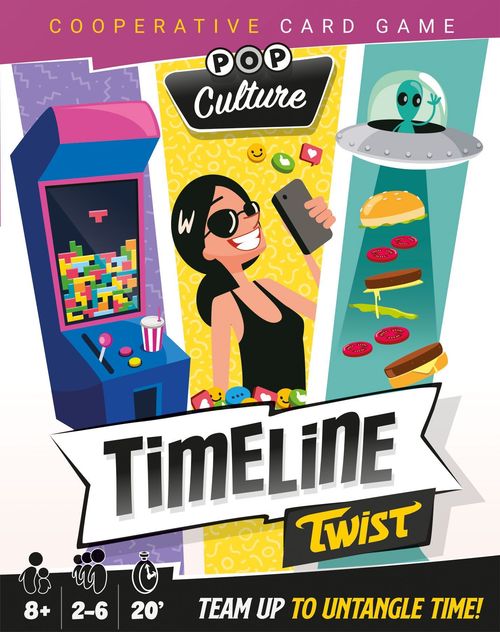
Timeline Twist: Pop Culture
Timeline Twist: Pop Culture Rulebook
Table of Contents
Table of Contents
Cooperative Mode
Object of the Game
This is a cooperative game. You play as one team. Your goal is to combine your actions and find the best strategy in order to place as many of your cards as possible in the correct places on the timeline. On your turn you may either place a card on the timeline or discard a card. At the end of the game you score points for correctly placed cards, while losing points for cards in the discard pile and for unplayed cards.
Game Setup
- Shuffle the deck of cards white-bordered side up and take the top 36 cards. Return the remaining cards to the box; they are not needed in this game. (White-bordered side: no date. Black-bordered side: with date.)
- Each player takes 4 cards and lays them in front of them white-bordered side up. Players may not look at the reverse side of the cards until they play them!
- Place the deck of cards white-bordered side up in the middle of the table. Turn over the top card and place it next to the deck; this is the start of the discard pile.
- Lay 1 card from the deck black-bordered side up in the middle of the table: it becomes the first point of the timeline, onto which players will add their cards.
The oldest player becomes the first player. Turn order then passes clockwise.
Setup example for a game with 4 players: the discard pile and the draw deck at the top, the starting timeline card in the center, and each player's four cards around the table.
Turn
On their turn a player must do one of the following:
- Place 1 or 2 cards on the timeline, one at a time, OR
- Discard 1 card.
At the end of their turn the player draws from the draw deck as many cards as they placed or discarded in that turn (so that 4 cards with the white-bordered side up lie in front of them). Then the turn passes to the player on their left.
Placing 1 or 2 Cards on the Timeline, One at a Time
A player must place at least one card of those lying in front of them on the timeline. They turn that card over and add it to the timeline according to the following rules:
- If the event occurred earlier than all events on the cards already on the timeline, the player puts their card to the left of them.
- If the event occurred later than all events on the cards already on the timeline, the player puts their card to the right of them.
- If the event occurred in the same year as the event on one of the cards, the player puts their card on top of that card so that the dates on both cards remain visible.
- If the event occurred in the interval between two neighbouring cards on the timeline, the player puts their card above these two cards, on the second level of the timeline. If a card already lies in that place, the player cannot place their card (see below).
If a player cannot place their card on the second level of the timeline (because a card already lies there), they turn it white-bordered side up and put it in front of themselves, laying it horizontally to distinguish it from the other cards. The player can no longer place this card, but can discard it on one of their following turns (see "Discard 1 Card" below). They cannot discard a card in that same turn. If the player has not yet placed a card this turn, they must try to place a different card (they cannot switch to the discard action!).
The player may try to place one more card. They may continue trying until they:
- successfully place two cards on the timeline in total;
- decide to end their turn;
- run out of cards to place.
Notes:
- In their turn a player is obliged to place at least one card. If the player cannot do this, the game ends immediately (see "End of the Game").
- If the player has successfully placed one card on the timeline, they may end their turn.
- If the player has successfully placed a second card on the timeline, their turn ends immediately.
Examples:
A) Katya successfully places one card on the timeline and decides not to risk any more. She ends her turn and draws a card.
B) Alena successfully places one card, and then a second. Her turn ends, since she has placed two cards. Alena draws two cards from the deck.
C) Dima tries to place a card on the timeline, but makes a mistake: he puts it in front of himself horizontally. Dima tries to place another card, and that attempt is successful. He decides to try to place a third card, but again makes a mistake and puts this card horizontally as well. Dima tries to place his last card and succeeds. Dima has placed two cards, so his turn ends. He draws two cards from the deck.
D) Seryozha tries to place a card on the timeline, but makes a mistake and puts that card in front of himself horizontally. Seryozha makes two more attempts, unsuccessfully. He was unable to place a single card on the timeline in his turn, and the game ends.
Discard 1 Card
A player may discard any one of their cards and take a new card from the deck in its place. The symbol in the top left corner of the discarded card must match the symbol in the top left corner of the top card of the discard pile. A card in the discard pile must always be placed black-bordered side up. Note that the symbols on the different sides of a card differ.
Discard example:
-
Alena thinks that the event on card (A) occurred in an interval between two events, but a card (B) already lies in that place on the second level of the timeline. Alena still would not be able to place card (A), so she discards it (B) and takes a new one (C).
-
Dima has three cards lying horizontally. That is, three times he made a mistake and placed cards that fell inside an already occupied interval on the timeline. Now he can place only one card, the one lying vertically in front of him (A); the three horizontal cards simply occupy places in front of Dima. He decides to discard one card (B) into the discard pile and take a new one (C).
Communication Between Players
Players should communicate with each other as much as possible and discuss the cards they have. Nevertheless, on their turn each player makes the decision themselves about which cards to place or discard, although they may ask for the advice of the other players.
End of the Game
If the draw deck runs out, players play the cards remaining in front of them. If a player has played all their cards and there are no cards in the deck, that player no longer takes part in the game. The other players, who still have cards, continue to take turns.
The game ends in one of two cases:
- on their turn a player cannot place at least one card on the timeline or discard one card;
- the players have played all their cards.
Scoring
When the game ends, players determine their result:
- each card on the timeline (the lower level) is worth 2 points (A);
- each card on the second level of the timeline is worth 1 point (B);
- each card in the discard pile (C), in the draw deck (D) and unplayed in front of the players (E) subtracts 1 point.
Scoring example: At the end of a game with two players, 15 cards are placed on the timeline (A), worth 2 x 15 = 30 points. On the second level of the timeline (B) 8 cards are placed, worth 1 x 8 = 8 points. In the discard pile (C) lie 11 cards (-1 x 11 = -11 points). There are no cards in the draw deck (D). One player played all their cards, and the other player (E) has 2 cards left (-1 x 2 = -2 points). In total the players get 30 + 8 - 11 - 2 = 25 points.
Rate Your Result
Check your score against the table below. Try to beat it in your next games!
| Score | Rank |
|---|---|
| <0 | Novices (Новички) |
| 0-10 | Young Gang (Юная сборная) |
| 11-20 | League of the Good (Лига хорошистов) |
| 21-30 | Team of the Clever (Команда умников) |
| 31-40 | Experienced Players (Опытные игроки) |
| 41-50 | Alliance of Experts (Альянс экспертов) |
| 51-60 | Circle of Geniuses (Кружок гениев) |
| 61+ | Time Travelers (Путешественники во времени) |
Competitive Mode
In this mode, do not pay attention to the symbols in the top left corners of the cards.
Overview and Object of the Game
Each player plays for themselves. On their turn, players try to place one of their cards in the correct place on the timeline. If a player makes a mistake, they discard the card and take a new card from the draw deck. The first player to get rid of their cards becomes the winner.
Game Setup
Players sit around the table.
- Shuffle the deck white-bordered side up and place it in the middle of the table.
- Each player takes 4 cards and lays them in front of them white-bordered side up. Players may not look at the reverse side of the cards until they play them!
- Lay 1 card from the deck black-bordered side up: it becomes the first point of the timeline onto which players will add their cards.
The youngest player becomes the first player. Turn order then passes clockwise.
Turn
Place your card to the right, to the left, or between other cards already laid out.
For example, the first player can put a card white-bordered side up to the left of the starting card if they think the event occurred earlier than the event on the starting card, or to the right of the starting card if they think the event occurred later than the event on the starting card.
After the player has placed their card, they turn it black-bordered side up in order to check the date:
- If the card was placed correctly and the event really occurred in that interval of time, the card stays on the timeline. The player's turn ends.
- If the card was placed incorrectly, the card is discarded from the timeline. Then the player takes the top card from the draw deck and puts it in front of themselves white-bordered side up next to their remaining cards. If the draw deck has run out of cards, shuffle the discarded cards white-bordered side up to form a new deck.
The turn passes to the next player clockwise. The next player may choose where to put their card: to the left of the cards already laid out in the middle of the table (A), to the right of them (B), or between them (C). Leave a little space between the cards in case you need to place a new card between them.
Example: Olya goes second; a card has already been placed before her. Olya can place her card to the left (A), to the right (B), or between the two cards (C).
The game continues until one or several players have placed all of their cards on the timeline. See the "End of the Game" section.
Special Situation
During the game, a situation may arise where a player places on the timeline a card whose date coincides with a card already laid out (two events occurred in the same year). In this case the cards must lie next to each other, but their order on the timeline may be any.
End of the Game
At the end of each round (each time the turn returns to the first player), check whether there are any players who have no cards left:
- If all players still have cards, begin a new round.
- If at the end of the current round only one player has got rid of their cards (and the other players still have cards), they are declared the winner.
- If during a round several players correctly placed their last cards, they will each take one card and play them, continuing the game until only one of them correctly places their card within a single round. That player is declared the winner. The other players do not take part in this final round.
Note
The information contained in this game is for entertainment purposes only. Although we strive to keep the information up to date and correct, we make no representations or warranties of any kind, express or implied, about the completeness, accuracy or reliability of the information contained in this game.
Have fun!