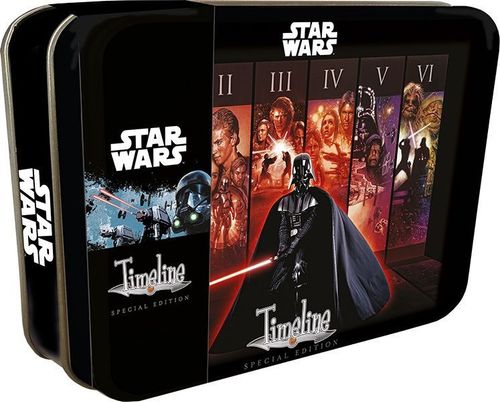
Timeline: Star Wars
Timeline: Star Wars Rulebook
Table of Contents
Table of Contents
In Brief
- Each time it is a player's turn, the player must try to place one of their cards in the correct "temporal gap".
- If they fail, they put the card back in the box and must draw another one.
- The first player to be the only one in the round to have placed their last card is declared the winner.
The temporal gaps are the spaces between (and at either end of) the cards already lined up in the timeline.
Components
110 cards, with on the front of each the name of the scene and its photograph, and on the back the same information plus its temporal position.
Front side (recto): 1. Photograph; 2. Description of the scene. "Position" side: 1. Photograph; 2. Description of the scene; 3. Temporal position; 4. Episode of the scene.
Object of the Game
Be the only one with no cards left.
Setup
- The players sit around the play area.
- The youngest is declared "first player".
- Shuffle the cards.
- Each player receives 4 cards, "position" side hidden. They place them in front of themselves. They must on no account look at the back (the "position" side). However, players are free to agree on the number of cards to deal according to their experience of the game.
- Leave the deck on the table with the "position" sides hidden.
- Place the first card of the deck in the centre of the play area, turned "position" side up. This is the card from which the chronological line is built, in which the players will place the cards they have in front of them.
- You can start playing!
Layout: Player 1; play area; initial card (centre); deck of cards; cards dealt to the players (in front of each player).
Course of the Game
Players each play in turn, clockwise. The first player must place one of their cards next to the initial card (the one placed in the centre of the play area during setup):
- If they think their card takes place before the initial card, they place their card to the left of it.
- If they think their card takes place after the initial card, they place their card to the right of it.
Once placed, the player turns their card "position" side up, in order to check that its position matches the position it occupies in the chronological line:
- If their card is correctly placed, it is left as it is, "position" side up.
- If their card is wrongly placed, it is put back in the box. The player must then draw the first card of the deck and place it in front of them "position" side hidden, next to their other cards.
First Player's Turn
(Illustration: the first player's card placed beside the initial card.)
Second Player's Turn
Next it is the second player's turn (the player directly to the left of the first player).
- If the first player placed their card correctly, the second player then has the choice between three places to put one of their cards: to the left of the two cards already placed, to their right, or between the two.
- If the first player placed their card wrongly, the second player has only two possible places (to the right or to the left of the initial card).
- If the second player places their card correctly on their turn, it stays as it is, "position" side up. The chronological line is then simply rearranged so that a space remains between each card.
Third Player's Turn
It is now the third player's turn.
- If the two players before them placed their cards correctly, they now have the choice between four places.
- And so on.
Special Case
During the game, a player may have to place a card with the same position as a card already placed. In this case, the two cards must be placed side by side, regardless of order.
End of Game and Victory
If a player is alone in correctly placing their last card during a round, they are immediately declared the winner.
If several players correctly place their last card during the same round, they stay in the game and the others are eliminated. The players who stayed in the game each receive a card from the deck with which they continue to play until only one player correctly places their card.