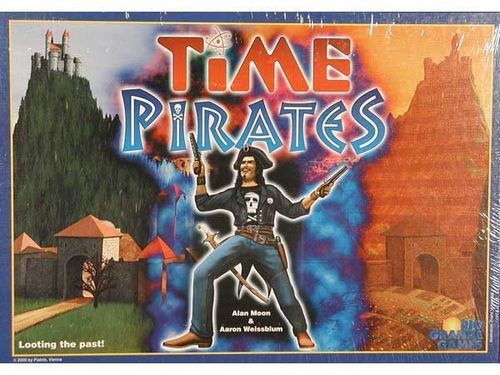
Time Pirates
Time Pirates Rulebook
Table of Contents
Table of Contents
Game Materials
The two boards:
- Epoch board: displays the 7 civilization/epochs of human history. Each epoch has a different number of sites where artifacts may be found. The epochs are connected by time paths, numbered 1 or 2. These paths are the primary routes used by the time pirates and the time police to travel among the 7 epochs. There are 7 time police travel squares at the bottom of the board. They hold the time police travel tokens as they are drawn and represent the passage of time in the game.
- Bazaar board: has a space for each of the 37 contracts, which are placed there at the beginning of the game and removed as the players sell their artifacts in the bazaar.
The other materials:
- 6 Time Pirate figures in 6 different colors
- 1 black Time Police figure
- 1 rule booklet, 1 rule summary, 1 bag
- 37 contracts
- 76 artifact tokens
- 10 time police travel tokens
End of the Game
The game is played over 3 game years. Each year ends when the 8th time police travel token is drawn. Each year only 8 of the 10 tokens will be drawn! After each of the first and second game years, the players score their contract points. After the third game year, the players participate in a final and special scoring round and the game ends. With 4 players, the game will last about an hour.
Preparation
Place the epoch board in the middle of the table and the bazaar board next to it. Place the 76 artifact tokens and 10 time police travel tokens in the bag and mix them well. Designate a place near the boards as a discard pile for artifact tokens as they are sold.
Place the contracts on their respective spaces on the bazaar board. Draw tokens from the bag one at a time and place them randomly on the empty artifact sites in the 7 epochs, filling all sites in all epochs. If a time police travel token is drawn, place it in the discard pile. After all artifact sites have been filled, return the time police travel tokens to the bag and mix well.
Place the black time police figure in the epoch 2200-2299 (with 7 artifact sites). The time police always begin the game in this epoch.
Playing the Game
The players choose a starting player by lot. Players then select, in counterclockwise order, the epoch where they will start the game. The first player to choose a starting epoch is the player to the right of the starting player. This player places his figure in any epoch except the one with the time police figure. The other players place their figures, in counterclockwise order, in any epoch that has no figure (either time pirate or time police).
Play now begins with the starting player and continues with the other players in clockwise order around the table.
Although the players (and the time police) begin the game in separate epochs, they may be in the same epoch during the game. Players place the artifacts and contracts they acquire during the game face up on the table in their play areas for all to see.
Turn Structure
When a player starts his turn, he first checks to see if he is in the same epoch as the time police:
-
The player is in the same epoch as the time police:
- He must discard 1 artifact token from his largest set (color). If he has 2 or more sets of equal size, he chooses which of these sets to discard from. If he has no artifact tokens, he does not discard.
- He must discard all white artifact tokens he has, if any.
- He must move along one of the two time paths from this epoch to the next epoch as his first action. He may not use an "atomic" artifact to make this move.
- He must perform one more standard action and may perform any number of special actions.
-
The player is not in the same epoch as the time police:
- He may restock the artifacts in one epoch.
- He must perform two standard actions and may perform any number of special actions.
Restocking one epoch: a player may restock any one epoch that has one or more empty artifact sites and no time pirate figure. It may have the time police figure in it. Of course, the player may not restock an epoch if he started his turn in the same epoch as the time police.
Filling the empty artifact sites: the player draws tokens from the bag one at a time and places artifact tokens on empty sites in the epoch he is filling. He must fill all the empty sites in that epoch. If he draws a time police travel token, he moves the time police figure one epoch along the route number shown on the token and places the token on the next available time police travel square on the epoch board. When the player attempts to place the 8th time police travel token (there is no square for it), the game year ends. The player places the 8 time police travel tokens and all discarded artifact tokens back in the bag and mixes them well. The players then score their contracts. After scoring the first and second years, the game continues where it was interrupted: the player continues to fill the epoch he was filling and takes his turn.
Performing special actions: during a turn, a player may perform any number of special actions as long as he has the artifact tokens that permit those actions. The special actions are available with artifact tokens with the special atomic or double-arrow symbols. The player may discard a token with an atomic symbol to jump to any epoch on the board. The player may use the token with the double arrow to trade tokens with another player. He simply gives the player the double-arrow token and takes the artifact token of his choice from that player.
Performing standard actions: a player is allowed 2 standard actions on a turn (if a player is caught by the time police, his first standard action is to move). He may do any of the three possible actions in any order or may do any one of them twice.
- The player moves his token along one of the time paths to the next epoch.
- The player takes one artifact token from the epoch where he is.
- The player jumps to the bazaar, fulfills one contract (collects the contract and discards the appropriate artifact tokens), and jumps back to any epoch.
Acquiring Contracts
A player may acquire any available contract in the bazaar if he has the necessary artifact tokens to fulfill it. As there are only 37 contracts, the player may find the contract he wants fulfilled before he can get it. To fulfill a colored contract, the player must discard the number of artifact tokens shown on the contract. The discarded artifact tokens must match the color of the contract. For example, to fulfill the blue contract worth 6 points, the player must discard exactly 5 blue artifact tokens. White artifact tokens are wild cards and may be used as any color when fulfilling a contract. In the above example, a player could discard 3 blue and 2 white artifact tokens to acquire the blue contract worth 6 points. To acquire the white contracts, a player must discard 3, 4, or 5 different colored artifact tokens. For example, to fulfill a white contract worth 3 points, a player could discard 1 each: blue, green, orange, and purple artifact tokens. Similarly, the player could use white artifact tokens to substitute for the colors: blue, green and 2 white could be discarded to fulfill a white contract worth 3 points.
White contracts cost more artifact tokens to fulfill than the colored ones as they do not require sets of colors, but different colors. They also have the advantage that they can be used as wild cards in the final scoring round, enabling players to earn even more points. The higher-valued colored contracts cost fewer artifact tokens than they score victory points because it is difficult to collect a large set of one color.
As the players score victory points for their acquired contracts at the end of each game year, contracts acquired in the first year score more points over the game than those acquired in the second and third years.
Scoring
- After each of the first two game years, players simply sum the values of the contracts they have acquired and record this on a sheet of paper.
- After the third game year (at the end of the game), players first sum the values of the contracts they have acquired and record this on a sheet of paper as they did after the first two game years. Then they proceed to the special final scoring:
Special final scoring: The players secretly place their white (wild card) contracts with one or more of their groups of colored contracts. The white contracts take on the color of the group they are placed with. A player may not place white contracts by themselves to act as a color he does not have. After all players have placed their white contracts, they reveal their placements simultaneously and may score special bonuses as indicated below:
- Each player with at least one contract from each of the five colors (white does not count as a color) scores a 2 point bonus.
- The player with the most points in a color (each of the 5 colors is scored separately) scores a 2 point bonus. Players who tie for the most points in a color each score the 2 point bonus.
Winning the Game
- The players sum their scores from the three game years, including any bonus points earned in the last year. The winner and the "Great Time Pirate" is the player with the most total points. If 2 or more players tie with the most points, the player among them with the most contracts is the winner.