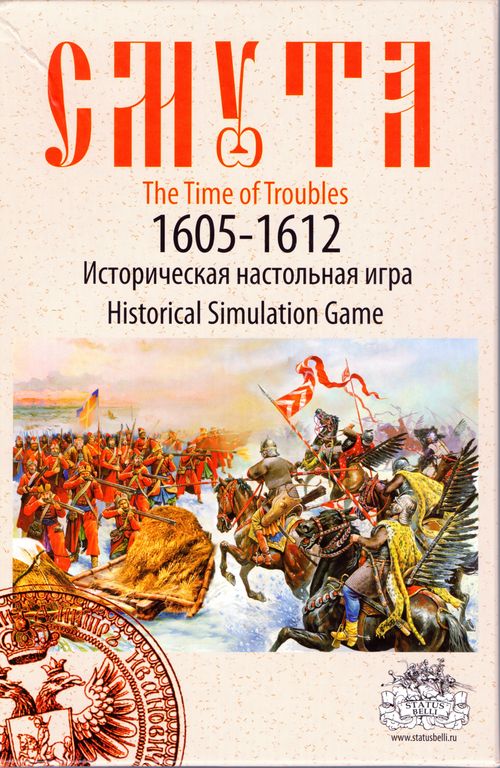
The Time of Troubles 1605-1612
The Time of Troubles 1605-1612 Rulebook
Table of Contents
Table of Contents
- 1. General Description of the Game
- 2. Components of the Game
- 3. Sequence of Play
- 4. Parties
- 5. Cards
- 6. Appearance of Personalities and Detachments
- 7. Movement
- 8. Formation of an Army. Recruiting Troops
- 9. Battle
- 10. Capturing Cities and Fortresses
- 11. Victory and Victory Points
- 12. Distribution of Personalities and Cards Among Parties. Playing with Different Numbers of Players
- 13. Setup
- 14. Miscellaneous
- 14.1. Capture of Moscow. Declaring the Tsar
- 14.2. Pretender to the Throne
- 14.3. Tsar's Campaign
- 14.4. Swedish Intervention
- 14.5. Poland
- 14.6. Swedish Reinforcements in the North
- 14.7. Winged Hussars
- 14.8. Artillery and "Siege" Markers
- 14.9. Gustav III Vasa
- 14.10. Capture of Smolensk by Poland
- 14.11. Capture of the Northern Fortresses by the Swedes
- Glossary
- Reference Tables
1. General Description of the Game
The game is for 2-5 players. Each player leads one Party (Партия), which struggles for power in the Muscovite state of the early 17th century. To win, a player must reach a set number of victory points. A Party's victory points are earned for control of cities and fortresses, for won battles, and for placing a candidate on the Tsar's throne. Gaining control of Moscow is very important for victory.
Under a player's control are Commanders (Полководцы). Only they can gather and lead armies, subjugate cities and fortresses. Commanders may be accompanied by Characters (Персонажи) — historical figures who give the player additional capabilities. Commanders and Characters together are called personalities (личности).
On the map, Commanders move from location to location along the roads connecting the locations. If two Commanders of different Parties meet in one location, either a battle takes place between them, or one of the Commanders evades battle. Battle or evasion is affected by the Commanders' combat characteristics. Armies led by Commanders consist of combat units (боевые части), representing different types of troops. Combat units have Shooting and Melee values, which determine the strength and order of battle.
The most important element of the game is the play of cards. They reproduce real and hypothetical historical events and allow the player to gain many advantages. The number of cards a player receives is affected by a personality characteristic called Administration.
The game ends either by a personality of a player remaining for a long time on the Tsar's throne, or by one side reaching the corresponding number of victory points, or, at the end of 1612, the points of each player are counted and a Zemsky Sobor is held. The player with the greater number of victory points is the winner.
IMPORTANT. Priorities of rules and cards. If information contained on a card contradicts the basic rules, the information on the card takes precedence. If you still cannot reach agreement, roll the dice: whoever wins is right. Do not forget that this is only a game.
2. Components of the Game
The game set consists of:
- one rulebook;
- one historical reference booklet «Русская Смута 1605-1612. События и участники» (Russian Smuta 1605-1612: Events and Participants);
- three separate player aids;
- one game card;
- counter sheets for 440 game counters and counter sheets for 26 vertical Commander counters;
- 124 game cards;
- 26 Commander cards;
- 26 Commander stands;
- 2 six-sided dice.
2.1. Counters
2.1.1. Personalities
Personalities come in two kinds: Commanders (vertical counters) and Characters. Commanders move across the map and lead armies with them. Characters cannot move across the map on their own, but they give additional capabilities to the player who controls them.
A. Commanders. A Commander's counter is inserted into a special plastic stand. Only Commanders can move independently across the map, fight, recruit troops, and capture cities and fortresses.
A Commander is represented in the game by a vertical counter and a card. The counter moves around the game board, the card lies on the table beside the counter, and the card holds the troops and Characters accompanying the Commander.
Each Commander has the following characteristics:
- Tactical rating. Affects the order of actions in battle.
- Strategic rating. Affects the possibility of evading battle.
- Legitimacy (Легитимность). Reflects the Commander's rights to the throne and noble status. Affects the subjugation of cities and a number of other game functions.
- Administration. Reflects the Commander's administrative abilities. For each "Administration" of a Commander, the player receives one extra card for each "Administration Card Phase" (see section 3.2.3).
- Nationality. Russian Commanders are marked with a double-headed eagle. Polish Commanders are marked on their counters with the white Polish eagle on a red field. Swedish Commanders (Jacob De la Gardie and Evert Horn) are marked with a yellow crown on a blue field.
The remaining characteristics of Commanders (conditions and time of appearance, types of troops that may be recruited, maximum army size, starting troop strength) are given on the Commander's card.
B. Characters. A Character's counter (an ordinary square grey counter) is considered to belong to the player's Party. Usually players place Character counters in front of themselves so that other players can see them (the exception is the Tsar, who is placed on the map in the "Tsar" field). If a Character is brought into the game as a Pretender to the throne (see section 14.2), it must be placed in a Commander's army. Which characteristics the Character strengthens is marked on its counter.
2.1.2. Combat Units
A Commander's army consists of combat units. Combat units are never placed on the map. They are always located on the Commander's card. The Commander's army may consist of a limited number of combat units — the maximum army size is given on the Commander's card.
Each combat unit has two characteristics — Shooting strength and Melee strength. Polish winged hussars have additional characteristics.
2.1.3. Detachments
Detachments (Отряды) in general correspond to Commanders. They can move independently, fight, evade, and have Tactical and Strategic ratings; detachments can subjugate cities. A detachment's counter may join an army, and in that case it counts as an ordinary combat counter.
2.1.4. Markers
Control markers. Control markers display the symbols of the Parties.
- The Muscovite Party: yellow double-headed eagle on a black field.
- The Polish Party: white eagle on a red field.
- The Rebel Party: black double-headed eagle on a yellow field.
- The Noble Party (Дворянская): yellow double-headed eagle on a green field.
- The Shuisky Party (Партия Шуйских): yellow eagle on a blue field.
In addition, to designate "Tsar's fortresses" (fortresses controlled by the Tsar, see section 10.3 as cited in the source; the heading for these is 10.6 in the source's table of contents), markers with a black eagle on a white field are used.
Other markers:
- Siege marker («Осада»).
- Victory marker («Победа»).
- Accusation of Catholicism marker («Обвинение в католичестве»).
- Pretender to the throne marker («Претендент на трон»).
- Fortress marker («Крепость»).
- Fortified camp marker («Укрепленный лагерь»).
- Victory points marker («Очки победы»).
- Legitimacy points marker («Очки легитимности»).
- Long reign marker («Долгое правление»).
- Zemsky Sobor marker («Земский собор»).
- Turn marker («Ход»).
- Zemsky verdict marker («Земский приговор»).
- Trinity-Sergius Lavra marker («Троице-Сергиевская Лавра»).
2.2. The Map
The game map represents the Muscovite state at the beginning of the 17th century. The map shows significant fortresses, cities and the roads connecting them. The map also contains the following tables and tracks:
- Combat table (contains the "Shooting table" and the "Melee table").
- "Troop cost" table.
- "Turn record" track (DZKh).
- "Victory points" track.
2.3. Game Cards
Game cards simplify the rules and give the game its historical flavour. All game cards have their own serial number. Rules concerning cards are set out in chapter 5.
Party decks (see section 5.4). Each player has "their own" deck. Such cards are marked with the symbol of belonging to the given Party (see section 2.1.4). The "own" deck includes not only ordinary game cards, but also Commander cards (Commanders are also marked with the Party symbol).
Single-use cards. After a card with the symbol of crossed sabres is played, it must be discarded and no longer takes part in the game (this condition is repeated at the bottom of the card).
Immediate-play cards. Cards with the arrow symbol may be played at any moment of the game (this condition is repeated at the bottom of the card).
2.4. Commander Cards
Commander cards are needed to display information about the player's Commander. A Commander's card corresponds to the Commander's counter and duplicates the information on it. In addition, the Commander's card states the conditions for the Commander's appearance in the game, the number and type of troops the Commander enters the game with or may recruit, the maximum army size of the Commander, and the card's sequence number. The combat units of a Commander's army and Characters are placed on the Commander's card.
2.4.1. Counters located on a Commander's card are available for study by other players.
3. Sequence of Play
Each turn (year) consists of a series of consecutive phases. It is not permitted to carry out game actions out of the phase intended for them; phases may not be swapped.
3.1. Start of the Year. Receiving Event Cards
Each year begins with the Season "Spring". Cards played in the previous turn (year) from the Party decks return to the Party decks. Each player restores the number of cards in their hand to 8. In addition, the player may additionally take one card (two cards when playing two-player) from their own Party deck of their choice.
3.2. Season
Each turn (year) consists of four Seasons (Spring, Summer, Autumn, Winter). Players carry out their main actions during a Season. Each Season consists of several phases.
The player who moves first carries out all phases in sequence, then the next player, and so on. When the turn returns to the first player, he moves the "Season" marker to the next cell and the next Season begins. After the Season "Winter" has been played, players proceed to the "End of turn phase".
3.2.1. Turn Order Determination Phase
Each player rolls a die. The player who rolls the higher value moves first. The order of turns is then determined by the seating of the players clockwise from the first player. Subsequent dice rolls for determining turn order have no effect.
3.2.2. Commander Return Phase
In turn order, players return to the game their Commanders and Characters who are on the "Record of Turn" track (see section 6). In this phase the player introduces into the game his new Commanders and Characters. All counters remaining on DZKh (the Turn Record track, see the Glossary) are turned face-down (see section 6.4).
3.2.3. Administration Card Phase
In turn order, each player receives cards. The number of cards is determined by the "Administration" characteristic of his Commanders and Characters.
3.2.4. Political Phase
In turn order each player conducts his Political Phase. Within this phase the player may carry out a number of actions. The order of actions within the phase is determined by the player himself. Calculation of any indicators is carried out at the current moment of the phase, not at its beginning.
- Playing event cards. The player plays no more than two game cards. Immediate-play cards (marked with an arrow) do not count toward this number. The player may play none of his cards ("pass") (see chapter 5). The player may exchange unneeded event cards for new ones in a ratio of two to one.
- Subjugation of cities by the current legitimacy of the player. The player has the right to subjugate a city using his "Legitimacy" (see section 10.2). The player chooses the region in which he intends to attempt subjugation, spends the corresponding legitimacy points, and rolls a die on the table of the selected region. The result of the die roll shows the outcome of his attempt.
- Subjugation of cities by Commanders and detachments. All cities (not fortresses) on which the player's Commanders and detachments are located pass under his control.
- Siege and storming of fortresses. If a player's Commander is in a location with a fortress, he may attempt to capture it. "Powerful fortresses" require use of the "Siege" marker and are taken on a "6". "Fortresses" do not require the "Siege" marker and are taken on a "5+".
- Advancement of a Party's "Pretender to the throne". The Party with the highest legitimacy value may declare the advancement of a "Pretender to the throne" (see section 14.2). If the "Pretender to the throne" is a Character, he must be placed in one of the armies of the player's Commander.
3.2.5. Military Phase
The military phase begins after all players have carried out their Political Phase. In the military phase, players in turn order move their Commanders in accordance with the movement rules (see section 7). Battles take place in the movement phase if a Commander ends up in one location with a Commander of another Party (see section 9). Instead of moving, a player may recruit troops (see section 8).
3.3. End of Turn Phase
Cards the player does not need are discarded, after which the "Season" marker must be moved to the "Spring" cell of the following year. If, according to the conditions of the scenario, the last turn has been played, the game ends.
4. Parties
The game is for 2-5 players. Each player represents one of the following Parties: "Muscovite", "Polish", "Rebel", "Noble", "Shuisky Party".
4.1. Control of Cities and Fortresses
To mark cities (fortresses) controlled by a Party, each Party has its own control markers, which are placed in the city (fortress) they control.
4.2. Tracking Victory Points and Legitimacy Points
Each Party keeps track of its victory points and legitimacy points, marking their quantity with the corresponding markers of its Party on the track.
5. Cards
5.1. Status of Cards During the Game
5.1.1. Cards in play may be in one of the following states: the player's hand, the player's undrawn card deck, the Party deck (cards played in this turn return to the Party decks), the discard pile of used cards, and cards that have been permanently removed from the game (single-use cards). When the undrawn cards run out, the discard pile is shuffled again and becomes a new deck of undrawn cards. Cards removed from the game, and cards from Party decks, are NOT added to the new deck.
5.1.2. The order of playing cards is determined by the order of turns of the players in the current season.
5.2. Party Deck
5.2.1. Each Party has its own deck, reflecting the specifics of that Party.
5.2.2. Party cards are not sent to the discard pile and never end up with another player. If by the conditions of the game another player must draw the Party's cards from a player's hand, such cards are temporarily set aside to the side. After playing, a Party card is set aside and returned to the Party deck on the following turn.
5.2.3. After cards are dealt at the start of the turn (the "Start of Year" phase), the player additionally receives one event card (two cards if two players are playing).
5.2.4. Except for the rules set out in sections 5.2.2 and 5.2.3, Party cards are used in the same way as ordinary game cards.
5.3. Game Cards
5.3.1. Dealing event cards. At the start of each turn, in the "Start of Year" phase, each player draws cards from the undrawn deck until he has eight cards in hand. At the end of the "Start of Year" phase the player must have eight cards in hand.
Example: the card "Ivan Zarutsky" bears, in the upper right corner of its white field, the text "Party deck of the Rebel Party, 1606, Belgorod, Voronezh, Putivl". This means the card is in the Rebel Party deck until the start of 1606. In the Commander Return phase of Spring 1606, Zarutsky's counter is placed on the map at Belgorod, Voronezh or Putivl, and his card is placed in front of the player. The combat units that come with the Commander (in this case 4 Cossacks) are placed on his card.
5.3.2. Dealing administration cards. In addition, in the "Administration Card Phase" the player takes cards from the undrawn deck. The number of cards received equals the total "Administration" value of all personalities the player controls. A player may use the "Administration" of his Characters even when they are on the Commander Return track (DZKh).
Example: the player has Commander Prokopy Lyapunov and Character Patriarch Filaret, and three cards left over from the previous turn. At the start of the year he receives five cards on hand (the base, making eight in total). Additionally, at the start of each Season he receives two more cards for the "Administration" of Lyapunov and Filaret. These two cards are received at the start of each Season for as long as the player has those personalities.
5.3.3. Maximum cards. At no moment of the game may a player's hand hold more than 12 cards.
5.3.4. During the "End of Turn" phase the player may discard any number of cards from his hand.
5.3.5. When cards are played, a card may be played only in the Political Phase of any Season, unless the card states otherwise. In one Political Phase a player may play no more than two cards (see 5.3.6).
5.3.6. Immediate-play cards (marked with an arrow) may be played at any moment of the game and are not counted toward the limit of two cards played during the Political Phase.
5.3.7. The conditions for playing a card are stated on the card and must be strictly observed.
5.3.8. Playing cards against other players. A player may not play his own cards to defend against another player. A card may be played only on the player himself.
5.3.9. The card "Spy" («Соглядатаи») (which cancels the play of any card) cannot cancel the same "Spy" card of an opponent. However, the card "Dagger in the Back" («Кинжал в спину») may always be used against "Spies".
6. Appearance of Personalities and Detachments
6.1. Commanders and/or detachments appear on the map when the condition stated on their card is met, or when the corresponding card is played from the player's hand. Commanders also appear on the map when they return from the Turn Record track.
Example: a player with 6 victory points has his counter on the Victory Points track field that lies after the field marked "+1 НВ" (the abbreviation is as printed in the source). Instead of moving one of his Commanders, the player rolls a die: he rolls "4", adds "1" for an administrative resource, and receives "5" formation points for recruiting troops.
6.2. Place of appearance of Commanders. When a Commander returns from the Turn Record track, and when the card does not specify where a Commander or detachment appears, the following priorities apply:
- a) The Commander (detachment) is placed in a city or fortress controlled by the player's Party.
- b) If the Party has no controlled city or fortress, or placement would violate the grouping rule (see 7.1), then it is placed in any city (not a fortress) that is controlled by nobody, and no closer than three locations to any opponent's Commander.
- c) If none of the above conditions can be met, the appearance is postponed to the next Season.
6.3. Polish territory. The Polish Party may always place its Commanders in Poland. Movement between any two locations inside Poland uses up the Commander's entire movement.
6.4. Destruction of counters on DZKh. Any counters (Commanders, Characters, combat units) located on DZKh are checked, each one separately, by a die roll at each "Commander Appearance Phase". If the player rolls a "1", the counter is destroyed and removed from the game. If a Commander dies on DZKh, all of his combat units leave the game together with him.
6.5. Commander returns without combat units. If a returning Commander has no combat units, he receives one combat unit of Cossacks.
6.6. Return of Characters from DZKh. Characters return from DZKh to the player's Party (placed in front of the player) or to any of the player's Commanders. If Characters were on DZKh together with a Commander, they return to the map together with him.
6.7. How a Commander ends up on DZKh. If a Commander lost a battle or lost all of his combat units for any reason, he is immediately removed to DZKh for two Seasons ahead.
7. Movement
7.1. Grouping
A city or fortress may not contain, at the end of a movement, more than two Commanders or detachments. A grouping of two Commanders, or of one detachment and one Commander, is permitted. Two detachments together with one Commander is not permitted.
7.1.1. Two Commanders may form a grouping. No more than two Commanders may be in one grouping, regardless of the number of combat counters present. The commanding Commander is chosen by the player; the second Commander's counter is removed from the map and placed on the card of the commanding Commander.
7.1.2. A grouping moves and fights as a single whole. In battle, the characteristics of the commanding Commander are used.
7.1.3. During movement it is not permitted to pick up other Commanders or to leave them behind. A Commander may be split from or merged into a grouping only at the starting or ending point of the movement.
7.1.4. Detachments and grouping. If a detachment is split off, it is counted toward the grouping limit. Note, however, that a detachment may be included in an army as an ordinary combat counter and is treated as a component of that army.
7.2. Movement Range of Armies and Detachments
Players move their Commanders only during their own "Military Phase". Each Commander may move through two locations in one Military Phase. Armies consisting exclusively of cavalry, and also detachments, may move through three locations. Armies that include a siege marker or artillery may move no more than two locations. Characters accompanying an army do not affect its movement.
7.3. Order of Movement of One Player's Commanders
A player must finish the entire movement of one Commander before the movement of another Commander begins. Returning to a Commander that has already moved is not permitted, even if it moved less than it could have.
7.4. Recruiting Troops Instead of Moving
Instead of moving, a Commander may recruit troops (see "Recruiting Troops", chapter 8).
7.5. Combat Units Move Separately
Combat units cannot move on their own outside the armies of Commanders. Commanders may not exchange their combat units with one another under any conditions.
7.6. Start of a Battle
As soon as a player's Commander enters a location containing a Commander of another player, its movement stops and a battle begins (see chapter 9). The battle is considered a component of the movement of the moving Commander. The Commander of the other Party may evade the battle by using its strategic rating.
7.6.1. Evasion. Use of the strategic rating. The attacked Commander may evade the battle. To do so he must roll "4+" on a die. The difference in strategic rating between the two Commanders is added to or subtracted from the roll: the positive or negative difference is applied to the roll. A natural "1" means failure of any evasion; a natural "6" means success of any evasion, regardless of the difference in strategic rating. If the evasion fails, the Commander remains in place.
Example: a Commander with strategic rating "2" tries to evade a Commander with strategic rating "3". The evading Commander concedes "1" to the opponent. This means that the negative difference of "1" affects the base evasion value of "4+", and the Commander needs to roll "5+" to evade. Otherwise, if the stronger strategic Commander tried to evade, he would need to roll "3+".
7.6.2. An evading Commander may retreat to any adjacent location except the location from which the opposing Commander attacked it.
7.6.3. Army attacks a detachment. If a Commander or detachment enters a location where a detachment is, and that detachment evades the battle, the movement of the Commander (detachment) is NOT ended and they may continue to move. That is, detachments evading battle cannot stop the movement.
8. Formation of an Army. Recruiting Troops
8.1. Recruiting Troops
Instead of moving, a Commander may recruit troops. The player rolls a die. The rolled value and possible bonuses show the number of formation points the Commander may spend on recruiting.
8.2. The "Troop cost" table gives the cost of combat units. A Commander may recruit any number of combat units, taking into account their cost and the formation possibilities indicated on the Commander's card. If he spends fewer formation points in this recruitment than he has, the unspent points are lost.
8.3. Administrative resource. The number of victory points affects the die roll for recruiting. The fields of the Victory points record track indicate from which fields the Commander adds the indicated value to the roll (+N troops).
8.3.1. Limit on use of the administrative resource. In one turn an administrative resource may be used by only one of the player's Commanders. The Commander using the resource declares it before the first recruiting die roll of his Military Phase.
8.4. Restrictions on types of troops and on maximum army size (in combat counters) may affect recruiting. These are stated on the card of the specific Commander.
8.5. A player may not disband his troops and replace them with others.
8.6. Cossacks. Mounted and foot Cossacks have different characteristics. When recruiting troops, the player himself decides which Cossacks he forms in his army.
9. Battle
A battle takes place in the movement phase of the specific Commander or detachment and is considered a component of its movement. Neither side participating in a battle may bring other Commanders or other detachments to the battle location.
9.1. Combat units and detachments have two characteristics: "Shooting" and "Melee".
9.1.1. When losses are taken, a detachment is equated to a combat unit.
9.2. Terrain, or the presence of a fortress, does not affect the battle.
9.3. A battle consists of rounds. Each round consists of shooting and melee.
9.4. Tactical advantage. Before the battle begins, each player rolls one die and adds to it the tactical rating of his Commander (detachment). The player whose total is greater gains tactical advantage, which he keeps for the whole battle. If the first roll does not reveal a holder of tactical advantage, the players roll again.
9.4.1. Tactical advantage allows the player to attack first either in the shooting OR in the melee (that is, the player is given the opportunity himself to choose the phase in which the battle will proceed, not simultaneously but sequentially). Before shooting begins, the player with tactical advantage decides when he will use it. This means the player who lost tactical advantage will fight second in the chosen phase, taking into account the losses sustained in that phase.
9.4.2. The sequence chosen with tactical advantage is kept until the end of the battle.
9.5. Order of the battle. First, shooting is carried out. Shooting is carried out simultaneously by the two players (unless the sequential phase was chosen as a result of tactical advantage). The shooting player adds up the Shooting value of all combat units in his army and rolls a die. In the "Shooting table" he finds the column of his shooting strength and the row of the rolled value. The result shows the number of combat units the opponent has lost. The player controlling the opponent decides which counters are removed. Lost counters no longer take part in the game (unless they are recruited again, see chapter 8).
9.6. After shooting, melee begins. It is in every way analogous to shooting, with the following exceptions:
- a) the "Melee table" is used;
- b) when adding up, the Melee values of the combat units are used.
9.6.1. Rout. The "Melee table" contains the value "!". This means that a Commander who obtains this result loses three combat units and automatically loses the battle.
9.6.2. Polish winged hussars add "+1" to the melee die roll if they take part in the melee. This modifier is given simply for the presence of winged hussars in the attack. If there are two or more such counters, the modifier is still "+1" (see also 14.7).
9.7. Losing a battle. A Commander (detachment) that has no combat units left at any moment of the battle loses the battle.
9.7.1. At the end of each round (consisting of the shooting and melee phases), any Commander may declare that he has lost the battle (retreated). Declaring a retreat between the shooting and melee phases is not allowed.
9.7.2. If a Commander loses the battle, he is removed from the card and his counter is placed on the "Turn Record" track two Seasons ahead. If the Commander has Characters and combat units, they accompany him to DZKh.
9.7.3. The winning Commander receives the "Victory" marker, which gives him one victory point.
9.7.4. Note: at the player's wish, a Commander may declare that he is losing the battle before it begins. In that case the victory is counted as usual, the losing Commander is removed to DZKh, but he takes no losses in the battle.
Battle example. The Commanders Lyudmitry I (strategic rating 4, tactical rating 3, 5 mounted Cossacks and 2 winged hussars) and Fyodor Mstislavsky (strategic rating 2, tactical rating 2, 1 Moscow musketeers, 1 town musketeers, 3 noble cavalry) meet. Mstislavsky wants to evade. He must roll "6 or more" on the die ("4+" base roll, plus the "2" negative difference in Mstislavsky's strategic rating, total 6). Assume the evasion attempt fails and Mstislavsky is forced to accept battle. Before the battle both players roll dice. Lyudmitry rolls "3" and adds his tactical rating of "3", total "6". Mstislavsky also rolls "3" and adds his tactical rating of "2", total "5". Lyudmitry gets the higher total and therefore has the right to choose the sequence; his tactical advantage makes the battle sequential rather than simultaneous.
Shooting. Lyudmitry I adds up the shooting strength of all his combat units (1 each for five mounted Cossacks, 0 for the winged hussars; total "5"). He rolls the die and gets "4". In the Shooting table this result corresponds to the result "1". This means Mstislavsky must lose one combat unit. The player controlling Mstislavsky decides which counter is lost; he chooses to lose one noble cavalry counter.
Shooting by Mstislavsky, which takes place simultaneously. He adds up the shooting strength of his whole army ("4" for the Moscow musketeers, "3" for the town musketeers, "1" each for three noble horsemen, total "10"). He rolls the die and gets "6". The result of his shooting is "3". Lyudmitry must lose three combat units after such a successful fire from Mstislavsky. He chooses to lose three mounted Cossacks, and both players remove their lost combat units.
Melee is sequential, because Lyudmitry I uses his tactical advantage in it. The melee strength of Lyudmitry I (two mounted Cossacks at "1" each and two winged hussars at "5" each) is "12". The player rolls the die and gets "4". To the chosen value for Lyudmitry I he adds "+1" for the presence of winged hussars (the special rule of winged hussars), so the value of the roll becomes "5". This roll corresponds to the result "!". Mstislavsky is routed. He loses three combat units and is removed from the field. All his remaining combat units are placed on the "Turn Record" track for two Seasons ahead. These two Seasons, and Mstislavsky himself, will be checked on DZKh for death on a "1" while they are on DZKh.
The player of Lyudmitry I receives the "Victory" marker (+1 victory point).
10. Capturing Cities and Fortresses
During his "Political Phase" players may subjugate cities and besiege fortresses.
10.1. Types of Cities and Fortresses
The map shows the following types of locations:
- a) cities that give victory points (the number of victory points a city gives is indicated in brackets after the city's name);
- b) cities that do not give victory points (no number follows the city's name);
- c) "fortresses", which may be captured by Commanders in the Political Phase if the player rolls "5+" on the die;
- d) "powerful fortresses", which require use of the "Siege" marker and a roll of "6+" on the die in the Political Phase.
10.2. Subjugation of Cities by Legitimacy
Cities that give victory points are grouped by region. The player chooses the region in which he wishes to transfer a city under his control, and rolls a die on the table of the chosen region. The rolled value shows which exact city passes under the player's control. The Party's control marker is placed in that city, and the player receives the victory points for it.
To make a roll on a city table, the player must spend legitimacy points. The cost of attempts varies between regions. The cost of attempts may not exceed the player's total number of legitimacy points.
10.2.1. If the rolled city is already controlled by another player, the city passes under the control of the new player.
10.2.2. If the rolled city contains a Commander or detachment of another player, that city cannot pass under control of the player who made the roll.
10.2.3. If the rolled city is already under the control of the player, nothing changes: the player gains no advantage from a "secondary" transfer of a city already under his control.
10.3. Subjugation (Establishing Control) of a City by a Commander or Detachment
Cities are subjugated if the player's Commander or detachment is located in them. Subjugation of a city in which a Commander is located does not require legitimacy.
10.4. "Fortresses"
A "fortress" may be subjugated either by a roll on the subjugation table of cities (the roll requires 8 legitimacy points), or by a player's Commander (not a detachment) located in a location with a fortress in the Political Phase. To capture a "fortress" a roll of "5+" on the die is required.
10.5. "Powerful Fortresses" and "Siege"
"Powerful fortresses" cannot be subjugated using legitimacy. A powerful fortress can be captured only by a "Siege". Note: Moscow, Smolensk and Novgorod are powerful fortresses.
10.5.1. To begin a siege, a Commander must have the "Siege" marker (it represents the siege park and combat charges). It may be obtained from a card or bought for formation points. One "Siege" marker is enough to conduct the siege of one fortress.
10.5.2. In his Political Phase, a player whose Commander is located at a location with a "powerful fortress" places the "Siege" marker on that powerful fortress and begins the siege.
10.5.3. If the "Siege" marker was placed on this turn, or is already at a location with a powerful fortress, the player rolls the die. On a "6" the fortress is captured. On a "1" or "2" the besieging player loses one combat unit of his choice.
10.5.4. If a player's Commander leaves the fortress location for any reason, the siege is ended and the "Siege" marker is considered lost.
10.5.5. When a siege ends, the "Siege" marker is lost. One marker is one siege.
10.5.6. During a siege, troops may be recruited.
10.5.7. Note that the "Siege" marker reflects the presence of a siege park, and an army with the "Siege" marker may not use the movement bonus of a cavalry army.
10.5.8. Siege of an ordinary "fortress". The player may use the "Siege" marker to capture an ordinary fortress. In that case the "fortress" is captured on "5+".
10.6. "Tsar's Fortresses"
All fortresses begin the game as "Tsar's" fortresses. A "Tsar's fortress" means that the victory points for owning it go to the Party that controls the Tsar. As soon as a Party loses the Tsar, the player loses the victory points for control of "Tsar's fortresses".
"Tsar's fortresses" may be captured by other Parties, including the Party that controls the Tsar. A siege of such a fortress is conducted by the ordinary rules. "Tsar's fortresses" are marked with a marker bearing a black eagle on a white field.
10.7. Army in a Fortress
The presence of an army in a location with any fortress gives no advantage to either side. However, when retreating (when evading battle, but before the evasion die is rolled) and when retreating as a result of a lost battle instead of going to DZKh, the player may retreat into the fortress. Only one army may retreat into a fortress.
10.7.1. An army in a fortress is besieged by the ordinary rules. If the fortress is captured, the Commander and all of his combat units are considered destroyed and are removed from the game.
10.7.2. An army may leave the fortress and attack an enemy army by the ordinary battle rules.
10.7.3. If another army of the same Party comes to help the besieged army, the besieged army takes part in the battle. Note that the rule on maximum grouping in one location must still be observed.
11. Victory and Victory Points
Victory in the game may be achieved in several ways.
11.1. Long Reign
If a player, without interruption, controls the Tsar for 8 Seasons (two years), he wins automatically at the end of that term. As soon as the player brings his Tsar to the throne, the "Long reign" marker is placed on DZKh [as printed in the source] at the field "8 Seasons ahead". As soon as the turn marker reaches that marker, the player controlling the Tsar wins the game.
11.2. Victory by Victory Points (VP)
11.2.1. Victory points are given:
- A) For possession of cities and fortresses. Some cities and fortresses give victory points. The number of victory points is indicated on the map in brackets in the names of the cities and fortresses. Control by a player of such a location is marked by the control marker of his Party.
- B) For winning a battle. Each victory in battle gives "1" victory point. The player receives the "Victory" marker.
- V) For the Tsar. The player who controls the Tsar receives the "Tsar" marker, which gives him "6" victory points.
- G) Peace with Sweden. Playing this event subtracts "4" victory points from the player (agreeing, not very good, to bring the Varangians to Rus'). The player receives the "Peace with Sweden" marker, "-4" VP.
The markers, taking into account control of cities on the map, allow at any moment of the game a check that the counting of victory points is correct. Victory points are marked by a marker on the "Victory points" track.
11.2.2. Early victory. As soon as a player gains 30 VP, he immediately wins the game (exception: "Power crisis", see 11.2.3).
11.2.3. Power crisis. At the start of the game, on DZKh, the "Power crisis" marker is placed in the field "Winter 1606". Until and including that time, victory by victory points for none of the Parties is possible.
11.3. "Zemsky Sobor". Victory by Exhaustion
At the end of winter 1612, players are obliged to hold a "Zemsky Sobor". The procedure is analogous to announcing a "Pretender to the throne" (see 14.2), but instead of announcing a pretender, the player announces a "Tsar". In this case that player becomes the winner of the game.
12. Distribution of Personalities and Cards Among Parties. Playing with Different Numbers of Players
12.1. Two-Player Game
Two Parties fight: the Muscovite and the Polish Party. Commanders and cards of the other Parties are distributed among the players as follows:
- A) Muscovite Party. Commanders: Dmitry Trubetskoy, Mikhail Sheyn, Andrei Telyatevsky, Ivan Kurakin, Fyodor Mstislavsky, Mikhail Skopin-Shuisky, Grigory Valuev. Characters: Boris Godunov (Tsar), Vasily Shuisky, Ivan Romanov, Ivan Vorotynsky. Cards: "Zemsky militia" («Земское ополчение»), "Noble militia" («Дворянское ополчение»), "Town musketeers" («Городовые стрельцы»), "Peace with Sweden" («Мир со Швецией»), two "Swedish intervention" («Шведская интервенция»).
- B) Polish Party. Commanders: Istoma Pashkov, Prokopy Lyapunov, Jan Sapieha, Ivan Bolotnikov, Ivan Zarutsky, Andrei Prosovetsky. Characters: Marina Mniszech, Tsarevich Peter, Andrei Trubetskoy, Andrei Golitsyn. Cards: "Rebellion" («Бунт»), "Support of supporters" («Поддержка сторонников»), "Fortified camp" («Укрепленный лагерь»), "Assassin sent" («Подосланный убийца»), "False Dmitry" («Лжедмитрий») x 3, "Assassin sent" («Подосланный убийца»), "Boyar conspirators" («Боярские заговорщики»). Jacob De la Gardie and Evert Horn are in reserve.
12.2. Three-Player Game
The Muscovite, Polish and Rebel Parties fight. Commanders and cards of the other Parties are distributed among the players as follows:
- A) Muscovite Party. Commanders: Fyodor Mstislavsky, Dmitry Shuisky, Mikhail Skopin-Shuisky, Grigory Valuev. Characters: Boris Godunov (Tsar), Vasily Shuisky, Ivan Romanov, Ivan Vorotynsky. Cards: "Zemsky militia", "Noble militia", "Town musketeers", "Peace with Sweden", "Swedish intervention".
- B) Polish Party. Commanders: Istoma Pashkov, Jan Sapieha. Characters: Marina Mniszech. Card: "Assassin sent" («Подосланный убийца»). Jacob De la Gardie and Evert Horn are in reserve.
- V) Rebel Party. Commanders: Dmitry Trubetskoy, Mikhail Sheyn, Prokopy Lyapunov. Characters: Tsarevich Peter, Andrei Trubetskoy, Andrei Golitsyn. Cards: "False Dmitry" («Лжедмитрий») x 2, "Assassin sent" («Подосланный убийца»), "Boyar conspirators" («Боярские заговорщики»). Jacob De la Gardie and Evert Horn are in reserve.
12.3. Four-Player Game
The Muscovite, Polish, Rebel and Noble Parties fight. The Commanders and cards of the Shuisky Party are distributed among the players as follows:
- A) Muscovite Party. Commanders: Mikhail Skopin-Shuisky, Dmitry Shuisky. Characters: Boris Godunov (Tsar), Ivan Romanov, Ivan Vorotynsky. Cards: "Town musketeers", "Peace with Sweden", "Swedish intervention".
- B) Polish Party. Characters: Marina Mniszech.
- V) Rebel Party. Commanders: Grigory Valuev. Characters: Tsarevich Peter, Andrei Trubetskoy.
- G) Noble Party. Commanders: Fyodor Mstislavsky. Characters: Andrei Golitsyn.
12.4. Five-Player Game
With five players, each Party uses the Commanders of its own deck.
Characters by Party:
- Muscovite Party: Boris Godunov (Tsar), Ivan Romanov.
- Polish Party: Marina Mniszech.
- Rebel Party: Tsarevich Peter, Andrei Trubetskoy.
- Noble Party: Andrei Golitsyn.
- Shuisky Party: Vasily Shuisky, Ivan Vorotynsky.
13. Setup
13.1. Placement of Commanders
Vasily Golitsyn – Moscow. Fyodor Mstislavsky – Kaluga. Lyudmitry I – Chernigov. Pyotr Basmanov – Bryansk. Ivan Bolotnikov – Putivl. Istoma Pashkov – Voronezh.
The troops with which the Commanders enter the game are shown below their personal cards. The choice of foot or mounted Cossacks depends on the owning player. The Commanders of a player are controlled by that player.
13.2. Placement of Characters
- Muscovite Party: Boris Godunov (Tsar) (placed in the "Tsar" field next to Moscow), Ivan Romanov.
- Polish Party: Marina Mniszech.
- Rebel Party: Tsarevich Peter, Andrei Trubetskoy.
- Noble Party: Andrei Golitsyn.
- Shuisky Party: Vasily Shuisky, Ivan Vorotynsky.
13.3. Placement of Markers
- "Tsar's fortress" markers are placed in all fortresses in the game (except Moscow).
- Commander Lyudmitry I receives the "Pretender to the throne" marker.
- On the Turn Record track, the "Turn" marker is placed in the cell "Winter 1605".
- On the Turn Record track, the "Power crisis" marker is placed in the cell "Winter 1606", and the "Zemsky Sobor" marker in the cell "Winter 1612".
- Players mark their victory points and legitimacy points on the "Victory points" track with their Party markers. The "Tsar's fortresses" legitimacy marker is also set there (12 legitimacy points at the start of the game).*
* The Polish player must not forget about the winged hussars of Lyudmitry I.
14. Miscellaneous
14.1. Capture of Moscow. Declaring the Tsar
At the start of the game, Moscow and the Tsar are controlled by the Muscovite Party. If for any reason the Tsar dies or is forced to leave Moscow (except on a "Tsar's campaign", see 14.3), the throne becomes vacant and a new procedure is required to install a Tsar.
Only a player who controls Moscow may declare a Tsar from his "Pretender to the throne". For this, the "Pretender" must begin his Political Phase while in Moscow. The player who raises his personality to the throne receives the "Tsar" marker, which gives him "6" victory points. The Tsar (Commander or Character) is placed in the "Tsar" field next to Moscow. A Commander's counter must be taken out of its stand and is treated as a Character.
After the Tsar has been declared, the player may not replace the Tsar with another of his personalities.
14.2. Pretender to the Throne
Only a "Pretender to the throne" may become Tsar. In the Political Phase, the player with the highest legitimacy may declare that he intends to choose a "Pretender to the throne". All Parties roll one die and add to the result the value of their legitimacy. The Party that scores more than all others may declare one of its personalities (Commander or Character) a "Pretender to the throne". This personality must have a Legitimacy of no less than "2".
That personality immediately receives the "Pretender to the throne" marker. If the "Pretender" is a Character, he must be placed in one of the armies of the player's Commander.
The maximum number of "Pretenders to the throne" at any moment of the game may not exceed three.
14.3. Tsar's Campaign
The Tsar may leave Moscow at the head of his army. To do so, at the start of his movement, the player controlling the Tsar must declare a "Tsar's campaign". The Tsar must be in the army as a Character. On declaring the "Tsar's campaign", the Tsar's army immediately receives an additional Muscovite musketeer counter (a combat unit of artillery or a "Siege" marker, at the player's choice). Such receiving of counters is possible only one time for each Tsar for the whole game.
If a grouping with the Tsar suffers a defeat in battle, the winning player immediately receives "3" victory points instead of one (three "Victory" markers).
14.4. Swedish Intervention
The event "Swedish intervention" may be played in two cases:
- If there is no Tsar in Moscow who played the "Peace with Sweden" card.
- If "Peace with Sweden" was not played and the Muscovite Party's victory points are fewer than "15". If, at the start of the Swedish intervention, there is no Tsar in Moscow, the Commander Jacob De la Gardie receives the Character "Karl-Philipp" («Карл-Филипп»).
14.5. Poland
No Commanders other than those of the Polish Party may enter the territory of Poland. Commanders of the Polish Party may appear in Poland.
14.6. Swedish Reinforcements in the North
Jacob De la Gardie and Evert Horn in the locations Kopore, Oreshek, Ivangorod, Pskov and Novgorod add "+2" to troop recruitment.
14.7. Winged Hussars
Polish winged hussars add "+1" to the die roll if they take part in melee. This modifier is given simply for the presence of winged hussars in the attack. If there are two or more such counters, the modifier still remains "+1". In addition, for each winged hussar counter in a Commander's army, the Commander's legitimacy drops by "1".
(The source adds the following note: the Catholic Polish gentry behaved wantonly and provocatively in the Orthodox Muscovite state.)
14.8. Artillery and "Siege" Markers
14.8.1. Artillery and "Siege" markers may be formed only in fortresses or in cities that give victory points.
14.8.2. One army may have no more than one artillery combat unit and one "Siege" marker (two in total).
14.8.3. Armies in which such markers are present may not use the cavalry movement of three locations.
14.9. Gustav III Vasa
The named Character appears when the event "Polish intervention" is played. The Polish Party immediately wins the game if it has 20 victory points, controls Smolensk and Moscow, and Gustav III Vasa enters Moscow. The Character Gustav III Vasa cannot win the game under the above rule if Prince Vladislav was or became Tsar.
14.10. Capture of Smolensk by Poland
If the Polish Party captures Smolensk, it doubles the victory points for control of Smolensk (6 "VP").
14.11. Capture of the Northern Fortresses by the Swedes
If the Shuisky Party captures Novgorod, Pskov, Oreshek or Ivangorod, it doubles the victory points for control of those fortresses.
14.12. Trinity-Sergius Lavra
Control of this location gives legitimacy points instead of victory points. The controlling player receives the "Trinity-Sergius Lavra" marker, "+2 legitimacy".
Glossary
DZKh – the "Turn Record track" («Дорожка записи хода»): the turn-tracking track on the game map. Counters (including Commanders) found on DZKh are each checked for destruction on a "1" at each turn, instead of moving.
PO (ПО) – victory points. Victory points are gained for owning cities and fortresses, for winning battles, and for raising the Tsar.
LG (ЛГ) – legitimacy. A characteristic that allows attempts to subjugate cities neighbouring the location where the Commander is.
Administration – allows the player to receive one extra card in the turn for each such characteristic.
Administrative resource (AR) – reflects the possibility of recruiting troops, taking into account territories under the player's control. AR adds to the recruiting roll. The modifier for the roll is given on the Victory points record track.
Tactical rating – reflects the Commander's tactical ability. Affects the order of play during the battle.
Strategic rating – reflects the Commander's strategic abilities. Affects evasion of battle. The positive or negative difference in strategic rating between Commanders is taken into account in the base roll of "4+" for evasion.
Personalities – the general term for Commanders and Characters.
Commanders – personalities able to recruit armies and lead them.
Characters – personalities that cannot lead armies or recruit troops, and cannot move across the map on their own.
Detachments – an army consisting of one combat unit. A detachment cannot include Characters.
Army – combat units led by a Commander. It may include Characters.
Combat unit – the conventional "regiments" («полки»), "banners" («хоругви») and "vatagas" («ватаги») that a Commander recruits, which reflect the quantitative and qualitative composition of his troops.
Subjugation – an action after which a city passes under the control of a Party.
Control – control of cities and fortresses brings victory points and allows the placement of Commanders.
1K6 – a roll of a six-sided die.
1K3 – a roll of a six-sided die treated as a three-sided die: 1, 2 = 1; 3, 4 = 2; 5, 6 = 3.
Reference Tables
Shooting Table («Таблица стрельбы»)
Columns: die roll / combat strength (1 | 2 | 3-4 | 5-7 | 8-11 | 12-15 | 16+). A "-" means no result.
| Die / Combat strength | 1 | 2 | 3-4 | 5-7 | 8-11 | 12-15 | 16+ |
|---|---|---|---|---|---|---|---|
| 1 | - | - | - | - | 1 | 1 | 1 |
| 2 | - | - | - | 1 | 1 | 1 | 2 |
| 3 | - | - | 1 | 1 | 1 | 2 | 2 |
Melee Table («Таблица рукопашной»)
| Die / Combat strength | 1 | 2 | 3-4 | 5-7 | 8-11 | 12-15 | 16+ |
|---|---|---|---|---|---|---|---|
| 1 | - | - | - | 1 | 1 | 1 | 2 |
| 2 | - | - | 1 | 1 | 1 | 2 | 2 |
| 3 | - | - | 1 | 1 | 2 | 2 | 3 |
Key to both tables:
- # – the number of the opponent's combat counters destroyed.
- ! – the opponent's army is routed. The army runs and is removed to the Turn Record track (DZKh) two turns ahead. A routed army loses three combat counters. The winner receives the "Victory" marker (+1 VP).
- * – "+1" to the die roll, regardless of the number of combat counters bearing this mark.
Troop Recruitment Table («Таблица набора войск»)
- Cossacks – 3
- Nobles – 4
- Town musketeers – 5
- German infantry – 7
- Reiters – 8
- Artillery – 8
- "Siege" marker – 6
- Polish infantry (only in Poland) – 4
Instead of moving, the Commander rolls the die. The number rolled shows the formation points he may spend on recruiting. The administrative resource may be added to the roll (see 8.3).
Turn Sequence (see chapter 3 of the Rules)
- Start of the year. Receiving event cards.
- Season (Spring, Summer, Autumn, Winter).
- 2.1. Turn order determination phase (3.2.1).
- 2.2. Commander return phase (3.2.2, chapter 6).
- 2.3. Administration card receiving phase (3.2.3).
- 2.4. Political phase:
- playing event cards (chapter 5);
- subjugation of cities by the player's current legitimacy (10.2);
- subjugation of cities by Commanders and detachments (10.3);
- siege and storming of fortresses (10.4, 10.5);
- advancement by a Party of a "Pretender to the throne" (14.2).
- 2.5. Military phase (chapters 7, 8, 9).
- End of turn phase.
City Subjugation by Legitimacy Table («Таблица подчинения городов по легитимности»)
The name of the region shows how many legitimacy points (LG) are required to make one roll on the table. The number in brackets after a city's name shows the victory points that control of that city gives.
Volga cities (5 LG)
- 1, 2 – nothing
- 3 – Kostroma (1)
- 4 – Tver (2)
- 5 – Uglich (2)
- 6 – Yaroslavl (2)
Western cities (3 LG)
- 1, 2 – nothing
- 3 – Rzhev (1)
- 4 – Mozhaysk (1)
- 5 – Vyazma (1)
- 6 – Kaluga (1)
North-Eastern cities (3 LG)
- 1, 2 – nothing
- 3 – Kolomna (1)
- 4 – Murom (1)
- 5 – Suzdal (1)
- 6 – Vladimir (1)
Southern cities (3 LG)
- 1, 2 – nothing
- 3 – Belgorod (1)
- 4 – Voronezh (1)
- 5 – Kursk (1)
- 6 – Chernigov (1)
Northern cities (3 LG)
- 1, 2 – nothing
- 3 – Ustyuzhna (1)
- 4 – Vologda (1)
- 5 – Belozero (1)
- 6 – Galich (1)
Fortresses (8 LG)
- 1, 2, 3 – nothing
- 4 – Oreshek (1) or Ivangorod (1)
- 5 – Tula (1) or Kolomna (1)
- 6 – Nizhny Novgorod (2)