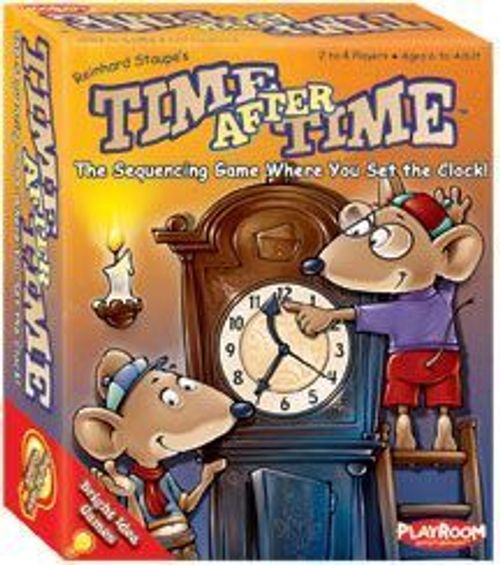
Time After Time
Time After Time Rulebook
Table of Contents
Table of Contents
Contents
- 34 Time cards (06H00 to 22H00, two copies of each)
- 2 Ghost cards
- 28 "?" cards
Principle of the Game
Each player receives 7 "?" cards, which they lay out in front of them. Each "?" space must be filled with a Time card, and every player tries to complete their row of 7 Time cards correctly while avoiding Ghosts.
Each player places cards in whatever order they wish: one may first place a Time card in the middle, then one all the way to the left, then one toward the right, and so on. One logical rule must nevertheless be respected: from left to right, the times shown must increase. The difference between two neighbouring times does not matter, but the times must always advance.
Example: Chloé first places the Time card 12H00 on one of her "?" cards. On her next turn she places 17H00. Then 08H00. The game continues... Finally she places 20H00, so she has correctly covered her 7 spaces.
Setup
Each player receives 7 "?" cards, which they lay out in front of them.
With 2 or 3 players, the unused "?" cards go back into the box. With 2 players, one Ghost card is also put back into the box.
The remaining Ghost card(s) are set aside. Then the 34 Time cards are shuffled and the following number is taken:
- 2 players: 13 Time cards plus the Ghost,
- 3 players: 19 Time cards plus the 2 Ghosts,
- 4 players: 26 Time cards plus the 2 Ghosts.
This set of 14, 21 or 28 cards is shuffled and dealt so that each player receives 7 cards.
The remaining Time cards form the draw pile, face down, in the centre of the table.
It is necessary to pay attention and anticipate in order to place each Time card logically. For example, a 06H00 card must be placed at the far left, a 22H00 card at the far right, and a 19H00 card fairly far to the right, and so on.
Gameplay
Players take turns clockwise. The youngest player begins: they draw a card at random from the hand of their right-hand neighbour. They show the card and clearly announce the time shown before placing it, face up, on one of their still-free "?" spaces. Their turn is then over, and the next player does the same, and so on.
Example: Lucas begins. He draws a card from his right-hand neighbour Nicolas. The card shows 14H00. Lucas announces "fourteen hours" and decides to place the card, face up, toward the middle of his "?" spaces.
Next, Lucas's left-hand neighbour, Martin, draws a card from Lucas's hand. The card shows 21H00. Martin announces "twenty-one hours" and chooses to place this card at the far right of his row.
When a player draws a Ghost from their right-hand neighbour, they briefly show it to the other players and add it to their hand. Their turn is over: they may not place any card, and the next player takes their turn.
If the drawn card is a Ghost, the player must draw a second card.
Likewise, a player who has only one (or two) Ghost(s) left in their hand must announce this and draw immediately, so as to have at least one Time card in hand.
Before a card is drawn from a player's cards, each player may secretly rearrange their hand and change the order of their cards, in particular after having received a Ghost. As the game progresses, each player has fewer and fewer cards and the danger of catching a Ghost increases!
A player must always have at least one Time card in hand. A player whose last card is taken therefore takes the top card of the draw pile without showing it; if it is a Ghost, they must draw a second card.
When a player cannot place in front of them the Time card they have just drawn, they ask aloud whether another player could still place this card in front of them:
- If at least one opponent answers "Yes", the player must keep this card so that it stays in play. Their turn is over and the next player takes their turn.
- If no opponent answers, the player discards the card into the box (it will no longer be used), then draws a card without being able to place it. Their turn is over.
Exhausted Draw Pile
It is very rare, but the draw pile may run out. Play then continues without drawing until a player has no cards left in hand, which ends the game. If this player does not meet the victory conditions, the game ends in a tie.
Emergency Cases
It sometimes happens that a player places their Time cards illogically, making it impossible to correctly complete their 7 spaces. In that case they must play as follows: on their turn, they do not draw a card from their right-hand neighbour, but instead move either one or two of their Time cards already placed by one position (to the left or to the right). This may only be done in case of an obvious error.
End of the Game
As soon as a player who has no Ghost in hand correctly covers all 7 spaces with 7 Time cards, the time advancing from left to right without any duplicate, they are declared the winner. The game ends immediately.
A player who has a Ghost in hand and has correctly filled their 7 spaces may no longer place any card, but must continue to play. On their turn, they draw a card from their right-hand neighbour as usual, to complete their hand. They will win when their left-hand neighbour has rid them of all Ghosts. An opponent may, however, get ahead and win before them!
Time has its own logic. Pay careful attention to where you place your cards: a rational arrangement leads to victory!