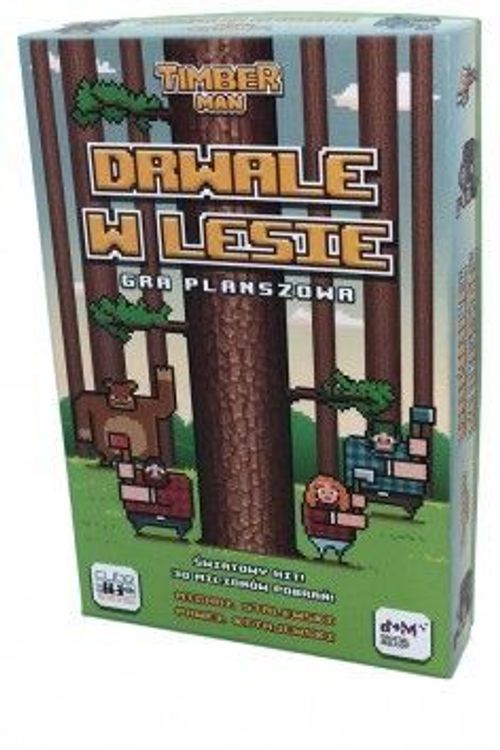
Timberman
Timberman Rulebook
Table of Contents
Table of Contents
Components
- 54 forest tiles:
- 12 trees worth 3 points
- 12 trees worth 2 points
- 12 trees worth 1 point
- 6 lakes
- 6 stones
- 6 bears
- 50 lumberjack tiles (in 6 colours)
- 36 scoring markers:
- 12 yellow markers (3 points)
- 12 grey markers (2 points)
- 12 brown markers (1 point)
- 1 cloth bag for the forest tiles
- Expansion: Magic Berry (5 tiles)
- Expansion: Spider (5 tiles)
- Rulebook
Setup
-
Prepare the forest tiles:
- Put all the forest tiles into the cloth bag. The bag should contain 54 forest tiles.
- 2 players: remove 12 random forest tiles from the bag.
- With expansions: add the tiles from the chosen expansion(s) to the bag and mix them with the base forest tiles. Then randomly remove from the bag as many forest tiles as the number of expansion tiles you added.
-
Prepare the lumberjack tiles:
- 2 players: each player takes 12 lumberjack tiles in a colour of their choice (orange or purple).
- 3 players: each player takes 8 lumberjack tiles in a colour of their choice (orange, purple or yellow).
- 4, 5 and 6 players: each player takes 6 lumberjack tiles in a colour of their choice (orange, red, purple, yellow, blue or grey).
Each player places their lumberjack tiles in front of them on the table.
-
Draw your starting forest tiles: each player draws 3 forest tiles from the cloth bag without showing them to the other players. They may hold them in hand or keep them face down on the table.
Start of the Game
The youngest player decides who starts the game. The player seated to the right of the first player draws 1 forest tile from the cloth bag and places it face up in the middle of the table. Then the first player takes their turn.
Gameplay
Players take their turns in order, clockwise, starting with the first player.
On your turn, perform the following actions, keeping to the given order:
-
You must place one of your forest tiles next to the tiles on the table, following the rules of the game. You may place one more of your forest tiles next to the tiles on the table, following the rules of the game. Note: if a player cannot place their first forest tile, they lose their turn!
-
You may additionally place one of your lumberjack tiles next to the tiles on the table, following the rules of the game.
-
You ALWAYS draw 1 forest tile from the bag (regardless of whether you placed 1 or 2 forest tiles in step 1), as long as there are tiles left in the bag. If the bag is empty, this step is skipped.
Then the turn passes to the next player (clockwise).
Rules for Placing Forest Tiles
On your turn you must place one of your face-down forest tiles next to the tiles on the table, applying the following rules:
A forest tile must be placed so that at least one of its sides touches a forest tile or a lumberjack tile of any colour that is already on the table.
Depending on the type of tile placed, carry out the appropriate action:
- Tree worth 3 points: after placing it on the table, place a 3-point marker on it.
- Tree worth 2 points: after placing it on the table, place a 2-point marker on it.
- Tree worth 1 point: after placing it on the table, place a 1-point marker on it.
- Lake: an obstacle; it does nothing.
- Stone: an obstacle; it does nothing.
- Bear: immediately after it is placed on the table, all lumberjack tiles that touch this tile return to their players. Note: the bear stays on the table until the end of the game. It may happen that, after the lumberjack tiles are removed, the bear is some distance away from other tiles and does not touch any other tile. This is a completely allowed situation.
Rules for Placing Lumberjack Tiles
In your turn, after placing forest tile(s), you may place one of your lumberjack tiles, applying the following rules:
- A new lumberjack tile must be placed so that at least one of its sides touches any tile (forest or lumberjack) already on the table. It may not be placed touching only the corner of a tile on the table!
- You may place only one lumberjack tile per turn.
- You may not move a lumberjack tile from one part of the forest to another.
Note: you do not have to place a lumberjack tile next to the forest tile you have just placed. You may place it next to any tile already on the table. Think strategically!
End of the Game and Scoring
The game ends at the end of the turn in which the last forest tile is placed on the table (no player has any forest tiles left). Then scoring takes place. Every tree tile that has a scoring marker on it is evaluated based on the lumberjack tiles that touch it side to side, as follows:
- If no lumberjack tile touches the tree tile side to side, the marker on that tile is discarded.
- If one or more lumberjack tiles touch the tree tile, the marker on that tree goes to the player who has the most lumberjacks touching the tree tile side to side.
- If 2 or more players have the same number of lumberjack tiles touching the tree tile, the marker on that tree is discarded.
Markers:
- Yellow marker = 3 points
- Grey marker = 2 points
- Brown marker = 1 point
The player who has collected the most points in total wins the game!
Example scoring (the tree being evaluated is marked with an orange frame):
- Fig. 5: Only 1 red lumberjack tile touches the tree. The grey 2-point marker goes to the red player.
- Fig. 6: One red lumberjack tile and one blue lumberjack tile touch the tree. Neither player has an advantage in this situation, so the brown marker on the tree is returned to the box. No player scores points.
Translator's note: the scoring rule in the Polish original contains a garbled sentence ("jeden lub więc kafelków", "gracz, który ma więcej drwali sąsiadujących krawędzią kafelka sąsiaduje bokiem"). The text above follows its evident meaning, which the Polish scoring example (Fig. 5 and 6) confirms.
Notes
- Remember that you have a limited number of lumberjacks to place during the game.
- You do not have to place a lumberjack on the table every turn; sometimes it pays to wait.
- Bear tiles can be used to remove your opponents' lumberjacks from the play area, but also to recover your own. Every lumberjack removed from the game by a bear returns to the player who plays that colour.
- Shorter game: if you want to shorten the playing time, halve the number of tiles in use. Prepare six forest tiles each with trees worth 3, 2 and 1 point, and three forest tiles each with lakes, stones and bears. You will also use fewer lumberjacks: 9 in a 2-player game, 6 with 3 or 4 players, and with 5 or 6 players each player gets 4 lumberjack tiles.
- It is possible that, after the forest tiles in the bag run out, some players run out of forest tiles while others still have them. In such a situation, the turn of a player without forest tiles is skipped, and the players who still have forest tiles keep playing until they run out too.
Expansions
Once you know the basic rules well, you may add the tiles from the expansions. Remember! After adding the tiles of one (or several) expansion(s) and mixing them with the base forest tiles, you ALWAYS randomly remove from the game as many forest tiles as the number of tiles you added.
- Spider (5 tiles): place a Spider tile on any lumberjack. From that moment, that lumberjack does not act. Remember! Such a lumberjack can still be frightened by a bear (in this way you can return it to the game; in such a case the Spider is discarded from the game).
- Magic Berry (5 tiles): at the end of the game, when resolving which lumberjacks are most numerous around a tree, each lumberjack that touches a Magic Berry tile is counted as two lumberjacks.