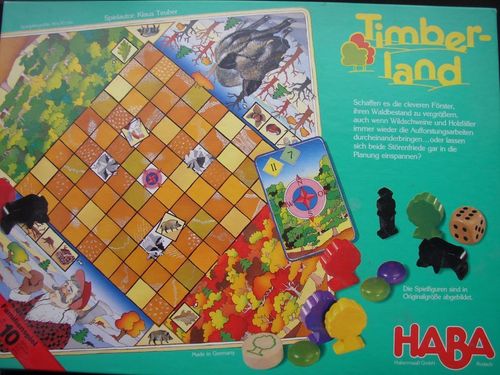
Timberland
Timberland Rulebook
Table of Contents
Table of Contents
Components
- 1 game board
- 32 playing cards
- 1 special die
- 50 trees
- 19 fruits
- 1 forest stone
- 1 woodcutter
- 1 wild boar
- 1 rulebook
The game board shows a forest clearing with three rocks and a compass rose that indicates the points of the compass. The edges of the board are labelled WOODCUTTER, SPRING/SUMMER, AUTUMN and WINTER. The label SPIELBEGINN (game start) is printed at the left edge of the board.
Object of the Game
Each player tries to form as many forests as possible with the trees of their own colour on this clearing.
Trees of the same colour form a forest when they stand on spaces that touch directly, edge to edge (not diagonally). In the example on the printed sheet, the light trees form a forest of two and the dark trees form a forest of three.
The larger a player's forests, the more points that player receives, with a maximum of ten points per forest (for four or more connected trees). The player with the most points at the end of the game wins. This is usually the player who, through clever use of the playing cards, steers the two disruptive figures, the woodcutter and the wild boar, to their own advantage.
Setup
Arrange the cards. The playing cards are sorted by their Roman numerals. This creates four stacks of 8 cards each. The player who rolls the highest takes card stack I. The next player clockwise receives card stack II, and so on.
Distribute trees and fruits. Each player receives:
- With 2 players: 15 trees and 6 fruits in red or green.
- With 3 players: 11 trees and 4 fruits in red, green or yellow.
- With 4 players: 9 trees and 3 fruits in red, green, yellow or violet.
Place the forest stone, woodcutter and wild boar. The woodcutter and the wild boar are placed on their corresponding start spaces of the forest clearing. The start spaces have no further significance during the rest of the game. The forest stone is placed on the AUTUMN space.
Sequence of Play
The game is normally played over two game years. Three or four game years are also possible (see the extended rules). A year is divided into four game phases:
- AUTUMN: Fruits fall from the trees.
- WINTER: The wild boar distributes the fruits.
- SPRING/SUMMER: Fruits are turned into trees.
- WOODCUTTER: Some trees are felled.
Start of Game
The forest stone marks the current game phase. The game begins in autumn.
Autumn
Place cards face down. Each player chooses one of their cards and places it face down in front of them. All players then reveal their cards together.
Place trees and fruits. The player with the highest card value begins. They place three of their trees on any three free spaces of the forest clearing. Then they place their fruits on free spaces that border their trees directly, edge to edge (not diagonally). The other players do the same in the order of their card values.
In autumn, fruits may only be placed on free spaces that directly border trees of the same colour. (The printed example grid shows one fruit crossed out, because it does not border a tree of the same colour.)
Exception. In the second game year it can happen that a player can no longer legally place a fruit next to their own trees. That player may then place this fruit, as an exception, on any free space.
Important. Trees and fruits may always only be placed on free spaces of the forest clearing. They may not be placed on spaces occupied by the wild boar, the woodcutter or a rock, or on spaces already covered by a tree or a fruit. Note: the space with the wind rose and the start spaces of the woodcutter and the wild boar count as completely normal free spaces.
Winter
Winter rounds. The forest stone is moved to the first winter space. Winter consists of three rounds. After each round the forest stone is moved one space further.
Place and reveal cards. Each player places one of their cards face down in front of them, and then all players reveal their cards together. The player with the highest card moves the wild boar first, followed by the player with the second-highest card. When playing with three or four players, the remaining players have no influence on the course of play in this round.
Cards are used up over the course of a year. Players lay out their played cards face up in a row in front of them, so that every player can see at any time which cards have already been played.
Moving the wild boar. Whoever may move the wild boar rolls the special die. They must move the wild boar straight or diagonally across as many spaces as the number of pips rolled. While doing so they may pick up to three fruits from the spaces the wild boar passes over. If the wild boar is left standing on a space with a fruit, that fruit must be picked up in every case.
Example. A player has rolled a 6. They move the wild boar onto the space with the light fruit; this fruit they must pick up in every case. Of the three dark fruits they may choose two. The fruits picked up may then be placed by the player on any free spaces of the forest clearing; they need not be spaces bordering trees.
In this way, a player can use their own fruits to lay the groundwork for new or larger forests. Fruits of other colours should be placed as unfavourably as possible.
Further rules for the wild boar:
- The wild boar may not be moved over the same space twice during one turn.
- The wild boar may not be moved over spaces with rocks or trees.
- If the wild boar's move cannot be carried out in full, the wild boar is placed on any free space and moved from there.
- The woodcutter and the wild boar may stand together on the same space.
Placing the forest stone. After three winter rounds, the forest stone is placed on SPRING/SUMMER.
Spring/Summer
In this round no cards are played. The player who placed the highest card in autumn first converts their fruits into trees. The other players follow in the order of their autumn card values. The following rules apply:
1. Convert fruits. Fruits can only become trees if they receive enough light. A fruit must have at least one directly adjacent "light space" in order to be converted into a tree. Otherwise it is removed from the playing field without replacement. A "light space" is a space on which there is neither a tree nor a rock.
2. Trees die. A tree dies when a newly created neighbouring tree takes its last "light space". It is removed from the playing field. Note: neighbouring fruits, the woodcutter, the wild boar and the wind rose take no light from trees and fruits.
Returning pieces. Fruits and dead trees are returned to their owners. If needed, they may be placed again.
Example. To illustrate this rule, here is an example.
The player with the dark figures begins. First they remove fruits A and B, because these have no neighbouring "light spaces". Fruits C and D they convert into trees.
Now it is the turn of the player with the white figures. They may choose the order in which they convert their fruits into trees. If they first converted fruits F and G into trees, they could no longer convert their fruit E into a tree, because it would then no longer have a neighbouring "light space".
The white player decides to convert their fruit E into a tree first. This settles the fate of tree H: it is removed from the field and returned to its owner.
Then the player converts their fruits F and G into trees, and thereby creates a winning forest of four.
Once every player has converted their fruits and taken back dead trees, the forest stone is placed on the first WOODCUTTER space.
The Woodcutter
For four rounds the warning is "Beware of the woodcutter." After each round the forest stone is moved one space further. In each round every player places one of their cards face down in front of them, and all cards are then revealed together.
Only the player with the highest card may move the woodcutter. The permitted direction or directions of movement are determined by the compass direction(s) shown on that player's card. The player determines the distance by rolling the die.
A move is compulsory.
Movement. The woodcutter always moves in a straight line, never diagonally. If, while moving, the woodcutter reaches the edge of the playing field, it is placed on the space on the opposite side, at the same height, and moved on from there. Rocks, the wild boar and the wind rose do not hinder the woodcutter.
Felled trees. The trees over which the woodcutter moves are removed from the game board and returned to their owners.
Example. In the illustration above, the woodcutter moves 6 spaces east, and two trees fall victim to it.
Caution. It can quite easily happen that a player must fell their own trees with the woodcutter.
End of the First Game Year
A scoring is carried out. Trees of the same colour whose spaces border each other directly, not diagonally, form a forest. Each player receives:
- for a single tree: 1 point
- for a forest of 2 trees: 3 points
- for a forest of 3 trees: 6 points
- for a forest of 4 or more trees: 10 points
The points are entered in the table at the end of the rulebook.
Scoring example. In the illustration opposite, the player with the light trees receives 4 points for one single tree and one forest of two. The player with the dark trees receives 10 points for a forest of five trees.
Second Game Year
Each player takes their played cards back into hand. The card sets are then exchanged: each player passes their card stack to their left-hand neighbour. If this seems too arbitrary to a player, they may instead roll the die for the cards (see the setup for the first game year).
In principle the second game year is played like the first. There are two small exceptions:
- In autumn no new trees are placed. Players place their fruits next to their already existing trees (see the autumn rule). If a player, for lack of trees, cannot place all of their fruits, they may also place them on any free spaces. But only then.
- The woodcutter and the wild boar are not returned to their start spaces. They remain where they currently are.
End of the Game
The winner is the player who has the highest total score after two game years.
Extended Rules for Three and Four Game Years
Once players are familiar with Timberland, they may try a somewhat longer game. Four game years are recommended for two or four players, and three game years for three players. With this variant it is advantageous if each player plays once with each card stack.
The exceptions described for the second game year also apply to further game years.
Additional rule. If a player in spring/summer no longer has enough trees to exchange all of their fruits, they may choose the fruits they want to exchange. The remaining fruits are then returned to them.
A Few More Tips
At the start of the game it is better to lay out several small forests rather than one large one. A forest of seven trees earns a player the same number of points as a forest of four trees (10 points). A forest of three trees and a forest of four trees together, on the other hand, earn 16 points.
In the winter rounds one should isolate other players' fruits, or better still place them somewhere they can never grow. The diagram shows how the player with the grey trees skilfully places the fruits they have picked up.
The player had rolled a 6. They move the wild boar so that it can pick up two black fruits and one of their own grey fruits.
One black fruit is placed on the bottom-right corner space. This fruit cannot be converted into a tree in spring (it has no neighbouring "light space").
The other black fruit threatens the existence of both the black tree and the white tree.
The player's own grey fruit would, in spring, become a tree in a respectable three-forest.
But the player must still reckon with the fact that their opponents, in the following winter round, will pick up fruits and place them to the player's disadvantage. Therefore the player first moves the wild boar far away from their own fruits.
Score Sheets
The printed score sheets (blank tables on the last two pages of the German manual, for recording each player's points for the first game year, the second game year and the total) are not reproduced here.