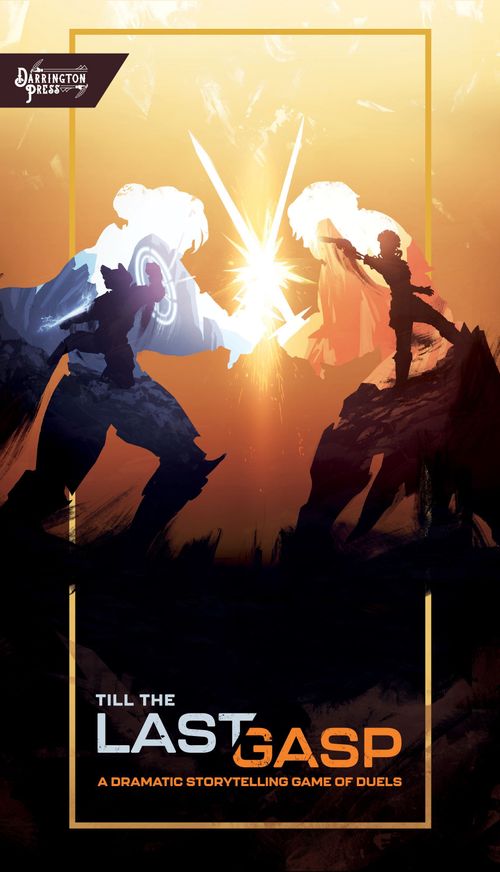
Till the Last Gasp
Till the Last Gasp Rulebook
Table of Contents
Table of Contents
- Quick Start Guide
- Introduction
- Materials
- Player Setup
- Play Aide Setup
- Get Ready to Play
- What Is a Duel?
- Create Characters
- Set the Stakes
- Choose Objectives
- Confront Your Foe
- Ready Your Weapon
- Duel for at Least Four Rounds
- Bring the Battle to Its Decisive End
- Part As Friends
- More Ways to Play
- Scenarios
- Glossary
Quick Start Guide
-
Get Ready to Play (do these steps together):
- Make sure you have all the game materials you'll need.
- Talk about the kind of story you want to tell together.
- Introduce the X-Card.
- Review the maps, and choose one together.
- Put a spare map down with the back side up. This is a Play Aide so you can track rounds, have a place to put the Drama Deck, and view information about the game.
- Each player puts a Round Token in the round 1 slot on the Play Aide.
-
Create Characters:
- Each player decides what their character is Known as, Notorious for, and Recognized by.
- Each player determines the Overt and Hidden Motivations for their character.
-
Set the Stakes:
- Together, decide if your characters are fighting a duel To Defeat, To Exile, To a Turn, or Till the Last Gasp.
-
Choose Objectives:
- Each player draws three Objective Cards, and chooses the one that appeals to them the most. They discard the other two.
Introduction
Welcome to Till the Last Gasp, a roleplaying game about dramatic, emotionally charged duels. It is a game for two players and can be played in 60 to 90 minutes.
You will create two duelists, decide the reasons they're fighting each other, and pick a location in which the fight will take place. Then, you'll play out their duel over a series of rounds, rolling dice to see how many Action Points you have available, then planning the Actions that character can take to strategically take down their foe. You'll also have a set of Objectives for your character. When you've completed at least three of these specific Objectives, and played at least four rounds, you can bring the battle to its decisive end.
That decisive end might mean your character's triumphant victory. It might instead mean their glorious defeat. It might mean a truce between your characters—or a kiss. One might even convince the other to join their cause. How the battle ends is up to you, the players, because Till The Last Gasp isn't just about fighting. It's about big feelings, bold speeches, devastating betrayals, and climactic showdowns in breathtaking vistas.
It's about telling a cool story together.
Throughout the game, you'll draw Drama Cards that will help both players reveal your characters' secrets, motivations, true feelings, and history. When in doubt, do what feels dramatic. Go overboard. And most importantly, have fun!
The best way to learn this game is to play it—grab one of our sample characters, review the Quick Start Rules (pg. 4), and see what happens when you take a stand, roll your dice, and get lost in the heat of battle.
Materials
The following materials are provided in the Till the Last Gasp game box. Make sure you have everything listed here before you begin.
- 2 Duel Dice (d20)
- 20 Edge Dice (d6)
- 2 foldable Player Boards
- 9 Jumbo Map Cards
- 12 Pre-Made Characters (on 6 double-sided sheets)
- 2 Blank Character Sheets
- 1 Wooden Location Tracker
- 1 Drama Deck (49 cards)
- 1 Objectives Deck (13 cards)
- 10 Stance Cards (5 each)
- 1 X-Card
- 2 Action Point Tracker Tokens
- 2 Round Tracker Tokens
- 1 Stakes Tracker Token
- 11 Blue Objective Tokens
- 8 Orange Objective Tokens
Map Cards
On the table between the two players, you will set up a Map Card. This will be the setting for your duel. See Choose a Map (pg. 11) for guidance. You will also need your Location Tracker to show where on the map the battle is taking place currently. This game comes with 9 Map Cards.
Player Setup
Each player starts the game with a Player Board, 1 set of Stance Cards, 10 Edge Dice, 1 Duel Die, and 1 Action Points Token. The dice and Action Points Token will match the color of your Player Board. Each player also starts the game with a Character Sheet. If creating your own characters, you can find additional blank sheets at http://darringtonpress.com. You will want pens or pencils to fill them out.
The Player Board's printed note at the bottom reads: "Complete 3 Objectives and 4 rounds to gain this climactic Action in every Stance," next to the Action "End the Duel Decisively" (4 Action Points).
Dice Results table
| Roll | Action Points |
|---|---|
| 1-4 | 1 |
| 5-9 | 2 |
| 10-14 | 3 |
| 15-19 | 4 |
| 20 | 5 |
Play Aide Setup
On the back of each Map Card, you'll find a Play Aide. Once you've chosen a Map Card, use the back of one of the unused cards to set up the Play Aide in the center, next to the chosen Map. Place the Drama Deck facedown on the appropriate spot on the Play Aide, and place the two Round Tokens on the first Round Number slot.
Set the Objective Deck next to the Play Aide. See Choose Objectives (pg. 18). Have the Stakes Token nearby, and see Set the Stakes (pg. 12). Set the X-Card in the middle of the table as well.
The Play Aide's Round Order lists, in order: Choose your Stance; Roll for Action Points (the player with the higher Duel Die roll takes the first Action); Spend Action Points to take Actions (each player alternates taking Actions until all Action Points are spent); Mark off completed Objectives; Set Round Number.
Get Ready to Play
Discuss the Story You Want To Tell
By playing Till The Last Gasp, you are working together to build a collaborative story that's fun for both of you. When setting up your game, discuss what kind of duel you want to play out and any topics you'd rather avoid. Working together on a story means making agreements like: let's do horror, but no zombies. Let's have our characters be lifelong friends, but not romantically involved. Collaboration sometimes requires compromise, but it also allows two people to come up with ideas, images, and moments that neither one would have imagined on their own. The players are more important than the game.
Introduce the X-Card
Improvising a story means you never know what will happen next. That's the fun of it—but it also means the game could go in a direction that players don't want. That's why this game comes with an X-Card.* The X-Card is a tool that allows either player to immediately remove content that anyone is uncomfortable with. If something comes up that you don't want in your story, just say, "Let's X that," or tap the X-Card. That provides a clear signal to your fellow player that you aren't into the idea you're currently discussing and should come up with a new one.
Think of it as a Get Out of Topic Free card. Use it whenever you need to. If your fellow player uses it, thank them and then work together on a fun alternative to the original idea. It'll sound something like this:
"So, I'm thinking my character is your character's mom—"
"Ah ... I want to X that."
"Ok, thanks! Sisters?"
"I was thinking ex-girlfriends!"
"Haha, great! Let's use it."
or
"Hundreds of spiders pour out of the ground..."
tapping X-Card
"No spiders! Got it. Thank you. How about snakes?"
"Snakes rule."
Place the X-Card somewhere easy to reach.
*The X-Card was created by John Stavropoulos (http://tinyurl.com/x-card-rpg).
Choose a Map
Look through the maps included with the game. Each map reflects different genres, moods, and settings, providing a backdrop to your duel.
Without worrying about the text on the maps, see if any of the locations are inspiring to either player. If one seems exciting to both players, or if it gets them thinking about cool character ideas, relationships, or dramatic moments, put that map on the table! If not, skip it for now. You can always decide on your characters first, then come back and select a map that works with those characters. If you pick a map, but decide during character creation that it doesn't fit, you can always choose a new one before you start playing.
Once you're familiar with the game and how it works, you might want to make your own!
Grab one of the Map Cards you're not using and flip it over. The back of the map is a Play Aide and includes places to track the round and the stakes, hold the Drama Deck and discard pile, and view information about gameplay. Place it between you where you can both read and access it easily.
What Is a Duel?
Simply put, a duel is two people having a showdown. They fight until one person is decisively declared the winner according to whatever stakes the duelists have set. Those stakes can be raised by either party at any time.
You might duel with swords, guns, or bolts of lightning. You can throw darts, throw hands, or throw shade. You can bloody your opponent with a switchblade or overwhelm them with psionic onslaught. Use whatever you both think would make a good story. First and foremost, your characters have a powerful and personal reason to fight. It might be for revenge, to defend something they love, to prove a point, or to prove themselves. They might insist that they're just here to do what's necessary, but it's never that simple. A duel is, by its nature, unwise. It shows a desperate willingness to risk death for a chance at justice. Keep that in mind. Let your characters be principled but messy, determined but torn, motivated by ideals and base instincts at the same time.
Create Characters
Your characters are evenly matched as duelists, but these character sheets will allow you to develop a sense of what makes them unique and interesting. They consist of a few key pieces of information, which you can answer as simply or elaborately as you like: what they are Known as, what they are Notorious for, what they can be Recognized by, their Overt Motivation for entering the duel, a Hidden Motivation for dueling that even they might not be aware of, and any Additional Details you want to include.
These characteristics will help inspire your play. If you're ever not sure what your character should say or do next, let the information on your character sheet guide you. Also: know that your character will continue to develop as you play.
If you'd like to skip this part and get right to playing the game, pick one of the pre-made characters that comes with the game and skip right to Set the Stakes (pg. 16).
Making characters can be a lot of fun! If you'd like to make your own characters, write down answers to each of the following on a sheet of paper, or on one of our blank character sheets.* You can also randomize some or all of your character's traits. If you're stuck on any of these characteristics, roll a twenty-sided die and pick the result on the corresponding table.
*Blank character sheets can be downloaded at http://darringtonpress.com.
Known As...
Think of a name for your character. It can be useful to do this part last. You could also roll a random name on the table below and build your character from there.
| d20 | Known As |
|---|---|
| 1 | Kulmar, Descended From Stars |
| 2 | Lieutenant Hazel Sharpe |
| 3 | Sammy the Blade |
| 4 | The Exterminator |
| 5 | Ataraxia, Dragon Rider |
| 6 | Princess Suon Rotha |
| 7 | Sal, who used to be in movies |
| 8 | Gold Medalist Yawara Nakamura |
| 9 | Andy |
| 10 | The One Who Arrives in Feathers and Jewels |
| 11 | Duarte, Vampire Prince |
| 12 |
Notorious For...
Think of this as your character's reputation. Ask yourself: what do people immediately associate them with? What part of their life or personality is most distinctive? What your character is Notorious for might be an exaggeration or even an outright lie, but the fact that people believe it says something about your character.
| d20 | Notorious For |
|---|---|
| 1 | Their unfailing adherence to social custom |
| 2 | Their wild imagination and ability to express it |
| 3 | Their irresistible charisma |
| 4 | Their grim stony countenance |
| 5 | Their unfailing optimism |
| 6 | Their absolute refutation of all social decency |
| 7 | Their blunt, cruel honesty |
| 8 | Their continued devotion to something long dead |
| 9 | Their infectious, and sometimes exhausting, excitement |
| 10 | Their well-earned pessimism |
| 11 | Their deeply-held spiritual beliefs |
Recognized By...
This is the first impression your character makes. Ask yourself: what makes them stand out in a crowd? If a bounty hunter were sent after your character, what information would they be given? This can be a single characteristic or a full description. Consider your character's demeanor as well as their appearance.
| d20 | Recognized By |
|---|---|
| 1 | Bright, colorful plumage |
| 2 | Mismatched, threadbare clothing |
| 3 | Flowing hair woven with flowers |
| 4 | Broad, muscular shoulders |
| 5 | Piercing blood-red eyes |
| 6 | Antennae that twitch with curiosity |
| 7 | A limp and an elegant silver cane |
| 8 | Their family's crest, always on display |
| 9 | The graceful movements of an accomplished dancer |
| 10 | A unique prosthetic limb |
| 11 | An unearthly and almost unbearable beauty |
Overt Motivation
How did this duel start? Why are these two people fighting? What has made each character so desperate to dominate, defeat, or destroy the other? Their overt motivation is something they would proudly declare, to their opponent or anyone else.
Your character might be defending someone's honour, preventing a catastrophe, making a savvy political move, or settling a personal score. Think about what they would say at the very beginning of the duel.
Discuss motivations with your fellow player. Think about needs and desires that are fundamentally incompatible with your foe's. Ideological differences and petty spats are both equally ripe for the dramatic, messy conflicts that Till The Last Gasp is designed for.
| d20 | Overt Motivation |
|---|---|
| 1 | I will not suffer another insult. |
| 2 | I have my orders. |
| 3 | You hurt someone I loved. |
| 4 | You don't deserve the respect you've been given. |
| 5 | You really get on my nerves. |
| 6 | I cannot have my eternal rest until you are defeated. |
| 7 | The bounty was too high to resist. |
| 8 | There's someone I need to impress. |
| 9 | This isn't for me, it's for someone else. |
| 10 | I'll prove I'm stronger than you. |
| 11 | You've stolen something from me, and I must reclaim it. |
Roleplaying Tips
When it's your turn, be obvious. It may sound odd, but trying to be clever or surprising is rarely as engaging as saying the obvious thing. If it seems clear to you that a knight with long flowing pink hair would wear a signet ring engraved with her prince's crest, say so. If you immediately think that your character would respond to the other character's apology with disdain, then go for it. Speak freely about what your character thinks, feels, wants, says, and does. Offer up your ideas like the gifts they are.
When it's the other player's turn, listen carefully. Accept your fellow player's ideas like the gifts they are. Pay attention to what they introduce to the fiction. Try to listen more than you talk. Ask questions. If you incorporate their ideas on your turn, they'll be delighted. Remember to let them decide what their character thinks, feels, wants, says, and does.
Don't forget the scenery. Although Till The Last Gasp is focused on two main characters, there is a big beautiful world around you. Your duel might take place amid driving rain, claps of thunder, the hum of the central mainframe, or the din of the city below. Take time to describe what your characters see, hear, and feel, whether it's the merciless heat of twin suns or the ground crumbling beneath their feet.
Hidden Motivation
What's really going on here? What private hurts and personal grievances are at play? Why can't these two people sit down and talk about this like adults?
Each character has a hidden motivation driving them. This is something they wouldn't readily admit—perhaps not even to themselves. They may have a strategic reason for keeping this to themselves. They might be sworn to secrecy. They might just be embarrassed about it.
You, as players, can freely share this information with each other. You may find that being transparent leads to a more interesting game, in which you can deliberately play with information that your characters are unaware of or refuse to acknowledge. Dramatic irony is fun!
| d20 | Hidden Motivation |
|---|---|
| 1 | You've become someone I can't stand. |
| 2 | I'm being blackmailed. |
| 3 | I still love you and can't stand it. |
| 4 | I'm attracted to you and can't stand it. |
| 5 | Someone chose you over me. |
| 6 | I resent the attention you get. |
| 7 | I'm involved in your past and you can't know. |
| 8 | I want to humiliate you. |
| 9 | I want to stop thinking about you. |
| 10 | I don't deserve what I have. |
| 11 | If I lose, you'll get the accolades you deserve. |
Set the Stakes
You've decided together who your characters are, what setting they come from, and why they are determined to resolve their differences through a one-on-one test of strength and will. Now, decide how your characters will declare a winner. This isn't a senseless brawl, after all; a duel requires agreement. Therefore, decide together what the stakes are:
To the Defeat. At this lowest level, the duel ends with one of the duelists defeating the other. No one needs to lose their life, their home, or their allegiances. One of them will simply be declared the winner, according to the rules of their particular form of combat—the loser might cry mercy, be pinned to a count of ten, or have a knife pressed against their throat, knowing what the slightest pressure could do. The important thing is that the characters know who's won.
To Exile. It might not be enough for one character to demonstrate their martial superiority. If fighting to exile, the defeated duelist is forced to leave a place or a group, never to return. A rebel might be cast out, a mercenary might be told they aren't up to company standards, or a knight may be banished.
To a Turn. A character who has turned has decided to join the other character's cause, group, or quest. They might defect to the opposing side in an ongoing conflict, swear to loan their skills to a band of mercenaries so long as they're allowed to live, or join the rebellion they've been trying to quell. Fighting to a turn means that the two duelists end the duel united.
Till the Last Gasp. At these stakes, at least one character will die. To fight till the last gasp means that the characters are willing to risk their lives—and are willing to kill—in the name of whatever desire or ideal they're fighting for.
Raising and Lowering the Stakes
At any time, both players can decide together to raise the stakes. Do this whenever it feels right. As you play, you'll notice shifts in the tone of the story, a sense of escalating or de-escalating drama. You can discuss raising the stakes out of character, and bring it into the story through roleplaying.
"I admire your spirit. Let's put this petty conflict aside, and work together."
"Fight beside you? After everything you've done?"
"We would be unbeatable! Upon my victory, swear you'll join me."
"And what if I win? Would you join my cause?"
"A distant possibility. But I suppose that's only fair."
At any time, either player can decide to lower the stakes. Both players should agree when it comes to escalating the intensity and lethality of the story they're telling together, but de-escalating is something anyone can do. Some players don't like having their character killed without their permission, for example. When your fellow player asks to lower the stakes, respect that and enjoy the flow of the story.
"Go on, finish it. We swore we would fight to the bitter end."
"No. Death is too glorious an end for you. Leave this place, and never return."
or
"Wait! You have every right to kill me. But please. Mercy. For her sake."
"You would dare bring her into this?"
"You know that my death would only embitter her to your cause."
"Very well. Know that I do this for her, not you. Now get out of my sight."
Choose Objectives
In order to bring your duel to its decisive end, you'll need to:
- Complete at least 4 rounds
- Accomplish at least 3 Objectives
Objectives are listed in groups of four on the Objective Cards. Draw three Objective Cards from the deck and choose whichever card seems most interesting to you. Objectives are strategic moves with a dramatic edge—moving your duel around the map, changing Stances mid-round, destroying scenery in a particular way—that keep the battle interesting while giving you opportunities for roleplaying.
Notice that the Objective Cards have titles. If you're not sure which Objectives are more or less interesting, choose your card based on the title's vibes. Ask yourself: "How do I want this character to show up to the duel?" and choose whichever card title gives you the most satisfying answer.
Use Objective Tokens to mark off Objectives as they are completed. Some Objectives have multiple steps. Use blue tokens for the initial steps, and orange tokens for the final step. For example, "Land a hit on your foe, and in the next turn, Rattle them." has two slots. You'd mark the first with a blue token and the second with an orange one. (Note: If you land a hit, but don't Rattle them in the next turn, remove the blue token from the first Objective—doing the steps in order is part of the Objective!)
You only need to complete three of your four Objectives to gain access to the game-finishing Action, and you don't need to complete them in any particular order.
Determining Objectives
- Draw three Objective Cards.
- Read the Objectives on each.
- Select the card that has the greatest number of Objectives you want to play with in this duel and discard the other two.
- Place the selected Objective Card in the Objective slot on your Player Board.
Confront Your Foe
The beginning of any duel is the confrontation: the moment when the duelists regard, acknowledge, or challenge each other before battle. They've already decided that they should have a duel. They've set the terms and the time. All that remains is to draw their weapons and move toward each other.
To dramatize the tension that comes before any great duel, each player has two tasks:
Describe how your character shows up. How does your character appear on the scene? They could be throwing open doors, emerging from a time portal, or leaning against a wall like they've been there for hours. This is the introduction to your character; take a moment to express whatever you want about their appearance, their attitude, and how they're approaching their foe.
Pose a question to the other player about their character. You can pose this question as your character speaking to theirs, or ask it yourself to your fellow player. Either way it must be answered. If you can't think of a question, roll a six-sided die and take the result from the following table.
| d6 | Question |
|---|---|
| 1 | When was the last time we saw each other? |
| 2 | What did you abandon to be here? |
| 3 | What do you fear, right now? |
| 4 | Why couldn't we have settled this another way? |
| 5 | What do you want most, right now? |
| 6 | What memory does this meeting evoke? |
Ready Your Weapon
At the start of the duel, you will prepare five dice, Readying your weapon before entering combat.
- Take five Edge Dice out of your dice pool.
- Place them in dice slots, divided however you prefer onto the Protective and Offensive sides of your board. Dice in these slots are Ready to be rolled to generate Action Points in upcoming Rounds.
Ready Five Edge Dice
Both players have a pool of ten six-sided dice (10d6), which are called Edge Dice. At the beginning of the game, you can Ready exactly five Edge Dice. Each round, you'll roll some of the Edge Dice you have Ready to generate Action Points, which you spend on doing Actions.
You can only roll dice which are already Ready, and every time you roll an Edge Die it returns to the dice pool. This means that unless you are taking Actions to Ready an Edge Die, your set of Readied dice will be dwindling throughout gameplay.
Don't worry—you will also roll one of the twenty-sided Duel Dice to generate Action Points at the start of each round, so you will never encounter a situation where you can't generate any Action Points at all. You will also be able to use the Action "Ready an Edge Die" in certain circumstances, which puts new dice on your board. This can even allow you to have more than five Edge Dice readied!
For now, Ready five.
Place Your Edge Dice
At the outset of the duel, decide how to divide your five Edge Dice between the "Protective" (blue) and "Offensive" (red) sides of your Player Board. They will stay there until you roll them at the start of a round to generate Action Points.
If you are in a Protective or Quick Stance at the start of a round, you can roll any number of the Edge Dice on your Protective side.
If you are in an Offensive or Quick Stance at the start of the round, you can roll any number of the Edge Dice on your Offensive side.
If this is your first time playing, you may find it easiest to put three dice on one side and two on the other. This will give you the most flexibility in how you want to play your character.
Duel for at Least Four Rounds
The rounds of gameplay represent the heat of the duel, when Actions are taken, blows are exchanged, and feelings are revealed. This is when players take turns and roll dice. There are four things that need to happen each round, explained below.
Select a Stance
Secretly, pick a Stance card. Then, both players should simultaneously reveal it and put it in the Stance section of your Player Board. Stances indicate the approach your character is taking to this round of combat. It will determine which dice you can roll and which actions you can take during the round.
There are three options: Bold (an offensive Stance), Quick (a ready Stance), and Wary (a protective Stance). These are the Stances you can choose from at the start of the round. Ignore the Rattled Stances for now, as you never start in a Rattled Stance.
At some point during the round, you may be shifted into another Stance. Stance changes happen immediately, so swap out your Stance card accordingly.
Rattled Stances. Certain effects, such as Drama Cards or Stance Actions, force you or your foe to become Rattled. Being Rattled means being disturbed or overwhelmed by what's happening to the extent that it is limiting your ability to fight.
When your character gets Rattled, you will have to put them in one of the two Rattled Stances, Defensive or Reckless. The person being Rattled chooses the Rattled Stance they think their character would go into, unless otherwise specified in the Action that Rattles them.
Roll the Dice
Pick Some of Your Readied Edge Dice
Choose how many of your Edge Dice you want to roll to generate Action Points for the upcoming round. Whether these dice come from the Protective or Offensive side of your Player Board depends on the Stance you've chosen to start the round in (you may choose or be forced to roll zero Edge Dice).
Starting in any of the protective Stances allows you to roll dice from the Protective side of the Player Board. Starting in any of the offensive Stances allows you to choose from the Offensive side. While in the Quick Stance, you can roll dice from either side, but you cannot select dice from both sides during the same round.
Once you have rolled these dice, they will no longer be Readied. They will be put back into your dice pool and thus will not be available for you in any subsequent round. However, you can take Actions that Ready these dice, and you will always be able to use the Duel Die to generate additional Action Points at the start of each round.
Roll the Selected Edge & Duel Dice
Pick up the Duel Die (the 20-sided die) as well as the Edge Dice that you previously picked, and roll all the dice you're currently holding.
Count Your Action Points
Looking at the dice you've rolled, compare each die one by one to the Dice Results Table (on your Player Board and page 24) to count up your available Action Points for the round. Each die generates its Action Points individually. Do not add the dice together.
Set your Action Point Tracker Token on your board to the number of Action Points you've earned this round. As you spend them, you can adjust the tracker.
| Roll | Number of Action Points |
|---|---|
| 1-4 | 1 |
| 5-9 | 2 |
| 10-14 | 3 |
| 15-19 | 4 |
| 20 | 5 |
Generating Action Points examples (each die counts individually):
- Example 1: three Edge Dice and a Duel Die showing 18. The Action Points tracker is set to 8.
- Example 2: two Edge Dice and a Duel Die showing 10. The Action Points tracker is set to 5.
- Example 3: three Edge Dice and a Duel Die showing 8. The Action Points tracker is set to 7.
Put Rolled Edge Dice Back in the Dice Pool
Any Edge Dice that you rolled in this round are no longer Ready. You must put them back in your dice pool, off to the side of your Player Board. (You may use Actions to Ready dice from the dice pool later.)
Confirm Initiative
Whoever rolled the higher number on the Duel Dice goes first in the round. If you both roll the same number, reroll. Feel free to add a dramatic spin when a tie occurs—perhaps your swords have locked, throwing sparks, and you must roll again to see who breaks first!
Take Your Turns
Take Turns Using Actions
Whoever rolled higher on the Duel Dice wins the initiative and thus takes the first turn. A turn consists of one Action, regardless of how many points the Action costs. Pick an Action you want to use from your Stance or the current location on the map and check how many Action Points it costs. Take away that many Action Points from your total, then roleplay what the Action looks, sounds, and feels like. Once a player has taken an Action, it becomes the next player's turn.
When one player is out of Action points, they cannot use Actions on their turn. However, they can still roleplay and describe their character's thoughts, words, feelings, and behaviours in response to their foe's Actions.
Note that Flex Actions allow you to use a variable number of Action Points. This is helpful if you still have Action Points, your fellow player doesn't, and you want to move on to the next round more quickly.
The Ready an Edge Die Action is available in the Protective Stances, as well as in some locations on a map. Each time you use it, you can spend a point to put a single Edge Die back on your Player Board in a Ready slot. You can decide to put it in either an Offensive or Protective slot, like you would when originally declaring it. Using this move allows you to add up to ten total Ready Edge Dice.
When both players are out of Action Points, the round is over.
Oh, the Drama!
Some Actions will cause you and/or your foe to draw a card from the Drama Deck. Drama Cards contain roleplaying prompts that reveal your character's background, intentions, and true feelings.
Whenever the game asks you to draw a Drama Card, take the top card off the deck and read it out loud, then immediately act out the scenario you've been given.
Some cards simply ask you to roleplay the scene; others include either mandatory effects (no cost given) or optional effects (where you can pay the listed cost to trigger the effect). Once you've acted it out and applied any effects, put the card in the discard pile on the Play Aide.
End the Round
When a player has run out of Action Points, advance your token to the next round on the Play Aide round tracker. Once both players have moved their token, you can begin the next round, starting with selecting a Stance.
Rounds continue until either player uses the game-ending Action: End the Duel Decisively.
Bring the Battle to Its Decisive End
If at least four rounds have been completed, any player who has also completed three of their Objectives can choose to use the Action End the Duel Decisively, which costs 4 Action Points and can be used in any Stance. You are not required to use it right away. Continue the game as you both like and use the Action when it feels right.
Although either player can suggest raising or lowering the stakes at any time during the game, this is a good time to check in and see if the current stakes feel right for the story you're about to conclude. Adjust as necessary.
If you End the Duel Decisively, this does not necessarily mean you do so as the victor. Strike your foe down if it feels most dramatically appropriate. But you may find that over the course of this game, your character's priorities and desires have changed. They may wish to decisively throw their victory away. To run away. To surrender. To tell their foe to kill them. This is the climax of your story; forgiveness can be just as dramatic as death.
Regardless of how it ends, the duel is done.
Part As Friends
You've just been roleplaying bitter rivals, estranged lovers, sworn enemies, or perhaps even some combination of all three. But you aren't your character. Take a moment to reconnect with your fellow player as a friend: compliment each other's creative contributions to the game! Reveal any of your character's thoughts, feelings, and secrets that didn't emerge during play. Revel in the highlights of the duel. Say what surprised and thrilled you!
After a finely prepared meal, you might want to offer your compliments to the chef. When playing a roleplaying game, your fellow player is the one who has put the time, energy, and creativity into making a fun experience. And so are you! So, whenever you play a game together, don't forget to share gratitude.
More Ways to Play
With Other Games
Till the Last Gasp is designed to help you create a short, intense, dramatic scene focused on two characters who are in conflict with each other. If you are playing a longer-term, ongoing game in which player characters usually work together as allies but have run into some conflicts, the system you're using might not support direct conflicts between player characters. Till the Last Gasp can make a great side session to highlight and explore that conflict.
Using this system alongside your usual game allows two characters to confront each other in a one-on-one showdown that doesn't involve comparing statistics and hit points—and carries no risk of either one bringing those hit points to zero.
Conflict in Till the Last Gasp is a way for players to explore their characters' history with each other, and dramatically change their relationship as it is now. If you're playing as characters you're already familiar with, the things they are Known as, Notorious for, and Recognized by will probably be obvious to you. Think about what makes your character distinct and interesting, whether or not it has anything to do with their stats and abilities on their character sheet.
When thinking about your Overt Motivation, consider what excuse your characters would need to fight. Was there a recent insult? A political or spiritual division? Something they both want, but only one of them can have? Ask yourself what they would readily admit, or even proudly declare, when proposing or accepting a duel.
When thinking about your Hidden Motivation, consider what is under the surface between these characters. Are there old grudges? Long-standing ideological differences? Painful unspoken feelings? Ask yourself what's really going on with these two.
Bringing other games into an ongoing campaign can add variety without giving up the system they know and love. Till the Last Gasp can provide an opportunity to focus on a single relationship and create climactic emotional moments.
Once More, With Feeling
If you enjoyed playing these two characters, and you want them to fight again, they absolutely can. If their first duel ended in anything other than death, these characters can always have a rematch.
If you play with the same characters again, talk about what has changed. How do they look now? How do they approach each other? What old, or new, score have they come together to settle? Note changes on your character sheet, revising any characteristics as necessary. Pay particular attention to their Motivations. It won't be very interesting to rehash the same issues they have already fought about. Remember that their last duel did come to a decisive end.
Even if playing with the exact same characters—a decade, a year, or even a day later—think about a new conflict for them to engage in. After developing new Overt and Hidden Motivations, play the game as usual.
Even if your characters did fight till the last gasp, they can always meet in the next life. Or, if you really enjoyed the world your two characters were fighting in, consider returning to it in another session. Your first set of characters' descendants may fight in the name of their ancestors. Their heirs may swear revenge for the death of their mentors. Their replacements may inherit their responsibilities. As long as two people have a powerful reason to fight each other, the possibilities are endless.
Scenarios
Want to jump right into the action? Need inspiration for a story? Here you'll find scenarios for an emotionally-charged, epic showdown!
For each scenario, there are two duels. You might want the first duel to be 'To the Defeat', as this is an opportunity for each character to learn about each other. In the second duel, they're likely to get serious about ending things. You're welcome to add additional duels, or do only one—what matters is the story you want to tell.
The pre-made character sheets include additional details. Reference these during play.
Tarnished Silverum
In the glittering, fantastical queendom of Silverum, a duty-bound mechanical protector faces off with an interloper set on overthrowing the Queen.
Silverum (Map: Last Bastion)
The city-state of Silverum is the crown jewel of culture, magic, and science. It was not always so: once, a great evil plagued the land. It was defeated by the First Queen, a woman of great magical power and vast scientific learning. The First Queen united the lands around Silverum, drove out the evil, and created an army of automaton fighters, the Wall, to defend the castle from any attacks.
Since then, Silverum has stood in apparent unity, ruled by a council—the head of which, regardless of gender, is given the title 'Queen'. When one Queen retires, they pick their successor from promising members of the council. However, many on the outskirts of the queendom have been left behind in poverty, and attempts by any one council member to enact significant change get blocked by the others. Discontent is brewing, and will soon come to a head.
Why They Fight
Unit K1LL3R is an automaton of the Wall, bound to protect Silverum for all time—despite any internal doubts they might harbor. Ghost is a revolutionary, set on overthrowing the council and becoming a singular ruler.
Each stands as a symbol for what the other must destroy; K1LL3R must prevent Ghost's actions against the council, and Ghost views the Wall units as mere tools, better used by sending them to defend the borders of the city-state instead of the castle alone. Duty to protect the status quo stands off against the drive for change.
The Duel
K1LL3R might advise the intruder to leave or surrender, but Ghost is going to stand and fight. Can K1LL3R's shields withstand the onslaught of Ghost's deadly skills? Will Ghost's arcano-hacking be able to disable K1LL3R's diabolical weaponry? It's time to find out.
As you draw Drama, questions might come up. Consider their answers. For example:
- In what ways will K1LL3R's internal conflicts manifest?
- Why did Ghost approach the political situation this way?
- How will Ghost react if they realize K1LL3R is sentient?
Act I: Theft From the Archives
(Suggested Stakes: To the Defeat)
Ghost has infiltrated the castle to steal information from the Council's Archives. K1LL3R catches Ghost in the act. Keep in mind that both might recognize some discontent in the other and be intrigued—even if they're not equipped to do anything about it yet. If K1LL3R wins, they might simply tell Ghost to drop the files and leave. If Ghost wins, they might leave the memory core intact as a 'message' to the council (allowing K1LL3R to come back with a new chassis).
Act II: A Murder or a Martyr
(Suggested Stakes: Any)
A short amount of time has passed since Ghost and K1LL3R tangled. Ghost is now ready to attempt a bloody revolution. Based on the results of the previous duel, decide what changes have happened for Ghost, K1LL3R and the queendom.
Decide also if the stakes have changed, and why. Is it enough to force one of them back? Do they want to make sure the other leaves the queendom? Do K1LL3R and Ghost want to find a way to work together? Do they simply want to destroy each other?
To Be Continued...
You may want to return to these characters or this world in later stories. Ask yourself how their previous duels impacted both the duelists and the world. For example:
- Does the status quo remain? Are they likely to tangle again in a third rematch?
- If Ghost took over as Queen, what has changed? If not a positive change, might K1LL3R stand up to them in the hopes of something different?
If one or both of them died, who takes up the mantle next? Other Wall units? Similar revolutionaries?
Friendships Forsworn
On the dying world of Forsworn, best friends become bitter enemies. Both are convinced they are the hero, and that the other is leading the world to destruction.
Forsworn (Map: Mudbrick Town)
The truth of Forsworn was lost long ago. Stories speak of rich greenery and endless bounty, but stories don't feed bellies. Now, there's just the wasteland, constant raids by bandits, and sleepless nights. Those who live here are always on guard.
Forsworn has few left who call it home. Those who remain have fire in their hearts, obsessed with the belief that they can return the land to its supposed former glory. These include the heroes of our story: Rend and Steel.
Why They Fight
For years, Rend and Steel were the best of friends, individuals from different worlds who embraced their differences, saved each other's lives, and worked to make Forsworn a better place for those living in it. They swore that if they were ever separated, they would return once a year to the place they'd first met.
Yet when a convoy they were guarding was attacked, all evidence pointed to the fact that one of them must have betrayed it to the raiders and their friendship fell apart. After all, in the harsh lands of Forsworn, everyone has a price.
Rend now believes that Steel is a newcomer to this planet whose scientific approach will anger the gods beyond appeasement. Steel believes Rend is blindly chasing after legends instead of looking for practical ways to help. Steel joined a group of citizens of Forsworn dedicated to scientific solutions; meanwhile, Rend is following the advice of spiritual mentors to track down a mystical relic to appease the gods. Tradition meets the sweeping wind of change, both unwilling to bend.
The Duel
Prior to their falling out, they made an oath to meet once each year—a good time to express their grievances. These duels take them through the next two years of these meetings.
As you draw Drama, questions might come up. Consider their answers. For example:
- Did one of them betray the other at the convoy? Why? And if not, what happened?
- Has Rend made any vows that they must hold to?
- What energy is in Steel's claws?
Act I: Anniversary
(Suggested Stakes: To the Defeat)
They see each other for the first time in a year since their falling out. Their anger and frustration has reached a fever pitch; they will settle this as warriors. But keep in mind that their close friendship is still a recent memory, and they likely harbor hopes of knocking some sense into the other.
Act II: Goodbye or Welcome Back
(Suggested Stakes: Any)
Another year has passed. Based on the results of the previous duel, decide what changes have happened for Rend and Steel and what condition Forsworn is currently in.
Decide also if the stakes have changed, and why. Do Rend and Steel simply want to defeat each other once more? Do they want to make sure the other never interferes again? To convince the other that they know the real way to save Forsworn? Or is death the only solution?
To Be Continued...
You may want to return to these characters or this world in later stories. Ask yourself how their previous duels impacted both the duelists and the world. For example:
- Are they still split in their beliefs? Decide what can help Forsworn. Both could be right (perhaps the relic contains a useful mineral), neither could be (making it a doomed world), or one of them could be fully correct.
- Are they still involved with other people? Perhaps they've left other organizations behind and are facing off to determine the truth of the betrayal at the convoy. Or, perhaps either the spiritual mentors or the scientific organization was a front for a warlord.
- If one or both of them died, who takes up the mantle next? Someone from the organizations they joined? A friend they made? Someone from the old convoy?
To Fight Evermore
Deep in the uncharted star fields of Unknown Space, two space pirates meet on the space station Evermore to resolve a long-time feud.
Unknown Space (Map: Overlook Station)
Unknown Space, which lies outside the reach of the centralized Galactic Forces, is a great place for people to disappear. It's the seedy edge of the universe where galactic bandits, pirates, and asteroid marauders hold court in the space station Evermore, raiding any ships that pass through. It's a place of danger, but high risk means high reward.
And here we find two long-lived and roguish captains who have clashed time and time again over petty conflicts. On the one hand, they hardly spend any willing time together, caught up as they are in their personal rivalry. On the other, after so long, few know them as well as they know each other.
Why They Fight
Several centuries ago, Captain Jamil Hawkins and Captain Thev Klaxor had the displeasure of meeting when they both attempted to raid a delivery of ethereal shards to the Galactic Forces. They crossed blades, finding themselves evenly matched. While they were busy fighting each other, the Galactic Forces closed in on them. Both blamed the other while they were jailed together for four lunar cycles. Eventually, Klaxor's crew came to their rescue and staged a jailbreak. Hawkins managed to stow away on Klaxor's ship, where they stole an escape shuttle—along with a good chunk of Klaxor's treasure.
This began a decades-long rivalry between them. When Hawkins escorts an illegal arms dealer, Klaxor steals all the weapons. When Klaxor plans to rob a convoy, Hawkins gets there first. And so on! When they run into each other on Evermore, it's time for action.
The Duel
Both captains believe in the freedom they found among the stars: treasure and good times, fast ships and loose morals. But they've been a thorn in each other's side for far too long. When they meet on Evermore, it's time to face off.
As you draw Drama, questions might come up. Consider their answers. For example:
- What do they each admire or dislike about the other?
- What keeps Hawkins traveling the stars?
- Why can't Klaxor go home?
Act I: The Greatest Show
(Suggested Stakes: To the Defeat)
For a long time, the two captains have been frustrating each other's goals and taunting each other. They're eager to fight, and want it to be a show. They're timing their duel for when the pubs let out, so that everyone here can see who wins and who loses. (If they'd want to fight to the death, but you want them to survive, you can always have their crew intervene).
Act II: Vengeance
(Suggested Stakes: Any)
The captain who lost the first duel may be simmering in resentment, and the winner at a loss after so many years of rivalry. Their final duel is likely to be about the true feelings between them, revealed and made raw. Based on the results of the previous duel, decide what changes have happened for Klaxor, Hawkins and their crews.
Decide also if the stakes have changed, and why. Is it enough for one of them to defeat the other? Do they want to permanently end the other's career? To make the other join their crew? Or do they have fight Till the Last Gasp?
To Be Continued...
You may want to return to these characters or this world in later stories. Ask yourself how their previous duels impacted both the duelists and the world. For example:
- Are they still rivals? Did they barely survive their duels and need to rebuild? Or, if they're now close, perhaps they duel simply for the thrill of it.
- Is there something that might turn them against each other? Someone from Hawkins' past? The reason for Klaxor's exile?
- If one or both of them died, who takes up the mantle next? A crewmate out for revenge? Someone they helped or hurt? Their lives have an impact even after the end.
Glossary
- Action: A move your character can enact. Use one Action per turn, spending the corresponding number of Action Points. Which Actions are available depends on your Stance and your location on the map.
- Action Points: A resource, generated by rolling Edge and Duel Dice at the start of a round, that can be spent to use different Actions. You must spend all your Action Points by the end of a round.
- Defensive: The Protective Rattled Stance. If your character gets Rattled, you can move them into this Stance to use the Edge Dice on the Protective side of your Player Board.
- Dice Pool: All of the dice available for you to Ready as Edge Dice. You cannot roll directly from the pool.
- Drama: A collection of cards containing roleplaying prompts that reveal your character's background, intentions, and true feelings. Some Actions cause you or your foe to draw Drama; enact a Drama Card as soon as you draw it, starting with the player whose turn it is.
- Duel Dice: One twenty-sided die for each player that is rolled at the start of each round to generate Action Points and determine Initiative.
- Edge Dice: Six-sided dice that can be rolled to generate Action Points. After being rolled, they go back into the dice pool. Edge Dice can be readied from the dice pool using certain Actions.
- Flex Action: An Action with a variable cost. For example, a Flex Action with a cost of 1-3 Action Points can cost 1, 2, or 3 Action Points. Spending higher numbers of Action Points may be one of the player's Objectives, and it can also help control when the round comes to an end.
- Initiative: The player who takes the first turn in a round is said to have the initiative. This is determined by who rolls the highest result on their Duel Die at the start of the round.