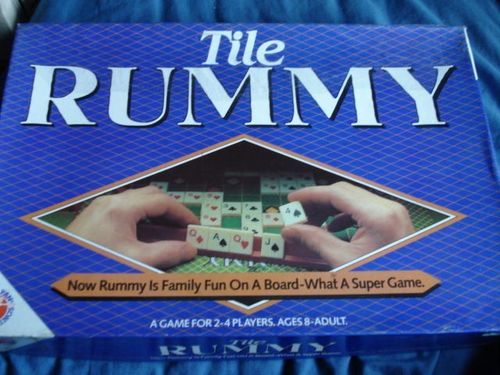
Tile Rummy
Tile Rummy Rulebook
Table of Contents
Table of Contents
Set Up
Shuffle the tiles on the table, facing down. To decide where to begin, each of you draws a tile — the player with the highest value tile opens the game. It's important to know that the game is played clockwise.
The revealed tiles are put back with the rest and reshuffled.
Each of you has to draw 14 tiles, and lay them on your racks, keeping them hidden from the others. The left-over tiles are now the stock, or pool.
Playing
To play your tiles and empty your playing rack you will need to arrange them in sets of at least 3 tiles. There are 2 valid combinations called groups and runs:
- Group: a set of 3 or 4 matching tiles, but in different colors.
- Run: a one-color set of at least three numbers in a row. The number 1 is always played as the lowest number and it can never come after the number 13.
Initial Play
To empty your playing rack, you will be placing tiles on the table. But before being able to do that, you must make an initial play of at least 30 points on your rack, in 1 or more sets. If you don't gather the points and cannot enter the round, or purposely choose not to, you will take a card from the stock and the turn ends.
Diagram captions (the printed illustrations show tiles on the rack and on the table):
- Combined split. You can place the red 1 from the rack with the orange 1 from the run and black 1 from the group to form a new group.
- Multiple split. You can manipulate the three existing sets on the table and use the black 7 and the blue 2 from the rack to make 3 groups and 1 new run.
Scoring
Each round is won by the first player who has used all of their tiles on the rack! The losing players sum up the worth of the tiles still on their racks, and this score is totaled as a minus (negative) amount. The winner of the round gets a positive (plus) score equal to the total of all the losers' points. After every round, each player adds up their minus and plus scores to get the total score. The player with the highest score at the end of the game wins. As an aid to checking the figures, the plus score should equal the total of the minus scores in each round and in the final tally.
If the tile stock is used up before someone says Rummy, the player with the lowest total on their rack wins the round. Each of the losing players sum up their tile value and subtracts that from the winner's total. This result is scored as a minus amount. The total of these is scored to the winner as a plus amount.
Winning
The player with the highest score at the end of the game wins.
Score Table
Example score table from the sheet (four players, three rounds):
| Player A | Player B | Player C | Player D | |
|---|---|---|---|---|
| Round 1 | + 24 | - 5 | - 16 | - 3 |
| Round 2 | - 6 | - 11 | + 22 | - 5 |
| Round 3 | - 32 | - 13 | - 2 | + 47 |
| Total | -14 | -29 | +4 | +39 |
Have fun & enjoy.
Counting
The worth of a tile is its face value. Jokers can be used to represent any tile and have the same point value as the tile they're replacing. When making sets, keep in mind that each tile can only be counted within the set they're in, and cannot exist in more than one group or run.
Round
You and the other players have made the initial play, you may now take tiles that are already on the table and combine them with your own in order to make new sets. If you cannot add to the other sets, you will need to end your turn, by drawing a tile and adding it to your rack. You cannot lay down a tile that you've just picked up, you will need to wait until the next turn.
End of Round
The round lasts until you or one of the players empty your rack and call Rummy. With the round completed, you and the other players need to calculate your scores. Note that if the stock, or pool, is empty, the game continues until no more plays are possible, at which time the round ends.
Playing the Joker
The two Jokers in the game can be used instead of any tile, and in any valid set. They're played in the same fashion as the tile they represent, and in opening scores their value is equal to the respective tile. While you could use both Jokers to make a set, it's best to keep your options open and formations flexible!
During your turn, you can extract a Joker from a set on the table and replace it with a tile from your rack, as long as it has the same numerical value and color it represents.
In a set of three, the joker can be replaced with a tile from one of the missing colors. To form a new set, a Joker that has been replaced must now be combined with two or more tiles from your rack during the same round.
You must first lay your initial sets before you can recover a joker, so be on the look-out for sneaky hands! If the end of the game catches you or another player with a Joker on your rack, that will cost you or the other player 30 points.
Time Limit and Penalties
If you choose to play within a time limit, due to the complexity and large number of variations, turns can have a time limit of 2 minutes. If the time limit passes before you can finish rearranging into valid sets, the tiles must be returned to their original configuration. As a penalty, you must return the tiles that have been withdrawn from the rack and draw 3 tiles from the pool.
Strategies
The Tile Rummy is a game that starts slowly, and gradually accelerates as the game progresses and more options become available. One way to approach the early stages of the game is by trying to keep certain tiles on your rack, so that other players can open up the table and give additional chances for plays.
Sometimes it is useful to hold back the fourth tile of a group or run and lay only three, so that on the next turn you can lay a tile instead of drawing from the pouch. Having a Joker on your rack could also be a good idea, but be wary — if you're caught with it, you will be deducted 30 points.
Building on Sets
You may build onto your sets by rearranging or adding tiles in order to increase the amount of tiles as long as you are creating only legitimate sets and there are no loose tiles at the end of your turn.
Diagram captions (the printed illustrations show tiles on the rack and on the table):
- Add one or more tiles from the rack to extend a run. Red 5, 6, 7 are on the table; you add a red 4 and a red 8 from the rack for more points.
- Remove a fourth tile from a group and use it to form a new set. A tile is missing from the potential blue run on the rack. You can take the blue 7 from the group of four on the table and lay the run.
- Add a fourth tile to a set and remove one tile from it to make another set. You can add a black 11 to the run and use the 8s to form a new group.
- Splitting a run. You can split the run and use the orange 7 to form two new runs.