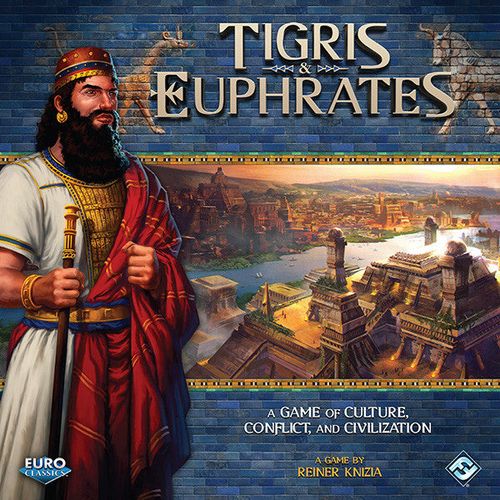
Tigris & Euphrates
Tigris & Euphrates Rulebook
Table of Contents
Table of Contents
Game Components
- 1 double-sided game board
- 153 civilization tiles: 57 red temples, 30 green markets, 30 black settlements, 36 blue farms
- 4 unification tiles, 8 catastrophe tiles, 4 player screens
- 140 victory point tokens (in four colors): bricks (red), amulets (blue... goods etc.) — 15 five-point and 20 one-point each of bricks, crops, amulets, goods
- 16 plastic leaders (4 of each color), 14 treasure tokens, 1 cloth bag
- 6 plastic monuments
- Optional variant components: 4 plastic civilization buildings, 1 wonder tile, 1 plastic Shedu idol
Tiles and Colors
Tigris & Euphrates' civilization tiles, buildings, leaders, and victory points exist in one of four colors: black, red, blue, or green. Each combination has a thematic name — for example, blue civilization tiles are "farms." When the rulebook references "tiles," it means civilization tiles; all other tile types are mentioned specifically.
The victory point colors correspond to tiles:
- Red temples → amulets
- Blue farms → crops
- Green markets → goods
- Black settlements → bricks
Assembling the Monuments
Before your first game, assemble the six monuments. Each consists of a small top over the hole in a large base. Make sure no two monuments are alike: blue top/red base; green top/black base; blue top/black base; green top/blue base; red top/green base; red top/black base.
Setup
- Set the game board. Use the standard side (gold border). The blue-border side is for the advanced game. Place a temple tile on each of the ten board spaces marked by a winged beast (a "Shedu"), then place a treasure token on top of each temple.
- Prepare the reserves. Put all remaining civilization tiles into the bag and shuffle. Place the four unused treasure tokens back in the box and all monuments near the board. Divide all victory point tokens by color and place them by the board.
- Choose dynasties. Each player chooses a dynasty of four leaders bearing the same dynastic symbol (archer, bull, pot, or lion) in a different color, and takes the unification tile and two catastrophe tiles with his symbol, plus his screen. (Players are identified by symbols, not colors — everyone uses all four colors.) Each player then draws six tiles from the bag and places them behind his screen. Leaders, catastrophe tiles, and the unification tile stay in front of the player in full view. Return spare components to the box.
- Starting player. Choose at random by mixing all players' unification tiles facedown and picking one. Play proceeds clockwise.
Object of the Game
The goal is to develop all four key spheres of civilization: settlements, temples, farms, and markets. Players position leaders, create and extend kingdoms, build monuments, and resolve conflicts, gaining victory points in each of the four spheres. At the end of the game, players compare their lowest spheres; the winner is the player with the most victory points in their lowest sphere.
Kingdoms
A region is any area on the game board covered by a lone tile or two or more linked tiles. Regions do not contain leaders. At the start there are ten distinct, one-tile regions.
Tiles and leaders with a common edge are adjacent. Tiles or leaders are linked if they are adjacent or connected through a chain of adjacent tiles and leaders.
A group of one or more linked tiles and at least one leader together is called a kingdom. A kingdom can contain several leaders, whether they belong to the same player or different players. As long as a kingdom contains only leaders of different colors, everything is peaceful. Conflicts arise when there are two like-colored leaders within one kingdom.
Turn Structure
The player taking his turn is the active player. During his turn, he may resolve up to two actions in any order (two different actions or the same action twice). After his turn, the player to his left becomes active. The possible actions are:
- Position (place, move, or withdraw) a leader.
- Place a tile.
- Play a catastrophe tile.
- Replace up to six tiles from his hand.
After a tile is placed, other events may occur (conflicts, monument building, or treasure distribution). The action is not finished until such events are resolved.
Positioning a Leader
Each player possesses a dynasty of four leaders: a king, a priest, a farmer, and a trader. A player may only position his own leaders. A leader can come from outside the board or be repositioned from another space, or be withdrawn from the board. Restrictions:
- A leader must be placed on an empty space.
- A leader can only be placed adjacent to a temple (common edge).
- A leader cannot be placed so as to unite kingdoms.
- A leader cannot be placed on a river space.
When the last temple adjacent to a given leader is removed or turned facedown, the leader is returned to the player. No victory points are gained for positioning leaders. A player cannot gain victory points without first having at least one leader on the board.
Placing a Civilization Tile
To place a tile, a player takes one from behind his screen and places it on the board:
- A tile must be placed faceup on an empty space.
- Farms can only be placed on river spaces.
- Settlements, temples, and markets cannot be placed on river spaces.
- A tile cannot be placed where it would unite more than two kingdoms.
A tile can be placed adjacent to another tile, a leader, or in isolation. Once placed, it cannot be relocated. Most of the time, a player gains a victory point when a tile is placed; the victory point is always the same color as the placed tile.
Gaining Victory Points
A victory point is gained for placing a tile when:
- The tile is placed in a kingdom that contains a leader of the same color → the victory point goes to the player controlling that leader.
- There is no leader of that color, but there is a king within the kingdom → the victory point goes to the player controlling the king.
No victory point is gained if: the tile is not placed in a kingdom; there is no leader of the respective color or king; or the tile unites two kingdoms (even if there are no conflicts).
Victory points are gained immediately, kept hidden behind screens. A player always takes a token valued at "1." At any point during his turn, he may exchange five "1" tokens for one "5" token.
Playing a Catastrophe Tile
Each player receives two catastrophe tiles to permanently occupy and negate spaces. When played, a catastrophe tile remains on the board for the rest of the game, creating a blocked space. It can be placed on an empty space or on top of an existing tile (which is then removed from the game). Restrictions:
- A catastrophe tile cannot be played on a tile bearing a treasure or a monument.
- A catastrophe tile cannot be played on a leader.
A catastrophe tile disrupts the connection between leaders or tiles, and may divide a kingdom into two or more parts. If it destroys the last temple adjacent to a leader, that leader is immediately withdrawn and returned to the player.
Replacing Tiles
A player may take up to six tiles from his hand and return them to the box facedown, then draw the same number from the bag. Discarded tiles are permanently removed from the game. If a player replaces tiles as his first action, he can use the new tiles for his second action.
End of a Turn
A player's turn ends after two actions (or if he chooses to end early). If one or more of his leaders are linked with monuments, he may gain additional victory points. Finally, he refreshes his hand by drawing from the bag to six tiles. If other players have fewer than six tiles, they also refresh. Then it is the next player's turn.
Conflicts
Conflicts arise when someone positions a leader or places a tile, whenever there are two like-colored leaders in a given kingdom. Two types:
- Revolt: occurs when a leader is positioned in a kingdom that already contains a leader of the same color. (Leader placement can only cause revolts.)
- War: occurs when two kingdoms are united through a new tile, and the new, larger kingdom contains leaders of the same color. (Tile placement can only cause wars.)
The conflict is resolved using tiles on the board and additional tiles played from behind screens. An action does not end before the conflict is resolved. After all conflicts, a kingdom will only contain leaders of different colors.
Revolts
The player positioning the new leader is the attacker; the controller of the existing same-color leader is the defender. Both draw strength from temples:
- Count temples adjacent to leaders: count temples adjacent to the conflicting leaders (a temple can count for both leaders).
- Commit temples from hands: first the attacker, then the defender, may commit any number of extra temples from their hands, placed faceup in front of their screens. Each player can commit extra temples only once.
Whoever has the higher total number of temples wins; the defender wins ties.
Consequences: The loser withdraws his leader from the board. The victor gains one amulet (the conflict was fought with temples). Both players remove all committed temples from the game.
Wars
Wars occur when two kingdoms are united and the new kingdom contains like-colored leaders. Two kingdoms can be united through tile placement but not through leader positioning; three or more kingdoms cannot be united by one tile. No victory point is gained for the uniting tile; instead it is covered by the unification tile. If the new kingdom contains no two leaders of a like color, remove the unification tile and conclude without conflict. Otherwise, war erupts.
All conflicts between two like-colored leaders are resolved individually. When there are wars in more than one color, the active player decides which to resolve first. Resolve each war using the kingdom's current configuration.
Resolve wars as follows:
- Determine the attacker: if the active player chooses to resolve a conflict involving one of his leaders, he is the attacker. Otherwise, the next player (clockwise) with an involved leader becomes the attacker. The other player is the defender.
- Count the supporters: both count their leader's supporters — tiles of like color still connected to the leader (need not be adjacent, but must be on his segment of the unification tile).
- Commit tiles from hands: first the attacker, then the defender, may commit any number of extra tiles of the matching color from their hands (faceup). Each player can commit tiles only once.
Whoever has the higher total (supporters on the board plus committed tiles) wins; the defender wins ties.
Consequences: The loser withdraws his leader and removes all supporters from the kingdom. The victor receives one victory point matching the color of the withdrawn leader, plus one (also matching) for each supporter removed. (Committed tiles do not count toward victory points.) The defeated leader returns to the losing player. Supporters of the defeated leader and any committed tiles are removed from the game.
- Priest exception: If two priests cause a conflict, temples (supporters) which bear a treasure or have another leader adjacent to them are not removed. Amulets are only gained for the defeated priest and the temples actually removed.
When a tile is removed, it might divide the kingdom, so leaders originally in war may end up in different kingdoms and are no longer in conflict. If like-colored leaders still remain in the kingdom, a new war commences (active player chooses order). After all wars are resolved, the active player's unification tile is removed. At the end of the turn, all other players who committed tiles refresh their hands to six.
Conflict Rewards
- Winning a revolt: the winner gains one (and only one) amulet.
- Winning a war: the winner gains one victory point token of the matching color for each tile (plus the leader) that the loser removes from the board.
Hidden Information
- All victory point and treasure tokens gained and tiles behind a player's screen are hidden until scoring.
- The number of tiles in the bag is hidden; players cannot deliberately count them.
- Tiles removed from the game are hidden, kept facedown in the box.
Temple Clarifications
- During a revolt, a single temple can be used by multiple leaders.
- If a catastrophe tile blocks a temple space adjacent to a leader, and that leader is no longer adjacent to a temple, the leader is removed.
- If a temple is flipped facedown or replaced with the wonder tile, any leaders adjacent to it that are no longer adjacent to any other temple are removed.
- When a player loses a war with a priest, he cannot remove temples that contain a treasure or are adjacent to leaders of any other color. The victor does not gain victory points for tiles that remain due to these exceptions.
- If a temple contains a treasure and the active player wishes to use that tile to build a monument or wonder, he temporarily removes the treasure and places it back on the tile after flipping (monument) or on the wonder tile (wonder). The treasure is still in play.
Playing a Unification Tile
When a player unites kingdoms, he places his unification tile on top of the linking tile, as a reminder that a war might take place. Whether or not a war ensues, no players gain victory points from the linking tile. Only one unification tile can be in play at a time; it remains on the board only while conflicts are resolved and is removed after all wars. A player does not place a unification tile when he links regions or links a kingdom and a region.
Monument Building
Monument building can occur when someone places a tile. Each monument has two different-colored parts. If the active player places a tile so as to create a 2x2 square of four like-colored tiles, he may flip those four tiles facedown and place a monument on top. One color of the monument must match the facedown tiles (if that color is unavailable, the monument cannot be built, and the tiles cannot be flipped).
If tile placement initiates a war, resolve the conflict before flipping tiles. A monument can be built only at the end of the action in which the active player completed a 2x2 square; if he doesn't build then, the tiles remain faceup. The four facedown tiles still count as part of regions and kingdoms (linking leaders and tiles) but no longer count for other functions (e.g., as supporters). A monument cannot be destroyed.
When four temples are flipped and a monument is built: if a treasure lies on a temple, it remains on that facedown tile; if a leader is no longer adjacent to a temple, withdraw that leader.
A monument regularly provides victory points. At the end of the active player's turn, for each of his leaders in the same kingdom as a like-colored monument, he gains one victory point of the leader's color for each like-colored monument in that kingdom. Since a monument has two colors, it can provide victory points for up to two leaders each turn. A king gains a victory point only when linked to a black monument (unlike tile placement, a king does not substitute for missing leaders where monuments are concerned).
Treasure Distribution
Treasure distribution can be initiated when a player positions a leader or places a tile. At the start, ten treasure tokens are placed on the first ten temples.
If a kingdom contains more than one treasure at the end of a player's action, the trader in that kingdom must gain all but one of these treasures. If there are treasures on a special border space, the player must take treasures from those spaces first; after that, he may choose from which space to take his remaining treasures. If there is no trader in the kingdom, the treasures remain until the kingdom has a trader.
Each treasure counts as one wild victory point. At the end of the game, you may allocate each treasure individually to any victory point type of your choice.
Game End and Winner
The game ends when either:
- Only one or two treasures remain on the board at the end of a player's turn, or
- A player attempting to draw a tile is unable to because the bag is empty.
All players lower their screens. Each player determines in which sphere they possess the fewest victory points, freely allocating treasures to any sphere(s). The player whose lowest sphere has the highest number of victory points is the winner. In a tie, compare second-lowest spheres, and so on. If multiple tied players are evenly matched in all four spheres, they share the victory.
Advanced Game Rules
Civilization Buildings
The advanced game uses four civilization buildings: a palace, a library, a market hall, and a granary. Place them near the board during setup.
When a player places a tile so that it becomes part of an uninterrupted vertical or horizontal line of three or more tiles of the same color, that player may take the corresponding-color building and place it on any one of the color tiles in the line. If that building is already on the board, the player may move it, provided the new line is longer than the line where it currently is (if on a tile part of both a horizontal and vertical line, the new line must be longer than each). Civilization buildings must be placed before building a monument or erecting a wonder.
When a player places a tile in a kingdom containing a building of the corresponding color, the reward for the respective leader (or the king if absent) increases from one to two victory points (rewards for conflicts or monuments are unaffected).
Players must resolve conflicts before building placement. A tile directly under a building counts in conflicts and cannot be removed. Catastrophe tiles cannot be played on a tile under a building. If you flip over a tile under a building to build a monument or wonder, remove the building and place it next to the board for future use.
Advanced Game Board
The advanced board (blue border) uses a different map and contains four extra treasures. Place one temple with a treasure on each of the fourteen Shedu spaces, then play by the original rules. When a player collects a treasure from a kingdom containing more than one treasure, he must first collect those from spaces outlined with the special border.
English Variant
To restrict discarding extra tiles during a conflict that do not influence its resolution: the attacker may commit extra tiles only if his total thereafter exceeds the current strength of the defender (if he has no chance of winning, he cannot commit any). The defender can commit extra tiles only to win by establishing a tie. No more, no less.
Wonder Variant
The wonder is a special five-tile monument with a cross-like shape. A player may erect the wonder when he creates a cross configuration of five tiles of a single color: discard the five tiles and replace them with the wonder tile (which cannot be destroyed), placing the Shedu idol on top. The wonder still counts as part of regions and kingdoms and can link leaders and tiles, but no longer counts for other functions (e.g., as supporters). All other monument rules apply. At the end of the active player's turn, if he has a king in a kingdom with the wonder, he gains 1 victory point token in the color of his choice.