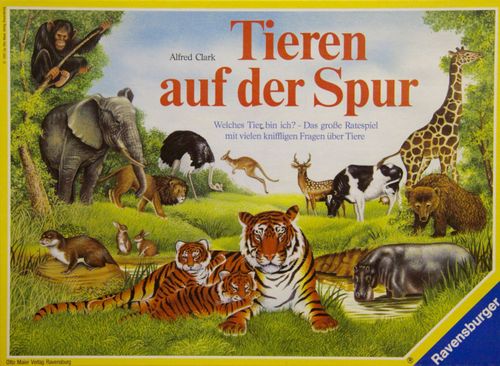
Tieren auf der Spur
Tieren auf der Spur Rulebook
Table of Contents
Table of Contents
Contents
- 1 game board with 78 animal pictures and question fields
- 78 colored animal cards
- 1 card dispenser
- 10 YES stones (green)
- 10 NO stones (red)
- 1 game piece
- 1 die
- 1 information booklet about the animals
Goal of the Game
The goal is to guess the sought-after animals by asking clever questions and combining the answers. The first player who holds three animal cards wins the game.
Setup
- Place the game board in the middle of the table where everyone can see it.
- Place the blue game piece on the blue circle at questions 1 to 6.
- Shuffle the 78 animal cards well and place them face down in the card dispenser.
- Sort the green YES stones and the red NO stones by color and insert them into the recesses of the card dispenser.
Illustration caption: When removing cards, gently press them downward!
Game Rules
Each round has one card holder, who knows the sought-after animal, and one guessing team, which tries to guess the animal.
The Card Holder
The youngest player begins. This player takes the card dispenser and, as the first step, draws one animal card face down from the dispenser. The other players must not see which animal is pictured. The number of each question is printed on this animal card. The card holder must answer every question whose number is on the card with YES. The card holder answers NO to every question whose number is missing from the card.
The Guessing Team
After the youngest player has drawn a card, the player to their left rolls the die and moves the blue game piece clockwise to the nearest question field in the rolled color.
If the player rolls the "star" (★), they may choose a question field of any color to move the game piece to. The player then picks one of the six questions shown around the game piece and asks it of the card holder. To do so, the player tells the card holder the number in front of the question.
Example: A player rolls yellow and moves the game piece to the nearest yellow question field. If the piece is already on a yellow field, the player moves it to the other yellow field. From the six questions the player has chosen question no. 28, "Lebt es im Wasser?" (Does it live in water?), and asks it of the card holder.
Board excerpt shown in the illustration: 30 "Kann es gut riechen?" (Can it smell well?); 29 "Hat es einen Schwanz?" (Does it have a tail?); 28 "Lebt es im Wasser?" (Does it live in water?); 27 "Ist es ein Zweibeiner?" (Is it a biped?); 26 "Ist es in Asien zu Hause?" (Is it found at home in Asia?); 25 "Lebt es im Dschungel?" (Does it live in the jungle?).
If question no. 28 is printed on the animal card, the card holder answers YES and places a green YES stone on the game board next to the corresponding question.
If question no. 28 is not printed on the animal card, the card holder answers NO and places a red NO stone next to this question.
YES or NO
After a NO answer, the next player rolls the die and moves on. The player moves to a new question field in the rolled color and asks the card holder a question.
After a YES answer, the player who was on turn has two options:
- One YES = one guess or one more roll. The player may guess immediately which animal it could be, or
- the player may roll again, move the game piece to the corresponding question field and ask the card holder a new question.
Two YES answers = two guesses or another roll. If the second question is also answered with YES, the player may either guess twice, or roll again. If the player decides to roll again, the game piece moves to the corresponding question field and the player asks a third question.
Three YES answers = three guesses. If the answer to the third question is also YES, the player may try to guess the animal three times. The player may not roll the die again. If the player does not guess the animal correctly, the next player takes the turn.
Over time, the players receive new clues about the sought-after animal through the YES and NO stones. If a player who is on turn believes they already know the clues well enough, they may skip rolling the die and guess once right away. If that guess is wrong, the next player takes the turn. A player should therefore be very sure before guessing.
Winning an Animal Card
- If a member of the guessing team guesses the animal before all green YES stones or all red NO stones are on the game board, that player receives the animal card. Only the player who is on turn may guess.
- If the card holder has placed all green YES stones or all red NO stones on the game board before any player has guessed the animal, the card holder reveals the solution and keeps the animal card.
New Animal Card – New Round
After the first animal card has been won, the YES and NO stones are collected from the game board and put back into the card dispenser. The player to the left of the previous card holder draws a new animal card, and the other players try to find the new animal by asking clever questions and combining answers.
End of the Game
New animal cards are drawn in turn, one after another, until one player holds three animal cards. The player who achieves this first wins the game.
The end of the game can be changed depending on the number and knowledge of the players. Before the game begins, the players agree how many animal cards a player must hold in order to win.
Note
Some of the 78 animals are whole animal groups that can be divided into different species or breeds. It is therefore sometimes difficult to answer a question for a whole animal group with a clear YES or NO. For example, there are spotted dogs, cats and horses as well as single-colored ones. In that case the answer to the question "Is it single-colored?" follows the picture on the game board and the animal cards.
For other questions, the answer follows the best-known species of that animal group. More precise information about the individual animals can be found in the information booklet, which gives a detailed description of every animal.
Explanations of Some Questions on the Game Board
1. Is it a hoofed animal? (Ist es ein Huftier?) "Hoofed animals" is the name for plant-eating mammals that have developed hoofs (hooves) from their last toe segments. Hoofed animals are divided into even-toed and odd-toed hoofed animals.
2. + 37. Does it eat plants / Does it eat meat? (Frißt es Pflanzen / Frißt es Fleisch?) These questions are answered with YES if the sought-after animal eats plants or meat, respectively. Some animal groups have species that eat either meat or plants. For these animal groups both questions are answered with YES.
4. Does it have horns? (Hat es Hörner?) Animals with horns belong to the family of even-toed hoofed animals and wear horns on their heads. Unlike antlers, horns are not shed.
5. Is it single-colored? (Ist es einfarbig?) If the fur, skin or plumage of an animal on the upper side shows no colorful pattern, the animal is described as single-colored. Some animals in the game occur both as single-colored and as patterned breeds, for example dogs, cats and cattle. In these cases the answer follows the picture on the game board.
7. Is it a reptile? (Ist es ein Reptil?) Reptiles, or creeping animals, are a class of vertebrates. They have horny scales and horny shields, such as crocodiles, snakes, lizards and turtles.
40. Is it an insect? (Ist es ein Insekt?) Insects are the most species-rich class among the animals (about 750,000 species). They breathe through tracheae (fine air tubes), have an exoskeleton made of chitin and lay eggs.
42. Does it stay in trees? (Hält es sich auf Bäumen auf?) This question is answered with YES if the animals frequently live in trees or under tree bark. Animals that only occasionally climb trees do not count.
43. + 28. Does it live on land? / Does it live in water? (Lebt es an Land? / Lebt es im Wasser?) These questions are answered with YES if the animal mainly lives on land or in water, respectively. For animals that live both on land and in water, both questions are answered with YES, for example amphibians.
44. Can it grip well? (Kann es gut greifen?) This question is answered with YES if the animal has limbs it can use to grip well, for example grasping hands, grasping feet or a trunk.
45. Is it a herd animal? (Ist es ein Herdentier?) The term "herd" is used when many relatively large animals gather into a large animal community. Usually the term "herd" refers to hoofed animals. For birds, fish and insects one speaks instead of a swarm.
48. Is it a quadruped? (Ist es ein Vierbeiner?) If an animal has four limbs with which it moves about, it is a quadruped.
50. Is it a rodent? (Ist es ein Nagetier?) Rodents are an order of mammals. What characterizes all rodents is their gnawing teeth: the two sharp gnawing teeth in the upper and lower jaw keep growing throughout life. Rodents wear their teeth down by gnawing.
53. Is it a vertebrate? (Ist es ein Wirbeltier?) There are vertebrates and invertebrates. Vertebrates always have a spinal column made of bones or cartilage.
54. Does it hibernate? (Hält es einen Winterschlaf?) To survive the season of scarce food, some mammals hibernate. During this sleeping period the animals use very little energy. Hibernation must not be confused with the winter torpor of cold-blooded animals. In winter torpor the body temperature falls to match the outside temperature, and the body functions are almost switched off.
55. Is it a predator? (Ist es ein Raubtier?) Predators are an order of mammals that have strong canine and carnassial teeth for seizing and tearing prey. They include cats, dogs, bears, martens and so on. Besides land predators there are also water predators. Predators are mostly meat eaters.
57. Is it a warm-blooded animal? (Ist es ein gleichwarmes Tier?) In warm-blooded animals the body temperature always stays the same, no matter how high the outside temperature is. In everyday speech they are wrongly called "warm-blooded". Cold-blooded animals have a changing body temperature. It is similar to the outside temperature, but can be actively raised through muscle movement.