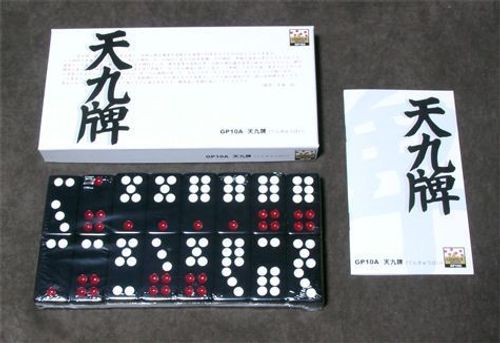
Tien Gow (Sky Nine)
Tien Gow (Sky Nine) Rulebook
Table of Contents
Table of Contents
1. Author's Comment
This is not an easy game because there is no simple logic for one to memorize the tiles. Besides, it seems there are too many special rules. At the beginning stage, it is suggested that you simply remember the fundamental rules and try the game. You will enjoy it and pick up the special rules as you play.
Why play this game? It is Chinese culture; the "Descendant of Dragon," or those who are interested in Chinese culture, should not miss it. It is not just a simple game: it requires you to use your wisdom to plan and predict what others are doing. You will enjoy it if you can predict the trend and use the tiles with lower ranking to win the game.
The unit scores are increased with the number of consecutive games won, which makes the game quite exciting. You can get more fun if you know how to speculate and catch other players. Moreover, each sub-game is quick, so you do not have to wait long before you have a chance to play another set of tiles.
Comparison with Bridge
a) Similarity
- You must follow the suit and combination of tiles.
- If you have no tile to play, you must surrender the same number of tiles.
- There is a benchmark requirement: at least you have to win 4 units.
b) Difference
- There are 2 suits only, but the leader can play up to 4 valid combinations of tiles at a time.
- There is a requirement for you to participate in the last round. If you have surrendered 7 tiles, the last tile has to be surrendered automatically, whatever its value.
- Winning more tiles does not mean you will be the final winner; the final tile is the gist.
- There is a special tile combination called Royal.
- There is a rule for players to speculate and allow themselves to be caught by their counterpart.
- The 32 tiles are not symmetric: 22 are civilian tiles and 10 are military tiles ("6" and "3" are odd tiles).
Common Misunderstandings
- Sky9 is not a simple-minded game for gamblers.
- "CC7" cannot be beaten by "BB8" even though "BB8" has a higher ranking. This is because they have different combinations of suits. "CC7" can only be beaten by "BB8" or "AA9".
- "A" and "9"; "B" and "8"; "C" and "7"; "D" and "5". There are four groups. The members of each group cannot be interchanged.
- There is "A9", "B8" and "C7" but there is no "D6". "D" is accompanied with "5"; "6" and "3" are odd tiles.
2. Tile Profile / History
Background on the Tile Names
For players who do not understand the Chinese language: since it is difficult to translate the exact meaning of the "Civilian tiles," the tiles are named simply by alphabetical order (from 'A' to 'K') in the game.
In ancient China, the officers who helped the Emperor were generally classified into two categories, "Secretariats" and "Military officers."
The Secretariats took care of the operations of the empire and helped the emperor to manage the civilians, etc. Therefore, these tiles are more or less related to nature and daily life. These tiles have existed since 1120 AD, and some have gradually evolved with other names, but their appearance remains unchanged. The civilian tiles' meanings (each kind has 2 identical tiles) are as follows:
- 'A' – Sky / Heaven (two pieces containing 24 dots, figures of the 24 solar periods in the Chinese calendar)
- 'B' – Earth (two pieces containing 4 dots, representing the 4 points of the compass: east, west, south, and north)
- 'C' – Man (two pieces containing 16 dots, representing the virtues of humanity, benevolence, propriety, and wisdom, four-fold)
- 'D' – Harmony (many people call it "Goose" now because its pronunciation in Mandarin is similar; two pieces containing 8 dots, figuring the breath of harmony, which pervades the eight divisions of the year)
- 'E' – Plum (each five-dot half represents a plum; each tile has two plums)
- 'F' – Long-three (also called Long-sleeve Cloth; it is a clone shape)
- 'G' – Wooden Chair (the four-dot represents the legs of the chair, which is what you see if you turn the chair upside-down)
- 'H' – Tiger-head (many people call it "Axe" now because its pronunciation in Mandarin is similar) (it is a clone shape)
- 'I' – Red-hat-ten (also called the curtain with red painting on the top; a clone shape)
- 'J' – Tall-seven
- 'K' – Short-six
The names of some tiles, such as "Harmony," "Long-three," and "Tiger-head," have gradually evolved to "Goose," "Long-sleeve Cloth," and "Axe." Their corresponding pronunciations in Mandarin are quite similar.
For 'A' to 'C', people in ancient China perceived "Sky" and "Earth" as the most important things in their life; "Man" lives on the earth and under the sky. These are the three most important entities in Chinese philosophy.
For 'D', "Harmony" is what humans want. Later on, its name evolved to "Goose" in Chinese.
For 'E' to 'I', "Plum," "Long-sleeve Cloth," "Wooden Chair," "Axe," and "Red Hat Curtain" are the most common entities in people's daily lives.
For 'J' and 'K', the meanings of these two tiles are not detailed in the literature.
For "Military officers," the army played an important role in the age of the emperor. The number of dots on a "Military tile" represents its ranking. The top rank is the 2 tiles with 9 dots, and the lowest rank is the single tile with 3 dots.
History (quoted from "Chinese Origin of Playing Tiles" by W.H. Wilkinson)
It is perfectly clear, indeed, that all that was done or asked for in 1120 was an imperial decision as to which of several forms or interpretations of the game now known as T'ien-kiu ("Heavens and Nines") was to be considered orthodox. The game and the tiles must have been in existence long before. The passage from the Cheng-tza-t'ung runs thus (s.v. pai):
Also ya p'ai, now the instruments of the game. A common legend states that in the second year of the Hsuan-ho, in the Sung dynasty [i.e. 1120 AD], a certain official memorialized the throne, praying that the ya p'ai (ivory tiles) be fixed as a pack of 32, comprising 127 pips [sic, it should be 227, but Chinese printers are careless], in order to accord with the expanse of the stars and constellations. The combination 'heaven' [6/6, 6/6] consisted of two pieces, containing 24 pips, figures of the 24 solar periods; 'earth' [1/1, 1/1] also composed two pieces, but contained 4 pips, the 4 points of the compass: east, west, south, and north; 'man' [4/4, 4/4] two pieces, containing 16 pips, the virtues of humanity, benevolence, propriety, and wisdom, four-fold; 'harmony' [1/3, 1/3] two pieces of 8 pips, figuring the breath of harmony, which pervades the eight divisions of the year. The other combinations had each their names. There were four players having eight tiles apiece for their hand, and the tiles won or lost according as the number of the pips was less or more, the winner being rewarded with counters. In the time of Kao-tsung [1127–1163] pattern packs were issued by imperial edict. They were known throughout the empire as Ku p'ai, 'bone p'ai;' but it does not follow that this class of games, po-sai, Ko-wu, and the rest originated in the reign of Hsuan-ho.
Ya Pai (ivory) and Ku Pai (bone) were the names of the Sky9 (Tin Gau in Cantonese, or Tien Gow in Mandarin) tiles in the Sung dynasty.
3. Game Rules
3.1 Basic Rules
The objective of the game is to win at the last round and maximize the score.
There are 32 tiles in total, which are classified into two suits: 11 pairs of civilian tiles (22 in total) and 10 military tiles.
There are 4 players, and everyone gets 8 tiles. Each sub-game has several rounds, and each round is led by the winner of the last round (namely the Banker).
For Royal (only the leader can play these tiles), no tiles can beat it, and one can get 2 unit scores from other players whoever the final winner is.
You can play 1–4 tiles in any of the above combinations.
To win the game, one must win at the last round and with at least 2 tiles.
In turn, you will be forced to surrender the last tile if you have lost 7 tiles out of 8 already.
3.2 Who Plays First?
For the very first game, a player will be randomly chosen to play tiles first. The one who follows him will be the "assumed leader" or "banker." Followers must either surrender the same number, or play the same combination of suits.
3.3 Ways to Win the Game
Smallest. You can double the game score by using the smallest to conclude the game. Of course, you bear the risk of being caught by its counterpart (see section 3.4).
Royal. For Royal, the unit score is multiplied by 2. No risk.
4-tile combination. For a 4-tile combination, the unit score is multiplied by 4. The risk is similar to the case with the smallest (see section 3.4).
Full House. A Full House requires you to win all tiles. But if you are the leader in the first round, you must not win by using the largest or Royal.
If you win the last round using the largest, the smallest, Royal, or a 4-tile combination, it is called a Perfect Full House.
The unit score for a Full House is multiplied by 2. (For a Perfect Full House, the multiplier is 8 if concluded by a 4-tile combination, or 4 otherwise.)
3.4 Special Rules: Speculation
If one is speculating by using the smallest or a 4-tile combination, they risk being caught. To speculate to get more score using the smallest, one must make sure its counterpart has not already been played. Otherwise it is not a valid speculation, i.e. there is no extra bonus even if you win.
Once caught by "J" or "6," the first catcher will be the winner, even though the follower may have a tile with a higher ranking of the same suit.
When speculating using a 4-tile combination, its counterpart is the brother with a higher rank. For example, "DD55" can only be caught by "AA99," "BB88," or "CC77."
The failed speculator must pay the loss of the other two players to the current winner. Besides, the unit score will further be doubled.
3.5 Special Rules: Unofficial Game Rules
These rules are not official, but they are common and optional. Therefore, one must discuss them with the other players before the game starts.
Royal:
- Some players consider that a pair of "KK" should not be treated as Royal; only "63" does.
- When it is treated as Royal, some players choose to allow "JJ" to catch "KK." Therefore, "KK" is sometimes called "Fake Royal." In case it is caught by "JJ" in the last round, the score calculation will be similar to the situation of a single "K" being caught by a single "J."
Straight-win Tiles:
- Some people allow a "Straight-win" when a special combination of tiles is on hand at the start of the game. The score calculation will be regarded as a Full House, depending on the tile combinations.
- For a Full House:
- Condition 1: with at least 7 civilian tiles, or at least 7 military tiles; or
- Condition 2: with all dots in the 8 tiles being white, with at most 1 red dot; or
- For a Perfect Full House:
- Condition 1: with all 8 tiles being civilian tiles, or all being military tiles; or
- Condition 2: with all dots in the 8 tiles being white; or
- Condition 3: with 4 pairs of civilian or military tiles (a combination of civilian and military tiles, such as "A9," "B8," "C7," or "D5," does not count).
- In case the banker and other players get the "Straight-win" tiles at the same time, the banker will be the winner if he chooses to declare it. After declaration, the Royal in your tiles cannot be used to claim the special bonuses. In other words, you have to take a risk and play the game in order to get the bonus from Royal. In other words, you need to choose between a higher score or a sure-win situation.
- For other non-banker players, they will take turns to declare their "Straight-win" according to the play tile sequence.
- Sometimes people may choose not to declare it. They forfeit their chance of a sure win to get a potential higher score. However, once a player forfeits the right, his followers can declare their "Straight-win" tiles. In this case, the former one will be the loser, and he can never reclaim it.
4. Score Rules
4 is a benchmark. Assume you lose and have got x tiles. If x is less than 4, you will lose 4 − x units. Conversely, you will get x − 4 units from the winner. If you get none, you will lose 5 units (+1 as penalty).
Your unit scores will be affected by the current status of the banker. If you or your opponent has won n games continuously, your unit scores will be multiplied by n + 1.
During the game, if you are the leader in any round and successfully play Royal, you can get 2 unit scores from all players, regardless of who wins the game finally.
Besides, if you play any of the 4-tile combinations and win, it will be regarded as 2 Royals, and you get 4 unit scores from other players.
Using Royal, the smallest, and a 4-tile combination to conclude the game, you can get a higher unit score. However, unless Royal is played, there is a risk of being caught by its counterpart.
Once caught, the speculator must pay the loss of the other two players to the winner. The score will also be multiplied by 2 or 4.
5. Other Links
The original document links to the following further resources (not transcribed here):
- Tin Kau Game Rules with Hints on how to memorize the tiles, by C.P. Lai (USA).
- Tin Kau History and Rules (in Chinese), by Edgar of the Tin Kau Schoolmate Club, Hong Kong.
- The Game of Ma-Jong (and Tin Kau), published in 1924 by Stuart Culin.
- Chinese games with dice (see Chak Tin Kau), published in 1889 by Stewart Culin.