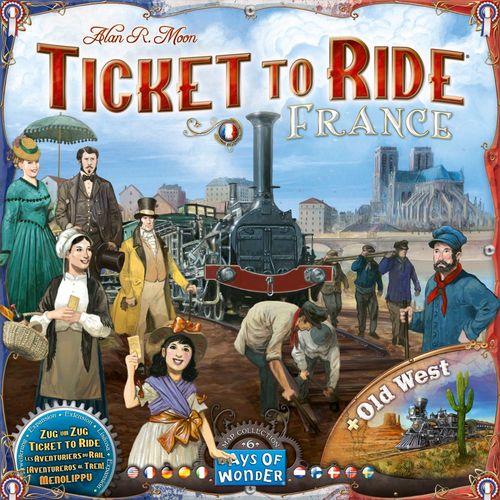
Ticket to Ride Map Collection 6: France & Old West
Ticket to Ride Map Collection 6: France & Old West Rulebook
Table of Contents
Table of Contents
France Map
This rules booklet describes the game play changes specific to the France Map and assumes that you are familiar with the rules first introduced in the original Ticket to Ride. This expansion is designed for 2-5 players.
In 4 and 5 Player games, players can use all tracks of the Double or Triple Routes (the same player cannot claim more than one track of those Routes though). In 2 and 3 Player games, only one Route of the Double or Triple Routes can be claimed. Once a player has claimed one of these, the other Route(s) forming the Double or Triple Route are locked and unavailable to other players.
To play with this expansion, you need 40 Trains (instead of the usual 45) per player, the matching Scoring Markers and the Train Car cards taken from Ticket to Ride or Ticket to Ride Europe, along with the new components described below.
New Components
- 58 Destination Ticket cards
- 2 Bonus Cards
- 64 Track Pieces
Set Up
- Sort the Track Pieces by length and put them beside the board.
- Each player receives 8 Train Car cards.
- Deal 5 Destination Ticket cards to each player. Each player must keep at least 3. Shuffle the discarded Ticket cards together and put them under the deck.
Track Bed
On this map, most of the Routes are in fact Track Beds and cannot be claimed at the beginning of the game. They must first be built.
Neighboring Countries and Corsica
Some Destination Tickets include the name of a zone (it might be one of France's neighboring countries or Corsica) instead of one (or both) of the cities. Each route leading to one of those zones is a dead-end and separate from others: Different routes leading toward the same zone are not considered connected together.
Special Rules
On his turn, a player must perform one (and only one) of the following three actions:
1. Draw Train Car Cards and Build a Route
The card draw follows the exact same rules as the core game, but when a player chooses this action he must also build one route on the Track Bed. After drawing, he chooses any available Track Piece and places it on any Track Bed route of the same length on the board. This Piece determines the color of the newly built Route.
Example: The blue player has just drawn two cards. He now chooses the yellow 5-space Track Piece and puts it on the Marseille-Grenoble Route. Note that the Avignon-Briançon and Avignon-Nice Routes are now permanently cut off and that nobody will be able to build them this game.
Notes:
- There are a number of places on the board where two or more Routes cross. When one crossing Route is built, one or more others may become unavailable: you can never place a Track Piece on top of or under another Track Piece or through a claimed Route.
- In 2 and 3 Player games, only one Track of the Double or Triple Routes can be built. In 4 and 5 player games, when a player builds a Track Piece on a Double or Triple Route, he only builds one track of the route, not all of them. The other routes must be built separately. For example, it would take three turns to build the three routes from Paris to Dijon. One player can build all of these Routes on three different turns or three players could each build one, or any other possible combination.
2. Claim a Route
Apart from the one space Routes and the grey Routes which are already built and can be claimed immediately, a player can only claim a Route if it has been built. Once a Route has been claimed, any Track Piece that was on the Track is put back in the supply and can be chosen again.
Some of the grey routes are special Ferries Routes linking two adjacent cities across a body of water. They are easily identified by the Locomotive icons featured on some of the spaces making the route. To claim a Ferry Route, a player must play a Locomotive card for each Locomotive icon on the track, and the usual set of cards of any one color for the remaining spaces of that Ferry Route.
Example: The red player happens to have 5 yellow cards in hand! He claims the Marseille-Grenoble Route by removing the Track Piece (which is now available again) and putting his wagon cars on the board to the blue player's great despair! Note that both crossed Routes remain cut off.
3. Draw Destination Tickets
A player draws 4 Destination Tickets from the top of the deck. He must keep at least one of them, but he may keep two, three or all four if he chooses. Any returned cards are placed at the bottom of the deck.
End of Game Bonuses
There are two bonuses awarded at the end of the game:
- The player who has the Longest Continuous Path of Routes receives the Longest Route bonus card and adds 10 points to his score.
- The player who has completed the most Destination Tickets receives the Globetrotter bonus card and adds 15 points to his score.
In case of a tie when attributing these bonuses, all tied players score them.
Old West Map
This rules booklet describes the game play changes specific to the Old West Map and assumes that you are familiar with the rules first introduced in the original Ticket to Ride. This expansion is designed for 2-6 players.
In 4, 5 and 6 Player games, players can use all tracks of the Double or Triple Routes, though the same player cannot claim more than one track of those Routes. In 2 and 3 Player games, only one Route of the Double or Triple Routes can be claimed. Once a player has claimed one of these, the other Route(s) forming the Double or Triple Route are locked and unavailable to other players.
Please note that this expansion is not compatible with the Alvin & Dexter expansion. Don't worry though, you'll hear from our beloved Alien soon enough...
To play with this expansion, you need 40 Trains (instead of the usual 45) per player, the matching Scoring Markers and the Train Car cards taken from Ticket to Ride or Ticket to Ride Europe, along with the new components described below.
New Components
- 50 Destination Ticket cards
- 2 Bonus Cards
- 40 White Train Cars (you should have a few spare cars, so make sure to remove them before your first play)
- 18 City Markers (3 per player)
- Alvin The Alien Marker (or you can use the Alvin miniature if you own the Alvin & Dexter Expansion)
Set Up
- Deal 5 Destination Ticket cards to each player. Each player must keep at least 3. Shuffle the discarded Ticket cards together and put them under the deck.
- Each player receives the 3 City Markers in his color.
- After choosing Tickets, beginning with the player who will go last and proceeding counter-clockwise around the table, each player chooses his starting city by placing one of his City Markers. Pick your starting city carefully because you will only be able to expand your rail network from this city.
Special Rules
On his turn, a player must perform one (and only one) of the following three actions:
1. Draw Train Car Cards
The card draw follows the exact same rules as the core game.
2. Claim a Route
The first route you Claim must be a route from your starting City. Every subsequent route you Claim must connect to your home city or a city you have already connected to. You can never claim a route that is not connected to your network.
Example: You have chosen Salt Lake City as your Starting City. The first route you claimed is from Salt Lake City to Green River. The next route you claim must connect to either Salt Lake City or Green River. You decide to claim the Green River-Cheyenne route. The next route you claim must then connect to Salt Lake City, Green River, or Cheyenne, etc.
After you Claim a Route, you may place one of your City Markers in either of the cities on the route by playing a pair of cards of the same color (Locomotives can be used to replace one or both of these cards). Each city can only have one City Marker so two players cannot both control the same city. You can control a maximum of 3 cities on the board since you only have 3 City Markers. Once a City Marker has been placed, it cannot be moved.
As usual, Claimed Routes give points to the player who claimed them, unless at least one of the connected cities is controlled by another player. In this case, the owner of the City Marker scores the points, not the player who claimed the Route. Of course if you claim a Route connected to one of your City Markers, you score that Route.
Example: You have a City Marker in Salt Lake City. An opponent claims the route from St. George to Salt Lake City. You receive 7 points and the opponent receives none.
If both Cities are controlled, both controlling players score the points for that Route. If the same player controls both cities, he scores the points twice.
Example: You have City Markers in St. George and Salt Lake City. An opponent claims the Route between those two cities. You receive 14 points and the opponent receives none.
Ferries
Ferries are special gray routes linking two adjacent cities across a body of water. They are easily identified by the Locomotive icon(s) featured on at least one of the spaces making the route. To claim a Ferry route, a player must play a Locomotive card for each Locomotive symbol on the route, and the usual set of cards of the proper color for the remaining spaces of that Ferry route.
3. Draw Destination Tickets
A player draws 4 Destination Tickets from the top of the deck. He must keep at least one of them, but he may keep two, three or all four if he chooses. Any returned cards are placed at the bottom of the deck.
End of Game Bonus
The player who has completed the most Destination Tickets receives the Globetrotter bonus card and adds 15 points to his score. In case of a tie, all tied players score the bonus.
Variant: Alvin the Alien
Alvin starts in Roswell. No player can start the game in Roswell. No player can place a City Marker in Roswell during the game.
The first player to Claim a Route into Roswell captures Alvin. He immediately receives 10 points. He must then move Alvin to any city he controls (including his starting city).
When another player Claims a Route into the city where Alvin is, he captures him. He receives 10 points, and must then move Alvin to any city he controls. This continues for the rest of the game.
The player who controls Alvin at the end of the game receives the Alvin bonus card and adds 10 points to his score.