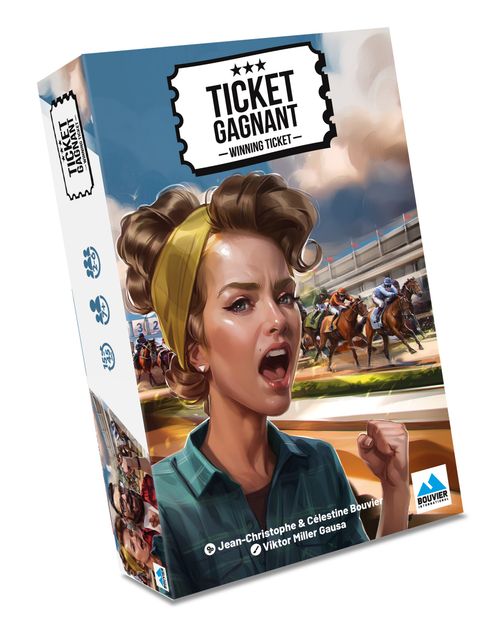
Ticket Gagnant
Ticket Gagnant Rulebook
Table of Contents
Table of Contents
Setup of a Flat Race
This is a setup of a flat race for 6 players, green side, no obstacle. (Obstacle races, steeple-chase, and harness races are covered on page 10.)
- Each player has a matching prediction ticket, 7 prediction tokens, and a scoring token positioned on the 0 of the scoring board.
- The last player who has recently done horseback riding takes the 1st player token and the deck of movement cards.
- The galloping horses are placed on the white circles in any order.
- The photo-finish cards are positioned at the end of the racetrack.
- The six +40 tokens are positioned on the 40 spot of the scoring track.
- The trot-with-a-sulky tokens, the hedges, and the river are put aside for now.
In the Box
- 1 double-sided racetrack board
- 7 gallop tokens
- 7 trot with a sulky tokens
- 16 bases (horses & hedges)
- 2 hedges
- 1 river
- 6 +40 tokens
- 42 prediction tokens
- 6 scoring tokens
- 6 prediction tickets
- 1 1st player token
- 45 movement cards
- 7 photo-finish cards
Number of Races in a Meeting
- 2 players: 4 or 6 races
- 3 players: 3 or 6 races
- 4 players: 4 or 8 races
- 5 players: 5 races
- 6 players: 6 races
Sequence of a Race in 5 Steps
1. The first player chooses the style of the race, the type of predictions, and deals the movement cards
The player with the 1st player token chooses to deal between 3 and 7 movement cards to everyone. By default, the predictions are visible.
Once the basic rules are mastered, he/she can, before dealing cards:
- switch between race styles: flat racing, harness racing and steeplechase (rules p.10)
- choose to keep the predictions hidden. Therefore, each player will keep their prediction tokens face down. (Printable screens are available for download on our site www.ticket-gagnant.com)
2. All players make their predictions simultaneously
According to their movement cards, all players will choose simultaneously which horse they think can win the race (a win bet) or finish in the top three (a place bet). Players can choose one, two or three horses. Then on the top section of their prediction tickets, they will place face down the tokens corresponding to the color and number of their favorite horses (only one token is allowed per space). Once everyone is done, the predictions can be revealed to everyone.
Note: Players must predict at least one horse before each race.
Example — Prediction on the Tickets
The red player has predicted 3 horses: Black #7, Green #3 and Red #5, to finish 1st, 2nd and 3rd.
The green player has predicted 2 horses: Orange #1 and Blue #4, to finish 1st and 2nd.
The blue player has predicted only one horse, Purple #2, to finish in 3rd place.
3. Players take turns moving the horses
And they're off! Clockwise, starting with the first player, each player must play one movement card from their hand on a common discard pile and move the corresponding horse. The orientation of the card is important because it indicates which direction the chosen horse will move. Once all players have played their movement cards, the final position of the horses determines the final rank of the race.
The black and white dashed line does not represent the finish line: it is not necessarily crossed during a race. However, if a horse crosses this line, it is the winner, and the race is over, even if there are still cards in play.
There are 3 types of movement cards:
I. The cards with one colored and numbered square:
- identify a specific horse according to its number and the color of its silks.
- the number of gray squares on the cards indicates how many spaces the corresponding horse has to move (forward, backward or sideways), but always within the limits of the racetrack.
Shorter moves are allowed only to keep horses on the racetrack. In obstacle and steeple-chase races, shorter moves will be allowed under certain conditions (rules p.10).
A horse can move through a space occupied by another horse.
Example — Possible moves for the red horse #5 depending on the orientation of the cards: 1 space backward, 2 spaces to the right, 3 spaces to the left, 3 spaces forward.
II. The 3 wild cards:
- can move any horse 1 to 3 spaces in any direction but never diagonally.
III. The cards with two different colored squares:
- identify two specific horses according to their number and the colors of their silks.
- move only one of the two horses to an adjacent space in front, behind or on any side of the other horse that stays still. A horse that moves can never be moved off track. It has to stay within the limits of the racetrack.
Example — 8 possible situations with the same card (Red #5 / Blue #4):
- Red #5 moves in front of Blue #4, or Blue #4 moves behind Red #5.
- Red #5 moves on the right of Blue #4, or Blue #4 goes to the left of Red #5.
- Red #5 moves behind Blue #4, or Blue #4 moves in front of Red #5.
- Red #5 moves to the left of Blue #4, or Blue #4 goes to the right of Red #5.
Note: if two horses are already adjacent to each other (next to each other or in front of each other) then it is possible to play a card matching their positions without having to move any horse.
Two Special Cases
Ending your move on an occupied space
If a horse ends up on a space already occupied by another horse, it takes its place and the 2nd horse is moved on any of the 8 adjacent free spaces.
In this situation, the Red horse #5 moves 2 spaces forward and takes the place of the Blue horse #4. The Blue horse #4 can be moved in any of the 6 surrounding free spaces because the Purple horse #2 and the Orange horse #1 are already occupying two of the other spaces.
If there is no free space available (other horses, edge of the racetrack, hedges, river), then the movement is illegal; the player has to play the card differently or has to choose a different card.
The black and white dashed line
The black and white dashed line isn't necessarily crossed during a race. However, if a horse crosses this line, it is the winner and the race immediately ends, even if there are still cards in people's hands.
In this example, the Red horse #5 has just crossed the dashed line, winning the race. The Blue horse #4 finishes 2nd and the Green horse #3 finishes 3rd. The race is over.
4. The first player establishes the rank at the finish line
Once all movement cards have been played or discarded, or when a horse has crossed the black and white dashed line, the final position of the horses determines the final rank of the race. In the case of horses finishing neck and neck, there is a photo finish between them.
Only the photo-finish cards of the neck and neck horses are shuffled. The first player randomly chooses one card. The selected card is the horse who wins by a nose. The first player proceeds until the winning trio and the last horse are selected.
Example — Rank at the Finish Line
In this example, the Black horse #7 won the race. The Red horse #5 finished 2nd. The Blue horse #4 and the Purple horse #2 finished neck and neck for 3rd place. A photo-finish is needed to select which horse actually finished 3rd.
The photo-finish cards #4 and #2 are shuffled face down and one is randomly picked to determine who will be 3rd on the podium. In this example, the Blue horse #4 has been drawn and will be the one finishing in 3rd place, the Purple horse #2 finishes in 4th place. The horses Orange #1, Green #3 and Yellow #6 will be ranked 5th, 6th and 7th respectively.
For those averse to randomness, final positions are determined not by the photo-finish cards but by the horses' positions on the inside rail (next to the 0 on the scoreboard track). In case of a tie, the horse closest to the rail wins. In the example above, the Purple horse #2 would then finish 3rd and the Blue horse #4 would be 4th.
5. Scoring
If the first player has chosen the "hidden predictions" option, then it is time for players to flip the prediction tokens face up.
Each player adjusts his/her prediction tokens in the correct zone of the prediction ticket according to the results of the race:
- if the prediction matches the results of the race, the prediction is a win bet. The prediction token stays in the WINNING BET section.
- if a horse finished the race in the top 3, but the prediction doesn't match the results of the race, then players move their prediction tokens from the WINNING BET to the SHOW BET section. The prediction is a place bet (1st or 2nd position) or a show bet (1st, 2nd or 3rd position).
Once the points are calculated, players move their tokens accordingly on the scoring board.
Example — Scoring
In this example, the red player had predicted #7 - #3 - #5. The finish order of the race is #7 - #5 - #4, and the Green horse #3 finished in 6th place.
- The Black horse #7 finished in first place as predicted. The black token #7 stays where it is in the WIN BET section and earns 7 points.
- The Green horse #3 arrived in 6th place. The green token #3 slides down to the 6th place spot of the NO SHOW section and earns -1 point.
- The Red horse #5 arrived in 2nd place but was predicted in 3rd place. The red token #5 slides down to the SHOW BET section and earns 3 points.
The final score is: 7 - 1 + 3 = 9 points: the red player moves 9 spots on the scoring board.
A horse trio (or tiercé in French) can bring bonus points:
- A WINNING TRIO or TRIFECTA (TRIO ORDRE in French) adds a bonus of 5 points: the 3 predicted horses arrived in the correct predicted order.
- A BOXED TRIFECTA (TRIO DÉSORDRE in French) adds 2 points: the 3 predicted horses arrived in a different order than the prediction.
When all players have moved their scoring tokens on the scoreboard, the 1st player token moves to the left to the next player and the next race can start.
Notes:
- If a player scores more than 40 points, he/she will take a +40 token and will continue scoring the difference of points starting back at 0 on the scoring board.
- A player's score cannot go below -8 points. Any additional negative points won't be considered.
End of the Game
After the last race, the player with the most number of points on the scoreboard wins and is declared the best handicapper. Several players can win with the same score.
Kinds of Racing
Obstacle Race
Before the start of a new race, the first player can decide to set up an obstacle race. The support of the two hedges will be placed on the dashed circles in the middle of the racetrack.
The movement rules are the same as a flat race while going forward or sideways. The hedges don't have any special effect, they are positioned at the limit of a regular space. However, backward movements are stopped by the hedges. A horse can never move back or be placed behind a hurdle it has already crossed, regardless of the type of movement card played. Hence, some moves will be restricted or impossible.
Steeple-Chase
In a steeple-chase race, the first player needs to add a river in front or behind a hedge.
Consider river spaces as regular spaces for movement, but a horse cannot stop on a river space. Also a horse cannot be repositioned on a river space. Some moves will be restricted or impossible.
Harness Races
Harness races use the figurines with a sulky and are played on the pink side of the pouzzolane racetrack boards. Be careful to remember the position of all score tokens before flipping the boards.
One additional rule with the harness race is that horses can be disqualified by the track stewards if they don't keep a certain gait. Usually, horses are trotting, but if they gallop just for a few strides, they can be out of the race.
One can find on the racetrack some spaces marked with horse hooves tracks. If a horse ends up on one of these spots at the end of the race, the horse is disqualified and removed from the gameboard. A disqualified horse will earn -2 points and be placed on the last spot on the NO SHOW section of the prediction ticket.
Players can download for free trot horse figurines (without the sulky) at www.ticket-gagnant.com
Glossary of Horse Racing
Kinds of racing — There are different kinds of horse racing:
- Flat racing is a race without obstacles where horses have to either trot or gallop.
- Obstacle racing is a race with obstacles horses have to cross or jump over. A race with a river and hedges is a steeple-chase.
- Harness racing is when horses pull a little cart where the jockey sits. Horses aren't allowed to gallop otherwise they will be disqualified.
Disqualification — in a harness race, when a horse doesn't keep the trotting gait and gallops several times for a few strides, it will be disqualified by the race stewards.
Favorite — The horse with the best odds to win a specific race.
Place bet — You predict that a horse finishes a race either in 1st or 2nd position.
Silks — The jacket and cap worn by riders which designate the owner of the horse.
Show bet — You predict a horse finishes a race in 1st, 2nd or 3rd position.
Photo-finish — When horses finish neck and neck at the finish line, a picture is sometimes needed to determine which horse was ahead of the other. Therefore, they can sometimes win by just a nose.
Racetrack surfaces — Turf commonly in Europe; Dirt, sand commonly in the US; Ash, pouzzolane, cinder.
Track stewards — Officials making sure that everyone respects the rules of the race.
Trifecta — The 3 predicted horses arrived in the correct predicted order.
Boxed trifecta — The 3 predicted horses arrived in a different order than the prediction.
Win bet — You predict a certain horse to finish in 1st place.
Yearling — A one year old horse, born the previous year.
The Authors' Word
Célestine Bouvier, Young Jockey:
On February 28, 2021, I made my first start in flat racing with "Live in Paris" at the Lyon Parilly racetrack. Six months later, the day of my 5th victory with Zita des Echanault, and during the 450 kilometer trip back from Montier-en-Der racetrack, my father and I imagined Winning Ticket (Ticket Gagnant). In my family, we all love games and horse racing was the perfect inspiration for a new game. Then just like you train a yearling before it becomes a racing horse, we have been refining the rules of Winning Ticket (Ticket Gagnant) to make the most of it.
Jean-Christophe Bouvier, Game creator and father:
After creating the Rallyman games, I developed a passion for horse racing, born out of my daughter Célestine's love and participation in the sport. After multiple prototypes, family tests, interactions with the public at game festivals, and visits to racecourses in Lyon and Vichy, we present to you today Winning Ticket (Ticket Gagnant), the culmination of this enriching journey. Designed for everyone, we hope you enjoy playing Winning Ticket (Ticket Gagnant) and maybe one day experience the same emotions in real life at one of the 235 magnificent racetracks in France... or elsewhere!
Thanks To
First of all, a big thank you to Célestine and her three sisters Camille, Justine and Clara-Andréa, to my brother Philippe and to my parents Paula and Pierre for their active participation in the development of Winning Ticket (Ticket Gagnant): tests, ideas, financial support, desktop publishing, illustrations, support at festivals, proofreading, etc.
Then, I would like to thank Christophe Guiard, Patrick O'Connell, Sergio Raccampo, Kiddo, Mistergos, Sébastien Patiny, Oisin Hopper, Eloïse Pradon, Yann Souillet-Désert, Olivier Louit, Gabriel Zeitlin, David, Stéphanie and Thomas Sire, Max Riock, Ludi Nat, Frédéric Ormières, Eric Massol, Alain and Jacqueline Ollier, Tony Rochon, Yoann Laurent, Jean-Luc Fayolle, Thierry Asselos, Quentin Saint-George, Cédric and Juliette Boutot, Dominique Chentre, Nicolas Thiriet, Kiko17, and all players we have met during the game festivals, the game nights, at the racetracks and on social media, your pieces of advice, your comments, your support, your suggestions, your translations have inspired and motivated us. To those I unintentionally forgot to mention, please forgive me.
A final thank you to all of you. We are very proud of the trust you are showing us by purchasing Winning Ticket (Ticket Gagnant).