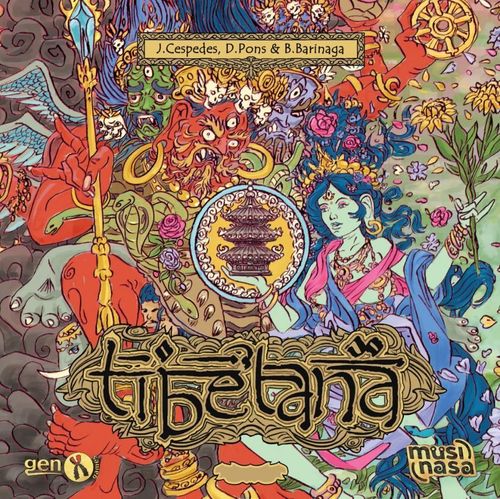
Tibetana
Tibetana Rulebook
Table of Contents
Table of Contents
How to Win
The goal of the game is to build pagodas to get more Victory Points than the opponent. The game ends immediately if:
- A player has three (3) pagodas with four (4) rings each. Automatic Victory.
- A player has no pagodas. Automatic Loss.
- The players agree to a draw, or one player concedes.
In Tibetana, as in many classic games, it is honourable to agree to a draw or even to concede. If this were the case, reset the pieces and seek your revenge in a new game!
- In the unlikely event that there is no energy left on the game map, or no one has Built in the last ten turns, Victory Points are calculated for each standing pagoda to determine the winner.
| Number of rings in pagoda | 0 | 1 | 2 | 3 | 4 |
|---|---|---|---|---|---|
| Victory Points | +1 | +3 | +6 | +10 | +15 |
The player with the most Victory Points wins. In case of a draw, the player with less pagodas wins. If there's still a draw, the victory is shared!
Overview
The first player to control three (3) completed pagodas wins the game. A pagoda is completed when it has four rings.
To stay ahead of your opponent, you must control the map by performing actions (Move, Train, and Build) with your guardians and priestesses, while collecting the energy from the territories in the process. This energy can then be spent on special actions (Portal, Expel Demon, and Summon Demon).
Demons are neutral and chaotic figures that alter the rules of the game with each new summoning.
Key Concepts
The Map
The map consists of hexagonal territories. Each type of territory has a maximum number of pieces it can hold, depending on the land type it represents. This is called capacity.
The capacity of each territory corresponds to the number of square slots it has.
Any territory can contain at most one pagoda OR one demon (never both at the same time).
- Desert: 2 guardians/priestesses; 1 pagoda OR 1 demon.
- Forest: 3 guardians/priestesses; 1 pagoda OR 1 demon.
- Mountain: 4 guardians/priestesses; 1 pagoda OR 1 demon.
The Pieces
In Tibetana, the pieces are divided into two groups: player pieces and neutral pieces.
Player pieces: guardians, priestesses, and pagodas can only be controlled (Move, Train, Build) by the player to whom they belong.
Neutral pieces: demons and portals are neutral, and may be moved by any player when performing special actions on their turn.
The Five Demons
They generate chaos wherever they are invoked, and their powers grow as the game progresses. They have 3 levels: Natural, Agitated, Explosive.
Two demons can never occupy the same territory, nor can they share a territory with a pagoda.
The Portal (2 halves)
Territories connected by the portal are considered adjacent to each other. Each half of the portal can only be connected to one territory at a time.
During the game, the portal may change locations.
The Priestesses
They may extract energy from the territories, channel it, and use it to Build pagodas.
They do this individually or in coordination with the other priestesses, provided they are adjacent to each other and not under pressure from enemy guardians.
The Guardians
They watch over the surrounding territories with a dual function:
- Pressuring adjacent enemy priestesses, preventing them from building or extracting energy.
- Protecting allied priestesses from the pressure of enemy guardians.
The Pagodas
Temples built to increase the players' presence on the map.
Their construction stage is represented by the number of rings they possess. All pagodas start with no rings and are completed at four rings.
Controlling three (3) pagodas with four (4) rings each wins the game.
A pagoda cannot occupy the same territory as a demon or another pagoda.
Board Setup
- Set up the game map. Place the territories as shown in the illustration. The orientation of each territory does not matter. This layout will work great for your first games. For rules on how to create your own map variants, see page 14.
- Prepare the initial settlement of each player in the highlighted territories. Initial settlements consist of:
- A pagoda with a ground ring (yellow) and a water ring (blue-yellow) on top of it.
- A priestess.
- A guardian.
- Place each portal half in the indicated positions. Each half is connected to one territory.
- Distribute 25 energies on the game map:
- Zero (0) energies in the territories with an initial settlement.
- One (1) energy in the territories adjacent to any initial settlement.
- Two (2) energies in the territories that are two territories away from the nearest initial settlement.
- Three (3) energies in the remaining territory.
- Prepare each player's reserve next to them. Each reserve consists of:
- Four (4) priestesses.
- Four (4) guardians.
- Four (4) pagodas.
- Hand the remaining priestess and guardian to the opposite player. Place the enemy pieces on a shelter.
- Set up the demon altar next to the game map. Place:
You are ready to start. The player who most closely resembles any of the demons will be the first player.
Game Turn
The game is played in alternating turns. On each turn, the player performs up to three actions (four if they choose to Exert).
Only during the first turn, the first player starts with two actions (instead of three).
There are two types of actions:
- Basic actions have no cost and may be repeated in the same turn. They are Train, Move and Build.
- Special actions consume two (2) energies from the player's energy pool (return them to the box), and the same special action may not be repeated in the same turn. They are Exert, Summon a Demon, Expel a Demon and Regenerate Portal.
Basic Actions
Train (free - repeatable)
Place a priestess or guardian from your reserve in a territory with one of your pagodas, without exceeding the capacity of that territory.
To Train your sixth priestess or guardian, consume two (2) energies from your energy pool. Ask your opponent for the piece. From now on, it is considered a normal piece for the rest of the game.
Move (free - repeatable)
Move one of your priestesses or guardians to an adjacent territory, without exceeding the capacity of that territory.
You may not move into a territory in which there are pieces from the opposite color.
However, you can force opponent pieces out of a territory with enough pressure. To clear a territory with 1/2/3 enemy pieces (guardians, priestesses and pagodas) you need 3/5/7 guardians in territories adjacent to the one you want to clear.
Return any rings and player pieces from that territory to their corresponding reserves. Then, move one of your adjacent guardians into the territory.
Protect your temples! Pagodas should always be guarded. For clearing purposes, a pagoda counts as one piece only if there is at least one priestess or guardian in the same territory. Otherwise, it's exposed.
If you Move into a territory with an exposed enemy pagoda, that pagoda is immediately returned to its reserve. Take out any rings and return them to the reserve as well.
Example.
- It's Pink's turn. There are two enemy pieces, and Pink has three guardians surrounding them. Pink doesn't have enough adjacent guardians to clear the territory.
- Some turns later, Pink has managed to place five guardians surrounding them. Pink decides to clear the territory:
- Pink removes all the green pieces, and then Moves one adjacent guardian into the cleared territory.
Build
Priestesses can turn the energy from a territory into a new pagoda, or upgrade an existing one with a ring.
Energy from the energy pool cannot be used to Build.
Any Build action consists of three steps:
-
Extract the energy. Choose a priestess that is not pressured and take one (1) energy from her territory (source). Place it in your energy pool.
A priestess is under pressure when there are more enemy guardians in adjacent territories than ally guardians in her territory and adjacent ones.
-
Use the energy. Choose a priestess that is not pressured in the territory where you will build the pagoda (target). This territory may not be occupied by a demon or a completed pagoda (with four rings).
- If the target territory is the same as the source territory, you may use the same priestess.
- If it's a different territory, it must be linked to the source by a chain of adjacent priestesses. Priestesses are adjacent if they are in adjacent territories.
Place a pagoda in the target territory. If there is a pagoda already, place a new, different ring instead.
A pagoda can hold a maximum of four rings. The ring order is: Ground (Yellow) » Water (Blue) » Fire (Red) » Air (Green).
A priestess may not be chosen to "USE THE ENERGY" (second step) more than once per turn. However, she can extract energy for another priestess to use it, or channel it with no limitation.
-
Stir the demons. Advance the die one (1) position on the altar.
Whenever the die completes a cycle and reaches the demon slot:
- If you have actions left on your turn, you must Summon a Demon as your next action.
- If you have no actions left on your turn, the first action of the opposing player must be Summon a Demon.
Example. In order to Build, Pink chooses a source (energy in A) and a target (pagoda in B) that are linked by a chain of priestesses. Pink needs to check for pressure in both the source and the target territories:
- Priestess in A counts three enemy guardians and three allied ones; therefore is not pressured.
- Priestess in B counts three enemy guardians and two allied ones. Hence, Priestess in B is pressured. The Build action cannot take place until she sees three allied guardians, at least.
If the priestess in B was not pressured, the energy could be used to place a new ring in B through the priestess chain A » C » B.
If this is your first time playing Tibetana, you are ready to start! You don't need to keep reading until a Build action triggers Summon a Demon.
Special Actions
The energy extracted during the game has a second life, as it can be consumed to perform some powerful, special actions.
To perform a special action, you must consume two (2) energies from their energy pool (the energy consumed is returned to the box).
You may not consume energy directly from the territory.
You can perform several special actions on the same turn, provided you can consume two (2) energies for each of them, but you may not repeat the same special action in the same turn.
Exert (consume two energies)
To push beyond one's limits is to tempt both glory and ruin. By exerting themselves, the tribes can channel deeper power, wresting one more action from the current of fate... though such effort comes at a cost.
Perform an additional action during this turn (four instead of three). The additional action can be a SPECIAL ACTION, provided you can consume the necessary energy for it.
Exert does not use a turn action.
Summon a Demon (consume two energies)
If you are forced to Summon a Demon as the result of a Build action, you do not consume any energy.
As the tribes meddle with the flow of the land's energy, the demonic deities stir in restless anticipation. In time, their power will break through, and their dreadful forms shall manifest in the earthly realm.
The tribes hold no sway over which demon emerges, yet they may beckon these beings to reveal themselves in chosen regions...
To start the summoning, roll the die. You may not decide the demon that will appear.
- If you roll a number (1 to 5), you triggered a normal invocation of the demon in the corresponding circle.
- If you roll the flame, reroll until you roll a number. You triggered a more powerful, enflamed invocation.
There's a summary of every demon effect in the back of their reference card, and a full description on the pages 10-12 of this rulebook.
Now, place the die on the demon icon of the altar. Check the demon occupying the position in the altar that corresponds with the number rolled:
- If the demon is still on the altar:
-
Normal invocation: place the demon in an available territory and apply the demon's natural effect.
A territory is available for a demon if there is no other demon or pagoda in that territory.
-
Enflamed invocation: take the demon and a pedestal. Place them in an available territory and apply the demon's agitated effect.
-
- If the demon is on the map without a pedestal:
-
Normal invocation: take the demon and a pedestal. Place them back in any available territory and apply the demon's agitated effect.
An agitated demon can be placed back in the same territory you took them from.
-
Enflamed invocation: apply their explosive effect immediately on the territory where the demon was located. Then, return the demon to their altar slot and the pedestal to its reserve.
-
- If the demon is on the map with a pedestal:
- Normal or enflamed invocation: apply their explosive effect immediately on the territory where the demon is located. Then, return the demon to their altar slot and the pedestal to its reserve.
You may never relocate the demon before the explosive effect takes place.
Example.
- As the first action of Pink's turn, the player Builds a new ring for the pagoda. The die completes the cycle and reaches the demon slot, so Pink is forced to Summon a Demon (without consuming energy) as their second action.
- Pink has rolled a flame, which means the next invocation will be an enflamed invocation. After that, another six (which is rerolled again) and a three. The chosen demon is Mahākāla. The die is placed back on the demon slot.
- As Mahākāla is on the demons altar: he is placed on a pedestal and Pink decides in which territory he will appear (as long as there is no demon or pagoda in that territory).
- The agitated effect of Mahākāla is now read and applied. After that, Pink performs their third action and completes a turn.
Expel Demon (consume two energies)
Through sacred rites and sheer force of will, the tribes may drive these beings away, displacing their chaos to a new ground.
To expel a demon is not to banish it, but to shift its shadow elsewhere.
Move a demon to an adjacent, available territory. The demon's natural effect or agitated effect is still active in the new territory.
Regenerate Portal (consume two energies)
Where the portal blooms, distance itself collapses.
Though separated, each half is bound to the other, opening a single passage that makes distant lands stand side by side.
Place each half of the portal next to a territory on the outer perimeter of the map (not necessarily opposite to each other).
A territory not connected to the outer perimeter of the map is not a valid location for a portal.
Each half of the portal can only be touching one territory. Territories connected by the portal are considered adjacent for all purposes.
The Demons
Do not spoil the surprise! Meet the demons as they arrive.
We recommend that players do not read ahead into the demon descriptions. Instead, reveal and learn their effects only when the summoning occurs. This section exists as a reference during play, not as preparation beforehand.
Trust in the unknown, and let the chaos of the demons shape your path to victory.
Demons are not bound by mortal notions of good or evil. They are the materialized chaos, unpredictable currents that twist the flow of the game itself.
Their presence unsettles the tribes, for each summoning reshapes the balance of power, bending rules and remaking the world around them. To prevail, the tribes must learn to bend with this chaos, adapting their strategy to each new apparition.
Demon effects are continuously updated. If something changes in the map, the effects changes accordingly:
- Build a new pagoda to protect that territory from current demon negative effects.
- Expel a Demon to change their area of influence.
Citipati - Impermanence
When there is any targetable guardian or priestess, the Citipati's effect must be applied.
-
Natural: At the end of each turn (including the one in which the Citipati is summoned), the active player chooses one (1) guardian or priestess from the Citipati's territory and returns it to their reserve.
-
Agitated: At the end of each turn (including the one in which the Citipati is summoned), the active player chooses two guardians, two priestesses, or one of each from the Citipati's territory and returns them to their reserves.
-
Explosive: The active player removes one (1) guardian or priestess from the Citipati's territory or from an adjacent territory (cannot target territories with a pagoda). The opponent repeats this effect. Lastly, the active player repeats this effect again.
The Citipati then returns to its circle on the altar.
Kurukullā - Transfiguration
-
Natural: Kurukullā counts as a guardian of the colour of the pieces in that territory. She can't be moved by a Move action. While there are no other pieces, Kurukullā has no effect. She does not affect the capacity of that territory.
-
Agitated: Kurukullā acts as a guardian and a priestess of the colour of the pieces in that territory. She can't be moved by a Move action. While there are no other pieces, Kurukullā has no effect. She does not affect the capacity of that territory.
-
Explosive: The active player Trains one (1) of their guardians or priestesses in Kurukullā's territory or an adjacent one (even if there is no pagoda) as long as territory capacity is respected and there are no enemy pieces in the territory. Their opponent repeats this effect. Lastly, the active player repeats this effect again.
Players can consume two (2) energies to get their sixth priestess/guardian during this effect.
Kurukullā then returns to her circle on the altar.
Kuberan - Momentum
-
Natural: Any guardian or priestess that leaves or crosses Kuberan's territory can move up to one (1) additional territory as part of the same Move action. The territories' capacity must be respected in every stage of this movement.
-
Agitated: Any guardian or priestess that leaves or crosses Kuberan's territory can move up to two (2) additional territories as part of that same Move action. The territories' capacities must be respected in every stage of this movement.
-
Explosive: The active player performs one of these two options:
- a) Build without energy (all other priestesses and pressure conditions apply). This does not count as a turn action.
- b) Place three (3) energies in your energy pool.
After that, their opponent performs the other.
Kuberan then returns to his circle on the altar.
Mahākāla - Infiniteness
-
Natural: Mahākāla completes the capacity of the territory in which he is located: no piece can pass through this territory or stop in it. When he is placed, any affected piece may leave or be crushed (see below).
-
Agitated: Mahakala applies the natural effect and also subtracts one (-1) from the capacity of adjacent territories (does not apply to territories with a pagoda). You can mark the affected territories with the fire tokens.
-
Explosive: Mahākāla destroys the territory: the hex is removed from the board along with everything it contains. Pieces are returned to their reserves. Energy is returned to the box. If the portal is there, it is disabled until someone regenerates it.
Mahākāla then returns to his circle on the altar.
Is someone exceeding the territory's capacity?
Mahākāla effects may provoke that some pieces exceed the maximum capacity allowed in the territory. If any of your guardians or priestesses is affected during your turn, you must:
- a. Use Move actions to move pieces out, one at a time.
- A piece must be moved to an adjacent territory with enough room and without enemy pieces (unless you clear the territory first).
- You can Exert before or between Move actions.
- b. Let some or all of your affected pieces be crushed. Remove as many as necessary (you choose which ones) until the maximum capacity of the territories is met, and place them back into their reserve. This does not count as an action.
If your guardians or priestesses reach this situation during the opposing player's turn, you must resolve the excess at the beginning of your turn.
Heruka - Enlightement
-
Natural: Priestesses in Heruka's territory cannot participate in any Build action (neither absorbing nor channelling energy nor using it to build pagodas).
-
Agitated: During any Build action, priestesses in Heruka's territory are considered priestesses of the opposite colour.
-
Explosive: The active player removes one (1) priestess (any color) from Heruka's territory or from an adjacent one without a pagoda, then adds (1) energy to the energy pool of the removed priestess' clan. Their opponent repeats this effect. Lastly, the active player repeats this effect again.
When there is any targetable priestess, Heruka's effect must be applied.
Heruka then returns to his circle on the altar.
FAQs
Can you Train if you have no priestesses or guardians in your reserve (i.e. by redeploying from elsewhere on the board to a pagoda location)? No, you can't. If all your pieces are in play, you can only Move them until some effect (demons, clear) brings any of them back to your reserve. This also applies to Building new pagodas: you can only do it when you have at least one in your reserve.
How am I supposed to clear a territory with three enemy pieces if I can have five (5) guardians at most? Beware of the demons!
What happens if the portal makes two territories double-adjacent? They are simply adjacent for every mechanic that considers adjacency. For example:
- Mahākāla substracts only one (-1) to the capacity.
- Guardians are not counted twice.
Can demons go through the portal? Can priestesses channels go through the portal? Yes and yes. As long as the portal exists, consider the territories adjacent to each other for any matter.
After Mahākāla explodes, does the perimeter of the board get redefined for the purposes of placing a portal half? Yes, the perimeter gets redefined. A hole not connected with the outer bound is not considered a valid location for a portal, but there are holes that may increase this perimeter.
Is Summoning a Demon good or bad for the clan summoning it? It depends. On the one hand, deciding where the demon will appear is always an advantage for the sumonner. On the other hand, forcing your opponent to Summon spends one of the three actions of their turn, which may slow their progress.
What happens if my sixth priestess or guardian gets removed from the map? Do I have to pay for it again? Once you have paid for it, you can consider it a normal piece, undistinguishable from the rest. If it is removed from the map, bring it to your reserve as you would do with any other piece.
Can I avoid to Summon a Demon if I Exert after Building as a third action? No, you can't bypass Summoning a Demon after the Build action triggers it. This must be the next action, either in your turn as a fourth action (if you decide to Exert) or the first one of your opponent.
Can I consume energy to Exert after my third action or does my turn end before I can do that? Yes, you can Exert even if you got the energy to do so as a result of the third action of your turn.
What happens if my turn is over and I'm not done moving pieces out of Mahakala's effect? By the end of your turn, remove as many of your affected pieces as necessary to comply with the capacity rules and return them to your reserve. You choose which ones to remove.
Create Your Own Map
Are you ready to explore some other worlds? The modular design of Tibetana lets you create countless scenarios in which your civilization can flourish. To set up your own scenario, follow these steps:
If one of the players doesn't have prior experience with Tibetana, that player should take Pink Player role in these steps.
-
Each player receives three (3) territories of each type. The remaining territory (a mountain) is placed on the table and marks the beginning of the map.
-
The Pink Player chooses three of their territories and places them on the map.
- a. Hexagons must be placed sharing full sides.
- b. Don't move territories placed on previous steps.
- c. After every step, when you finish placing your three territories, every territory should be touching no less than two other territories. Notice that holes are not forbidden!
-
The Green Player chooses three of their territories and places them on the map.
-
Repeat steps 2-3 until all the territories have been placed.
-
The Pink Player places the two halves of the portal. They must be placed touching two separate territories in the outer perimeter of the board (see blue line). A hole (not connected with the outer bound) is not considered a valid location for a portal.
-
The Green Player chooses two non-adjacent territories and place two green pagodas to mark them. This will be the player's initial settlements, but don't decide which one belongs to which faction yet.
-
Place 27 energies following these sequence: (the manual's lettering skips "d" and goes a, b, c, e, as printed)
- a. Place three (3) energies in each of the territories that are three territories away or more from the nearest initial settlement.
- b. If there are energies left, place two (2) energies in each of the territories that are two territories away from the nearest initial settlement.
- c. If there are energies left, place one (1) energy in each of the territories that are adjacent to any initial settlement.
These rules will allow you to create millions of balanced maps to play with. Either resembling real-life geography or going wild with your own narratives...
Don't hesitate to share your custom-made game maps with us! We will feature our favourite ones on our website and social networks.