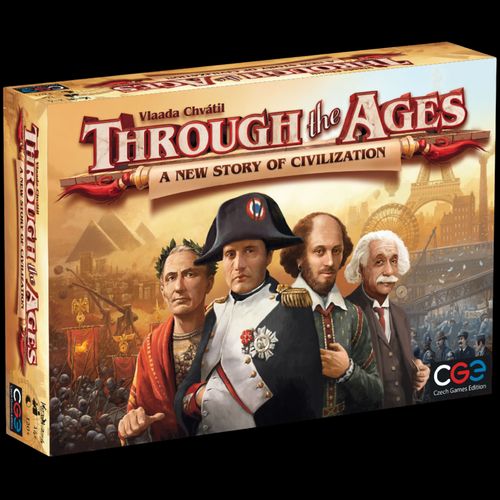
Through the Ages: A New Story of Civilization
291 questions players ask about Through the Ages: A New Story of Civilization, answered in plain words and graded by where the answer comes from. See also the full rulebook.
Updated 2026-10-24.
291 questions players ask about Through the Ages: A New Story of Civilization, answered in plain words and graded by where the answer comes from. See also the full rulebook.
Updated 2026-10-24.
The designer answered this directly on BGG in 2015.
Play only to the end of Age II, take out every aggression, war and pact, and use the simple extra scoring the handbook describes for the end. Once everyone knows the game, add aggressions, wars, pacts and air forces back in for the full game. The handbook also gives a separate two-age variant that keeps the full military rules and random Age III events.
The rulebook's "Deck Setup" section answers this directly.
Remove the cards with the small player-count marking in their top-right corner. 3 players: take the three cards marked for 4 players out of civil decks I, II and III: Iron, Alchemy and Knights (Age I), Selective Breeding, Cannon and Republic (Age II), and Professional Sports, Air Forces and Military Theory (Age III). 2 players: remove nine marked cards from each of those civil decks, plus every pact from military decks I, II and III. Pacts carry no marking because all of them go. Only one copy of each listed card comes out, and it doesn't matter which copy. That is why a 2-player deck has, for example, only one Journalism.
The rulebook's "Preparing the Event Deck" section answers this directly.
Only to build the starting current events deck. Shuffle it, deal a number of cards equal to the player count plus 2 face down as the current events, and return the rest to the box unseen. Nobody ever draws Age A military cards.
The rulebook's "Initial Actions" section answers this directly.
The starting player gets 1 civil action, and each player after them in clockwise order gets one more (2, 3, 4). This is the same in a 2-player game. Nobody has military actions in the first round. From the second round on, everyone uses their full totals.
The rulebook's "First Turn" section answers this directly.
No. On your first turn you may only take cards from the card row. A leader you take stays in your hand until a later turn, when you pay a civil action to play it. A wonder you take goes straight into play as your unfinished wonder, but you can't build any stages yet.
The rulebook's "Action Phase" section answers this directly.
As many as you can pay for. Each action costs civil actions (white tokens) or military actions (red tokens), and some cost more than one. Players don't alternate single actions: you take your whole Action Phase, then the next player goes.
The rulebook's "Game Flow" section answers this directly.
No. Dealing the last Age III civil card starts Age IV, and that sets up the final round. If this happens during the starting player's turn, the current round is the last. If it happens during anyone else's turn, finish the current round and then play one more full round. Either way, everyone gets the same number of turns. Since the card row is refilled at the start of a turn, Age IV always begins at the start of someone's turn.
The rulebook's "Game Flow" section answers this directly.
Only the Age III events, in any order. Any Age I or Age II events still in either deck are ignored, including seeded ones like Politics of Strength. An Impact you seed therefore always scores, either when it is revealed during the game or at final scoring.
The rulebook's "Evaluating an Event" section answers this directly.
Treat the starting player as the current player. A tied player who comes earlier in turn order, starting from the starting player, counts as having the higher value, so the last player in turn order loses every such tie. Cards that apply to all civilizations with the most or least of something leave ties unbroken.
No. The extra end scoring for technologies, science, wonders and so on belongs only to the shorter game that ends after Age II. In the full game, end-of-game points come from Age III events, mainly Impacts, that players seed into the events decks as their political action, plus cards like Bill Gates. Nothing is drawn or set aside at setup.
One experienced player applies the rulebook's last-round rule to the two-age game; the two-age variant itself isn't in the rulebook.
It works like the end of the full game: finish the current round, then play one more full round before final scoring. If the age ends during the starting player's turn, the current round is the last.
Several experienced players agree on this; there is no official ruling.
By what you produce per turn, not what you have stored. Food or resource production is each worker on a farm or mine multiplied by the value printed on its card, not a count of blue tokens. Science scores your science rating, not your science points.
The rulebook's "Replenish the Card Row" section answers this directly.
At the start of each player's turn, as the first step of that player's turn. Discard the cards in the leftmost spaces (three spaces with 2 players, two with 3, one with 4), slide the rest left, and deal new cards into the gaps. To save time, the next player often does this while the previous player is finishing production.
The rulebook's "End of an Age" section answers this directly.
Nothing is refilled during the first round. On the starting player's second turn, refill the row normally from the Age A deck, then remove the rest of the Age A deck from the game. Age I begins at once: shuffle the Age I civil and military decks onto the current age board, and if the row still has gaps, keep filling them from Age I.
The rulebook's "End of an Age" section answers this directly.
Ages I, II and III end the moment the last card of the current civil deck is dealt into the card row. The next age starts right then, during that same start-of-turn step, and the row keeps filling from the new deck. Age A is the exception: it ends the first time the row is replenished.
The rulebook's "Replenish the Card Row" section answers this directly.
Yes. At the start of each turn, discard the cards in the leftmost spaces and slide the rest left as usual. Only the refill is skipped, because Age IV has no deck, so the row shrinks and can run out before the game ends.
The rulebook's "End of an Age" section answers this directly.
Cards two ages old become antiquated. Everyone discards antiquated cards from their hand, and antiquated leaders, unfinished wonders and pacts are removed from play. Blue tokens on a removed wonder go back to its owner's blue bank. Each player also loses 2 yellow tokens, and the new age's decks replace the old ones. All of this also happens when Age III ends and Age IV begins, so Age II leaders like Napoleon disappear then. That can change a war that is about to resolve.
The rulebook's "End of an Age" section answers this directly.
No. Only antiquated ones are removed, which at that point means Age II wonders. An unfinished Age III wonder stays in play, and you can still complete it during the remaining turns.
The rulebook's "End of an Age" section answers this directly.
No. Technologies in play stay forever, along with the farms, mines, buildings and units on them. The same goes for colonies, completed wonders, tactics and declared wars. Only cards in hand, leaders, unfinished wonders and pacts can become antiquated.
Yes, any card in the card row can be taken. An antiquated card can never be in the row anyway. A card only becomes antiquated two ages after its own (Age A when Age II begins), and by then all the old cards have been pushed off the row.
An experienced player states it, and the rulebook's list of what an age change removes doesn't include events in the decks.
No. Events already in the current or future events deck stay there until they are revealed and resolved. The future deck is sorted so older events come up first.
The rulebook's "End of an Age" section answers this directly.
They come out of your yellow bank and go back to the box. Workers on your cards and in your worker pool are not touched, so your population doesn't shrink, but expanding later gets harder. If your bank holds fewer than 2 tokens, you lose only what is there. This happens when Ages II, III and IV begin, but not when Age A gives way to Age I.
The rulebook's "Your Turn — Course of the Turn" section answers this directly.
After. The start-of-turn order is: refill the card row, which may end an age and remove antiquated leaders and wonders; then resolve your war; then make your exclusive tactic common. A leader like Napoleon or Genghis Khan who dies at the age change therefore no longer counts in the war. Your Politics Phase follows as normal.
The rulebook's "Politics Phase" section answers this directly.
At most one per Politics Phase, and it's optional: you can always skip it. Preparing an event, offering or cancelling a pact, and resigning cost no civil or military actions. An aggression or war costs the military actions printed on the card. Julius Caesar is the exception to the one-action limit.
The rulebook's "Declare a War" section answers this directly.
Immediately, except wars. An aggression resolves as soon as you play it, and an accepted pact applies at once. Preparing an event immediately reveals and resolves the top card of the current events deck; the event you put down comes up later. A war resolves at the start of your next turn.
The rulebook's "Prepare an Event" section answers this directly.
Only when you prepare an event. Putting an event on the future events deck scores culture equal to its level (Age I = 1, and so on). Aggressions, wars and pacts score nothing for playing them.
The rulebook's "Prepare an Event" section answers this directly.
No. Only green event cards, which include territories, can be prepared this way.
The rulebook's "Prepare an Event" section answers this directly.
When the last current event is revealed, shuffle the future events deck and sort it by age, face down, so older-age events sit above newer ones. Shuffling each age's events separately and stacking them oldest on top does the same thing. That stack is the new current events deck.
The rulebook's "Play an Aggression" section answers this directly.
For an aggression, yes: you can't attack a player whose strength equals or exceeds yours. Count bonuses that apply when you attack that player, but not bonuses from a pact that ends when you attack. A war has no such requirement, because strength is only compared when it resolves on your next turn.
The rulebook's "Play an Aggression" section answers this directly.
Up to your military action total, counting every card you use. Military bonus cards add their defense value, and any other military card discarded face down adds +1, but the combined number of cards can't exceed your military action total. If several aggressions hit you, for example from Julius Caesar, the limit applies to each one separately.
The rulebook's "Play an Aggression" section answers this directly.
No. Only the defender adds temporary strength. The attacker pays the military actions and discards the aggression card whether it succeeds or fails. The defender discards any cards they used to defend.
The rulebook's "Play an Aggression" section answers this directly.
No. This edition removed sacrificing for aggressions and wars, for both attacker and defender. A defender can only play bonus cards or discard military cards. Units are sacrificed when colonizing, or when a specific card says so. The handbook mentions sacrificing in wars only as an optional variant.
The rulebook's "Play an Aggression" section answers this directly.
No. When an aggression's effect refers to a card's cost, use the cost printed on the card and ignore all modifiers, such as Masonry, Architecture or Engineering.
The attacker chooses how the total splits between food and resources. The card says the rival loses up to that amount, so in the physical game you may take less, for example to avoid corruption. The app always takes the full amount only to keep its interface simple.
The rulebook's "Food and Resources" section answers this directly.
No. Each player uses their own tokens. The loser returns tokens from their farms or mines to their own blue bank, and you move tokens from your own blue bank onto your farms or mines for the amount they actually lost. If your blue bank is empty you gain nothing, but they still lose it.
Several experienced players agree on this; there is no official ruling.
If it succeeds, your rival removes their leader or unfinished wonder (the card says which), and you score culture based on that card's level. The military cards the defender discards have nothing to do with it. You need a target that has such a card, and a successful defense cancels the whole effect.
The rulebook's "Science and Culture Points" section answers this directly.
Yes. Taking culture from a player means they lose it and you score it, but only as much as they actually had.
The rulebook's "Military Cards in Play" section answers this directly.
No. A stolen colony moves to your play area with its permanent effect: its bottom-edge bonuses, including any blue or yellow tokens. The immediate effect in the middle of the card only applies when the territory is first colonized.
The rulebook's "End of an Age" section answers this directly.
Yes. Only antiquated cards, two ages old, are discarded at the age change. Wars, aggressions, tactics, bonus cards and events from the previous age work normally. Once played, they go to their own age's discard pile, which is no longer used.
The rulebook's "Resign" section answers this directly.
Resigning is a political action, so you do it in your Politics Phase, and it needs no justification. You can't resign once Age IV has begun.
The rulebook's "Resign" section answers this directly.
Every player who has declared war on the resigning player removes that war and scores 7 culture. Any pact the resigning player is part of is removed, wherever it is. Pacts between the remaining players stay in play.
The rulebook's "Declare a War" section answers this directly.
Not in the last round, since the war could never resolve. But Age IV and the last round aren't always the same. If Age IV begins during a non-starting player's turn, the rest of that round is not the last round, and players who still get another turn may declare wars. Wars declared earlier still resolve in the last round.
The rulebook's "Resolve a War" section answers this directly.
Strength is compared when the war resolves at the start of the attacker's next turn, not when it is declared. Everything in between counts: units built, units sacrificed to colonize, leaders lost at an age change, and pacts such as Open Borders cancelled in the meantime. Neither side can play bonus cards in a war.
The rulebook's "Resolve a War" section answers this directly.
Nothing happens. A tied war is discarded with no effect, and a defender who matches the attacker's strength stops an aggression. The current-player tiebreak applies only to events, not to wars or aggressions.
Several experienced players agree on this; there is no official ruling.
Yes. There's no limit. Several players can declare war on the same target, even in the same round, and the target can declare war back. The only cap is your one political action per turn.
The rulebook's "Science and Culture Points" section answers this directly.
Yes. The loser loses the amount and you score it. If they don't have enough, you gain only what they actually lost.
The rulebook's "Resolve a War" section answers this directly.
The winner takes science points up to the strength advantage, limited by what the loser has. They may instead take blue special technologies from the loser's play area, each counting its science cost against that amount, and put them into play. You can't steal a technology you already have in hand or in play. If you steal a lower or higher one of a type you already have, keep the higher-level card and discard the other.
The rulebook's "Develop a Technology" section answers this directly.
No. The older card was removed from play when you developed the newer one, so losing the newer one leaves you with no technology of that type.
The rulebook's "Discard or Remove from Play" section answers this directly.
Yes. Remove from play and discard send a card to the same place. A resolved war goes to its age's military discard pile, so if that age's deck runs out, the war is shuffled back in and can be drawn again. Only resolved events go to a separate past events pile.
Yes. Nothing limits which wars you may declare in Age III. The Age III military deck happens to contain only War over Culture, but an Age II war still in your hand can be played normally.
The rulebook's "Offer a Pact" section answers this directly.
No. A pact that forbids attacks or wars only stops future ones; a declared war still resolves. Pacts like Peace Treaty or Acceptance of Supremacy don't change that. A declared war is only cancelled if its target resigns.
Several experienced players agree, citing the handbook's note on offering pacts; one player argued groups may negotiate freely.
No, according to the handbook and most experienced players. To offer a pact you first commit your political action, reveal the card, name the player and choose your side. The other player then accepts or refuses, and a refusal still uses up your political action. Some groups allow negotiation anyway as a house rule.
Several experienced players agree on this; there is no official ruling.
Yes. The rules don't ban talking about the game. The only explicit restriction covers pacts, which you can't negotiate before offering. How much other strategic chatter is fine is up to your group.
The rulebook's "Offer a Pact" section answers this directly.
The offering player. When you reveal a pact with A and B sides, you declare which side you take, and the other player can only accept or refuse that offer.
The rulebook's "Pacts and Wars" section answers this directly.
You can have only one pact in your own play area: one that you offered and that was accepted. If you get another one accepted, your old one ends. You can also be party to any number of pacts in other players' areas, so two players can each have offered the other a pact at the same time.
The rulebook's "Play an Aggression" section answers this directly.
It depends on the pact. If it says you can't attack each other, you can't, until one of you cancels it with a political action on an earlier turn. If it says it ends when you attack, it is removed as soon as you play the aggression or declare the war, before strength is compared, so its bonus doesn't help. Any other pact stays in play and doesn't stop the attack.
The rulebook's "Cancel a Pact" section answers this directly.
No. Pacts aren't tied to leaders. A pact lasts until a party cancels it, it becomes antiquated at an age change, a party resigns, or its own text ends it, for example when one partner attacks the other.
Several experienced players agree on this; there is no official ruling.
Yes. Unlike Patriotism's one-turn bonus, a pact in play gives a real military action. Take a red token for it; it raises your military action total, so you may keep and draw military cards accordingly.
When you develop a technology, you pay 2 science less and your partner pays 1. For example, Coal costs you 5 instead of 7, and your partner pays 1. The partner's 1 is separate from your price. If they can't pay it, you can't develop the technology this way. The discount applies to every technology, special ones included.
Several experienced players agree on this; there is no official ruling.
One more unit of production, placed as a blue token on your lowest farm or mine technology (Agriculture or Bronze). It doesn't let a lower farm or mine produce on a higher technology.
Only one or two forum replies address this and there is no official ruling, but the answer fits the card and rules text.
No. It only stops the partner (civilization A) from targeting civilization B with aggressions. Other players can still attack B normally.
The rulebook's "Take a Non-Wonder Card from the Card Row" section answers this directly.
No. You can't take a non-wonder card while the number of civil cards in your hand is equal to or greater than your civil action total, and you can't take one and then discard another to make room. Wonders are the exception: they go straight into play, so you can take one with a full hand. Military cards have their own limit, which is checked only at the end of your turn.
The rulebook's "Your Hand" section answers this directly.
No. You keep the extra civil cards; you just can't add civil cards until you're back under the limit. This can happen after switching to a government with fewer civil actions, having a special technology stolen in a war, or Ravages of Time hitting the Library of Alexandria. Military cards over the limit are discarded as usual at the end of your turn.
Several experienced players agree on this; there is no official ruling.
No. There is no action for discarding civil cards. They leave your hand only when you play them, or when they become antiquated at an age change. Take cards with that in mind, because a dead card can clog your hand for a long time.
The rulebook's "Your Hand" section answers this directly.
It's up to your group. Civil cards are always taken openly from the card row, so the rules let players agree to keep civil hands public; the official online implementation shows them. Military cards are always drawn and held secretly.
Yes. The number of cards left in the current civil deck is public information; it tells everyone how close the next age, or the end of the game, is.
The rulebook's "Take a Non-Wonder Card from the Card Row" section answers this directly.
No. You can't take a technology with the same name as one in your hand or in play, and governments count as technologies. So you can't collect a duplicate just to deny it to an opponent.
The rulebook's "Take a Non-Wonder Card from the Card Row" section answers this directly.
Yes. The restriction only covers technologies currently in your hand or in play. A government or special technology you replaced is gone, so you may take another copy later. A technology taken from you by an expansion effect like Kidnap can also be taken again.
Several experienced players agree on this; there is no official ruling.
Yes. There's no special limit on governments. The only limits are the same-name rule and your civil hand limit. Hate-drafting this way is legal, though it's usually an expensive use of civil actions and hand space.
The rulebook's "Take a Non-Wonder Card from the Card Row" section answers this directly.
Yes. The same-name restriction applies only to technology cards. You may hold two copies of the same yellow action card.
The rulebook's "Take a Non-Wonder Card from the Card Row" section answers this directly.
No. Once you've taken a leader of an age from the card row, you can never take another leader of that age. This holds even if the first leader never entered play, left play by its own ability (such as Columbus), or was removed by an event or aggression. You may still take leaders from other ages.
The rulebook's "Play an Action Card" section answers this directly.
Yes, except yellow action cards. An action card can't be played in the Action Phase in which you took it. Leaders and technologies can be played right away if you can pay. Wonders go into play the moment you take them.
The rulebook's "Develop a Technology" section answers this directly.
No. Taking a card costs only the 1–3 civil actions shown under its space. Developing it is a separate action: 1 civil action plus its science cost, on the same turn or later. Building on it is yet another action, costing resources and an unused worker. You don't need an unused worker to develop the technology.
Several experienced players agree on this; there is no official ruling.
Yes, but never below 0. With a discount like the base-game Hammurabi's (leaders) or Taj Mahal's, a card in a 1-action space costs nothing to take. There is no minimum of 1, and you don't gain an action from the excess.
The rulebook's "Build a Farm, Mine, or Urban Building" section answers this directly.
Every farm, mine, urban building or military unit you build costs an action (civil for buildings, military for units) plus the resource cost printed on its card, even on an older or empty card. The science you paid to develop the technology only unlocked it.
The rulebook's "Build a Farm, Mine, or Urban Building" section answers this directly.
Per building type. The number in your government card's lower-right corner caps the total urban buildings you may have of each type (labs, temples, libraries, theaters, arenas), counting workers on all cards of that type, whatever their age. Despotism allows 2 of each type, so for example two labs across Philosophy and Alchemy combined. Age I and II governments allow 3 and Age III governments 4. Farms, mines and military units have no limit.
The rulebook's "Build a Farm, Mine, or Urban Building" section answers this directly.
No. The limit is only checked when you build a new urban building. You keep everything you have, and you may still upgrade those buildings. You just can't build another of that type while you're at or over the limit.
The rulebook's "Technology Cards in Play" section answers this directly.
No. Farms, mines and military units have no limit. In practice you're limited by workers, by blue tokens (which more farms and mines tie up), and by corruption.
The rulebook's "Your Statistics" section answers this directly.
Yes. Each worker on an urban building card is a separate building that produces everything shown at the bottom of the card, so two workers on Religion give 2 culture and 2 happy faces. The card on its own, with no workers, produces nothing. The same applies when a leader or wonder counts your temples, labs or theaters: each worker is one building.
The rulebook's "Upgrade a Farm, Mine, or Urban Building" section answers this directly.
Apply the discount to both buildings' costs, then pay the difference. It's not a discount on the upgrade itself, and what you originally paid doesn't matter. A flat discount that applies equally to both buildings cancels out, so Masonry doesn't make an Age I to Age II upgrade cheaper. Discounts that grow with the building's age do help. For example, with Engineering, Scientific Method (8 − 2 = 6) to Computers (11 − 3 = 8) costs 2.
The rulebook's "Build a Farm, Mine, or Urban Building" section answers this directly.
No. The construction technologies (Masonry, Architecture, Engineering) reduce the resource cost of building urban buildings, which also feeds into upgrade costs. They also let you build several wonder stages with one civil action. They don't affect farms, mines or military units.
Several experienced players agree on this; there is no official ruling.
No. The discount always applies, so you pay the reduced cost.
The rulebook's "Upgrade a Farm, Mine, or Urban Building" section answers this directly.
No. Each farm, mine or building is upgraded separately, for 1 civil action plus the cost difference, and moves one worker to the higher card. You may leave the older card empty; it stays in play to hold lower-value tokens.
The rulebook's "End of an Age" section answers this directly.
Yes. Technology cards never leave play because of their age, so you can still build farms, mines, buildings or units on any of them. Don't discard an old farm or mine card after upgrading: you need it for lower-value tokens when making change.
The rulebook's "Increase Population" section answers this directly.
Pay the white number shown under the rightmost occupied section of your yellow bank, the section you're about to take a token from. The negative numbers are your food consumption during production, not part of the cost of increasing population.
The rulebook's "Play an Action Card" section answers this directly.
No. You pay the 1 civil action to play the card, and the build or upgrade it grants costs no further civil action. You still pay its (discounted) resources and need an unused worker.
The rulebook's "Play an Action Card" section answers this directly.
No. Each action card is its own action and grants its own build or upgrade, so two can't be combined into one. You can build a building with one and upgrade it with the other. Likewise, Engineering Genius builds one stage and can't be combined with a multi-stage wonder build.
Several experienced players agree on this; there is no official ruling.
Yes. Calculate the upgrade's cost difference using the discounted building costs, then apply Efficient Upgrade's reduction. Because the construction discount applies to both buildings, it often doesn't change the difference much.
The rulebook's "Action Phase" section answers this directly.
Yes. Each action is independent, so you can repeat one as long as you can pay its actions and costs and no other limit stops you, such as the urban building limit or your hand limit. Playing or copying a tactic is the one action limited to once per turn.
The rulebook's "Develop a Technology" section answers this directly.
The higher cost is for developing the government normally, like any technology, for 1 civil action. The lower cost is for declaring a revolution, which costs civil actions equal to your whole civil action total.
The rulebook's "Declare a Revolution" section answers this directly.
Civil actions equal to your current civil action total, including extras from cards like Pyramids or Code of Laws, not the new government's number. It doesn't have to be your first action. You just need that many available when you declare it, so you can use military actions or regain a civil action first, for example by replacing your leader. Developing Code of Laws earlier the same turn raises your total, and with it the revolution's cost.
The rulebook's "Declare a Revolution" section answers this directly.
New civil actions arrive already spent, so you have none left after a revolution, apart from effects like Isaac Newton's. New military actions are available right away. If you develop a government normally instead, all the new actions can be used immediately.
The rulebook's "Production Phase" section answers this directly.
No. A revolution only costs your civil actions and the lower science cost. Production and science and culture scoring happen as normal at the end of your turn. Only an uprising skips the Production Phase.
The rulebook's "Declare a Revolution" section answers this directly.
Yes. Any card effect that lets you develop a technology lets you declare a revolution instead. You still pay civil actions equal to your total, in place of Breakthrough's 1 civil action, and the lower science cost, and you then get Breakthrough's science bonus. With Isaac Newton you end up with 1 civil action available.
The rulebook's "Appendix — Card Clarifications" section answers this directly.
Yes. The revolution costs 1 science less, but it still spends all your civil actions, and they only come back at the end of your own turn. If you revolt during another player's turn, you start your next turn with no civil actions. The event's other options cost no actions.
The rulebook's "Declare a Revolution" section answers this directly.
Usually not. A revolution needs civil actions equal to your full total, so if some are already spent you can't afford it. With Maximilien Robespierre, though, revolutions are paid with military actions, so it's still possible.
The rulebook's "Play a Leader" section answers this directly.
Yes. Replacing a leader gives back the civil action it cost, so you can still have your full total available for the revolution. The other order usually fails: after a revolution you have no civil actions left to play a leader, unless an effect like Newton or Hammurabi gives you one.
The rulebook's "Civil and Military Actions" section answers this directly.
Yes. When your action total goes up, the new tokens go straight onto your government card as available actions. This applies to technologies, wonders and leaders. A peaceful government change gives only the difference: going from 4 to 6 civil actions after paying 1 for the government leaves you with your remaining actions plus 2. The exception is a revolution.
The rulebook's "Develop a Technology" section answers this directly.
No. Developing a technology only requires 1 civil action and its science cost. Special technologies and governments replace their predecessors, while other technologies just add new options next to the old ones.
The rulebook's "Technology Cards in Play" section answers this directly.
No. You can have only one special (blue) technology of each type: law, warfare, exploration or construction. When you develop a higher-level one, the older card is removed and its bonus is gone, so Code of Laws plus Civil Service gives only Civil Service's bonus.
The rulebook's "Develop a Technology" section covers this case, and it refines the forum answer: you can play the lower card, but it is removed immediately.
No. Only the higher-level card stays in play. You may develop the lower one, but it is removed at once and the higher card stays. That still counts as developing a technology for cards like Einstein, which is the only reason to do it.
The rulebook's "Develop a Technology" section answers this directly.
No. You pay the new card's full printed science cost; there's no credit for the technology it replaces.
The rulebook's "Develop a Technology" section answers this directly.
No. A replaced government or special technology is out of the game for all purposes, whether you tuck it under the new card or discard it. You lose all its effects at once, whether you changed peacefully or by revolution. Older farm, mine, building and unit technologies, by contrast, stay in play and still count.
The designer answered this directly on BGG in 2015, consistent with the rulebook's "Play a Leader" section.
No. Replacing a leader gives back a spent civil action by moving a token back onto your government card. If none are spent, you gain nothing, and you can never go above your civil action total. This also applies when you paid with a military action through Hammurabi: you only get a civil action back if you had already spent at least one.
“In that case, you get one civil action back even if you used a red action, but only if you have spent at least one civil action before doing that.”
— Vlaada, designer
The rulebook's "Play a Leader" section answers this directly.
No. Playing a leader always costs 1 civil action up front. Replacing one gives an action back afterwards, but you need an available civil action to start the play.
No. Only replacing a leader with a new one from your hand returns a civil action. Losing a leader any other way, such as at an age change or to Iconoclasm, gives nothing back.
Yes, it's legal, though rarely useful. The older leader still dies when its age becomes antiquated. Since you can't discard civil cards, playing an old leader is also the only way to get one out of your hand before it's antiquated.
Several experienced players agree on this; there is no official ruling.
Yes. Using an ability, such as Caesar's extra political action, Leonardo's bonus or Robespierre's revolution, doesn't stop you from replacing that leader later the same turn.
The rulebook's "Other Civil Cards in Play" section answers this directly.
A leader's effects apply as soon as it's in play and can't be switched off, unless the text says "you may". A fixed effect like Moses's always applies even when it hurts you. The only way to get rid of a leader is to replace them.
The rulebook's "Your Statistics" section answers this directly.
No. Your statistics always reflect only the cards in play, so the old leader's strength, culture, science, happiness and actions all disappear when they leave, whether by replacement, antiquation or an event. The new leader's effects apply immediately.
The rulebook's "Discard or Remove from Play" section answers this directly.
No. A civil card that is discarded or removed from play never enters the game again, and you can only ever take one leader of each age.
The rulebook's "Take a Wonder from the Card Row" section answers this directly.
The civil actions shown under its card row space, plus 1 for each wonder you've already completed. Wonders turned to ruins by Ravages of Time still count as completed. Unfinished wonders you lost don't count. Michelangelo, as a special ability, ignores the extra cost.
The rulebook's "Take a Wonder from the Card Row" section answers this directly.
No to both. You can't take a wonder while you have an unfinished one, and you can't discard it yourself. It only leaves play when it becomes antiquated at an age change. You may have any number of completed wonders, including several from the same age.
The rulebook's "End of an Age" section answers this directly.
Yes. Just remember you can't take another wonder until it's finished, and if it's still unfinished when Age II ends, it becomes antiquated and is removed.
The rulebook's "Build a Stage of a Wonder" section answers this directly.
Yes. Each stage normally costs 1 civil action plus its resources, so you can build several stages, or the whole wonder, in one turn if you can pay. Masonry, Architecture and Engineering let you build more than one stage for a single civil action.
The rulebook's "Build a Stage of a Wonder" section answers this directly.
From your blue bank, one per stage built. They stay on the wonder until it's finished, so a wonder under construction raises your corruption risk. That's intended. When the last stage is built, all the tokens go back to your blue bank. They also go back if the unfinished wonder is lost at an age change.
The rulebook's "Build a Stage of a Wonder" section answers this directly.
Yes to both. You still mark the stage with a blue token. If your bank is empty, take one from your farm or mine cards, losing that food or resource; usually it can be one of the tokens you're spending anyway. A stage reduced to 0 resources, for example with Engineering Genius, still takes a token from your bank.
Only one or two forum replies address this and there is no official ruling, but the answer fits the card and rules text.
It shows what you pay for each stage. Almost every wonder is paid in resources; the Red Cross is the only one paid with food.
The rulebook's "Disband a Military Unit" section answers this directly.
Building, upgrading and disbanding military units (1 each), playing a tactic (1), copying a common tactic (2), and the cost printed on aggressions and wars. Developing a military technology is a civil action, and you can't remove a worker from a unit with a civil action.
Yes. Each complete set of the unit types shown on your current tactic is one army, and every army adds the tactic's strength on top of the units' own strength. For example, four Warriors with Fighting Band make two armies for +2. Each unit can be in only one army.
The rulebook's "Tactics Cards" section answers this directly.
No. A tactic only adds strength for complete armies matching the units pictured on it. With a single unit, or units that don't fit the set, the tactic adds nothing, though your units still give their own strength.
The rulebook's "Tactics Cards" section answers this directly.
When any unit in that army is two or more levels below the tactic card's level. Units one age older still get full value. This depends only on the tactic and the units, not on the current age, so nothing changes when an age ends, and Age A and I tactics can never be outdated. Units themselves never become antiquated.
Several experienced players agree on this; there is no official ruling.
In the base game it rarely or never matters. Fortifications has it for consistency. Mobile Artillery can be outdated when Genghis Khan lets Age A Warriors fill cavalry slots. The expansion's Jan Žižka can make farms count as level 0 units, which can trigger it too.
The rulebook's "Tactics Cards" section answers this directly.
Each Air Forces unit adds its own strength, and when part of an army it doubles that army's tactical strength (or doubles the lesser value if the army is outdated). An army can include only one Air Forces unit, so a second one doubles a second army only if you can form one. Otherwise it adds just its own strength.
The rulebook's "Make Tactics Available" section answers this directly.
No. At the start of your next turn, your exclusive tactic moves to the common area so others can copy it. Your tactics standard moves with it at no cost, and it stays your current tactic until you play or copy a different one. Others get one full round in which they can't copy it.
The rulebook's "Make Tactics Available" section answers this directly.
Yes, any number of players can have their standard on the same common tactic. Common tactics stay available for the rest of the game, even if they're from an antiquated age or nobody uses them.
No. Your standard stays on the tactic. You simply get no bonus for armies you can't currently form, and the bonus returns automatically when you rebuild the units, at no extra cost. Your standard only moves when you play or copy a different tactic.
The rulebook's "Copy a Tactic" section answers this directly.
Yes. You may play a tactic at any time during your Action Phase, even if it gives you no strength yet, for example while you plan to build the units.
The rulebook's "Play a Tactic" section answers this directly.
No. You may play or copy a tactic only once per turn, so you can't switch away and back in the same turn. You may, however, adopt a tactic your units don't fit to lower your strength before playing a card like Military Build-Up, since only your strength when you play it matters.
The rulebook's "Tactics Cards" section answers this directly.
No. Only the tactic under your tactics standard counts, and your strength is recalculated from it as soon as you switch.
Once. It gives a fixed amount of resources for that turn, usable only on building or upgrading military units, however many you build. The Age A card's single resource can go to a build or an upgrade, not one of each.
The rulebook's "Discard Excess Military Cards" section answers this directly.
First discard down to your military action total, spent or not. That is the only time the military hand limit is checked. Then draw one card for each military action you still have available, but never more than 3. With 6 military actions you can keep up to 6 cards but still draw at most 3 a turn.
The rulebook's "Play an Action Card" section answers this directly.
It can let you draw one more card, because an unused temporary military action counts when drawing at the end of your turn (still at most 3). It doesn't raise your military action total, so it doesn't let you keep more cards. A temporary action is also always spent first: the first military action you pay that turn uses it.
The rulebook's "Draw Military Cards" section answers this directly.
No. In the first round nobody has military actions, so nobody draws. Age A lasts only that first round, and Age A military cards are never drawn anyway.
The rulebook's "Draw Military Cards" section answers this directly.
Shuffle the current age's military discard pile into a new deck and keep drawing; you never draw from the next age's deck. Discarded cards, including events discarded from hands and resolved wars, can come back. Events that were resolved go to the past events pile and are never reshuffled. Neither are territories nobody bid on.
The rulebook's "Check for an Uprising" section answers this directly.
An uprising skips the entire Production Phase: no science or culture scoring, no corruption, no food production or consumption, and no resource production. So you also suffer no famine that turn. Drawing military cards isn't part of production and still happens. An uprising has no other penalty, and it doesn't affect Impact scoring at the end of the game.
The rulebook's "Check for an Uprising" section answers this directly.
Not right away. You're only checked for an uprising at the end of your own turn, so you have until then to fix your happiness or free up workers.
The rulebook's "Production Phase" section answers this directly.
No. Every farm and mine with a worker produces during your Production Phase. To stop one from producing, spend a civil action to destroy the farm or mine, which returns its worker to your pool.
The rulebook's "Production Phase" section answers this directly.
You pay only the leftmost uncovered negative number in your yellow bank; the numbers don't add up. Corruption works the same way with the blue bank. Consumption grows as you take yellow tokens out of the bank, and gaining yellow tokens is the only way to lower it. If you can't pay all the food, you lose 4 culture for each food you are short.
The rulebook's "Production Phase" section answers this directly.
Corruption takes resources first, then food for any shortfall. If you run out of both, you just lose everything you have; there's no further penalty.
The rulebook's "Production Phase" section answers this directly.
Each worker on a farm or mine produces one blue token onto that same card, so Bronze mines produce on Bronze even if you've developed Coal. Any number of tokens can pile up on a card. The limits are your blue tokens and the corruption that a shrinking blue bank causes. Food or resources gained from card effects are placed differently.
The rulebook's "Food and Resources" section answers this directly.
From your own blue bank, moved onto your farm or mine cards. Tokens come from the box only when an effect gives you blue tokens themselves, such as a colony's bottom-edge bonus, and those go into your blue bank. Production, events, action cards and colonies all use your own bank.
The rulebook's "Food and Resources" section answers this directly.
You choose any combination of your farm or mine technologies, as long as the total is exactly the amount gained. Those technologies don't need workers on them. The tokens must be new ones from your blue bank; you can't move tokens already on lower cards up. Using as few tokens as possible is usually best: 3 food could be one token on Irrigation plus one on Agriculture.
The rulebook's "Food and Resources" section answers this directly.
The highest amount below it that you can make. For example, gaining 4 with a single token and cards worth 5, 3 and 1 means putting it on the 3. With an empty blue bank you gain nothing.
The rulebook's "Food and Resources" section answers this directly.
Yes, you take change, and it isn't optional, even if the extra tokens worsen corruption. Return the token or move it down to a lower-value farm or mine card, adding tokens from your bank as needed so the total paid is exact. For example, paying 3 with Iron tokens worth 2: return one and move the other to Bronze. The lower card may be empty. Only if you lack the bank tokens to make exact change do you lose the surplus.
The rulebook's "Food and Resources" section answers this directly.
No. Tokens only ever move from higher-value technologies to lower ones, and only as part of paying. You can never consolidate them upward. To free up tokens, spend your lower-value tokens first.
The rulebook's "Food and Resources" section answers this directly.
You can't overpay: the total value paid must equal the cost. The one exception is when exact payment is impossible and overpaying leaves your blue bank empty. How you make change is up to you, though. You may break a high-value token into many low-value ones instead of the fewest possible, for example to change your corruption.
No. There's no way to discard food or resources voluntarily. Manage corruption by spending them, for example on buildings, wonders or population growth.
The rulebook's "Food and Resources" section answers this directly.
Yes. Resources or science given for a turn or a specific purpose are always spent first whenever you pay for something they apply to, even if you'd rather keep them to avoid corruption.
The rulebook's "Blue and Yellow Tokens" section answers this directly.
Keep them. Banks fill from left to right, and once all squares are full, extra tokens go in the rightmost section, which has no limit. Extra blue tokens help keep corruption away, and extra yellow tokens keep consumption low. Taking a yellow token from that section to increase population costs that section's food price.
No. Treat them as unlimited and use a substitute in the rare case you run out.
The rulebook's "Blue and Yellow Tokens" section answers this directly.
Blue: lose what's in your blue bank, then make up the rest from tokens on your farms and mines of your choice, losing that food or resources. Yellow: lose only what's in your yellow bank. Workers are never removed to cover the difference, and nothing carries over as a debt. If an opponent takes tokens from you, they gain only what you actually lost.
The rulebook's "Discontent Workers" section answers this directly.
Find the leftmost subsection of your yellow bank that is completely empty; the number above it is how many happy faces you need. Partly emptied subsections don't count yet, and the numbers don't add up. Each happy face you're short is one discontent worker. Discontent workers are just a number: no particular token is discontent, and unused workers don't reduce the count.
The rulebook's "Discontent Workers" section answers this directly.
Only if your discontent workers outnumber your unused workers at the end of your turn. Every unused worker in your pool counts toward covering them. Until then you may use those workers for anything, and the order you do things in doesn't matter. If you have no unused workers at all, even one discontent worker causes an uprising. To avoid it, destroy a building or disband a unit to free a worker. Placing workers over missing happy faces is only a reminder.
The rulebook's "Discontent Workers" section answers this directly.
No. Unused workers only prevent an uprising. Events that count discontent workers use the full shortfall between required and actual happy faces, however many unused workers you have.
The rulebook's "Ratings" section answers this directly.
No. If unhappy faces outnumber happy faces, your happiness is 0 and the extra unhappy faces do nothing more. Happiness also caps at 8. An unhappy face isn't a discontent worker either; it just cancels one happy face.
The rulebook's "Workers and Population" section answers this directly.
Destroying a building, disbanding a unit or having a building raided moves that worker to your worker pool, so you keep the population. Losing population (Pestilence, Emigration, sacrificing units to colonize) sends a yellow token back to your yellow bank. It must come from an unused worker if you have one; only otherwise do you take it from a building or unit of your choice.
The rulebook's "Workers and Population" section answers this directly.
Gaining yellow tokens (from a colony, wonder or event) puts new tokens from the box into your yellow bank, filling empty squares from left to right; they aren't workers. Gaining population moves a token from your yellow bank to your worker pool without paying food, and it never takes a new token from the box.
The rulebook's "Workers and Population" section answers this directly.
A yellow token in your worker pool, including one placed over a missing happy face as a reminder. Tokens still in your yellow bank aren't workers at all, and tokens on cards are workers in use.
The rulebook's "Your Statistics" section answers this directly.
Icons along a card's bottom edge are ongoing. They add to your ratings while the card is in play, per worker on cards that hold workers, and you score science and culture ratings every Production Phase. Icons in the middle of a card or in its text are one-time gains: a colony's immediate effect, Historic Territory's culture, yellow action cards and events. A colony's bottom edge is ongoing like any other card.
The rulebook's "Science and Culture Points" section answers this directly.
Your rating is what you produce each turn, calculated from the cards and workers in play. Your points are your score, which goes up by your rating every Production Phase. When a card says you score, gain or lose culture, it changes your points, not your rating. Losing a card lowers your rating, not your points. Science works the same way.
The rulebook's "Ratings" section answers this directly.
No. Science and culture ratings bottom out at 0, as do strength and happiness. So does a science rating pushed negative by Fundamentalism, with no extra penalty. Culture and science points also stop at 0 when you lose them.
The rulebook's "Ratings" section answers this directly.
Strength isn't produced per round. It's simply the current total of everything in play: units, complete armies under your tactic, leaders, wonders, pacts and colonies. It changes whenever any of these changes, such as building, disbanding or sacrificing units, breaking an army, or a card entering or leaving play. Wonder and leader strength counts fully in aggressions and wars.
The rulebook's "Civil and Military Actions" section answers this directly.
Only the net difference. When a card replaces another, update tokens once after the swap; it's not lose-then-gain. Upgrading from Warfare to Strategy after spending a military action gives you one more unspent action, not a refund. When a total drops, return spent tokens first, so you never go negative and keep unspent actions where possible.
The rulebook's "Level of a Card" section answers this directly.
Its age: Age A is level 0, Age I level 1, Age II level 2, Age III level 3. A building's or unit's level is that of the technology it sits on. You need an actual building on the card for it to count as your best.
One experienced player explains it, and it matches the rulebook principle that ratings always reflect the cards in play.
Yes. Recalculate when the leader enters play and whenever the condition it depends on changes. Your ratings always reflect what's currently in play.
The rulebook's "Evaluating an Event" section answers this directly.
The current player wins ties, then the players after them in clockwise order. Who prepared the event doesn't matter. Winning a tie can hurt, for example with events like Terrorism or Barbarians. Cards that apply to all civilizations with the most or least of something leave ties unbroken. Unless a card says otherwise, strongest and weakest refer to military strength.
The rulebook's "Evaluating an Event" section answers this directly.
They affect only one civilization: read "the two strongest" as "the strongest", and so on. Genghis Khan's "one of the two strongest" is read the same way.
Each event resolves completely the moment it is revealed by someone's political action, so two events never resolve at the same time. The app sometimes asks you to order effects only because of how it handles start-of-turn triggers.
The rulebook's "Appendix — Card Clarifications" section answers this directly.
You pay no civil or military actions, but you still pay the other costs: food, resources or science, reduced by 1 for Development of Civilization. You also need everything else the action requires, such as an unused worker to build. Declaring a revolution is the exception: it still uses up all your civil actions.
Several experienced players agree on this; there is no official ruling.
No. Playing an action card is itself an action in your Action Phase, costing a civil action, and an event is resolved outside it. Action cards can't modify an event's resolution. Ongoing effects like Moses's discount still apply.
The rulebook's "Military Cards in Play" section answers this directly.
No. Military bonus cards are only played to defend against an aggression or to add to a colonization force. Events use your strength rating as it stands.
The rulebook's "Workers and Population" section answers this directly.
Count your discontent workers (required happy faces minus the ones you have), halve that rounding up, and lose that many population. Each one sends a yellow token back to your yellow bank. Take unused workers first; if your pool is empty, take them from buildings, farms, mines or units. An empty worker pool doesn't mean you have no discontent workers.
Only one or two forum replies address this and there is no official ruling, but the answer fits the card and rules text.
You lose 2 civil actions for each discontent worker, whether or not you face an uprising. For example, if you are two happy faces short, you lose 4 civil actions. Track it by moving that many white tokens off your government card, as if they were already spent.
No. Each civilization immediately produces food as in normal production, and only that extra production ignores corruption and consumption. Your regular Production Phase at the end of your turn is unchanged.
The rulebook's "Production Phase" section answers this directly.
Every civilization runs the production steps immediately, in the usual order: corruption, food production, food consumption (with the 4-culture penalty per missing food), then resource production. Science and culture are not scored, because this isn't a full Production Phase.
The rulebook's "Appendix — Card Clarifications" section answers this directly.
Yes, if the event resolves in your own Politics Phase. You took the cards outside this Action Phase, so the same-turn restriction doesn't apply. The usual rules for taking cards still apply, including your hand limit.
The rulebook's "Appendix — Card Clarifications" section answers this directly.
Only the taken cards leave the row. Slide the rest left and refill from the deck, without discarding anything from the first spaces; if this empties the Age III deck, the game end is triggered. The civil actions the card gives you are a separate allowance used only for taking those cards, so your own actions are unaffected. You skip your next political action.
Several experienced players agree on this; there is no official ruling.
The strongest civilization benefits and the weakest is penalized. Before Age IV that means military cards. In Age IV there's no military deck, so instead the strongest scores 5 culture and the weakest loses 3. Being an Age II event, it isn't evaluated at final scoring.
The rulebook's "Evaluating an Event" section answers this directly.
Nothing. With tie-breaks or a 2-player game, one player can be both. They would take a yellow token from themselves, which has no effect. Other events, like Border Conflict, can still do something in that situation.
Only one or two forum replies address this and there is no official ruling, but the answer fits the card and rules text.
Two in total, in any mix: two resources, two food, or one of each.
Several experienced players agree on this; there is no official ruling.
It removes only leaders in play, not ones in your hand. A leader removed this way has left play, so effects that trigger on leaving play happen. Effects that trigger only on replacement, such as Nobel's, do not.
The rulebook's "Blue and Yellow Tokens" section answers this directly.
No. You lose the colony's permanent effect, so you return the yellow or blue tokens it gave. Yellow tokens come only out of your yellow bank, and if it's short you lose just what's there. Workers, buildings and units aren't touched. If you have several colonies, you choose which one is lost.
The rulebook's "Colonization" section answers this directly.
No. Every bid must be an amount you could really send if you won; bluffing isn't allowed. You don't have to show how you'd make up the force until you actually colonize.
The rulebook's "Colonization" section answers this directly.
The player who revealed the territory bids first, then bidding goes clockwise. Each bid must be higher than the previous one; otherwise you pass and drop out. A player with no military units can't bid. If nobody bids, the territory goes to the past events pile.
The rulebook's "Colonization" section answers this directly.
Only the strength of the units you send, plus the tactical strength of any armies those units form, your colonization modifier (e.g. Cartography, Navigation, Colossus, James Cook) and any military bonus cards' colonization values. General strength bonuses from leaders, wonders or pacts don't count. You must always send at least one unit, even if modifiers and cards would cover the bid on their own.
The rulebook's "Colonization" section answers this directly.
Only for armies formed from the units you actually send. The sent units are grouped on their own under your current tactic, however they were grouped for your strength rating, and outdated armies use the lower value. An Air Forces unit doubles an army's value only if it is sent too. Your bid is covered by the strength sent, not by how much your strength rating drops.
The rulebook's "Colonization" section answers this directly.
Only the units you sent: their tokens go back to your yellow bank, plus any bonus cards you used. You can't downgrade a unit to make change, and there's no refund if you send more than you bid. Your tactic, standard and permanent colonization modifiers like Colossus all stay. Your army bonus comes back once you rebuild the units.
The rulebook's "Colonization" section answers this directly.
Yes. First apply the bottom-edge effect, including any blue or yellow tokens it gives, and update your statistics. Then resolve the immediate effect in the middle of the card. So the blue tokens from a Wealthy Territory can hold its immediate resources. If the colony makes you lose a blue token and your bank is empty, you lose food or resources of your choice instead.
The rulebook's "Military Cards in Play" section answers this directly.
Once. The middle of a territory card is its immediate effect, gained only when you colonize it. Only the bottom edge is a lasting effect.
The rulebook's "Colonization" section answers this directly.
It permanently adds strength, and as its immediate effect you draw military cards (3 for the Age I card, 5 for Age II), ignoring the usual limits. In Age IV there's no military deck, so you draw nothing. Nothing replaces the draw, but you still get the strength and the colony.
The rulebook's "Colonization" section answers this directly.
Yes. Bonus cards used for colonization are discarded before the immediate effect is resolved. If the deck runs out while you draw, shuffle the current age's military discard pile, including those cards, into a new deck and keep drawing. Only resolved events are kept out.
Based on a player's report of a CGE reply quoting the designer; there is no official post on BGG, so treat this as unconfirmed.
The printed base-game card says 5, and the app uses 6. According to a reply from CGE that quoted the designer, both values were considered, the versions split by accident, and 6 is the intended value going forward. Groups playing the physical game can use either, but 6 matches the designer's stated intent.
Ratings: your current science, culture or strength rating from every source, including wonders and leaders, not your stored points. Players are ranked and score by rank as shown on the card for the player count.
Several experienced players agree on this; there is no official ruling.
Each urban building, meaning each worker on an urban building technology, scores culture equal to its level. One Alchemy lab (I) plus one Computers lab (III) scores 4, and two workers on a level III card score 6. Technologies with no workers on them score nothing.
Several experienced players agree on this; there is no official ruling.
2 culture for each type you have: each military unit type and urban building type with at least one built (a worker on it), plus each special technology type. Several buildings or units of one type, even from different ages, count once. With 4 unit types, 5 urban types and 4 special types, the maximum is 26.
Several experienced players agree on this; there is no official ruling.
Yes. They use gross production per turn (each worker times its card's value), before food consumption or corruption. Impact of Agriculture's extra bonus applies only if your food production exceeds your consumption. Impact of Balance scores double your lower production value.
The rulebook's "Appendix — Card Clarifications" section answers this directly.
Transcontinental Railroad does, because it makes your best mine produce more. Bill Gates's lab production doesn't: Impact of Industry counts only what your mines produce, and the rulebook says so explicitly. Lab production under Bill Gates does count as resource production for Impact of Balance.
The rulebook's "Discontent Workers" section answers this directly.
Count all your workers, meaning every yellow token not in your yellow bank, whether on cards or in your pool. Subtract your discontent workers, then subtract 10, and score 2 culture for each one left.
Only one or two forum replies address this and there is no official ruling, but the answer fits the card and rules text.
Count your workers in three groups: on military units, on farms and mines, and on urban buildings. Take the smallest group and multiply by 4.
Several experienced players agree on this; there is no official ruling.
Every level III technology you have in play, including governments and special technologies, whether or not it has workers. The mention of level II on the card applies only to the shorter two-age game.
Yes. It uses your culture rating, which includes leader bonuses that work as production. Culture a leader scores separately, such as Genghis Khan's end-of-turn bonus or Mandela's, isn't part of the rating and doesn't count.
Yes. You may pay with the red token whenever you like, but in practice it matters mainly when you replace Hammurabi. Then you get a civil action back even if you paid with the military action, as long as you had already spent at least one civil action. The app spends the red token automatically only when you're out of civil actions.
“Technically, you can use a red token even if you have white tokens available.”
— Vlaada, designer
The designer answered this directly on BGG in 2015, consistent with the rulebook's "Declare a Revolution" section.
Yes. A revolution costs actions equal to your civil action total, and Hammurabi lets one military action stand in for a civil one. With a total of 4, you can pay 3 civil actions plus 1 military action, so one civil action may already be spent.
“With Hammurabi, it can be 3 civil and one military action, so you can declare revolution even when you spent one civil action before.”
— Vlaada, designer
Yes. Hammurabi's converted action isn't part of your civil action total, so it's still available after the revolution, for example to play a leader. The printed base-game Hammurabi also makes taking a leader cost 1 civil action less, so a leader in a 1-action space is free even right after a revolution. The rebalanced Hammurabi from New Leaders and Wonders drops that discount.
The rulebook's "Appendix — Card Clarifications" section answers this directly.
Yes. Homer gives a happy face while he is your leader. When you replace him and tuck him under a completed wonder, that wonder counts as having one extra happy face printed on it. If Ravages of Time turns the wonder to ruins, Homer's face is not flipped and the ruins keep producing it. Michelangelo counts it like any other happy face on a wonder.
No to both. His wonder ability triggers only when you replace him with another leader. An antiquated Homer is simply discarded, and you can't spend a civil action to replace him during the age change. When you do replace him and attach him to a wonder, the card says you don't get the usual civil action back.
Players are split. The app's behavior and a reported CGE support answer favor keeping the resource, but there is no official ruling on BGG.
Probably yes, but players disagree. The official app, which the designer built, keeps the unused resource for the rest of the turn, and a player reported CGE support confirming this. Others argue that, like any leader's ability, it ends the moment Homer leaves play; Boardgaming Online ruled it that way. Follow the app unless your group agrees otherwise.
The printed base-game Caesar lets you take a second political action once per game, so two political actions in that phase, never three. The actions can be the same kind, so you can play two aggressions, even against the same player, paying both cards' military action costs. The defender's card limit applies to each aggression separately. The rebalanced Caesar from New Leaders and Wonders works every turn.
Several experienced players agree on this; there is no official ruling.
Yes. Moses is an ongoing effect, so it applies every time you increase population while he's in play, including during an event. It stacks with the event's own reduction.
As your political action, remove Columbus from the game and put a territory card from your hand straight into play as your colony. You get its effects without seeding it as an event or winning an auction. You can't take another Age I leader afterward.
The rulebook's "Level of a Card" section answers this directly.
It's equal to the level of your best lab or library, not what it produces: 0 for Age A (Philosophy), 1 for Age I, 2 for Age II, 3 for Age III. It's an ongoing increase to your science rating, so you score it every turn, and it adjusts if your best building changes. Science you already scored stays if the leader leaves.
The rulebook's "Level of a Card" section answers this directly.
No, only once. Each worker is one building, so "your best lab" is a single building of the highest level. Leonardo, Newton and Einstein boost one lab or library, and Transcontinental Railroad adds to one mine, even if several are tied for best. The same goes for a leader that affects your best theater. You need an actual building there; the technology card alone doesn't count.
The rulebook's "Technology Cards in Play" section answers this directly.
Any civil card with a science cost: farms, mines, urban buildings, military units, special technologies and governments. Wonders, leaders and action cards don't count. Read each leader's trigger carefully; Aristotle, for example, rewards taking a technology from the card row, not developing it.
It's ongoing: +1 strength for each happy face produced by your temples (each worker on a temple card is one temple) and your government, recalculated whenever those change. It includes extra faces from St. Peter's Basilica, and it isn't limited by the happiness cap of 8. You lose it when she leaves play.
The rulebook's "Appendix — Card Clarifications" section answers this directly.
Every turn. At the end of each of your turns while you're one of the two strongest (the strongest in a 2-player game), you score his culture. His tie-winning applies only to that check. Other ties follow the normal rules, so tied wars and aggressions still fail. His bonus is scored separately and doesn't raise your culture rating.
The rulebook's "Appendix — Card Clarifications" section answers this directly.
Yes. Genghis Khan only lets each infantry unit fill either an infantry or a cavalry slot when forming armies. The units remain infantry for everything else, including the Great Wall.
Several experienced players agree on this; there is no official ruling.
It's one combined action: pay 1 military action plus the food and resource costs to move a token from your yellow bank straight onto a military technology as a new unit. You can't use it just to grow population or with an existing worker. You can repeat it as often as you have military actions, food and resources. It isn't an increase-population action, so yellow action cards can't modify it.
It's an ongoing increase to your culture rating: 1 culture for each happy face on your completed wonders and urban buildings, counting every building, not every type. It includes St. Peter's Basilica's extra faces, and it isn't capped at 8, because the cap limits your civilization's happiness, not the faces printed on cards.
You pay only the civil actions shown under the wonder's card row space and ignore the usual extra 1 per wonder you've already completed.
The rulebook's "Appendix — Card Clarifications" section answers this directly.
You pay military actions equal to your military action total instead of civil actions, plus the lower science cost. Military actions the new government adds arrive already spent. Your unspent civil actions, including new ones from the government, stay available. A revolution through Breakthrough costs all your military actions but no civil action for the card. It doesn't have to be your first action, and any military actions gained later in the turn, from Kremlin for example, are usable.
The rulebook's "Appendix — Card Clarifications" section answers this directly.
Yes. Patriotism's extra military action isn't part of your military action total, so the revolution doesn't use it up, and you can still spend it afterward.
Players disagree. The app supports the first reading, but the rulebook's Robespierre note can be read either way and there is no official ruling.
Probably yes; this is disputed. One reading: the revolution costs military actions equal to your total, and Patriotism's temporary action can cover the one you spent, so you can still pay; the app allows this. The other reading takes the rulebook's note that Patriotism's action "is not spent on the revolution" to mean it can't help pay at all.
The rulebook's "Appendix — Card Clarifications" section answers this directly.
Use the normal upgrade rules, except the two buildings don't have to be the same type and may be the same level. Pay the cost difference; if the building you're converting costs as much as the theater or more, it's free. It's a regular upgrade, so Urban Growth or Efficient Upgrade can apply to it for a single civil action. You still can't exceed your urban building limit.
The rulebook's "Appendix — Card Clarifications" section answers this directly.
Yes to both. Every theater, meaning each worker on a theater card, produces the extra culture, unlike Chaplin, who boosts only one. The extra counts as culture produced by the theaters, so Hollywood includes it. The rebalanced Bach from the expansion also produces 2 culture of his own.
Each library paired with a theater gives +2 culture, so 3 of each give +6. The two buildings don't need to be the same age. The discount works as long as you have at least one built building of the other type; pairs don't matter for it. Because it lowers every theater or library cost by the same amount, it doesn't make upgrades between them any cheaper.
Several experienced players agree on this; there is no official ruling.
Yes. He counts every colony you currently have, however you got it, and the culture is ongoing: it adds to your rating each turn and stops when he leaves. Cook has no culture icon on his bottom edge because the colonies themselves produce the culture.
The rulebook's "Appendix — Card Clarifications" section answers this directly.
While he's in play, during resource production each worker on an Age I or later lab gets a blue token worth its level: Alchemy 1, Scientific Method 2, Computers 3. That's not the lab's science output. You spend and make change from these tokens like mine resources, but labs aren't mines for other cards. If Gates leaves play, labs stop producing, but tokens already on them can still be spent.
Several players quote the card's "leaves play or at the end of the game" wording and the app agrees, but the first replies in the thread said the opposite; there is no official ruling.
You score culture equal to one round of his extra lab production, not the total over the game. The card scores it when he leaves play or at the end of the game, so if Iconoclasm or Infiltrate removes him early, you score it then, based on that moment's production. Both the app and Boardgaming Online work this way.
During your Action Phase, every turn he's your leader, including the turn you play him. If an event like Iconoclasm removes him during your Politics Phase, you get nothing that turn. When you choose the science and resources option, those are temporary amounts for military technologies and units that turn. Use any part of them or none, but they can't be saved.
Only one or two forum replies address this and there is no official ruling, but the answer fits the card and rules text.
Yes. Gandhi doesn't prevent you from defending: you can still play or discard military cards to defend as usual, within your military action limit.
The rulebook's "Appendix — Card Clarifications" section answers this directly.
Every other card in play that shows at least one happy face gets one more: temples, other wonders, leaders, colonies and governments. On cards that hold workers, each worker counts, so two workers on Religion give 4 happy faces. It adds one per card or building, it doesn't double, and it doesn't boost itself.
The rulebook's "Appendix — Card Clarifications" section answers this directly.
Homer's face counts as printed on the wonder, and the Basilica then adds one to that wonder, not one per source. Hanging Gardens with Homer gives 3, and the Basilica makes it 4, not 5. If Homer sits under the Basilica itself, it gets no extra face, because the Basilica only boosts other cards.
The rulebook's "Appendix — Card Clarifications" section answers this directly.
Yes. Hollywood counts the culture your theaters and libraries actually produce, including boosts from Shakespeare, Bach and Chaplin.
The rulebook's "Appendix — Card Clarifications" section answers this directly.
It counts what your urban buildings produce, including strength from arenas, plus any boost leaders give to that production: Shakespeare, Bach, Chaplin, Newton, Einstein, Sid Meier's lab bonus, Coubertin's arenas. Culture or science a leader produces directly, rather than through your buildings, doesn't count.
Several experienced players agree on this; there is no official ruling.
Yes. Once completed it's one of your wonders, so its count includes itself.
Several experienced players agree on this; there is no official ruling.
During production, your single best mine produces one extra blue token on its card, worth that mine's value: 1, 2, 3 or 5. You need a worker on that mine technology. It's one extra token, not double production for every mine on the card.
Several experienced players agree on this; there is no official ruling.
Count only your own workers: 1 culture for each worker on military units or urban buildings, plus 2 for each worker on farms or mines, added together. Like every wonder, it only looks at its owner's civilization.
Several experienced players agree on this; there is no official ruling.
It checks each category separately (science, culture, strength, food production and resource production). You score for a category only if your rating there is strictly higher than every other player's. Ties earn nothing; the normal turn-order tiebreak doesn't apply.
Several experienced players agree on this; there is no official ruling.
Once completed, it gives you a free population each turn, starting the turn you finish it: no civil action and no food. It's not an increase-population action, so Frugality can't modify it. The new worker still raises your food consumption and may need happy faces.
No. Each stage gives science equal to its printed cost (1, 2, 2, 1), whatever you actually paid.
Only one or two forum replies address this and there is no official ruling, but the answer fits the card and rules text.
Per building: each worker on your urban buildings counts toward the discount.
Yes. It lets you hold one more civil card and one more military card than your action totals would allow. If it crumbles to Ravages of Time, you don't discard civil cards over the new limit, but you can't take more until you're under it.
No. Only replacing one leader with another counts. Putting a leader into play when you have none, for example after Columbus leaves, doesn't trigger it.
Yes. It counts the level of every technology card you have in play. Older farm, mine, building and unit technologies stay in play and count. Replaced governments and special technologies are gone and don't.
Per unit: +1 for each infantry unit and +1 for each artillery unit.
The rulebook's "Play an Action Card" section answers this directly.
No. Engineering Genius builds exactly one stage at its discount, even if a construction technology would normally let you build several stages per action. Any discount beyond that stage's cost is wasted. Use either the card or the technology's multi-stage action, not both at once.
The designer ruled on this directly on BGG in 2019 and said the app's earlier behavior was a bug.
First you lose the civil actions, as many of the required ones as you actually have available. Then you draw one military card for each action you actually lost. With only 1 available you lose 1 and draw 1; with none you draw nothing. If the deck is empty, as in Age IV, you still lose the actions but draw nothing. The losses apply only to the affected players' upcoming turn: 2 for the weakest and 1 for the second weakest.
“So, if you do not have enough actions, you lose none (or just 1 instead of 2). And then you draw no (or just one) cards.”
— Vlaada, designer
Yes. When you choose the civil action option, Saladin gives you an ordinary civil action that counts toward your total, so a revolution uses it up like any other.
“Yes it does count as a regular civil action.”
— Vlaada, designer
Yes. Gutenberg's action can only be used for a specific purpose, so it isn't part of your civil action total. A revolution doesn't consume it, and you can use it before or after the revolution.
No. Replacing a leader only returns a spent civil action and never takes you above your total. To benefit, spend a civil action before you replace her.
Nothing happens to that player. You may only choose an option you can pay in full, so if none can be paid, the event has no effect on them.
Several experienced players agree on this; there is no official ruling.
No. The base game is complete on its own. Each game you can use only the new leaders and wonders, only the original ones, or a mix. The rebalanced base cards change only a few cards slightly, which matters mostly at a high level. The expansion also adds extra card copies for larger player counts. The digital version offers base game, base game with updated cards, and full expansion modes.
Only one or two forum replies address this and there is no official ruling, but the answer fits the card and rules text.
At setup, randomly choose which leaders and wonders appear in each age and place them on the boards in numbered spots. The civil decks contain generic numbered cards; when you take one from the card row, you take the leader or wonder in that position.
Several experienced players agree on this; there is no official ruling.
Yes. In round 1, Age A leaders and wonders appear in the card row as usual, and anyone may look through the rest of the Age A deck. Shuffle it again before the row is refilled so nobody knows the order. Proxy cards aren't used for Age A, and they're optional anyway.
Only one or two forum replies address this and there is no official ruling, but the answer fits the card and rules text.
The base cards in it are identical. The expansion includes a full military deck only because its card backs differ. To play just the base game, take out the expansion's new military cards.
Every turn. The rebalanced Caesar, also used in the digital version, can take two political actions each turn. The once-per-game limit belongs only to the original printed card.
At the start of your Action Phase, after your Politics Phase. Strength you gained from an event resolved in your Politics Phase counts, and as the current player you win strength ties. The digital rules time her bonus after other delayed triggers, but the card's power itself is unchanged.
Boudica's bonus is checked at the start of your Action Phase, so it begins on your next turn, not the turn you play her. In a 2-player tie you count as the stronger player on your own turn. Saladin's choice is made at the end of your turn, so his extra civil action arrives next turn. If it's a 5th action you may hold a 5th civil card, and you don't discard it if you later lose the action.
+1 culture for each urban building type you have built, all five included (labs, temples, libraries, theaters, arenas), even types that don't normally produce culture. It's one point per type, however many buildings share the top level. The culture counts as produced by your best building of that type.
Several experienced players agree on this; there is no official ruling.
No. A colonization force can only include military units you actually send, and only those units form armies for the tactic bonus. A farm counted by Žižka can't be sent, so it can't help colonize or complete an army there.
Each army of two cavalry gets a bonus based on its lowest-level unit, as printed on the card for Age I, II or III units, so pair your best units together. Age A Warriors acting as cavalry through Genghis Khan give only the base bonus.
Only one or two forum replies address this and there is no official ruling, but the answer fits the card and rules text.
Complete it during Age I or lose it. Once completed, it gives a yellow and a blue token plus an effect that changes with the age: +1 resource per turn in Age I, +1 science in Age II, and +2 culture in Ages III and IV.
Explained by a beta tester before release; there is no official ruling.
Yes. Whenever you prepare a card you score the usual culture plus 1 science, and you may also prepare non-event military cards this way. When such a card is later revealed from the events deck, every player gains 1 science.
Several experienced players agree on this; there is no official ruling.
According to a beta tester, every player using the tactic gets the bonus, including those who copy it. Sun Tzu keeps your tactic exclusive only while he's in play; once he leaves, it becomes common as usual. The app differs here for abandoned tactics.
Several experienced players agree on this; there is no official ruling.
He scores 3 culture on top of the usual culture whenever you prepare an event. His +3 strength applies only when checking who is the weakest. So the same player can count as both strongest and weakest and receive both effects, which can cancel out an event like Uncertain Borders.
Several experienced players agree on this; there is no official ruling.
No tie-breaker: you need strictly the highest rating, and if players are tied, nobody has the most. Her special political action is neither an aggression nor an event, so bonuses and defense cards that work only against those almost certainly don't help.
Only one or two forum replies address this and there is no official ruling, but the answer fits the card and rules text.
Yes. You draw the cards right away, whoever's turn it is.
Several experienced players agree on this; there is no official ruling.
When defending, sacrifice a unit to add its strength plus 3. When attacking, the unit's strength still counts, but you score 3 culture instead of the +3. The token goes back to your yellow bank, as in colonization, and the sacrifice can't be undone. A tactic bonus that the unit was part of is unaffected. Who played the war or aggression decides whether your unit is attacking or defending.
Several experienced players agree on this; there is no official ruling.
In an aggression, the attacker declares the sacrifice when playing the card, before the defender decides on defense cards. In a war, you choose when the war is resolved.
Several experienced players agree on this; there is no official ruling.
Yes, if your strength including the declared sacrifice is higher than theirs. You can attack only a civilization weaker than your temporary strength, so if the sacrifice still leaves you short, you can't attack.
No. The sacrifice adds only its flat bonus: the unit's strength, plus 3 when defending. That's at most +8, for an Age III unit. The unit doesn't count as extra units for tactics, and leader or tactic effects don't increase the bonus.
Several experienced players agree on this; there is no official ruling.
Up to two discontent workers are ignored, so they don't cause an uprising and you can use those workers freely. They aren't happy faces, though, so events that check happiness, like Prosperity or Impact of Happiness, get nothing from it. Unhappy faces from Hybrid War don't interact with it.
Several experienced players agree on this; there is no official ruling.
They apply from when the war is declared, not just when it resolves, even though wars normally do nothing until then. They can't push happiness below zero: each unhappy face cancels one happy face, and you bottom out at 0.
Just one. The card says "or", so score only the single category of the three that gives you the most.
Add up all bonus resources from every source and gain them separately from normal mine production, placing them as efficiently as possible: the fewest blue tokens, on your highest-value mine technologies, even ones with no mine built. Normal mine production still puts one token on each producing mine's own card. Suez Canal gives 1 extra resource per colony each turn.
You may take another copy of a kidnapped technology, since you no longer have it. You still can't take a second leader from the age of a kidnapped leader. An action card taken with Kidnap during the Politics Phase can be played in that turn's Action Phase.
Yes, as intended. The cost is the new card's cost minus the reduced cost of the urban building you move from, so a Masonry-line discount on the old building makes the move more expensive. App support confirmed this is intended.
8 culture. A 7 on at least one localized printing is a typo; the German printing and the app show 8. If his player resigns, the Olympics end immediately, according to an email ruling from CGE that a player reported.
Deal 3 random Age A events that weren't used in setup. Starting with the active player, each player picks one and applies it to their own civilization. Several players may pick the same event.
The owner's. The tokens marking the stage come from the Red Cross owner's blue bank. A player who doesn't own it can do this only once per turn.
Like Plunder: the target returns tokens from their own farms or mines to their own blue bank, and you move tokens from your own blue bank onto your own cards for the same amount. "Steal" just means one player loses and the other gains.
Darwin adds 1 culture to each of your labs and libraries, Philosophy included, even though it normally produces none. When Darwin's effect and St. Peter's Basilica both apply to a temple, the expansion rules say they resolve at the same time, so each Religion worker gives the happy faces printed on the card.
Only when her duplicated unit completes an army for your current tactic that you otherwise couldn't form. If it doesn't complete an army, she adds no strength.
Several experienced players agree on this; there is no official ruling.
Apply his discount to both mine technologies' costs and pay the difference, so Coal to Oil costs 1 resource, not 0. His culture is based on your mine's production, so Transcontinental Railroad's extra output increases it.
Yes. The tokens stored on your government card stay there, and you still move one to your yellow bank at each later age change, even though Hippocrates is no longer in play.
All tied players count as best, so each gains the 2 resources for that unit type. The card says "best or tied for best", unlike turn-order tiebreaks. Age A technologies count too.
No. Mandela scores culture at the end of your turn, so it isn't part of your culture rating. That matters for rating-based events like Impact of Culture.
Only one or two forum replies address this and there is no official ruling, but the answer fits the card and rules text.
Culture equal to the level of your best mine, not its output. A Petroleum (level III) mine gives 3.
Several experienced players agree on this; there is no official ruling.
Yes. The wonder is completed first, which immediately raises your partner's culture rating through International Tourism. The Empire State Building then scores against the updated ratings.