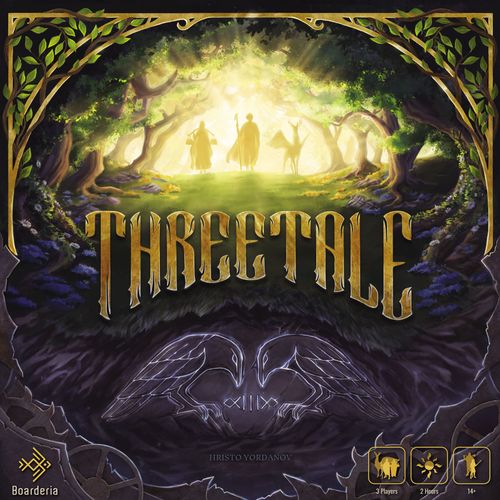
ThreeTale
ThreeTale Rulebook
Table of Contents
Table of Contents
Game Components
- 5 Hero dashboards: The Silver Deer, The Queen of Living Water, The Youngest Son, The Unborn Maiden, Sun and Moon (each with a Hero miniature)
- 30 map tiles
- 70 tokens: Battle, Treasure, Quest, Damage tokens, Sacred Stone
- 15 custom dice
- 110 wooden cubes (white, black, red and blue)
- 36 Artifact cards (12 each of Level 1, 2, 3)
- 20 Bonus cards (Hero cards and Enemy cards)
- 30 Battle cards (10 each of Level 1, 2, 3)
- 10 Quest cards
- 3 Guide cards
- 30 Treasure cards (10 each of Level 1, 2, 3)
- 5 Prophecy cards
- Rulebook
- Future Book
- Future Boxes (each with a Future miniature, tokens and cards for its Quest)
Overview
ThreeTale is a cooperative adventure game for 3 players. You take the role of fairytale Heroes, each with their unique, asymmetric talents. As a team, you go through three phases – the Past, Present, and Future – in order to complete the final Quest.
In the Past Phase, you build the map of the land. No two maps will be the same because you'll be drawing tiles at random to build a different world every time you play. Seven unique Quests hold the possible Future scenarios the Heroes will face. The players draw 3 Prophecies at the beginning of the game that warn them about what tribulations are about to come. To be able to achieve their future goal, the Heroes will have to return to the past to build up their strength. When the Past Phase is over, your Quest is revealed in the Present, showing which Prophecy has been fulfilled. Then, the Future comes, knocking on the door…
1. Prophecy Phase
Draw three Prophecy Cards and pick a Hero to play with. The Prophecy Phase is explained below under Gameplay.
2. Past Phase
This is the time when you develop your character and help others develop theirs – this should be a team effort. This is also the time when you create the Map that will be used later during your Future quest.
3. Present Phase
You learn which one of the three Prophecies has been fulfilled.
4. Future Phase
The Future Phase has a unique goal you need to achieve in order to win the game. Every Hero is essential in those difficult times.
Winning and Losing
You win the game when you achieve the objective described in the Future Phase. When the winning condition is met, the game ends and all players share the victory.
You lose the game when one of the Heroes dies or you don't meet the specific conditions to fulfill the Quest in time. All players share the defeat.
Duo and Solo Play
You can play the game solo by taking control of three Heroes, or duo by one of you controlling two Heroes. Part of the game's experience comes from collaboration with other players and demonstrating the Virtues that are not only part of the game's mechanics, but also inherent to the actual activities happening around the table. We recommend playing with three players, but since the game doesn't involve hiding information from others, it can easily be played solo or with two players as long as three Heroes are used. One player can control multiple Heroes, or two players can take turns controlling the extra Hero - your choice!
Setup
Before starting the game, make sure you have these components on the table:
- All Hero Boards and miniatures;
- All Map tiles;
- All Quest, Treasure and Battle Cards arranged in decks according to their level;
- All Artifact cards arranged in decks according to their level;
- All Bonus Cards (Hero and Enemy) arranged in two decks;
- All tokens (Quest, Treasure, Battle, damage and Sacred Stone);
- All cubes (white, black, red and blue);
- All dice;
- All Prophecy Cards (if it's not your first time use all 7 cards (without the Tutorial card). If it is your first time use only the Tutorial Prophecy);
- The Future Book;
- The Rule Book.
Things you will need later:
- One of the Future Boxes and its miniature (we recommend leaving the box closed until the conclusion of the Past Phase).
Gameplay
Prophecy
To start the game, draw three Prophecy Cards. They give you information about what the Future Phase holds. Examine them carefully - one of them will be fulfilled later in the game. Depending on the Prophecies, choose the three Heroes you'll use in this game. You are now ready to start the Past Phase.
Past Phase
The group agrees on what order the Heroes should be activated in. Then, starting with the first player, complete this cycle:
- Draw 1 tile and place it on the table, rotating it as you choose. If there are other tiles on the Map already, snap the new tile to one of them (see Map, Tiles and Tokens).
- Place your Hero in an empty space of the tile you just placed. You'll start your movement from there.
- Place all corresponding components (tokens and cubes) on the tile to indicate they are ready to be claimed;
- Minding your Speed, start moving on the Map;
- Perform 1 Action. An Action is any interaction with an item on the Map, such as claiming a token or using an Altar. Using the Portal is not considered an Action. For more information, see Map, Tiles and Tokens.
Note: You can get additional Actions by increasing your Endeavor. For more information, see Virtues.
Fig. 1: On this tile the player has to place Battle 1 and Treasure 3 tokens, and a white cube on their places.
Fig. 2: The Youngest Son starts with 2 Speed and 1 Action. They can choose to move 1 or 2 spaces and perform 1 action along the way.
The second player repeats these same steps in the same order, then the third. Then, start with the first player again, and keep placing a new tile at the beginning of your Hero's activation. However, Heroes begin their movement from the space where they ended the last turn (skipping Step 2). When there are no more tiles to be placed, the Map is completed and the Past Phase is over. Proceed to the Present Phase.
Present Phase
This is the time after our characters have grown in power, but before the Future unfolds before their eyes. Shuffle and draw at random one of the three Prophecy Cards you have read out loud earlier. The drawn card is the upcoming Future Phase.
Note! The players can change the order of their turns at this point if they wish.
Future Phase
Once the Prophecy Card is drawn, the Future Phase begins. Open the Future Book and read the short introduction, followed by the appropriate chapter dedicated to the Quest you've drawn. They will teach you about the necessary changes to the Map you need to do, the special rules and objectives you'll follow on your Quest, and most importantly - what you need to do in order to win the game!
Basic Concepts
This section details the various components, symbols and Actions in the game. Consult it every time you're not certain how to proceed or what a certain keyword or symbol means.
Base Symbols and Icons
This game uses Icons and Symbols to shorten the terminology used to indicate in-game components:
- Virtues: Love, Hope, Faith, Endeavor, Endurance, Mercy
- Virtuous Effect: Dice in Battle, Dice Flipping, Bonus Cards, Action, Adding Virtue, Giving Virtue
- Stones and Creature Stats: Virtues (all), Shevitsa, Speed, Defense, Strength
- Artifact Icons: Artifact, Head Artifact, Hands Artifact, Feet Artifact, Damage, One Time Use, Activation Needed, Permanent
- Other Icons: Dice, Bonus Cards, Nothing, Positive Dice, Spirit, Sacred Stone
Dice
This game uses custom dice featuring three symbol (positive) sides and three blank (negative) sides. Whenever you're asked to use the dice (mainly during Battles and while using Treasures and Artifacts), roll the appropriate number of dice and count the positive sides – this is your result.
Hero Boards
Each player has their own Hero board that keeps track of their Hero's Virtues, Speed, Shevitsa, Spirit, Quests and all used Bonus Cards and Artifacts.
Every Hero has their own starting Virtues that are highlighted. They also have asymmetric talents, shown in the middle of the Hero board. Every Hero starts with full Spirit - 3 points.
- Name: the name of your mighty hero.
- Spirit: can be used during battles.
- Effect of Virtues: icon showing what is the effect of every virtue.
- Bonus Cards: a slot to put your bonus cards for your current turn.
- Quest Cards: a slot to put your Quest Cards that you need to finish during the Past Phase.
- Head Artifact / Hand Artifact / Leg Artifact: slots to put your Head, Hand and Feet Artifacts.
- Virtue Icons: icons showing what is every Virtue (Love, Hope, Faith, Endeavor, Endurance, Mercy).
- Speed: used to move on the Map.
- Shevitsa: used to show the experience of the Hero and their activated talents (one for every level).
What is Shevitsa? Shevitsa is a specific type of embroidery, a core element to traditional Bulgarian clothing. Every shevitsa requires countless hours of labor to craft and years of practice to master. The intricate patterns bear hidden meaning, making the garment a cryptic form of writing, not unlike runes or hieroglyphs. Different shevitsa symbols signify wishes for fertility, health and prosperity, offering protection to the one wearing them and their household.
Virtues
Virtues are statistics on the Hero board. When a Hero collects White Stone or suffers damage, choose which Virtue to be increased or decreased, respectively (for more details on taking damage, see the Battle section).
Love. This is the Virtue you use during Battle: roll a number of dice equal to your Love. Depending on your Love's value (0-13), roll that many dice during one round of attack. If your Love's value is 4, you roll 4 dice during one round of attack. Bonus Cards can add more Love to your attack during your turn.
Hope. This Virtue lets you change the value of the dice from negative to positive or vice versa. This effect can be used to benefit you or weaken your enemy. The number of dice you can change is based on how much Hope you have: 0-2 = 0 dice; 3-6 = 1 dice; 7-10 = 2 dice; 11-13 = 3 dice. It turns negative dice to positive to benefit you. It turns positive dice to negative to weaken your enemy.
Faith. This Virtue lets you draw and use Bonus Cards (from the Player's deck) during your turn. The Bonus Cards can grant you additional Speed, Love, Actions, dice turning, or nothing. A Bonus Card can only be used on the turn it was drawn and has to be returned to the deck at the end of your turn. The deck is then shuffled. Depending on how much Faith you have, you can draw: 0-2 = 0 cards; 3-6 = 1 card; 7-10 = 2 cards; 11-13 = 3 cards.
Endeavor. This Virtue lets you perform additional Action(s) during your turn. An Action is considered any interaction with any item on the Map or using an Altar. Using a Portal does not require an Action. Based on how much Endeavor you have, you get: 0-2 = 0 Actions; 3-6 = 1 Action; 7-10 = 2 Actions; 11-13 = 3 Actions. E.g. 1 default Action + 1 from Endeavor + 1 from a Bonus Card = 3 Actions during your turn. Bonus Cards can add more Actions.
Endurance. This Virtue lets you increase another Virtue of your choice by 1 at the end of your turn. This ability is used simultaneously with Mercy (see below). You cannot increase your Mercy and then use the augmented Mercy in the same turn. Depending on how much Endurance you have, you can increase: 0-2 = 0 Virtues; 3-6 = 1 Virtue; 7-10 = 2 Virtues; 11-13 = 3 Virtues. E.g. You have 3 Endurance (3-6 = 1 virtue). It allows you to add 1 more Love (or any other virtue).
Mercy. This Virtue lets you increase a chosen Virtue of another player by 1 at the end of your turn. Depending on how much Mercy you have, you can increase: 0-2 = 0 Virtues; 3-6 = 1 Virtue; 7-10 = 2 Virtues; 11-13 = 3 Virtues.
Other Stats
Speed allows you to move through the Map. The value of your Speed indicates how many Steps you can go up, down, left, and right from your current location. You cannot move diagonally or pass through Trees. Using a Portal is considered one Step. You can continue moving until you exhaust all your Steps even if you have performed all allowed Actions for your turn.
You cannot end your turn on a space occupied by another player or perform any Actions while you're on an already occupied space, but you can pass through the player to reach your destination. You don't have to interact with the object located on the space you find yourself at the end of your turn (e.g. if there is a Battle token on the same space, you don't have to engage in a Battle).
Spirit represents your health. Every player has 3 Spirit. You can use it to negate an enemy attack, blocking the damage you would suffer from one round of attack. You can escape the Battle at any time by spending 1 Spirit. If your Hero's Spirit reaches 0, the Hero dies and the game is over for everyone.
Shevitsa helps you develop your Talents as you gain experience. The Shevitsa Talents are unique for every Hero. There are 6 Talents in total, but you can only develop 3 at a time. Each Talent requires a different amount of experience (Red Stone on the Map). The first Talent you can activate requires 2 Shevitsa. Mark your chosen Talent. To unlock the second one, you need 4 additional Shevitsa. Mark your chosen Talent again. The last one requires 6 more Shevitsa. Mark it as your final Talent. You can mix and match your Talents as you wish but you cannot unlock two Talents from the same level.
The Sacred Stone is the most valuable asset in the game. It helps you in a unique way in every Future Phase scenario.
Artifact Cards
Artifacts are additional items you can place on your Hero's head, hands, or feet. You can have an unlimited number of Artifacts in your hand but you can only use one of each type (head, hands, and feet) during your turn.
Artifacts differ by strength and activation type. There are 3 Artifact strength levels – a higher level indicates a more powerful Artifact. Activation types can be either passive (can be used each turn), active (you need to roll dice to find out if you can use them) or one-timers (can be used only once, then return to the corresponding deck).
Set aside 3 decks, depending on the level of the Artifacts. Every time you win an Artifact, draw 3 cards at random from the respective deck and choose 1 Artifact to keep. Return the other 2 to the deck and then shuffle. Every used-up or transformed Artifact is returned to its corresponding deck.
During your turn, you can use an Action to give one of your Artifacts to another Hero standing on an adjacent space on the Map.
Note: In order to activate an Artifact, you need to use positive dice you roll during your round of attack. Using positive dice to activate an Artifact during a Battle means you cannot count those dice as damage. For more information on how to activate Artifacts during your round of attack, please check the Battle section.
Example: If you have rolled 5 positive dice during your attack, you can activate the Forest Axe by using 1 of these 5 dice. This means you do 2 damage (using the Forest Axe) + 4 damage (from your positive dice) = 6 damage in total.
Card parts: Slot (the place where the Artifact goes), Name, Symbol (shows the level of the Artifact), Effect, Usage (shows if the Artifact is active, passive or needs activation), Story.
Map, Tiles and Tokens
Tiles are used to create the Map during the Past Phase. The tiles come in squares divided into 2x2 spaces. When you add another tile to the Map, snap the tile's edge to the already existing tiles. You can choose how to rotate the tile when you're placing it but you can't change its orientation at a later time. Always snap the new tile's entire edge to the already generated tiles. When you place a tile on the Map, you also place all corresponding components – Red, Black, and White Stone, and the tokens for Battles, Treasure, and Quests on it. The Trees on the tiles represent impassable obstacles. Altars and Portals are permanent – they don't require tokens and can be used multiple times.
Map example: objects claimed in a previous turn are taken; available objects haven't been claimed yet; permanent objects can be used multiple times. The next tile you need to place: choose how to rotate it and place all illustrated tokens on their slots (in the example, a White Stone (Virtue), a Red Stone (Shevitsa), and a Level 2 Artifact).
The only permanent objects on the Map are the Altar, the Portal, and the Trees.
- Trees: You can't pass through the tree-covered area.
- Portal: When a Hero enters a Portal, immediately move the Hero to any other Portal on the Map.
- Altar: A place where you can Sacrifice objects to receive something more valuable.
All other objects are temporary, represented by tokens. Whenever you reach a token on the Map, you can use an Action to claim it – take the token from the tile and do the corresponding action. The object is then depleted.
- Virtue (White Stone): Take it from the Map and increase a chosen Virtue by 1.
- Shevitsa (Red Stone): Take it from the Map and gain 1 Shevitsa.
- Speed (Black Stone): Take it from the Map and increase your Speed by 1.
- Treasure: Taking this token allows you to draw a Treasure Card from the deck of the corresponding level.
- Battle: Taking this token allows you to draw a Battle Card from the deck of the corresponding level.
- Quest: Taking this token allows you to draw a Quest Card from the deck of Quests.
- Offering: Taking this token and giving it to another player (on a space adjacent to you) allows you to gain an Artifact of the corresponding level.
Offering
When a tile with an Altar is placed on the Map, place an Offering token on the Altar. Any Hero can claim it, using one Action. Giving the Offering to another Hero as an Action blesses it, turning it into an Artifact:
- The first Offering that is given turns into a Level 1 Artifact
- The second Offering that is given turns into a Level 2 Artifact
- The third Offering that is given turns into a Level 3 Artifact
- The players decide which Hero keeps the Artifact.
When the Future Phase begins, remove all Offering tokens from the Map. However, Heroes keep all Offerings they've already claimed and they may still bless them.
Treasure Cards
When you take a Treasure token, remove it from the Map and draw a Treasure Card from the deck of the corresponding level. Then, roll 3 dice to see what you discover.
Looting Treasure is not without risk! There are three levels of Treasure corresponding to the level of the Artifact. The higher the level, the bigger the potential reward, but also the bigger the chance for the Hero to get nothing, or even lose something. The potential outcomes are listed in the table below:
| Positive dice | Level 1 | Level 2 | Level 3 |
|---|---|---|---|
| 0 | A meager reward | Nothing | You lose something |
| 1-2 | A small reward | A medium reward | Nothing |
| 3 | A medium reward | A substantial reward | A huge reward |
The Treasure Cards are discarded after use.
Card parts: Symbol (shows this is a Treasure Card and its level), Name, Requirement (what you have to achieve and what the reward is), Story, and the outcomes for Treasure Level 2 (if you roll 0 you get nothing) and Treasure Level 3 (if you roll 0 you lose something).
Quest Cards
When you take a Quest token, it is removed from the Map and you draw a Quest Card from the deck. If you manage to fulfil the requirement(s), you immediately win the reward. For example, one of the Quest cards states that when you win five battles, you receive an Artifact.
Note: Quests can only be completed during the Past Phase.
The Quest Cards are discarded after use.
Bonus Cards
When you draw a Bonus Card, you can use one of the effects shown on the card (if there is more than one). There are two types of cards – Hero Bonus Cards (used by the heroes) and Enemy Bonus Cards (used by the enemies), kept in two separate decks.
When the turn is over, return all Bonus Cards to their corresponding decks. Shuffle the decks.
Battle Cards
When you take a Battle token, remove it from the Map and draw a Battle Card of the corresponding level. You now have an enemy you need to fight to gain a prize.
Battles are divided into 3 levels, ascending in difficulty. Each enemy uses the same three stats – Speed, Defense, and Strength. However, Level 2 Battles feature enemies who draw Bonus Cards beforehand, and Level 3 Battles feature enemies with unique Talents.
Whoever has the greater Speed gets to attack first. If you have the same Speed as the enemy, the enemy attacks first. Attacking is done by rolling the dice. Attack by rolling a number of dice equal to your Love. The enemy attacks by rolling a number of dice equal to their Strength. You inflict damage equal to your positive dice. You may also use Artifacts and Talents to inflict additional damage. When you inflict damage, reduce the enemy's Defense. When the Defense is completely exhausted, you have successfully defeated the enemy. Claim the prize detailed on its card.
The enemy also inflicts damage equal to their positive dice. When they inflict damage, you have a choice – either spread the damage among your Virtues, diminishing them by the number of damage points (e.g. 3 damage to you means you can choose to reduce your Endeavor by 2 and your Hope by 1), or block all the damage by removing 1 of your Spirit. You can use the Damage tokens to track the inflicted damage.
You and the enemy keep taking turns until one side is defeated.
In the Past Phase you can escape the Battle at any time by sacrificing 1 Spirit. If you die, the game ends for everyone.
The Battle Cards are discarded after use.
Card parts: Stats (the Speed, Defense and Strength of the enemy), Reward (what the Hero wins after defeating the enemy), Symbol (shows this is a Battle Card and its level), Name, Story, Bonus Cards (the amount of cards the enemy draws from their deck), Talent (the asymmetric talent the enemy uses).
Reminder: If you have already used the effect of a Virtue during your turn, you can still choose to diminish it when taking damage in battle (e.g. if you have 3 Hope and you have already changed the roll of a die, you can still diminish your Hope without this affecting your previous actions).
Battle example.
- Start of a Battle: Your Speed is 5, your enemy's is 4, therefore you are the first to attack.
- Hero's round of attack: You have 7 Love, therefore you roll 7 dice when you attack your enemy. You manage to roll 5 positive dice and your enemy suffers 5 damage. However, you also possess an Artifact, which can help you in Battle. Your Artifact requires 1 positive die for activation and in order to use it, you sacrifice 1 of these 5 dice. The Artifact allows you to cause 2 damage. You cause 6 damage in total to your enemy – 4 from the dice roll and 2 from the Artifact. Your enemy's Defense was 7 and now is 1. It's your enemy's turn to attack.
- Enemy's round of attack: Your enemy has 3 Strength, therefore they roll 3 dice when they attack you. They manage to roll 2 positive dice. However, you have 3 Hope, which allows you to turn 1 of their positive dice into negative. You suffer 1 damage and choose to decrease your Love from 4 to 3. It's your turn to attack.
- Hero's round of attack 2: You have 7 Love, therefore you roll 7 dice. You manage to roll 3 positive dice and your enemy suffers 3 damage. You caused your enemy 9 damage in total during your two rounds and they are defeated. You can now collect your prize.
For easier tracking of inflicted damage, you can use the Damage tokens (they help you keep track of the enemy's Defense).
Using Portals and Altars
Portal – An object found both in the Past and Future Phases that can be used more than once. When your Hero enters it, immediately place them on another Portal of your choice anywhere on the Map.
Altar – An object found both in the Past and Future Phases that can be used more than once. Altars allow you to spend an Action and perform a Sacrifice – discard Artifacts or Shevitsa to transform them into something more valuable to you at the moment. You need to spend an Action to use the Altar. During that Action, you can Sacrifice as many objects as you wish.
You can Sacrifice the following on the Altar:
- 1x Shevitsa to increase a Virtue of your choice by 1
- 1x Level 1 Artifact to convert into 2x Shevitsa
- 1x Level 2 Artifact to convert into 3x Shevitsa
- 1x Level 3 Artifact to convert into 4x Shevitsa
- 2x Level 1 Artifacts to convert into 1x Level 2 Artifact
- 2x Level 2 Artifacts to convert into 1x Level 3 Artifact
- 2x Level 3 Artifacts to convert into 1x Sacred Stone
Prophecy Cards
The Prophecy Cards are drawn at the beginning of the game. They give you information about the possible future scenarios that can play out and how the game objects are transformed in the possible future. Draw three Prophecy Cards and read them aloud. When the Past Phase is over, choose at random which Prophecy has been fulfilled (except for the Tutorial, when you know the Future Phase from the start of the game).
Card parts: Sign (the sign of the future, with a number for easy tracking), Name, Statistics (which skills your team needs to develop in order to be victorious in this Final Quest), Story (a glimpse of the possible future, with subtle hints of what may come to pass).
Scoring
At the end of the game, count your points to see how you fared. All points are counted together for all players.
- For each remaining Virtue (all-Virtues drop icon), score 1 point.
- For each remaining Speed, score 2 points.
- For each remaining Shevitsa, score 2 points.
- For each remaining Artifact of Level 1/2/3, score 3/6/12 points respectively.
- For each remaining Sacred Stone, score 30 points.
- For each remaining Spirit, score 15 points.
- For each completed Future Quest, score the points specified for that quest.
- For each remaining turn from the Future Quest, score 10 points.
Tutorial
More will be revealed during the Kickstarter campaign.
Future Book
Source note: the sections below transcribe the rules of the official ThreeTale Future Book (scenario book, image-only PDF); scenario narrative and victory flavour text are omitted. Icons on the "where they go" token diagrams were read from the images.
The Future Is Now
You've played through the Past and Present Phases of the game and you've drawn one of the three Future cards. This Prophecy comes to fruition and marks your final objective. Read the corresponding chapter of this Future Book and follow the instructions. They will tell you how to set up the Map, what special conditions and objects will be introduced, and what you'll need to do in order to win. Remember that this is a cooperative experience – the three Heroes always win and lose together.
Additions in the Future Phase
The Future Phase is played using the same rules you've followed so far. However, some scenarios introduce intricate exceptions and special objectives and obstacles you need to take into account. Some Quests are a battle against time – take too long, and you lose. Read the special conditions carefully before proceeding.
Map, Tiles and Tokens - Future Rules
During the Future Phase, you can interact with objects only once – if you claim a token or a Stone off the Map, or draw a card, discard it immediately after use. Cards and tokens are never returned back on the Map or in their deck.
This phase introduces new types of components – Aiding, Conditional, Hostile and Mixed. Using this Future Book, place them on the Map, after you remove all currently existing tokens and cubes on the Map.
- Aiding objects are those with a white back and a golden border. They provide a boon to the Heroes.
- Conditional objects are those with a black back and a bronze border. They might provide something to the Heroes but require a certain condition to be met first (for example, you will receive their gift only if you have a Virtue at 13).
- Hostile objects are those with a red back and a steel border. They hide your enemies. You cannot escape from them once you enter a Battle. If you die, the game ends for everyone.
- Mixed objects signify that you can come upon either Conditional, Aiding or Hostile object. For example, when you draw a card from such a deck, you will either have to face your enemy or receive a conditional gift.
- Special objects are those with a grey back and a blue border. They are represented by tokens and cards and have an effect on the specific Future setting they are a part of. Sometimes, they have a blocking effect. Other times, your goal is to collect them.
In the Future Phase, you sometimes have to turn tiles upside down. Movement through flipped tiles is allowed but it counts as 2 Steps (and therefore requires 2 Speed) instead of 1.
Battle - Future Rules
Sometimes, the enemies from the Future can only be attacked in one round of Battle. In such cases, the Battle doesn't end with a defeat for either of you, as you can only inflict damage once.
1. The Nine Rings of Creation
Goal. Every Hero needs to collect 3 Rings and bring them to the Fountain.
Set up. Place the Fountain on a chosen Altar. New tokens replace old ones: Nymph replaces Quest tokens; Beldame replaces Battle 1; Heartless Ruler replaces Battle 2 and Battle 3. Prepare three decks of cards: Heartless Rulers, Beldames, and Nymphs. Place the Ring tokens next to the cards.
New objects. The Fountain is the object where the players need to gather after they've collected 3 Rings each in order to win. Each player should stand on one of the 8 adjacent spaces to the Fountain. You can use an Action to interact with a Heartless Ruler, Beldame, or Nymph. If you do, draw a card from the corresponding deck. The players cannot escape a Battle they have entered. Each card can only be played once. After that, discard it.
Time. After all three players finish their turns, choose one tile to be flipped upside down. The objects on it cannot be used once it's flipped. Going through a flipped tile takes 2x Speed (instead of 1). The game is over when the 7th tile has been flipped.
Sacred Stone. 1 Sacred Stone inflicts 15 damage to a Heartless Ruler. You can use a Sacred Stone to inflict damage at any point during the battle and it is not considered a part of your round.
Reward. Add 150 points to your final score.
2. The Information Flood
Goal. Collect 42 Words of Wisdom and gather at the Ark of Truth.
Set up. Place the Ark of Truth on an Altar of your choice. New tokens replace old ones: Cartographer replaces Quest tokens; Translator replaces Battle 2; Hypnotist replaces Battle 3. Prepare three decks of cards: Hypnotists, Cartographers, Translators, and one Ark of Truth card. Place the Words of Wisdom tokens (1, 2, 5, 10) next to the decks. Place all White Stones on the Virtues, as they would represent the Words of Wisdom.
New objects. To win, gather at the Ark of Truth after you've collected 42 Words of Wisdom. Each player should stand on one of the 8 adjacent spaces to the Ark of Truth. You can use an Action to interact with Hypnotists, Cartographers, or Translators. If you do, draw a card from the corresponding deck. When you collect a White Stone from the Map, add 1 Word of Wisdom to the Ark.
Time. Before you start your turn, remove a tile of your choice from the Map. Then, roll 1 die to determine if you have to remove a second one (positive – no, negative – yes). You cannot manipulate the result of the dice in any way – Virtues and Artifacts cannot be used to alter that dice roll. Remove the tiles in the following order:
- First, remove the tiles that only have 1 border with another tile.
- Then remove the tiles that have 2 borders with other tiles.
If you remove a tile occupied by a Hero, you lose the game. You have to collect 42 Words of Wisdom before there are only 4 tiles left of the Map. Mark the Words of Wisdom on the Ark of Truth card.
Sacred Stone. 1 Sacred Stone inflicts 20 damage to a Hypnotist. You can inflict damage with a Sacred Stone at any point during the battle and it is not considered a part of your round. You can sacrifice 1 Sacred Stone to prevent the removal of 1 tile.
Reward. Add 100 points to your final score.
3. The Parallel Land
Goal. All Heroes must survive.
Set up. Place the Tree on one of the 4 spaces of a tile that has Battle 1 on it. (Note: The Tree should be placed on a tile that has at least two adjacent tiles.) New tokens replace old ones: Forester replaces Quest tokens; Incubator replaces Treasure 3; Charmer replaces Battle 2; Storm Whisperer replaces Battle 3. Prepare three decks of cards: Storm Whisperers, Charmers, and Foresters. Next to the cards, place the Seed tokens and 30 White Cubes representing Parallel Virtues. White Stones (White Cubes) are Parallel Virtues in this world.
New objects. The flipping of tiles begins next to the Tree. The Tree cannot be attacked. You use an Action to interact with Charmers, Storm Whisperers, or Foresters. When you do, draw a card from the corresponding deck. You can use an Action to Claim an Incubator from the Map. If you do, roll three dice. If all three are positive, get a Seed – a special object that blocks the placement of a Parallel Virtue by occupying a tile.
Enemy turn. In this Future scenario, the Tree is a living thing that takes Actions to protect itself and stop you. The Tree takes the first turn. It flips 2 of the tiles that are adjacent to the tile it's occupying. Passing through a flipped tile requires x2 speed. Place a Parallel Virtue on 1 of the four dark spaces on each of the flipped tiles. A Parallel Virtue is an object that, if left unclaimed, will damage every Hero. At the beginning of your turn, flip 1 tile and place 1 Parallel Virtue on it. You can spend an Action to Claim Parallel Virtues (Note: Parallel Virtues don't boost your own Virtues). If you have a Seed, you can place it on the space of the Claimed Parallel Virtue, preventing more Parallel Virtues from appearing on that tile.
When each of the three Heroes finishes a turn, the Tree inflicts 2 damage for every Parallel Virtue currently on the Map. You can block the Tree's attack by Sacrificing 1 Spirit. Every tile that doesn't have a Seed or a Parallel Virtue on it is considered an empty tile. At the end of its turn, the Tree places 1 Parallel Virtue on every empty tile. If you flip a tile occupied by a Hero, you lose the game.
Time. You need to survive until there are only 3 tiles left unturned on the Map.
Sacred Stone. 1 Sacred Stone inflicts 10 damage to a Storm Whisperer or a Charmer. You can use a Sacred Stone to inflict damage at any point during the battle and this is not considered part of your round. You can Sacrifice 1 Sacred Stone to prevent the Tree from inflicting damage to one of the Heroes at the end of the round.
Reward. Add 300 points to your final score.
4. The Path of Initiation
Goal. Each of you needs to defeat your own reflection 3 times and collect 3 Heads – one of each level. You then need to gather on tiles adjacent to the Throne.
Set up. Place the Throne on a Treasure 3. New tokens replace old ones: Crystal replaces Treasure 3; Reflector 1, Reflector 2 and Reflector 3 replace Battle 1, Battle 2 and Battle 3 respectively. Prepare four decks of cards: Reflectors 1, 2, and 3, and Crystals. Place the Head tokens for Levels 1, 2, and 3 next to the cards.
New objects. After you have defeated Reflectors of Darkness of levels 1, 2, and 3, you need to gather on the tiles adjacent to the Throne. When you use an Action to interact with a Reflector, draw a card from the corresponding deck. You will either meet a Reflector of Darkness that you have to Battle or a Reflector of Light who holds a conditional gift. When you defeat a Reflector of Darkness, collect the Head token of the corresponding level.
Time. When each Hero finishes a turn, flip 1 tile upside down. The objects on it cannot be used anymore. As soon as the 7th tile is flipped this way, the game is over.
Sacred Stone. 1 Sacred Stone can be used to inflict 10 damage to a Reflector of Darkness. You can use a Sacred Stone to inflict damage at any point during the battle and this is not considered part of your round.
Reward. Add 250 points to your final score.
5. The Crown of Evil
Goal. Defeat the Vicinator.
Set up. Place the Vicinator on a tile that has either Battle 2 or Battle 3 on it. The chosen tile must be surrounded by tiles on all sides, including diagonally. If there is no such tile, Sacrifice 1 Spirit to move 1 tile. New tokens replace old ones: Elixir 1 replaces Treasure 1; Elixir 2 replaces Treasure 3; Elixir 3 replaces Treasure 2. Prepare four decks: Elixirs 1, 2, 3, and Tentacles (plus the Virus and Vicinator cards and the Stendee/standee for the Viruses).
New objects. The Vicinator and the Viruses are enemies you can attack if you are positioned on a space adjacent to the one occupied by the Virus or the Vicinator, diagonals included (for more information read the Enemy Turn section below). You can use an Action to Claim an Elixir 1, 2, or 3. If you do, draw a card from the corresponding deck.
Enemy turn. The Vicinator always goes first. It places the 8 Viruses on its 8 adjacent tile spaces. The Vicinator draws a Tentacle card and activates it.
The Viruses go next. Each of them starts moving towards the nearest Altar. The Viruses can pass through trees but cannot pass through Portals. When a Virus reaches an Altar, it inflicts 2 damage to every Hero. You can block a Virus's attack for everyone by Sacrificing 1 Spirit. When a Virus reaches an Altar, it instantly goes back to one of the 8 spaces adjacent to the Vicinator, and the enemy's turn is over.
You can attack either the Vicinator or a Virus during your turn. If you fail to defeat a Virus, your Spirit decreases by 1 and the Virus remains on the same spot. You cannot finish your turn standing on an Altar. When each Hero finishes 1 turn, it's the Vicinator's turn again. The Vicinator always activates a new Tentacle card during its turn.
Time. Defeat the Vicinator before it activates its last Tentacle card (before it finishes its Tentacle deck).
Sacred Stone. 1 Sacred Stone can be used to inflict 10 damage to the Vicinator. You can use a Sacred Stone to inflict damage at any point during the battle and this is not considered part of your round.
Reward. Add 250 points to your final score.