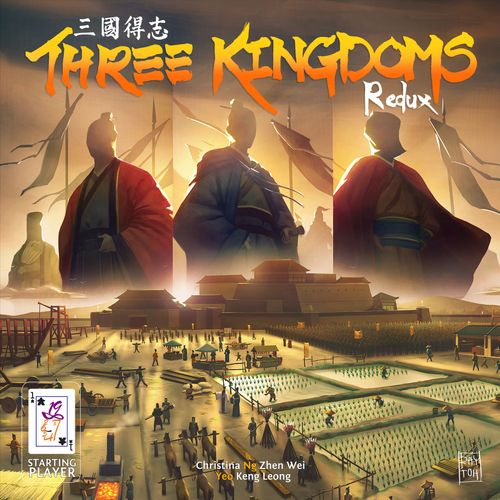
Three Kingdoms Redux
Three Kingdoms Redux Rulebook
Table of Contents
Table of Contents
Game Overview and Goal
Three Kingdoms Redux is played over a number of rounds, up to a maximum of 12. Players bid for various actions with their general tokens. The highest bidder of each action space obtains the right to carry out the actions.
These actions allow players to improve your state's domestic development, gain military strength, construct state enhancements, increase popularity with your people, improve relationship with your border tribes and gain promotion to the next higher rank.
The actions available to each player are:
- develop your state's farm or marketplace,
- recruit or train army units,
- produce weapons,
- trade resources,
- import technology,
- construct state enhancements,
- control the Han emperor,
- demand tributes from your vassals,
- win support from your people,
- improve your relationship with your border tribe, and
- wage battle against other states to expand your borders
The winner is the player with the most victory points (VPs) at the end of the game.
Game Components
General Game Components:
-
this 28-page rulebook
-
3 player aids (1 per state)
-
1 game board
-
1 Round Marker
-
1 Alliance Token
-
1 Han Emperor Token
-
2 Criterion Markers (Administration/Combat)
-
15 Border Location Tokens (0 VP/1 VP)
-
5 Deficit Tokens
-
20 Farm Tokens (Undeveloped/Developed)
-
20 Marketplace Tokens (Undeveloped/Developed)
-
30 Gold Tokens (20 valued "1" and 10 valued "5")
-
30 Rice Tokens (20 valued "1" and 10 valued "5")
-
40 Army Tokens (Untrained/Trained)
-
12 Spear Tokens
-
15 Horse Tokens
-
15 Crossbow Tokens
-
15 Vessel Tokens
-
15 Popular Support Tokens
-
42 State Enhancement Cards (21 Unification and 21 Separation)
Player-specific Game Components (one colour per state):
- 18 State Marker Pieces (3 of each piece above, each pair interlocks to form a state marker)
- 6 State Action Marker Pieces (each pair interlocks to form a state action marker)
- 3 Tribe Markers
- 69 General Cards (23 per state including Lord)
- 69 General Tokens (23 per state including Lord)
- 6 Bid Tokens (+1/+2, 2 per state)
Game Setup
Each player selects one of the states of Wei, Wu and Shu to play.
Game Board Place the game board face up on a flat surface.
A. Round Track Place the round marker on the "1" space of the round track.
B. Bid Order Track and Action Order Track Place a Wei, Wu and Shu state marker on the "1", "2" and "3" space of the bid order track respectively. The action order track is left empty for now.
Set the Wei, Wu and Shu state action markers aside, within easy reach of all players. These will be used during the Resolution Phase to update the action order track.
C. Criterion Marker Spaces Both criterion markers show administration on one side and combat on the other. With one of the criterion markers, randomly select one side and place it on the criterion marker space of the "control Han emperor" action space. Place the other criterion marker with the opposite side face up on the criterion marker space of the "win popular support" action space. These represent the bidding criterion for the respective action spaces in round 1.
Example: Criterion Markers Placement If the combat side of one criterion marker is chosen for the "control Han emperor" action space, then the administration side of the other criterion marker is placed face up on the "win popular support" action space.
D. Border Location Spaces On each of the 15 border location spaces, place a border location token with the 0 VP side face up.
E. Military VP and Rank Track Place one of each of the Wei, Wu and Shu state markers on the 0 VP space of the military VP track and the Governor space of the rank track.
F. Farm and Marketplace Development Spaces Each player places 5 farm tokens and 5 marketplace tokens, with the undeveloped farm and marketplace sides face up, on his state's farm and marketplace development spaces respectively. The remaining farm and marketplace tokens are set aside, within easy reach of all players.
There are two spaces above each state's farm and marketplace development spaces. These are the state's granary and treasury respectively, and are left empty at the start of the game.
Tribal Relations Track The tribal relations track of each state is found below the state's farm and marketplace development spaces. Place each state's tribe marker on the following spaces of the corresponding state's tribal relations track:
- Wei (Xiong Nu 匈奴): 5
- Wu (Shan Yue 山越): 6
- Shu (Nan Man 南蠻): 7
H. Alliance Token The Shu player collects the alliance token and holds onto it for now.
I. Han Emperor Token Set the Han emperor token aside, within easy reach of all players.
J. Gold, Rice and Popular Support Tokens Players collect the following number of gold, rice and popular support tokens to start the game with:
- Wei: 3 gold tokens and 3 rice tokens
- Wu: 4 gold tokens, 4 rice tokens and 1 popular support token
- Shu: 5 gold tokens, 5 rice tokens and 2 popular support tokens
K. State Enhancement Cards There are two decks of state enhancement cards, namely the Separation and Unification decks. Shuffle the two decks separately and deal to each player the following number of state enhancement cards:
- Wei: 1 Separation and 3 Unification
- Wu: 2 Separation and 3 Unification
- Shu: 3 Separation and 3 Unification
Players may read their dealt state enhancement cards, but keep them covered from other players' view. The two decks of the remaining state enhancement cards are placed aside and face down, within easy reach of all players.
L. General Cards and Tokens Wei, Wu and Shu players start the game with 5, 4 and 3 generals respectively, comprising of the lord and a number of recruited generals.
Each player collects his state's general cards and tokens, sets aside the lord's general card and token, shuffles the remaining general cards and draws 6 general cards. The Wei, Wu and Shu player selects 4, 3 and 2 general cards respectively from their 6 drawn general cards, then collects the corresponding general tokens. Players keep the selected general cards and tokens covered from other players' view.
Return unselected general cards to each state's remaining general cards. Set each state's remaining general cards and tokens aside, within easy reach of the corresponding player. This completes the initial recruitment.
Summary of initial recruitment:
- Wei: Cao Cao + draw 6, select 4 to recruit
- Wu: Sun Jian + draw 6, select 3 to recruit
- Shu: Liu Bei + draw 6, select 2 to recruit
M. Bid Tokens Each player collects his state's bid tokens and sets them aside, within easy reach of the corresponding player.
Remaining Tokens (army, spear, horse, crossbow, vessel, deficit, gold, rice and popular support tokens) Set aside the rest of the tokens, within easy reach of all players.
A picture of the initial setup is shown on page 5 of the original rulebook.
Game Icons
The rulebook and player aids use the following icons throughout:
- Alliance
- Select Alliance
- Recruit Generals
- Victory Point
- Starting Tribal Relations Level
- Administration
- Combat
- Leadership
- Untrained Army
- Trained Army
- Spear
- Horse
- Crossbow
- Vessel
- Gold
- Rice
- Criterion Marker Space
- Non-Alliance
- Increase Rank by 1 Level
- Leave 1 General Here
- Popular Support
- Undeveloped Marketplace
- Developed Marketplace
- Treasury
- Undeveloped Farm
- Developed Farm
- Granary
- Unification Card
- Separation Card
- Played State Enhancement Card
Game Terminology
Common bidding action space – Any of the 12 action spaces found at the centre of the game board that all players may bid for.
General – Civil official or military general, as denoted by the two types of headgear on the general tokens.
Untrained army – Army token with the untrained army side face up.
Trained army – Army token with the trained army side face up.
Weapon – Crossbow, horse, spear or vessel token.
Army unit: Trained army equipped with weapon, as follows:
- Archery unit – Trained army with crossbow token
- Cavalry unit – Trained army with horse token
- Infantry unit – Trained army with spear token
- Naval unit – Trained army with vessel token
Assigned army/general – Army unit/general token placed on an action space during bidding.
Stationed army/general – Army unit/general token sent to border location.
Flipped marketplace/farm token - Marketplace/farm token with developed side face up.
Game Sequence
Each round consists of two phases, occurring sequentially:
- Conflict Phase
- Resolution Phase
At the end of each round during which none of the game end conditions is triggered, Update and Maintenance takes place.
Conflict Phase
During the Conflict Phase of each round, players strengthen their states by recruiting generals of calibre and bid for the right to take certain actions. Carry out the following in the order of presentation:
Recruit Generals (Rounds 3, 5 and 9)
During rounds 3, 5 and 9, all players recruit new generals. Skip this step for all other rounds.
All players shuffle their remaining general cards, then draw and select a number of the drawn cards to recruit, based on the following table:
| Round | Wei 魏 | Wu 吳 | Shu 蜀 |
|---|---|---|---|
| 3 | Draw 3, select 1 | Draw 4, select 2 | Draw 4, select 2 |
| 5 | Draw 3, select 1 | Draw 3, select 1 | Draw 4, select 2 |
| 9 | Draw 3, select 1 | Draw 3, select 1 | Draw 3, select 1 |
The number of general cards to draw is always two more than the number of generals to be selected for recruitment.
After selecting the generals, players collect the newly recruited general tokens. Keep the recruited general cards and tokens covered from the other players' view. Return the unselected general cards to each player's remaining general cards. The newly recruited generals may be used for bidding of actions from this round onwards.
Select Alliance Action Space
The "1", "2" and "3" of the bid order track indicates the turn order of players during the Conflict Phase of the current round. The turn order in round 1 is Wei at first, Wu at second, followed by Shu at third.
The "2" and "3" spaces contain the alliance icon, indicating that the second and third players form an alliance. Alliance players will bid for a selected action space together against the first player during the current round.
The "3" space also includes the select alliance icon, indicating that the third player selects the alliance action space. The third player may discuss the choice of alliance action space with the second player. After deciding, the third player places the alliance token on the selected action space to indicate it is the alliance action space for the current round.
The alliance action space may only be one of the 10 common bidding action spaces without the non-alliance icon; the "control Han emperor" and "win popular support" action spaces may not be chosen as the alliance action space. Players may not choose the same action space as the alliance action space for consecutive rounds, even if different players become the third player in turn order.
If both alliance players bid and win the alliance action space, then both players may take the associated action (during the Resolution Phase). If only one of the alliance players bids for and wins the alliance action space, then only the bidding player may take the associated action (during the Resolution Phase). The other alliance player who did not bid for the alliance action space may not take the associated action.
Bid For Action Spaces
Bidding with Generals
Each general possesses administration, combat and leadership attributes. Administration and combat vary between 1 to 5. Leadership vary between 1 and 2, and determines the maximum number of army units that may be assigned with the general. Administration, combat and army units form the basis for the bidding of action spaces.
Each general also has a unique skill that provides certain benefits to the player during the game. Players may refer to their respective player aids for other players' generals' skills.
Lastly, each general specialises in one or two army types. The player earns 1 VP whenever his general is assigned, then stationed with one of these army types.
Here is an example of a general card and general token, belonging to Zhao Yun: the general card shows his Administration, Combat, Leadership, Unique Skill and Army Type Specialisation; the general token shows his Administration, Combat and Leadership.
Action Spaces
There are a total of 18 action spaces. 12 of these are common bidding action spaces and are open to bidding by all players. The remaining 6 action spaces are state specific and only open to bidding by specific players.
The bidding criterions for the action spaces are listed below:
a) Bidding for the following 5 common bidding action spaces depend on administration:
- Develop farm or harvest
- Develop marketplace or collect tax
- Trade rice and/or weapons
- Hire instructor and/or import technology
- Construct state enhancement
b) Bidding for the following 5 common bidding action spaces depend on combat:
- Produce spears/horses
- Produce crossbows/vessels
- Recruit armies
- Train armies
- Demand tribute
c) Bidding for the remaining 2 common bidding action spaces depend on either administration or combat:
- Win popular support
- Control Han emperor
A criterion marker is placed at the bottom of each of these 2 common bidding action spaces, to denote the criterion applicable for that round. The bidding criterion for these 2 action spaces must be different from each other, i.e. if one is based on administration, then the other must be based on combat. Both criterion markers are flipped over during the Update and Maintenance after each round. The bidding criterions will therefore alternate between administration and combat from round to round.
d) Just outside of the 12 common bidding action spaces are the 3 battle action spaces. Bidding for the 3 battle action spaces depends on the sum of each assigned general's combat and the number of army units with them. A general's leadership determines the maximum number of army units that can be assigned with him. Although generals may be assigned to bid for battle action spaces without any army units, army units may not be assigned without any general leading them.
If more than 1 army unit is assigned with the general for bidding, they must be of the same type. If additional generals are assigned for bidding at the same battle action space, they may be assigned with a different army type.
The 3 battle action spaces are:
- Battle (for Shu – Wei border)
- Battle (for Shu – Wu border)
- Battle (for Wei – Wu border)
Players may only bid for battle action spaces along their own borders. For example, Shu may not bid for the battle action space of Wei – Wu border.
Example: Bidding for Battle Action Space Shu assigns Zhou Cang (leadership 1) with 1 infantry unit to the "battle" action space for the Shu – Wu border. His leadership of 1 allows him to be assigned with at most 1 army unit. Wu then assigns Gan Ning (leadership 2) with 2 cavalry units to the same "battle" action space. The 2 army units assigned with Gan Ning must be of the same type.
Shu supports Zhou Cang's bid by assigning Zhao Yun (leadership 2) with 2 archery units. This can be done as different generals may be assigned with different army types when bidding for the same "battle" action space. Shu also has the option to assign Zhao Yun without any army units to the "battle" action space to support Zhou Cang.
e) Below the farm and marketplace development spaces of each state is an action space unique to each player. These are the improve tribal relations action spaces. Players are guaranteed of this action during the Resolution Phase as long as they assign a general to the action space during the Conflict Phase of the same round. Players may only assign generals to their own improve tribal relations action space and may assign at most one general per Conflict Phase.
The general may be assigned on his own or he may be assigned with either army units or gold tokens, but not both. The maximum number of army units or gold tokens that may be assigned is equal to the leadership of the assigned general. If more than 1 army unit is assigned, they must be of the same army type.
The 3 improve tribal relations action spaces and the states they correspond to are:
- Improve tribal relations (Xiong Nu 匈奴, for Wei)
- Improve tribal relations (Shan Yue 山越, for Wu)
- Improve tribal relations (Nan Man 南蠻, for Shu)
Bidding Process
Based on the bid order track, players take turns assigning their generals to bid for action spaces. This is done by placing a general token, face up, on a desired action space. Only 1 general may be assigned per turn. Unless specified, each general may only be assigned once per round. There is no limit on the maximum number of generals that may bid for the same action space.
When a player has run out of generals to assign, his turn is skipped. Bidding continues until generals of all players have been assigned. Players may pass on their own turn when they still have generals on hand, but this brings an end to their bidding for that round. There is no benefit for any unused generals at the end of bidding, unless otherwise stated on the general cards.
During the Resolution Phase, the player with the highest bid for an action space based on its bidding criterion wins the bid and gets to carry out the associated action. In the case of a tie, the player who reached the highest bid total first is the winner of that action space.
Example: Bidding Wei assigns Jia Xu (administration 5) to the "develop marketplace or collect tax" action space (bidding criterion of administration), followed by Shu, which assigns Jiang Wei (administration 4). Wei wins the action space as its bid of 5 is larger than Shu's bid of 4.
Example: Ties in Bidding Wei assigns Jia Xu (administration 5) to the "develop marketplace or collect tax" action space, followed by Shu, which assigns Jiang Wan (administration 5). Wei wins the action space as it was the first to reach the bid of 5.
As a further example, if Shu also assigns Jiang Wei (administration 4) to the "develop marketplace or collect tax" action space in a later turn, the total administration bid for Shu is 9. If Wei responds by assigning Xun You (administration 4) to the same action space on its later turn, then its total bid is also 9. In this case, Shu wins the bid as it is the first to reach the total bid of 9.
As a final example, if Wei assigns Cao Cao (administration 5) instead of Jia Xu but Shu was still the first to reach the total bid of 9, then Wei wins the action space due to Cao Cao's skill.
For the alliance action space, the alliance players' bids are combined by summing up the corresponding attribute of their assigned generals. In order for the non-alliance player to win the alliance action space, his bid has to either reach the highest bid total first or exceed the combined bid of the two alliance players.
Example: Bid for Alliance Action Space Wu and Shu are in alliance and the "develop marketplace or collect tax" action space is the chosen alliance action space. During bidding, Wei, Wu and Shu assign Jia Xu (administration 5), Lu Fan (administration 4), and Jiang Wan (administration 5) respectively to the alliance action space. Wei loses out on this action space as its bid of 5 is smaller than the combined bid of 9 by the alliance. Both Wu and Shu may therefore take the "develop marketplace or collect tax" action during the Resolution Phase.
If instead, Wei assigns Jia Xu (administration 5) and Xun You (administration 4) and was also the first to reach the bid of 9 ahead of the alliance players, then Wei wins the action space and may take the "develop marketplace or collect tax" action during the Resolution Phase.
Ways to Increase Bids
There are a number of ways to increase the bids of generals:
- Generals' skills – A number of generals have skills that increase their bids, e.g. Sun Jian. When utilising these generals' skills, the bidding player places the corresponding bid token on the action space together with the general token to reflect the increased bid.
- Han emperor token – A player in possession of the Han emperor token for that round may use it to increase one of his general's bid by 1. The Han emperor token must be placed together with a general token on an action space to reflect the increased bid; it cannot be placed on its own on an action space.
- Popular support tokens – Players in possession of popular support tokens may use them to increase their generals' bids. Each popular support token increases a bid by 1. There is no limit on the number of popular support tokens that may be placed with each general. The popular support tokens must be placed together with a general token on an action space to reflect the increased bid; they cannot be placed on their own on an action space.
The popular support tokens may be used together with the Han emperor token during bidding.
Resolution Phase
During the Resolution Phase of each round, players determine the bidding order for the following round and take the actions they won. Carry out the following in the order of presentation:
Remove Tokens
After all players have assigned their generals or passed, determine the winners of each action space by comparing the bids of each player.
Players with losing bids on any action space must:
- return the corresponding losing bid general tokens with the army units, bid tokens and the Han emperor token, if applicable, from those action spaces to their respective supplies.
- return any popular support tokens placed with the corresponding general tokens from those action spaces to the general supply.
Return any general token that was flipped over and left on the "control Han emperor" action space during the previous round to the corresponding player's supply.
Players with winning bids on any action spaces leave their corresponding winning bid general tokens with the army units, bid tokens, Han emperor token and/or popular support tokens, if applicable, on the action spaces for now.
The alliance token is left on the game board regardless of the bid result for the alliance action space.
Determine Turn Order For Next Round
Rearrange the state action markers on the action order track in the same order as the state markers on the bid order track. The state action markers serve as a reference for the turn order when taking actions.
Count the number of successful bids for each player. This total includes the improve tribal relations action, if it was taken by the player. If both alliance players bid and won the alliance action space, the successful bid counts towards the total for both alliance players.
Determine the turn order for next round's bidding in the following manner:
- Number of successful bids in the current round – The players with the highest, second highest and lowest number of successful bids take turn order 1, 2 and 3 in next round's bidding respectively.
- First tiebreaker: Total number of military VPs – In the case of any ties between the number of successful bids, read off the military VPs for each affected player. The player with the highest number of military VPs takes the smaller turn order (1<2<3) among the affected players.
- Second tiebreaker: Order of Wei, Wu and Shu – In the case of any ties between the number of successful bids and the total number of military VPs, the order of Wei, Wu and Shu is followed between the affected players, in increasing turn order manner.
Rearrange the state markers on the bid order track labelled "1", "2" and "3" to indicate the following round's bidding order. The player going first will be out of the alliance in the next round. The players going second and third will form a new alliance, with the player going third choosing the alliance action space.
Example: Determine Turn Order The current round is round 4, with the current turn order of Wei, Wu and Shu. The turn order in round 3 was Wu, Wei and Shu.
Rearrange the state action markers on the action order track in the same order as that of the state markers on the bid order track, which in this case is Wei, Wu and Shu.
Count the number of successful bids for each player in the current round. Suppose Wei, Wu and Shu won 4, 3 and 4 bids respectively in the current round. Wu will therefore be third in turn order for next round's bidding.
Wei and Shu enters the first tiebreaker. Suppose that Wei and Shu have 0 and 2 military VPs respectively. Since Shu's military VPs exceed that of Wei, Shu will be first in turn order and Wei will be second.
Wei and Wu will be in alliance next round, with Wu choosing the alliance action space.
Rearrange the state markers on the bid order track to reflect the new turn order, which in this case is Shu, Wei and Wu.
Suppose that both Wei and Shu have 0 military VPs instead. In this case, they enter the second tiebreaker, which follows the order of Wei, Wu and Shu.
This implies that Wei will be first and Shu be second in turn order, since Wu is already occupying third. Thus, Wu and Shu will be in alliance next round, with Wu choosing the alliance action space.
Rearrange the state markers on the bid order track to reflect the new turn order, which in this case is Wei, Shu and Wu.
Take Actions
Players take the actions for which they won the bids in the order reflected by the state action markers on the action order track.
If a player has won more than one action space, the player determines the sequence in which these actions are taken. A player may choose not to take the actions of any action spaces won.
As each action is taken, the player must:
- return the general tokens, bid tokens and the Han emperor token, where applicable, from the corresponding action space to the player's supply.
- return any army units not stationed at a border location from the corresponding action space to the player's supply.
- return any popular support tokens placed with the general tokens from the corresponding action space to the general supply.
The action spaces and how a player takes the action corresponding to each action space are described below:
Develop Farm or Harvest
At the start of the game, all players' farm development spaces are covered with 5 farm tokens, with the undeveloped farm side face up. This indicates their farm development levels are at 0.
When resolving this action space, the player may carry out one of the following two actions:
- Develop farm – Flip over 1 farm token on his farm development space, starting from the leftmost farm token, so that the developed farm side is now face up. This indicates that the player has developed his farm by 1 level.
- Harvest – Move any number of the flipped farm tokens, i.e. developed farm side face up, from his farm development space to his granary. Collect 5 rice tokens per remaining flipped farm token not placed on his granary and remove these flipped farm tokens from the game.
Taking the "harvest" action does not affect the player's farm development level.
Every farm token placed on the granary reduces the player's stationed armies' upkeep by 1 rice token during Update and Maintenance after each round.
Example: Develop Farm Wei wins the bid for the "develop farm or harvest" action space in round 1. As there is no flipped farm token on Wei's farm development space, the player may only choose to take the "develop farm" action. The leftmost farm token is flipped from the undeveloped side to the developed side to indicate development of 1 level.
Example: Harvest Wei has taken the "develop farm" action three times in previous rounds. In the current round, Wei wins the bid for "develop farm or harvest" action space. Wei decides to take the "harvest" action and chooses to move only 2 of the 3 flipped farm tokens from its farm development space to its granary. The third flipped farm token is therefore exchanged for 5 rice tokens and removed from the game.
Note that Wei's farm development level is unaffected by the "harvest" action and remains at 3.
Develop Marketplace or Collect Tax
At the start of the game, all players' marketplace development spaces are covered with 5 marketplace tokens, with the undeveloped marketplace side face up. This indicates their marketplace development levels are at 0.
When resolving this action space, the player may carry out one of the following two actions:
- Develop marketplace – Flip over 1 marketplace token on his marketplace development space, starting from the leftmost marketplace token, so that the developed marketplace side is now face up. This indicates that the player has developed his marketplace by 1 level.
- Collect tax – Move any number of the flipped marketplace tokens, i.e. developed marketplace side face up, from his marketplace development space to his treasury. Collect 4 gold tokens per remaining flipped marketplace token not placed on his treasury and remove these flipped marketplace tokens from the game.
Taking the "collect tax" action does not affect the player's marketplace development level.
Every marketplace token placed on the treasury reduces the player's stationed armies' upkeep by 1 gold token during Update and Maintenance after each round.
Example: Develop marketplace Wei wins the bid for "develop marketplace or collect tax" action space in round 1. As there is no flipped marketplace token on Wei's marketplace development space, the player may only choose to take the "develop marketplace" action. The leftmost marketplace token is flipped from the undeveloped side to the developed side to indicate development of 1 level.
Example: Collect tax Wei has taken the "develop marketplace" action four times in previous rounds. In the current round, Wei wins the bid for "develop marketplace or collect tax" action space. Wei decides to take the "collect tax" action to move 2 of the 4 flipped marketplace tokens from its marketplace development space to its treasury. The third and fourth flipped marketplace tokens are exchanged for 4 gold tokens each and removed from the game.
Note that Wei's marketplace development level is unaffected by the "collect tax" action and remains at 4.
Trade Rice and/or Weapons
When resolving this action space, the player may carry out one or both of the following actions:
-
Trade rice: Trade gold tokens for rice tokens, or vice versa, but not both ways, at the following rates:
- Buy every 4 rice tokens for 3 gold tokens.
- Sell every 4 rice tokens for 5 gold tokens.
Each trade may not exceed 12 rice tokens.
-
Trade weapons: Trade gold tokens for spear/horse/crossbow/vessel tokens, or vice versa, but not both ways, at the following rates:
- Buy every 3 spear/horse/crossbow/vessel tokens for 5 gold tokens.
- Sell every 3 spear/horse/crossbow/vessel tokens for 7 gold tokens.
Each trade may not exceed 6 weapons but may involve different weapon types.
Hire Instructor and/or Import Technology
When resolving this action space, the player may carry out one or both of the following actions:
- Hire instructor: Pay 1 rice token and flip over up to 2 of his untrained armies to the trained army side.
- Import technology: Draw 1 state enhancement card from either the Separation or the Unification deck.
The Separation deck provides alternative ways of scoring additional VPs, while the Unification deck provides alternative ways of collecting various resources.
Construct State Enhancement
When resolving this action space, the player may play 1 state enhancement card. To do so, choose 1 state enhancement card from his hand and demonstrate to the other players that its pre-requisite, if any, is satisfied. The player then pays the cost of constructing the state enhancement to the general supply and places the card face up in front of him.
Only 1 state enhancement may be constructed per successful bid of this action space. Once constructed, the benefit of the state enhancement lasts for the duration of the game. Any VPs earned are stated on the state enhancement card.
Here is an example of a state enhancement card, belonging to Watchtower: the card shows its Pre-requisite, Cost, Benefit and VPs.
There are state enhancements with costs that include an icon meaning the cost may be met with either untrained armies or trained armies.
Produce Spears/Horses
When resolving this action space, the player may carry out one of the following actions:
- Collect 2 spear tokens from the general supply.
- Collect 2 horse tokens from the general supply.
- Collect 1 spear token and 1 horse token from the general supply.
Produce Crossbows/Vessels
When resolving this action space, the player may carry out one of the following actions:
- Collect 2 crossbow tokens from the general supply.
- Collect 2 vessel tokens from the general supply.
- Collect 1 crossbow token and 1 vessel token from the general supply.
Recruit Armies
When resolving this action space, the player collects 2 untrained armies from the general supply.
Train Armies
When resolving this action space, the player flips over up to 2 of his untrained armies to the trained army side.
Demand Tribute
When resolving this action space, the player may carry out one of the following actions:
- Collect 2 gold tokens from the general supply.
- Collect 2 rice tokens from the general supply.
- Collect 1 gold token and 1 rice token from the general supply.
- Collect 1 untrained army from the general supply.
Win Popular Support
When resolving this action space, the player collects 1 popular support token from the general supply.
Control Han Emperor
When resolving this action space, the player carries out the following:
- Pay 1 gold token to the general supply.
- Move his state marker up the rank track to the next higher rank; each incremental rank earns 1 VP for the player at the end of the game.
- Choose 1 of the general tokens from those he used to bid for the "control Han emperor" action space and leave it face down on the action space. This general is not available for bidding of all action spaces, including the "control Han emperor" action space, during the following round.
During Update and Maintenance following the current round, the player collects the Han emperor token from either the player who is holding the Han emperor token or from the general supply, as the case may be.
Example: Control Han Emperor and Han Emperor Token Wei won the "control Han emperor" action space in round 2 and left Cao Hong's general token face down on the action space. The turn order for round 3 is Wei, Wu and Shu.
During bidding of the Conflict Phase in round 3:
- Wei bids for the "develop marketplace or collect tax" action space with Xun You and the Han emperor token and wins the action space.
- Wu bids for the "control Han emperor" action space with Zhou Yu and Gan Ning and wins the action space.
- Shu bids for the "control Han emperor" action space with Zhao Yun and loses the bid to Wu.
During the Update and Maintenance immediately after round 3, Wei passes the Han emperor token to Wu, as Wu won the "control Han emperor" action space in round 3.
If all players do not bid for the "control Han emperor" action space in a round, return the Han emperor token to the general supply during the Update and Maintenance immediately after the round. No player may use the Han emperor token for bidding in the following round.
Example: Han Emperor Token (No Bids) Using the above example, suppose instead that no player bids for the "control Han emperor" action space during round 3, return Cao Hong's general token to Wei's supply during the Resolution Phase of round 3.
During Update and Maintenance immediately after round 3, Wei returns the Han emperor token to the general supply. No player may use the Han emperor token for bidding in round 4.
The following take place during the Resolution Phase of round 3:
- Return Zhao Yun's general token to Shu's supply.
- Return Cao Hong's general token to Wei's supply. Cao Hong is available for bidding in the following round, i.e. round 4.
- Update action order and bid order tracks. The action order is Wei, Wu and Shu.
- Wei develops its marketplace by flipping over 1 marketplace token on his marketplace development space. After taking the action, return Xun You's general token and the Han emperor token to Wei's supply.
- Wu pays 1 gold token and promotes to the next rank, Grand General. Wu leaves Gan Ning's general token on the "control Han emperor" action space face down. Gan Ning is not available for bidding in round 4. Zhou Yu's general token is returned to Wu's supply and he is available for bidding in round 4.
Battle
When resolving this action space, the player carries out the following:
- Station a general and army units by moving 1 of his general tokens and army units assigned with that general from the "battle" action space to an unoccupied border location at that border.
- Remove the border location token on the just occupied border location and place it on the player's choice of his treasury or granary.
The following rules apply during the stationing of generals and army units at unoccupied border locations:
-
Number of Generals – Only 1 of the generals assigned to bid for a "battle" action space may be stationed at an unoccupied border location of the corresponding border during each round.
-
Minimum Number of Army Units – The chosen general must be stationed with at least 1 of his assigned army units.
-
Maximum Number of Army Units – The maximum number of army units that may be stationed is equal to the leadership of the stationed general.
-
Army Type and Border Location – The type of army unit stationed at an unoccupied border location must match that denoted on the border location. For example, only naval units can be stationed at Chi Bi.
-
Army Type Specialisation and Border Location Token – Each general specialises in 1 or 2 army types, as denoted by the army type specialisation icons on the general card. When placing the border location token on the player's choice of his treasury or granary, flip the border location token over to the 1 VP side if the general is stationed with army units of his army type specialisation. Otherwise, place the border location token with the 0 VP side face up.
Each border location token placed on the player's treasury and granary reduces his stationed armies' upkeep by 1 gold and 1 rice token respectively.
-
Stationed Generals and Army Units – Stationed generals and army units remain at the border locations until the end of the game and are therefore not available for bidding of action spaces in future rounds.
-
Occupied Border Locations – Players may not station generals and army units at occupied border locations; players may only station generals and army units at the other unoccupied border locations.
-
Stationing of Second and Subsequent Generals – The second general stationed by each player must be at the opposite border from that of the first general. There are no restrictions for the stationing of each player's third and subsequent generals.
A player may bid for the "battle" action spaces at both of his borders in the same round. In the case where this occurs with the second and third generals to be stationed and the bid with the second general is unsuccessful, then the player may not station his generals and army units at both borders, due to the above rule.
Example: Stationing of General and Army Units at Border Location Wu wins the bid for the "battle" action space at the Shu – Wu border by assigning Gan Ning with 2 archery units and Ling Cao with 1 naval unit. Wu may station either Gan Ning with 1 or 2 archery units, or Ling Cao with 1 naval unit. This is due to Gan Ning and Ling Cao's leaderships of 2 and 1 respectively.
Gan Ning may only be stationed with the archery units and Ling Cao may only be stationed with a naval unit, as these are the army units assigned with the respective generals during bidding.
Furthermore, considering the army type required by each of the 5 border locations along Shu – Wu border, Wu may station either Ling Cao and the naval unit at Yi Du as that is the only border location requiring naval units, or Gan Ning and the archery units at Xiao Ting or Bai Di Cheng as these are the only border locations requiring archery units.
Suppose Wu chooses to station Gan Ning with 2 archery units at Xiao Ting, then Wu does not flip the border location token when placing it on its granary or treasury, and does not earn 1 VP from it. This is because Gan Ning's army type specialisation is cavalry and not archery.
Suppose Wu chooses to station Ling Cao with 1 naval unit at Yi Du instead, then Wu flips the border location token when placing it on its granary or treasury, and earns 1 VP from it. This is because one of Ling Cao's army type specialisations is naval.
Example: Stationing of Second and Subsequent Generals Wei has stationed Cao Ren with 2 naval units at Chi Bi of the Wei – Wu border in a previous round. Cao Ren was Wei's first general to be stationed at a border location. The second general stationed by Wei must therefore be at the opposite border, i.e. the Shu – Wei border.
During the current round, Wei bids for the "battle" action spaces at both of his borders. Wei wins the bid for the "battle" action space at the Wei – Wu border with a bid of 7 against Wu's bid of 5. However, Wei loses the bid at the "battle" action space for the Shu – Wei border with a bid of 5 against Shu's bid of 6.
Even though Wei won the bid for the "battle" action space at the Wei – Wu border, Wei may not station Xiahou Dun with the cavalry units at Guang Ling along that border. This is because the second general stationed by Wei must be at the opposite border from its first. By losing the bid for the "battle" action space at the Shu – Wei border, Wei loses the opportunity to station generals and army units at both borders at the same time.
If Wei assigns Xu Chu with 2 infantry units instead of Xu Huang with 1 infantry unit to bid for the "battle" action space at the Shu – Wei border, then Wei wins both bids for the "battle" action spaces at both borders. Wei may then station Xiahou Dun and Xu Chu with their respective army units at both borders.
Wei may also choose to station only Xu Chu with 1 or 2 infantry units at Hua Rong Dao along the Shu – Wei border as this is at the opposite border to that of his first stationed general. However, Wei may not choose to station only Xiahou Dun with 1 or 2 cavalry units at Guang Ling along the Wei – Wu border, for the same reason as above.
Improve Tribal Relations
When resolving this action space, the player moves his tribe marker up his tribal relations track, towards the maximum of level 12. The number of spaces to move is based on the number of gold tokens or army units assigned with the general to the "improve tribal relations" action space:
- 0 gold tokens or 0 army units – 0 levels
- 1 gold token or 1 army unit – 1 level
- 2 gold tokens or 2 army units – 2 levels
Pay any assigned gold tokens to the general supply. Return any assigned army units to the player's supply.
If the tribal relations level of 12 is reached or maintained, the player may pay 2 rice tokens to collect 1, and only 1, popular support token. This includes situations where the player did not take the "improve tribal relations" action but the tribal relations level is increased to or maintained at 12 due to a general's skill.
Example: Improve Tribal Relations The tribal relations level of Shu is at level 2 at the beginning of the round. Shu assigns Jiang Wei with 2 gold tokens to the "improve tribal relations" action space during the Conflict Phase. When resolving the action space during the Resolution Phase, Shu may move its tribe marker up by 2 levels and return the 2 assigned gold tokens to the general supply.
If Shu assigns Jiang Wei with 2 army units instead of 2 gold tokens, Shu may move its tribe marker up by 2 levels and return the 2 army units to Shu's supply.
Example: Tribal Relations Level 12 Jia Xu's skill: At the end of each even round, if Wei did not take the "improve tribal relations" action, Wei's tribal relations level is maintained instead.
Wei recruited Jia Xu in a previous round. In round 7, Wei increased its tribal relations level to 12. During round 8, Wei's tribal relations level is maintained at 12 due to Jia Xu's skill. Wei may pay 2 rice tokens for 1 popular support token, even though Wei did not take the "improve tribal relations" action.
Reduce Tribal Relations Level (If Action Is Not Taken In The Round)
After a player has taken all his actions in a round, if he did not take the "improve tribal relations" action during the round, he must now move his tribe marker down his tribal relations track by 1 level, towards the minimum of level 1.
If the tribal relations level reaches or stays at level 1 after the updating of tribal relations track, the player suffers a rebellion and receives 1 deficit token. Each deficit token carries -3 VPs at the end of the game.
Receive/Activate Benefits
A player may have recruited generals or constructed state enhancements that provide benefits at the end of a round. The player with such generals and/or state enhancements activates and receives these benefits now. The player determines the sequence in which the benefits are activated and received.
Example: Activate and Receive Benefit Shu recruited Ma Chao and constructed the Barter Market in a previous round. It did not take the "trade rice and/or weapons" action in the current round, and has 1 horse in its supply at the end of the round.
Ma Chao's skill: At the end of the round when Ma Chao is recruited, place 4 horses on this card. At the end of each subsequent round, he receives 1 of these horses if Shu has at least 2 horses in its supply (they breed).
Barter Market: At the end of each round when you did not take the "trade rice and/or weapons action", you may trade 1, and only 1, weapon for 2 rice.
Based on the above, Shu may first activate the Barter Market to buy 1 horse for 2 rice. Shu now has 2 horses in its supply and activates Ma Chao's skill to move 1 of the horses on Ma Chao's general card to its supply.
Update and Maintenance
After each round, if none of the game end conditions is triggered, all players perform Update and Maintenance. Carry out the following in the order of presentation:
Flip Criterion Markers
Flip the criterion markers on the "win popular support" and "control Han emperor" action spaces to the opposite side to reflect the change in criterion for bidding of these action spaces in the Conflict Phase of the next round.
Pass Han Emperor Token
The winner of "control Han emperor" action space in the just completed round collects the Han emperor token from either the player who is holding the Han emperor token or from the general supply, as the case may be.
Pay Popular Support Tokens' and Stationed Armies' Upkeep
All players pay upkeep for popular support tokens in their respective supplies and for their army units stationed at border locations, as follows:
- 1 rice token for every 2 popular support tokens.
- 1 gold token for each stationed army unit, reduced by the number of marketplace and border location tokens on the corresponding state's treasury space.
- 1 rice token for each stationed army unit, reduced by the number of farm and border location tokens on the corresponding state's granary space.
Players who lack either gold or rice tokens for payment of either upkeep collect 1 deficit token for every lacking gold or rice token. Each deficit token carries -3 VPs at the end of the game.
Example: Pay Upkeep Wu has 3 popular support tokens in its supply and has stationed 2 army units thus far. It has no marketplace and border location tokens on its treasury space and 1 border location token with no farm tokens on its granary space. Wu therefore needs to pay 1 rice token for its popular support tokens, 2 gold tokens and 2 – 1 = 1 rice token for its stationed armies' upkeep.
Suppose Wu has 4 popular support tokens in its supply, has 1 marketplace token on its treasury space and 1 border location token with 1 farm token on its granary space instead. Wu therefore needs to pay 2 rice tokens for its popular support tokens, 2 – 1 = 1 gold token and 2 – 1 – 1 = 0 rice tokens for its stationed armies' upkeep.
Award Military VPs for Stationed Armies
1 military VP is awarded for each stationed army unit. This includes army units stationed in previous rounds. Sum up the total military VPs earned by each player and update the corresponding state markers on the military VP track.
Example: Award Military VPs Shu has stationed Zhang Fei with 2 cavalry units at Gong An of the Shu – Wu border in a previous round. During the current round, Shu successfully wins the bid for "battle" action space of the Shu – Wei border and stations Jiang Wei with 2 archery units at Qi Shan.
During Update and Maintenance after the end of the round, Shu earns a total of 4 military VPs as it has stationed 4 army units at border locations.
Update Round Track
Advance the round marker to the next round space to indicate the start of a new round.
Deficit Tokens
Each deficit token carries -3 VPs at the end of the game. Players collect deficit tokens for the following three situations:
- 1 deficit token every time his tribal relations level reaches or remains at level 1.
- 1 deficit token for each lacking gold or rice token during payment of stationed armies' upkeep.
- 1 deficit token for each lacking rice token during payment of popular support tokens' upkeep.
Game End
The game ends immediately after the Resolution Phase of a round when any of the following conditions is met:
- Round 12.
- A player reaches level 5 for both of his farm and marketplace developments.
- A player gains promotion to Emperor, thereby disposing the Han emperor.
- A player stations his 5th general at a border location.
If any of the above game end conditions is triggered during a round, the Update and Maintenance after the Resolution Phase is not carried out.
At the end of the game, sum up the VPs earned by each player. The various categories of VPs are as follows:
Military VPs
Read off the military VPs earned by each player from the military VP track.
Example: Military VPs Wei, Wu and Shu has 14, 16 and 17 military VPs respectively.
Border VPs
At each border, the player occupying more border locations than his opponent wins that border. Occupying the same number of border locations results in a tie. Award border VPs to each player for border victories, ties and losses, as follows:
| Border Results | VPs |
|---|---|
| Wins both borders | 5 |
| Wins 1 border, ties 1 border | 3 |
| Wins 1 border, loses 1 border OR Ties both borders | 2 |
| Ties 1 border, loses 1 border | 1 |
| Loses both borders | 0 |
Example: Border VPs Wei wins 1 border (Wei – Shu border) and loses 1 border (Wei – Wu border), earning it 2 VPs.
Wu wins 1 border (Wei – Wu border) and ties 1 border (Shu – Wu border), earning it 3 VPs.
Shu ties 1 border (Shu – Wu border) and loses 1 border (Shu – Wei border), earning it 1 VP.
Border Location VPs
Sum up the number of VPs from the border location tokens on each player's granary and treasury.
Example: Border Location VPs There are 4 border location tokens on Wu's granary and treasury, of which only 3 are flipped over to the 1 VP side. Wu therefore earns 3 border location VPs.
Domestic Development VPs
Sum up each player's farm and marketplace development levels. Compare each player's total domestic development levels, and award domestic development VPs to each player in the following manner:
| Sum of Farm and Marketplace Development Levels | VPs |
|---|---|
| Individual First | 5 |
| Joint First | 3 |
| Individual Second | 2 |
| Joint Second | 1 |
| Individual Third | 0 |
If all three players are tied, then all players are considered joint first, i.e. all players earn 3 VPs. The player with the highest sum total has achieved economic success.
Example: Domestic Development VPs Wei's farm development level is 5 and marketplace development level is 5. Its total domestic development level is 10, which is the highest among the three players, earning it 5 VPs.
Wu's farm development level is 2 and marketplace development level is 3. Its total domestic development level is 5, which is the lowest among the three players, earning it 0 VPs.
Shu's farm development level is 4 and marketplace development level is 3. Its total domestic development level is 7, which is the second highest among the three players, earning it 2 VPs.
Suppose instead that Wu's total domestic development level is also 7, then it is joint second with Shu and both players earn 1 VP each.
Civil Harmony VPs
Sum up the tribal relations level and number of popular support tokens of each player. Compare each player's total, and award civil harmony VPs to each player in the following manner:
| Sum of Tribal Relations Level and Number of Popular Support Tokens | VPs |
|---|---|
| Individual First | 5 |
| Joint First | 3 |
| Individual Second | 2 |
| Joint Second | 1 |
| Individual Third | 0 |
If all three players are tied, then all players are considered joint first, i.e. all players earn 3 VPs. The player with the highest sum total has achieved civil harmony.
Award additional civil harmony VPs based on each player's tribal relations level at the end of the game. Tribal relations levels 9, 10, 11 and 12 earns the player 1, 2, 3 and 4 additional VPs respectively, as indicated on all the tribal relations tracks.
Example: Civil Harmony VPs Wei's tribal relations level is level 11 and it has 2 popular support tokens. Summing, this gives a total level of 13. This is the second highest among the three players, earning it 2 VPs. On top of that, Wei's tribal relations level of 11 earns it 3 additional VPs.
Wu's tribal relations level is level 12 and it has 0 popular support tokens. Summing, this gives a total level of 12. This is the lowest among the three players, earning it 0 VPs. On top of that, Wu's tribal relations level of 12 earns it 4 additional VPs.
Shu's tribal relations level is level 10 and it has 4 popular support tokens. Summing, this gives a total level of 14. This is the highest among the three players, earning it 5 VPs. On top of that, Shu's tribal relations level of 10 earns it 2 additional VPs.
Rank VPs
Compare each player's rank and award rank VPs to each player in the following manner:
| Rank | VPs |
|---|---|
| Individual First | 5 |
| Joint First | 3 |
| Individual Second | 2 |
| Joint Second | 1 |
| Individual Third | 0 |
If all three players are tied, then all players are considered joint first, i.e. all players earn 3 VPs. The player attaining the Emperor rank has disposed the Han emperor.
Award additional rank VPs based on each player's rank at the end of the game. Each incremental rank earns the player 1 additional VP, as indicated on the rank track.
Han Emperor Token VPs
The holder of the Han emperor token earns 2 VPs at the end of the game, i.e. the player who won the "control Han emperor" action space in the penultimate round.
Example: Rank VPs and Han Emperor Token VPs One of the game end conditions is triggered in the current round. The game ends immediately after the Resolution Phase and Update and Maintenance does not take place after the Resolution Phase of the current round.
Shu won the "control Han emperor" action space in the previous round and is holding onto the Han emperor token. Wei wins the "control Han emperor" action space in the current round and promotes its rank from Duke to King.
From the above,
- Wei's rank is King, which is the highest rank among the three players, earning Wei 5 VPs. On top of that, the rank of King earns it 4 additional VPs.
- Wu's rank is Duke, which is the second highest rank among the three players, earning Wu 2 VPs. On top of that, the rank of Duke earns it 3 additional VPs.
- Shu's rank is Prime Minister, which is the lowest rank among the three players, earning Shu 0 VPs. On top of that, the rank of Prime Minister earns it 2 additional VPs.
- Shu is the holder of the Han emperor token at the end of the game, earning it 2 VPs.
State Enhancement VPs
Award VPs for constructed state enhancement cards. The VPs are stated on the bottom right corner of the state enhancement cards. Separation deck state enhancement cards may also earn the player additional VPs if certain conditions are satisfied.
Deficit Token Negative VPs
Sum up the total number of negative VPs from any deficit tokens in each player's supply. Each deficit token carries -3 VPs.
Sum up the VPs from all the categories described above. The player with the highest VP total is the winner!
In case of a tie, the player with the highest number of gold and rice tokens in his supply is the winner. If there is still a tie, the order of Shu, Wu and Wei is followed among the affected players. For example, if Shu and Wu have the highest and same VP totals as well as the same number of gold and rice tokens, Shu will be the winner.
Example Play (One Round)
The following is round 1 of an actual play, extracted from one of our playtests.
GAME SETUP
Criterion Markers
- Combat for "control Han emperor" action space, administration for "win popular support" action space
Initial Dealt State Enhancement Cards
- Wei
- Square-pallet Chain Pumps (Unification)
- Stable (Unification)
- Weapon Trading Post (Unification)
- Tax Modification System (Separation)
- Wu
- Barter Market (Unification)
- Hereditary Army System (Unification)
- Imperial Academy (Unification)
- Imperial Jade Seal (Separation)
- Puppet Theatre (Separation)
- Shu
- Harbour (Unification)
- Office of Minister of Finance (Unification)
- Spear Armoury (Unification)
- Bronze Sparrow (Separation)
- Mobile Siege Tower (Separation)
- Pulp Papermaking (Separation)
Initial Recruitment
- Wei: Cao Cao, Jia Xu, Sima Yi, Yu Jin, Zhang He,
Cheng Yu,Guo Jia - Wu: Sun Jian, Ling Cao, Taishi Ci, Zhuge Jin,
Chen Wu,Ding Feng,Lu Meng - Shu: Liu Bei, Ma Chao, Zhuge Liang,
Jiang Wan,Jiang Wei,Wang Ping,Yan Yan
Crossed out generals are generals not recruited during the draft.
ROUND 1
Conflict Phase
-
Select Alliance Action Space
The bid turn order is Wei, Wu followed by Shu in round 1. Wu and Shu are in alliance with Shu choosing the alliance action space. Shu spots the potential of Zhuge Liang¹ with the Office of Minister of Finance² state enhancement card in hand and chooses to recruit him. Shu therefore proposes "develop marketplace or collect tax" action space as the alliance action space. Wu's initial recruitment leaves it a little weak on the administration side, and agrees to the proposal.
¹ Zhuge Liang: After Zhuge Liang takes the "develop marketplace action"/"develop farm action" and there is at most 2 flipped marketplace/farm tokens on Shu's marketplace/farm development space after he does so, he receives 2 gold/rice.
² Office of Minister of Finance (no prerequisite, costs 1 popular support, 1 VP): "Collect tax" immediately after you construct this state enhancement.
-
Bid for Action Spaces
State General Assigned Action Space Wei Zhang He (combat 4) Recruit Armies Wu Sun Jian³ (combat 4) + 1 Produce Crossbows/Vessels Shu Ma Chao (combat 5) Produce Spears/Horses Wei Jia Xu (administration 5) Develop Farm or Harvest Wu Ling Cao (combat 4) Demand Tribute Shu Liu Bei (administration 4) + 2 popular support tokens Construct State Enhancement Wei Sima Yi (administration 5) Hire Instructor and/or Import Technology Wu Zhuge Jin (administration 4) Develop Marketplace or Collect Tax Shu Zhuge Liang (administration 5) Develop Marketplace or Collect Tax Wei Yu Jin (combat 4) Control Han Emperor Wu Taishi Ci⁴, passes turn NA Wei Cao Cao (administration 5) Win Popular Support ³ Sun Jian: When Sun Jian is the first general assigned by Wu, his contribution to the combat bid total is increased by 1.
⁴ Taishi Ci: If Taishi Ci is not assigned during the Conflict Phase of the round when he is recruited, he receives 1 trained army and 1 weapon of his choice at the end of that round.
Short Analysis of Bidding:
Wei
With the most manpower, Wei dominates bidding in the first two rounds. Although Zhang He's combat is 4 and can be outbid by the likes of Sun Jian and Ma Chao, Wei still wins the action space easily due to its threat of numerical superiority. Wei also keeps Cao Cao⁵ to the last as his skill of prevailing ties in bids maintains pressure on the other players.
Wu
Wu's initial recruitment of Taishi Ci⁶ is geared towards stationing Ling Cao⁷ at a border location as soon as possible, so as to start activating and taking advantage of his skill. Wu has therefore planned for bidding with only three generals this round, and any action spaces it wins this round is a bonus.
Shu
The alliance action space is important to Shu in early rounds, as it more or less guarantees Shu gets its top priority action space, provided it is able to convince Wu to bid for the alliance action space. In this case, Wu does. Shu also deems the "construct state enhancement" action as high priority and places a bid of 6 on it. The additional popular support tokens placed with Liu Bei⁸ act as protection against Cao Cao⁵; Wei would have to assign two generals to the action space to win it.
⁵ Cao Cao: Cao Cao prevails in cases of ties of totals during bidding.
⁶ Taishi Ci: If Taishi Ci is not assigned during the Conflict Phase of the round when he is recruited, he receives 1 trained army and 1 weapon of his choice at the end of that round.
⁷ Ling Cao: At the end of each round after Ling Cao has been stationed with a naval unit, if Wu did not take the "improve tribal relations action" that round, Wu's tribal relations level is increased by 1 (or maintained at 12) instead.
⁸ Liu Bei: If Liu Bei bids for an action space with popular support tokens, 1 of the popular support tokens is returned to Shu's supply after he takes his action or when he returns to Shu's supply.
Resolution Phase
-
Remove Tokens
All players win their respective bids and there is no general token left on the "control Han emperor" action space since it is round 1. As such, no tokens are removed from the game board.
-
Determine Turn Order for Next Round
The state action markers are arranged in Wei, Wu followed by Shu on the action order track, in accordance to the bid order track.
The total number of successful bids per player is then counted. Wei has 5 successful bids while both Wu and Shu have 3 successful bids. The bid turn order for round 2 is therefore Wei, Wu followed by Shu.
-
Take Actions
State General Action Space Wei Jia Xu Develops farm by 1 level Wei Zhang He Collects 2 untrained armies and 1 horse⁹ Wei Sima Yi Pays 1 rice to flip 2 untrained armies, draws 2 state enhancement cards¹⁰ Wei Cao Cao Collects 1 popular support Wei Yu Jin Pays 1 gold, promotes 1 rank, leaves Yu Jin face down on action space Wu Sun Jian Collects 2 crossbows Wu Ling Cao Collects 1 untrained army Wu Zhuge Jin Collects 1 rice and develops marketplace by 1 level¹¹ Shu Ma Chao Collects 2 spears Shu Liu Bei Constructs Spear Armoury¹² Shu Zhuge Liang Collects 2 gold and develops marketplace by 1 level¹³ ⁹ Zhang He: At the end of the round when Zhang He is recruited, he receives 1 untrained army and 2 horses. After he takes the "recruit armies action" or "train armies action", he receives 1 horse.
¹⁰ Sima Yi: When Sima Yi takes the "import technology action", he draws 1 state enhancement card from both the Separation and Unification decks instead.
¹¹ Zhuge Jin: When Wu is in the alliance and Zhuge Jin takes the "alliance action", he receives 1 rice before taking the action. If Wu is not in the alliance and takes at most 4 actions in the round, Zhuge Jin receives 2 rice before Wu takes its actions.
Update and Maintenance
-
Flip Criterion Markers
Administration for "control Han emperor" action space, combat for "win popular support" action space
-
Pass Han Emperor Token
Wei collects the Han emperor token from the general supply as it won the "control Han emperor" action space during the just completed round.
-
Pay Popular Support Tokens' and Stationed Armies' Upkeep
No upkeep is required for all states as all states have not stationed any army units at border locations nor hold at least 2 popular support tokens in their respective supplies.
-
Award Military VPs for Stationed Armies
No military VPs are awarded as none of the states has stationed any army units at border locations.
-
Update Round Track
Move the round marker to round 2.
That was an example play of round 1 of one of our playtests. To find out how the rest of the game went and to gain further insight into the gameplay, refer to http://startingplayer.com/games/three-kingdoms-redux/rules-and-downloads.
Tips For Players
Recruitment of Generals
Consider the overall position and the needs of your state when deciding which generals to recruit. Basing your recruitment solely on the general's attributes or skill may mean you are not taking full advantage of potential synergies between generals and state enhancements.
A general with stronger attributes, i.e. administration or combat, has a weaker skill, and vice versa. In addition, keep in mind the leadership of a general when recruiting. Leadership determines the number of army units that may be assigned with the general to "battle" or the "improve tribal relations" action spaces.
Alliance
It may be useful to be part of the alliance as there is a significantly higher chance of winning the chosen alliance action space in the following round. This is especially helpful for Wu and Shu at the beginning of the game.
As such, players should note that there is a trade-off between taking more actions in the current round and being out of the alliance in the following round.
Bidding
Bidding against one player repeatedly will allow the third player a free go at the other action spaces. A balance has to be struck between both opponents. This part of the game is designed to replicate the political environment facing the three states during the three kingdoms era, where one of the states stood to gain when the other two states fought each other.
State Enhancements
Many state enhancement cards of the Separation deck have a pre-requisite that has to be satisfied before they can be played. During early game, it may be more useful to draw Separation deck cards, to help you form a long term strategy.
Resources
Accumulating armies and weapons in your supply do not translate into victory points. To earn victory points, players need to station the army units at the border locations. Each army unit stationed at a border location earns 1 victory point per round.
Similarly, accumulating a lot of gold and rice do not translate into victory points. Gold and rice go towards the paying of upkeeps, and form the tie breaker at the end of the game.
Popular Support Tokens
At first glance, popular support tokens may seem costly to obtain and maintain, but they can be immensely useful. Popular support tokens on hand act as a threat to the other players during bidding, forcing them to support existing bids. They may also be used to snag vital action spaces for you. Use your popular support tokens judiciously!
Battle
Be aware of the border locations that have already been occupied along your two borders. This affects the type of weapons you produce and the generals you intend to station.
Some generals have skills that may still be activated even after they are stationed at a border location. It may be useful to station such generals to border locations first if you intend to activate the skills of your other generals. Examples of such generals include Zhang Liao of Wei, Zhou Yu of Wu and Li Yan of Shu.
You do not need to station a general who is strong in combat to a border location.
Tribal Relations
The "improve tribal relations" action space cannot be blocked by opponents. As such, the 1-4 victory points on offer from tribal relations levels 9 to 12 are relatively easy to earn. Keep in mind that these victory points are in addition to what you earn under the comparative Civil Harmony scoring.
Scoring Categories
It is difficult to finish first in all comparative scoring categories. Focus on your state's strengths.
Controlling the Game End
Be aware of the game end conditions and which players are able to trigger them during a round. If they can be triggered in a round, be prepared for it. Otherwise, you may be expending manpower to take ultimately wasteful actions when a player does end the game.
Conversely, if you are able to control one of the game end conditions before your opponents do, use that to your advantage by keeping them on their toes. The threat of not ending the game forces your opponents to maintain sufficient resources for their corresponding upkeeps, or they will risk collecting deficit tokens. While other players expend manpower to meet their upkeeps, you can take the opportunity to gain in the scoring categories.
Game Tokens' Uses
The army, weapons, gold, rice, popular support and deficit tokens are non-exhaustive. If any of the tokens run out during the game, player can use their own tokens as a temporary replacement.
Gold Tokens:
- Pay upkeep of stationed armies at border locations during Update and Maintenance.
- Trade for weapons when taking the "trade rice and/or weapons" action.
- Trade for rice tokens when taking the "trade rice and/or weapons" action.
- Pay for promotion of the lord when taking the "control Han emperor" action.
- Assign with general to take the "improve tribal relations" action (returned to general supply after taking the action).
- Pay for part of construction costs of a state enhancement card.
Rice Tokens:
- Pay upkeep of stationed armies at border locations during Update and Maintenance.
- Pay upkeep of popular support tokens in player's supply during Update and Maintenance.
- Trade for gold tokens when taking the "trade rice and/or weapons" action.
- Pay to train up to 2 untrained armies when taking the "hire instructor" action.
- Pay for 1 popular support token (2 rice required) when player reaches or maintains tribal relations level 12.
- Pay for part of construction costs of a state enhancement card.
Untrained Armies:
- Train to form trained armies.
- Pay for part of construction costs of a state enhancement card.
Trained Armies:
- Equip with weapons to form army units.
- Pay for part of construction costs of a state enhancement card.
Weapons:
- Trade for gold tokens when taking the "trade rice and/or weapons" action.
- Equip trained armies to form army units.
- Pay for part of construction costs of a state enhancement card.
Army Units:
- Assign with general to take the "improve tribal relations" action (returned to player's supply after taking the action).
- Assign with general to bid for "battle" action spaces (returned to the player's supply if they are not stationed at a border location).
- Station with generals at border locations (not returned to player's supply after taking the action).
Popular Support Tokens:
- Increase a general's bid by 1 (returned to the general supply during Resolution Phase).
- Pay for part of construction costs of a state enhancement card.
- Retain in players' supply for final scoring in the Civil Harmony category.
Beginners' Tutorial
We recommend that players start with the Beginners' Tutorial for your initial play of Three Kingdoms Redux. This tutorial is designed to help players get up to speed with the basic rules of the game before trying the full Three Kingdoms Redux experience.
The beginners' tutorial is the same as the full game, with the exception that players play with the following set of generals and ignore their skills during gameplay:
| Recruitment | Wei | Wu | Shu |
|---|---|---|---|
| Initial | Cao Cao | Sun Jian | Liu Bei |
| Initial | Xiahou Dun | Huang Gai | Guan Yu |
| Initial | Xiahou Yuan | Sun Ce | Zhang Fei |
| Initial | Xu Huang | Zhou Yu | – |
| Initial | Guo Jia | – | – |
| Round 3 | Zhang He | Sun Quan | Zhao Yun |
| Round 3 | – | Taishi Ci | Zhuge Liang |
| Round 5 | Zhang Liao | Lu Su | Huang Zhong |
| Round 5 | – | – | Pang Tong |
| Round 9 | Sima Yi | Gan Ning | Ma Chao |
When recruiting generals in rounds 3, 5 and 9, players do not draw general cards. Instead, they recruit the generals listed in the table above. All other rules of the game remain the same.
Scoring Sheet
| Scoring Categories | Wei | Wu | Shu |
|---|---|---|---|
| Military | |||
| Border | |||
| Border Location | |||
| Domestic Development | |||
| Civil Harmony | |||
| Rank | |||
| Han Emperor Token | |||
| State Enhancement | |||
| Deficit Token | |||
| Total |
(The scoring sheet is printed twice on the final page of the rulebook, for use across two plays.)