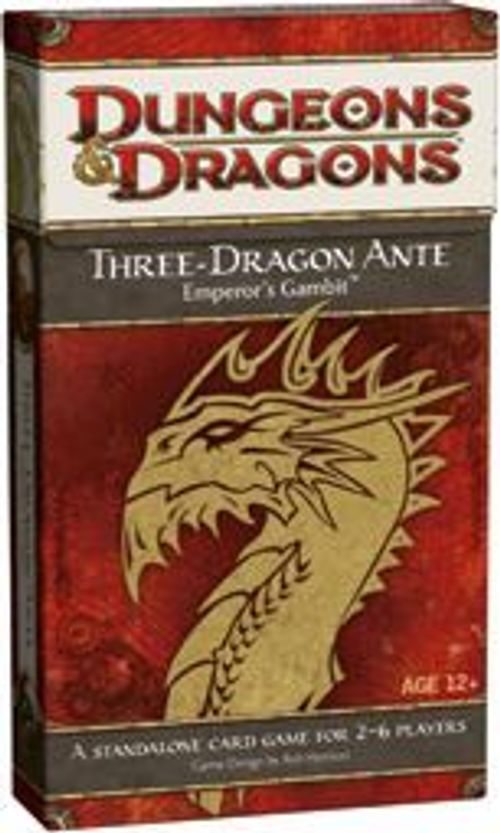
Three-Dragon Ante: Emperor's Gambit
Three-Dragon Ante: Emperor's Gambit Rulebook
Table of Contents
Table of Contents
Changes from the Previous Edition
If you played the original Three-Dragon Ante™ game, you already know how to play this version, with the exception of the following changes. These changes should be used with all Three-Dragon Ante games, even games that don't use any Emperor's Gambit cards.
-
To determine the amount of gold each player starts with, multiply the number of players by 10. (For example, in a four-player game, each player starts with 40 gold coins.) Previous Rule: Each player started with 50 gold coins regardless of the number of players.
-
Mortals can be part of strength flights. Previous Rule: Only dragons could be part of strength flights.
-
You take only three cards from the ante when completing a strength flight. Previous Rule: You took all the remaining ante cards.
-
Debts are settled at the end of the gambit. Previous Rule: Debts were settled during the course of the gambit.
-
Ante effects have been added. (See "Ante Effects" below.)
Game Components
- 70 playing cards
- 2 reference cards
- Rulebook
Summary of Play
In Three-Dragon Ante, you and the other players ante gold into the stakes and then take turns playing one card at a time from your hands. After you play a card, leave it face up in front of you. If the number on your card is equal to or lower than that of the card just played by the person on your right, you get to use your card's special power. Otherwise, ignore the power.
Once each player has played three cards, check to see whose three cards have the highest total number. That player wins the gold in the stakes. Keep playing gambits of three cards each until someone runs out of gold, ending the game.
How to Win
If you have the most gold in your hoard when the game ends, you win!
Setup
You'll need some coins, poker chips, or other tokens to represent gold coins. You'll also need a pen and paper for keeping track of debts owed during the game.
Multiply the number of players by 10. Give each player that many gold coins. (For example, in a three-player game, give each player 30 gold coins.) These form each player's hoard.
Shuffle the deck. Each player draws a hand of six cards. Keep the cards in your hand hidden from the other players.
Parts of a Card
Each card represents a dragon or a mortal and has four key elements.
Strength is a card's value. The weakest cards have strength 1; the strongest have strength 13.
Name describes the dragon or mortal the card represents. For most dragons, the name also tells you what color the dragon is.
Type tells you what kind of card it is: good, evil, unaligned, mortal, or dragon god. All cards except mortal cards are dragons. A dragon god is a special type of dragon; see "Dragon God Abilities" below.
Power is a card's ability. A card's power might take effect when it's played. Some cards have ante effects, which take effect only if the card is in the ante. See "Ante Effects" below.
Gambit Sequence
A Three-Dragon Ante game is played in a series of gambits. The game ends when a player has no gold at the end of a gambit. A gambit consists of the following steps.
- Ante
- Play cards
- Determine gambit winner
- Settle debts and check for game end
- Draw cards
1. Ante
Each player chooses one card from his or her hand and puts it face down in the center of the table. These are the ante cards. Once all players have chosen ante cards, reveal them. When an ante card is revealed, ignore its power (but don't ignore ante effects—see "Ante Effects" below).
Check to see which ante card has the highest strength (the strongest ante card). Each player takes a number of gold coins from his or her hoard equal to that card's strength and pays that gold to the stakes in the center of the table. If some, but not all, of the cards are tied for strongest, that strength number still determines how much the players pay.
If all the ante cards are tied for strongest, discard them. Then each player draws a card from the deck and chooses a new ante card from his or her hand.
Ante cards remain face up in the center of the table for the rest of the gambit. They're not part of the stakes.
After three rounds of play, you score the gambit. Check to see which player's flight has the highest total strength at the end of the third round. If only one player has the strongest flight, go to step 3. If two or more players are tied for strongest flight, play another round.
Strongest and Weakest Flights
Some cards refer to the "strongest" or "weakest" flight. The flight of cards with the highest total strength is the strongest flight. The flight with the lowest total is the weakest flight. (More than one flight can be the strongest or weakest.)
If a card instructs you to choose the player with the strongest flight and one or more players' flights are tied for strongest, you choose one of those players. The same is true for weakest.
Triggering Powers
A card's power doesn't do anything unless it triggers. When it triggers, follow its instructions. A power triggers in the following situations.
- The leader plays it as the first card of the round.
- When you play a card, the strength of the card is equal to or lower than the strength of the card just played by the person to your right. (For example, if you play a strength 5 card, its power triggers if the player to your right played a card of strength 5 or higher.)
Dragon God Abilities
Dragon god abilities have the words "Dragon God" preceding their text and are printed in a different color from the rest of the card. (Some dragon gods also have powers that trigger normally.)
Dragon god abilities are not powers; they are always in effect regardless of the card's strength. Cards that copy other cards' powers ignore dragon god abilities.
Special Flights
You can earn extra rewards by having three or more similar cards in a flight. A color flight has three dragons of the same color. A strength flight has any three cards of the same strength.
You complete a special flight on the turn you play the third matching card. Also, if the effect of a power changes the cards already in your flight so that they create a special flight, you complete that special flight.
When you complete a special flight, follow the instructions of all powers that trigger on that turn, and then collect the reward.
Special-Flight Rewards
You earn the following rewards when completing a special flight.
Color Flight: Each opponent pays you gold equal to the strength of the second-strongest dragon in the flight. (For example, if you have three Mithral Dragons of strengths 3, 7, and 11, each other player would pay you 7 gold.)
Strength Flight: You steal gold from the stakes equal to the strength of one of those cards. You also take three ante cards and add them to your hand. (For example, if you have three strength 5 cards, you steal 5 gold from the stakes and add any three of the remaining ante cards to your hand.)
Sometimes gambits go on for more than three rounds. In a gambit that lasts five or more rounds, it's possible to complete a color flight and a strength flight—even at the same time! If you complete both a color flight and a strength flight during the same turn, collect gold for completing the color flight first. Each player can't complete more than one of a given color flight and one of a given strength flight in a gambit.
Buying Cards
You must buy new cards in the following situations.
- At the start of your turn, if you have only one card in your hand.
- During any turn, if you have no cards in your hand.
To buy new cards, reveal and discard the top card of the deck. Pay gold equal to that card's strength to the stakes, then draw cards until your hand contains four cards.
Going into Debt
Whenever you have to pay more gold than the amount remaining in your hoard, you pay as much as you can and go into debt for the remaining amount. Keep track of the amount of each player's debts and who they're owed to, in the order they happen.
All debts are settled at the end of the gambit. See step 4.
No Gold in the Stakes
If, at any time, no gold remains in the stakes, the gambit ends immediately. Go to step 3.
Ante Effects
Some cards have ante effects. An ante effect is a special ability that affects the game in some way when that card is put into the ante or is revealed as an ante card. An ante effect is not a power; cards that copy other cards' powers ignore ante effects.
A card's ante effect doesn't do anything when the card is not in the ante. If the card is removed from the ante during the course of a gambit, the effect no longer applies.
2. Play Cards
The player who revealed the strongest ante card is the leader in the first round of the gambit. Do not count any ante cards that are tied for strongest. The leader takes the first turn, then the other players take turns clockwise around the table until each has taken a turn.
On your turn, play one card from your hand face up onto the table in front of you and check to see if the card's power triggers (see "Triggering Powers" above).
Your face-up cards make up your flight. When you play a card, add it to the right of the last card you played. Flights stay face up on the table until the end of the gambit. You can complete a special flight for extra benefits (see "Special Flights" above).
Once each player has taken a turn, the player who played the strongest card that round becomes the leader in the next round. Do not count any cards that are tied for strongest. If all cards played in a round are tied for strongest, the current round's leader is also the leader in the next round.
3. Determine Gambit Winner
The player with the strongest flight wins the gambit. That player takes all the gold in the stakes and adds it to his or her hoard.
Then discard all the cards in the ante and in all players' flights (but not cards in hand).
4. Settle Debts and Check for Game End
If any players are in debt, they pay back as much gold as they can in the order the debts were incurred during the gambit. The gambit winner ignores any debts he or she owes to the stakes. Then, if at least one player's hoard is empty, the game ends. See "Winning the Game" below.
5. Draw Cards
If the game has not ended, each player draws two cards. Then start the next gambit.
Hand Size Limit
You can't have more than ten cards in your hand at any time. As soon as you have ten cards in your hand, you can no longer draw cards from the deck or take them from the ante or from other players. If a card power instructs you to draw or take cards, ignore that part of the power once you reach ten cards in hand. (For example, if you have nine cards in your hand and a power lets you draw three cards, you can draw only one.)
No Cards in Deck
Whenever the deck runs out of cards, shuffle the discard pile to form a new deck.
Winning the Game
When the game ends, the player with the most gold wins!
Optional Rules
If all players agree, you can try one or more of these optional rules for playing, or create your own.
- Play a set number of games in a row (such as three). The player who has the highest ending gold total from all those games combined is the winner.
- The game ends when only a set number of players (such as two) remain in the game.
- Play until one player's hoard contains at least a set amount of gold (such as 100) at the end of a gambit.
- Play a set number of gambits (such as three or five) for a shorter game.
- Set a time limit for the game, then play one final gambit after reaching that time limit.
- Start with a different amount of gold: more for a longer game, less for a shorter one.
Appendix 1: Theme Decks
In this section, Odranauk discusses some Three-Dragon Ante decks that mix cards from the original game with Emperor's Gambit cards. Try these variants or invent your own!
Age of Mortals
This variant was popular a couple of hundred years ago, during the reign of the emperors of Nerath, when it was also known as the "Face Deck." The courtiers indulged themselves with a version of the game that emphasized mortal cards at the expense of the dragons. Certainly the game that results is varied and wild, even if its origins owe more to hubris than to considerations of play.
Surviving versions of the Nerathi decks use caricatures, so that the images on cards such as the Fool, the Thief, or the Princess are sure to have sent a titter of recognition around the table. The identities of most of the people pictured, even the Emperor, are lost to us. Likely many copies of these decks were destroyed by courtiers who later came to power and didn't appreciate such unflattering depictions from earlier in their careers.
Earlier versions of this deck used the Bronze Dragon instead of the Copper, but apparently the courtiers got tired of seeing their "face" cards removed from the ante by the imperious Bronze.
Age of Mortals
| Good Dragons | Evil Dragons | Unique Cards | |
|---|---|---|---|
| Adamantine | Brown | The Adventurer | Hatchling |
| Copper | Purple | The Archmage | Io |
| Silver | Red | Bahamut | The Priest |
| Steel | White | Dracolich | The Princess |
| Dragon Turtle | The Queen | ||
| Dragonslayer | The Sorcerer | ||
Avandra's Hand
The name of this deck mix comes from a popular reference to the cards in the initial ante. The ante isn't my hand, it's not your hand—it's "Avandra's hand." The deck uses as many cards as possible that tinker with the ante.
Some players dislike using both the Bronze and the Iron together, reasoning that those two good dragons draw too many cards out of the ante, and replace one or the other of the two with the Gold Dragon.
Avandra's Hand
| Good Dragons | Evil Dragons | Unique Cards | |
|---|---|---|---|
| Adamantine | Black | The Adventurer | The Exarch |
| Bronze | Earthquake | The Archmage | Hatchling |
| Copper | Gray | Bahamut | The Sorcerer |
| Iron | Green | Dracolich | The Spy |
| Steel | Purple | Dragon Turtle | Tiamat |
Strength and Greed
This deck is most popular among dragonborn. It pivots around evil dragons and other cards that seek to strip the stakes bare before anyone can win. One of the good dragons, and several of the mortals, respond by adding to the stakes. The tension comes from different play goals: winning the gambit, gathering cards, or stealing as much gold as possible before someone else wins.
Some dragonborn say that the Strength and Greed deck is a teaching tool for their young, which demonstrates that losing while playing good dragons is better than winning by playing evil dragons. I admit that I have difficulty following their reasoning, and suspect that they might be teasing me, since these same dragonborn seem to have no compunctions about playing evil dragons to win.
Strength and Greed
| Good Dragons | Evil Dragons | Unique Cards | |
|---|---|---|---|
| Adamantine | Black | The Adventurer | The Druid |
| Bronze | Blue | The Archmage | The Exarch |
| Iron | Brown | Dracolich | Io |
| Mercury | Purple | Dragon Turtle | The Princess |
| Silver | White | The Dragonslayer | The Thief |
Oddshuffle
This version of the game aims for surprising events and unpredictable outcomes. Oddshuffle's most devoted players are the nomadic halflings, who carry the deck with them wherever they go. I've noticed that when there are no strangers in the game, the halflings are just as likely to play Emperor's Gambit, but when they play with bigger folk they always prefer Oddshuffle. That way, when they win, they can claim that their victory was only a matter of luck, avoiding hard feelings or harder beatings.
Oddshuffle
| Good Dragons | Evil Dragons | Unique Cards | |
|---|---|---|---|
| Copper | Earthquake | The Adventurer | Hatchling |
| Iron | Gray | The Archmage | The Princess |
| Mithral | Purple | Dracolich | The Queen |
| Mercury | Red | Dragon Turtle | The Sorcerer |
| Silver | Shadow | The Exarch | The Spy |
Evil Times
This variant comes up again and again in ancient histories. In the worst of times, some people find it clever to strip the good dragons from the deck and play with as many evil dragons as possible. The resulting game resembles a plunge off a cliff. The stakes continually decrease, refreshed only when players must buy cards, since evil dragons rarely allow you to add to your hand. When the dragonborn tell me that Strength and Greed offers a moral lesson, I respond that Evil Times provides a true moral: Evil spirals down hopelessly.
Evil Times
| Evil Dragons | Unique Cards | ||
|---|---|---|---|
| Black | Green | Dracolich | Hatchling |
| Blue | Purple | Dragon Turtle | Io |
| Brown | Red | The Dragonslayer | The Sorcerer |
| Earthquake | Shadow | The Exarch | The Spy |
| Gray | White | The Fool | Tiamat |
Appendix 2: Three-Dragon Ante in your D&D Campaign
If the characters in your D&D campaign want to play a Three-Dragon Ante game, consider the following options.
Roleplaying
You play the game with the normal rules, roleplaying dialogue and acting or reacting in character.
Special Abilities
These optional rules give you a way to represent the advantages skilled D&D characters might enjoy in a world of magic and superhuman abilities. Each character makes an Insight check. In order from the highest check result to the lowest, each character chooses one of the special abilities he or she qualifies for from the list below. Once a special ability has been chosen, no other character can choose that ability in that game.
For a wilder game, allow each character to choose two abilities, one at a time. A character who is a professional gambler, or an epic-tier character, might even have three.
The following special abilities require the character to be trained in the listed skill.
Arcana: Whenever you complete a special flight, draw a card.
Bluff: Each time you would pay 2 or more gold to another player, reduce the amount of gold you pay by 1.
Diplomacy: Once per gambit, when you would be the leader in a round, you can choose another player to be the leader in that round instead.
Dungeoneering: When you take a random card from an opponent's hand, you can choose to take a different card from that opponent's hand and then return the original card. You cannot use this ability again until you complete a special flight.
Endurance: Whenever an opponent buys cards, you steal 2 gold from the stakes.
Heal: You can choose to reveal and discard the top card of the deck, then pay gold equal to that card's strength to a player of your choice. You cannot use this ability again until you complete a special flight.
History: Whenever you play mortal or a dragon god, steal 1 gold from the stakes.
Insight: After a gambit you did not win, but before players draw new cards, you can choose to look at the hand of the gambit's winner. Do not say anything about his or her cards to other players. You cannot use this ability again until you complete a special flight.
Intimidate: As long as you and any other player are tied for the strongest flight, you can't be chosen as the opponent with the strongest flight.
Nature: Whenever you complete a special flight, add 2 to the strength used to determine how much gold other players pay you or that you steal from the stakes.
Perception: After everyone's ante cards are revealed, you can choose to replace your ante card with another card from your hand. Return the original ante card to your hand. You cannot use this ability again until you complete a special flight.
Religion: Whenever you reveal a card to determine how much gold you must pay to buy cards, you can choose to keep the revealed card.
Stealth: Draw an additional card whenever you buy cards.
Streetwise: When you complete a strength flight, you can choose not to steal gold from the stakes. Instead, each opponent pays you gold equal to the strength of one of the cards in the flight. You cannot use this ability again until you complete a special flight.
Thievery: Whenever you steal gold from the stakes with a card's power, steal an extra 1 gold from the stakes.
Luck Domain (Feat): This special ability requires that you have one or more feats from the luck domain. Domain feats first appeared in the Divine Power™ supplement.
After you draw a card as a result of a card's power, you may choose to discard that card and draw a different card. You cannot use this ability again until you complete a special flight.
Appendix 3: Card Power Explanations
If you're not sure what happens when a specific card's power triggers, check here for any additional explanations of that power.
Adamantine Dragon
Draw a card. Each opponent pays 1 gold to the stakes.
You draw a card even if one or more opponents must go into debt to pay the gold.
The Adventurer
Discard one card from your hand or discard your entire hand. Then draw as many cards as you discarded.
If you have only one card in hand, discard it and then draw a card.
Ante Effect: The winner of the gambit splits the stakes evenly with opponents who scored special flights during the gambit.
Split the stakes as evenly as possible, counting the gold into separate stacks. If the stacks aren't equal, you choose who gets which one. (For example, if the stakes contain 23 gold and you split the stakes with two other players, you count out three stacks: 8 gold, 8 gold, and 7 gold. You choose who gets which stack.)
Brown Dragon
Steal 1 gold from the stakes. If your flight doesn't contain any good dragons, steal an extra 2 gold from the stakes.
If fewer than 3 gold coins remain in the stakes when you would steal 3 gold, steal all the remaining gold. Emptying the stakes ends the gambit, so you go to step 3 of the gambit to determine the winner.
Dragon Turtle
The power of each other mortal in your flight triggers.
This power ignores ante effects and dragon god abilities.
Ante Effect: When this card is put into the ante or is revealed as an ante card, each player pays gold to the stakes equal to the strength of the weakest ante card.
Include this card when determining the weakest ante card. If there's a tie for weakest card, each player pays gold to the stakes equal to the strength of one of those cards.
Earthquake Dragon
Count the number of Earthquake Dragons in all flights and in the ante. Each opponent pays you that much gold.
Include this card and other Earthquake Dragons in your own flight when counting the number of Earthquake Dragons.
The Emperor
The gambit will not be scored until after the fourth round. When the gambit is scored, add 4 to the strength of your flight.
If this power triggers on the fourth round or later of a gambit, the first part of the power has no effect, but you still add 4 to the strength of your flight when scoring.
The Exarch
Each opponent puts a card from his or her hand into the ante.
The player to your left puts a card into the ante first, then players go clockwise around the table. If any card put into the ante in this way has an ante effect that immediately affects the game, resolve it when its player places that card.
Ante Effect: Cards of strength 10 or higher trigger when played.
If you play a card of strength 10 or higher and its strength is equal to or lower than the card just played by the player to your right, your card's power triggers only once, not twice.
Gray Dragon
The opponent with the strongest flight pays you 1 gold for each evil dragon in the ante.
If two or more opponents tie for the strongest flight, you choose which of those players this power affects.
Hatchling
Copy the power of a weaker card in any flight.
Follow the instructions of the chosen card's power as if it were the Hatchling's power. This power ignores ante effects and dragon god abilities.
Ante Effect: The player with the weakest flight wins the gambit instead of the player with the strongest flight.
If two flights tie for the weakest flight after three rounds, play additional rounds until only one player's flight is the weakest at the end of a round.
Io
Each player pays gold to the stakes equal to the number of players.
This power triggers normally. You also have to pay.
Dragon God—As long as you have Io and a mortal in your flight, you can't win the gambit.
This ability is always in effect.
Iron Dragon
Put an evil dragon from the ante into your hand.
This power has no effect if there are no evil dragons in the ante.
Mercury Dragon
Draw a card for each color of good dragon in your flight.
Include this card when counting how many good dragon colors are in your flight.
Mithral Dragon
Each player with three or fewer cards in hand draws a card. Then draw a card.
If you have three or fewer cards in hand, you draw first, then the nearest player to your left who has three or fewer cards in hand, and so on around the table until each player with three or fewer cards in hand has drawn a card. Then you draw another card.
Purple Dragon
Draw a card. Then put a card from your hand into the ante.
If the card you put into the ante has an ante effect, it will affect the game.
The Queen
Each opponent with both good and evil dragons in the same flight pays you 5 gold, and you take a random card from that player's hand.
Start with the nearest player to your left who has a good dragon and an evil dragon in his or her flight, and then go clockwise around the table until each player with a good dragon and evil dragon in his or her flight has paid you and given you a card.
You don't get to see your opponent's hand before taking a card. After you've chosen a card at random, the opponent may see it before you add it to your hand. Other players don't get to see the card.
Shadow Dragon
Take a random card from the hand of the opponent with the most cards in hand. Discard this card and replace it with the card you took. That card's power triggers.
If one or more opponents are tied for most cards in hand, you choose which of those players this power affects.
You don't get to see your opponent's hand before taking a card.
A Shadow Dragon doesn't complete a color flight or strength flight before it's discarded. At the end of your turn, if any new cards complete a color flight or strength flight you haven't already collected a reward for in this gambit, collect the reward for that special flight.
The Sorcerer
Reveal the top three cards of the deck. Discard this card and replace it with one of the revealed cards. That card's power triggers. Put the other two revealed cards into the ante.
If either of the cards you put into the ante has an ante effect, it will affect the game. If both do, you choose the order in which they take effect.
When this power triggers, ignore the Sorcerer's strength; it's not part of your flight and doesn't affect whether or not the next player's power triggers. Instead, the card that replaces it is considered the card you played this turn—use it to determine the total strength of your flight and whether or not the next player's card's power triggers.
The Sorcerer doesn't complete a strength flight before it's discarded. At the end of your turn, if any new cards complete a strength flight you haven't already collected a reward for in this gambit, collect the reward for that special flight.
The Spy
Put an ante card into your hand.
You take any one card from the ante, even a card with an ante effect.
Ante Effect: Whenever a player takes the first turn of a round, that player pays each opponent 2 gold.
The player pays the gold before playing a card for the turn.
Steel Dragon
The opponent to your left chooses either to give you a mortal from his or her hand or to pay you 4 gold.
If the opponent gives you a mortal, reveal it so all players can see that it's a mortal.
If that player doesn't give you a mortal, he or she must pay you 4 gold. If the player doesn't have that much, he or she goes into debt for the rest.
The Wyrmpriest
For the rest of the gambit, this card counts as a dragon of any color for completing a color flight, and you can complete a color flight with three mortals.
You don't need to announce the color this card counts as when the power triggers. It counts as all colors throughout the course of the gambit. (Think of it as a wild card.)
Glossary
ante: The cards used at the start of each gambit to set the stakes and determine the leader for the first round. You also ante when you pay gold to the stakes at the start of the gambit.
ante card: A card that is placed into the ante, whether at the start of a gambit or during play as the result of a card's power.
ante effect: An ability that has an effect on the game only when the card it appears on is an ante card. Ante effects are not powers. Cards that copy or trigger other cards' powers ignore ante effects.
color: A dragon's name includes the dragon's color. The dragon colors in Emperor's Gambit are Adamantine, Brown, Earthquake, Gray, Iron, Mercury, Mithral, Purple, Shadow, and Steel. The dragon colors from the original Three-Dragon Ante game are Black, Blue, Brass, Bronze, Copper, Gold, Green, Red, Silver, and White.
color flight: A flight with three or more dragons of the same color.
debt: You go into debt when you must pay more gold than you have in your hoard. At the end of a gambit, players repay each of their debts as much as possible, in the order those debts were incurred.
dragon: A card whose type does not include the word "Mortal" is a dragon. Most dragons are either good or evil.
dragon god: A card whose type includes the words "Dragon God" and has a special dragon god ability. A dragon god also counts as a dragon. Dragon god abilities are not powers. Cards that copy or trigger other cards' powers ignore dragon god abilities.
flight: The face-up cards in front of each player. At the end of each gambit, the player with the strongest flight wins the stakes.
gambit: A series of at least three rounds of card play to determine who wins the stakes.
hand: The cards you're holding. Other players don't see the cards in your hand. Your hand can never have more than ten cards.
hoard: Your gold. When your hoard is empty, you go into debt to pay any gold owed. If your hoard is empty at the end of a gambit, the game ends. Your hoard remains visible throughout the game, and you must reveal how much gold you have if asked.
leader: The player who takes the first turn in a round. The strongest card played each round (ignoring tied cards) determines the leader for the next round of the gambit.
mortal: A card whose type includes the word "Mortal" is a mortal. Mortal cards are not dragons (not even the Dragon Turtle).
pay: When you pay, you put gold into the stakes or give gold to another player.
play: You play a card by putting it from your hand into your flight on your turn.
power: A card's ability. When the leader plays a card, its power always triggers. Any other card's power triggers when it is played, as long as its strength is equal to or lower than the strength of the card just played that round by the player to the right.
round: Each player takes one turn in a round.
special ability: When your Dungeons & Dragons characters play a Three-Dragon Ante game, their skills and feats might grant them special abilities. See Appendix 2.
stakes: The gold in the center of the table. At the end of each gambit, the player with the strongest flight wins the stakes. Emptying the stakes ends the gambit immediately.
steal: When you take gold from the stakes, you steal it.
strength: A card's value.
strength flight: A flight with three or more cards of the same strength.
strongest: A card or flight with the highest strength.
trigger: When a card's power triggers, you follow its instructions.
turn: When you take your turn, you play a card from your hand into your flight. The card's power might trigger.
type: The basic card types are good, evil, unaligned, dragon god, and mortal. Cards whose type is not mortal are dragons.
weakest: A card or flight with the lowest strength.
Questions?
U.S., Canada, Asia Pacific & Latin America www.wizards.com/customerservice Wizards of the Coast LLC P.O. Box 707 Renton WA 98057-0707, U.S.A. Tel: 1-800-324-6496
U.K., Eire, & South Africa Hasbro UK Ltd Caswell Way Newport, Gwent NP9 0YH GREAT BRITAIN Tel: + 800 22 427276 Email: [email protected]
All Other European Countries Wizards of the Coast, Belgium NV/SA 't Hofveld 6D 1702 Groot-Bijgaarden BELGIUM Tel: +32.070.233.277 Email: [email protected]
For more information on Three-Dragon Ante, its use in Dungeons & Dragons, or D&D in general, tune in to www.dndinsider.com.