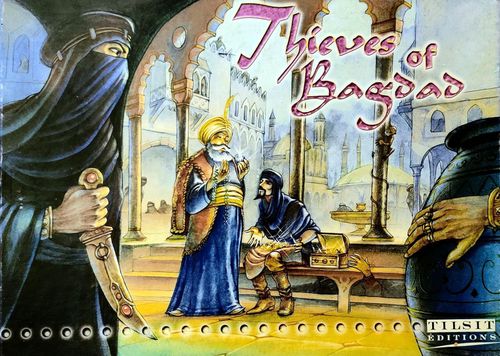
Thieves of Bagdad
Thieves of Bagdad Rulebook
Table of Contents
Table of Contents
Components
A beautiful game board, carefully hand-painted by the finest artists of the East. The artwork depicts the city of Baghdad and its five famous districts:
- the Souk
- the Harbour
- the Bazaar
- the Kasbah
- and finally the Palace
The desert is included free of charge. Each district consists of streets and shops and is accessible through gates.
A unique card set:
- 6 Grand Vizier wish cards
- 6 character cards, 1 for each player
- 13 merchandise cards for the Bazaar
- 14 merchandise cards for the Harbour
- 14 merchandise cards for the Souk
- 14 merchandise cards for the Kasbah
- 13 merchandise cards for the Palace
Six celebrated players from the Middle East, each with their own piece and character card: Ali Baba, Sinbad, David, Sheherazade, Afif and Said.
First-class playing pieces for each player, representing:
- caravaneers (A)
- merchants (B)
- traders (C)
- assassins
The Grand Vizier has his own piece, not a playing card.
Certified gems:
- diamonds (transparent)
- rubies (red)
- emeralds (green)
- sapphires (blue)
- and false stones (yellow)
Six camel-leather pouches (guaranteed free of hormones).
One Eastern slipper (for the starting player).
This rulebook, added free of charge, just for you!
Hey, isn't this a beautiful game? At this price I will soon be bankrupt. But since I happen to like you, you may join in.
Setting Up the Game
- Put on your djellaba.
- Place the game board on the floor of your living room and serve mint tea.
- Place the Grand Vizier in the desert at the entrance to Baghdad.
- Provide the 5 districts with their name tiles.
- Sort the 80 cards by their district, shuffle them and place them face down next to their district.
- Each player:
- chooses a player card that represents him;
- draws one Grand Vizier wish card blindly and keeps it secret until the end of the game;
- receives the thief piece that goes with the thief card, and all the caravaneers, merchants, traders and assassins (chips) in the colour of his name on his thief card;
- receives an empty camel-leather pouch for the gems he collects.
Starting Player
The youngest player receives the slipper and is the first starting player. During a round the slipper constantly changes hands. The player who holds the slipper at the end of a round is the starting player of the next round.
The starting player places one of his three pieces on one of the Bazaar squares: the 2 caravaneers each in a shop, and the thief on a street. The player to his left does the same, and so on clockwise, until every player has placed three pieces on the board. Pieces must be placed on empty spaces.
The game can now begin.
Playing the Game
The game is divided into rounds, each with three successive phases: income, exchange and purchase.
Phase 1: Income
The player holding the Eastern slipper begins each round with this phase. For each of his own thieves, caravaneers, traders or merchants standing in a shop, players draw one merchandise card from the district (Bazaar, Harbour, Kasbah, Souk, Palace) where that piece stands.
Assassins never earn income.
If a district has no cards left, you are out of luck.
Example 1: During the first round each player draws 2 merchandise cards from the Bazaar stack, because everyone owns two pieces in shops of this district. The thief receives nothing because he stands on a street.
Only shops yield merchandise cards.
Example 2: A player owns five pieces: a trader in the Harbour shop, an assassin in the Harbour shop, a merchant on the Kasbah square, a thief in a Kasbah shop and a caravaneer in a Kasbah shop. During step 1 he draws one card from the Harbour stack and two cards from the Kasbah stack. An assassin never receives anything, and the merchant in the Kasbah receives nothing because he is not in a shop.
There are three kinds of merchandise cards:
Merchandise
These cards have a different market value for each player. For example, the COPPER card from the Bazaar is worth 6 dinars to David and only 1 dinar to Said. (The 6 character cards show each player's preferred types of merchandise.)
Aladdin's Genie
There are only three genies in the game. They are worth the same to every player, but the value rises when you own several of them. A single genie card is worth 1 dinar, two genie cards are worth 10 dinars, and the set of three genie cards is worth 50 dinars.
Gems
These cards are worth one free gem. They have no dinar value and are used during the purchase phase.
For example, a player who holds the SAPPHIRE card from the Harbour may take a free sapphire, but he cannot buy anything else with that card.
The gem cards are distributed as follows:
- an imitation gem in the Bazaar
- a sapphire in the Harbour
- an emerald in the Souk
- a ruby in the Kasbah
- a diamond in the Palace
Once every player has received his merchandise cards, phase 2 begins: Exchange.
Phase 2: Exchange
The players may now freely swap their merchandise cards, simultaneously and at will, or even give them to one another. They may not exchange gems or pieces. Merchandise cards have a market value expressed in dinars.
You may not show your cards to one another or reveal their market value. You also may not lie about the origin (the district) of your cards. You may lie about the name of the cards or the value of the goods: "...I have magnificent rugs for you..." Once the players have agreed a deal, they exchange their goods. You may sell your reputation and deceive, but a deal is a deal.
Once the players have finished exchanging, the purchase phase begins.
Phase 3: Purchase
You may buy only one item at a time, using one or more cards:
- a new piece
- a gem
- a move (and to abduct, steal or assassinate)
The player holding the slipper begins. When this player has completed at least one purchase, he gives the Eastern slipper to a player of his choice (who must have at least one card in hand). That player must then buy something on his turn.
This phase continues until every player has spent all his cards. A player holding the slipper with at least one card must buy something, but may choose to keep his remaining cards to buy something again later in this phase.
To buy something, a player must spend one or more cards with a total value at least equal to its price. Surplus value is not refunded. (Pay attention to the specific value that merchandise cards have for you.)
Buying a New Piece
The player who buys a new piece places it immediately in the desert. The different pieces have their own abilities:
- A caravaneer costs 5 dinars and receives 1 merchandise card.
- A merchant costs 9 dinars, receives 1 merchandise card and can kidnap a caravaneer.
- A trader costs 12 dinars, receives 1 merchandise card and can kidnap a merchant.
- An assassin costs 12 dinars and can kill opponents.
- The thief always remains in the game and receives 1 merchandise card. He can rob another thief.
Translator's note: the source gives no price for the thief. Its short list of piece abilities says the trader "can kidnap a trader" (a probable typo for "merchant"). The detailed kidnapping rules later in this rulebook, and the English quick-reference card, both say that a trader kidnaps a merchant. The text above follows the detailed rule.
Buying a Gem
The player who buys a gem may pay with a gem card, or with one or more cards whose value equals the price of the gem. The player puts the gem in his pouch.
- An imitation gem (yellow) costs 9 dinars.
- A sapphire (blue) costs 12 dinars.
- An emerald (green) costs 20 dinars.
- A ruby (red) costs 27 dinars.
- A diamond (transparent) costs 35 dinars.
Buying a Move
A player may move one of his own pieces, or the Grand Vizier, at a price of one dinar per street or shop. The Grand Vizier may therefore be moved by anyone.
A piece in the desert may enter the city of Baghdad through one of the five gates to the Bazaar. A piece may move in any direction, but it cannot return to the desert. To move from one district to another you must pass through gates.
You may pass through a space occupied by another piece (of any colour), but the move must end on an empty space. No more than one piece may stand on a space, except in the desert.
You cannot split the value of a card across several pieces: a card can be used to move only one piece. As with purchases, surplus dinars spent are lost.
Using Special Abilities: Assassinate, Kidnap and Steal
You may use the abilities of your pieces together with a move. However, a piece's ability may be used only once per move, and only if the piece ends its movement in a street or shop next to its victim.
No wall may stand between you and your victim.
In the desert everyone is safe from everyone else. It is warm enough already.
If you already stand next to another piece, you must still pay a merchandise card to use an ability. In that case you take 0 steps.
- A merchant or a trader may send another piece out to the desert (kidnap). The other piece goes to the desert.
- The merchant may kidnap only a caravaneer.
- The trader may kidnap only a merchant.
- Pieces of the same type cannot kidnap each other.
- An assassin may kill anyone except thieves or the Grand Vizier. When an assassin kills another piece, the assassin itself is also sent to the desert. If an assassin kills another assassin, both pieces are removed from the game.
Translator's note: the English quick-reference card says only that the assassin kills a caravaneer, merchant or trader, and does not mention the assassin being sent to the desert. The source text states it, so it is transcribed as printed.
- A thief may only rob another thief. In this case the sly thief puts his hand into the pouch of his victim and takes one gem without looking. The gem disappears into his own pouch, preferably without showing the loot to the other players.
Of course you may kill or kidnap your own gang, but I wouldn't know why!
End of Round
When the last player has spent his last card and holds the slipper, that player is the starting player for the next round, which again begins with phase 1.
End of the Game
The game ends when the Grand Vizier stands on a shop in the Palace (district) after everyone has finished their purchases, that is, at the end of the purchase phase (phase 3).
How to Win
There may be several winners. To win, the Grand Vizier must stand on a Palace shop, and you must own the gems named on your Grand Vizier wish card.
If no player can give the Grand Vizier what he asks for, the winner is the lucky player who holds the gems of highest value. Imitation gems (yellow) have no value at this point.